LearnRisk essentials
When Do Several Trades Count as One Trade Idea?
Separate trades count as one trade idea when the account's rules group them by instrument, direction, overlap or re-entry timing. Closing a losing ticket can therefore leave its loss attached to the next entry. The new ticket number does not necessarily start a new loss allowance.
On this page
FundingPips Zero provides a useful example. On its $100,000 Master Account, the open-risk limit can remain unbroken while a sequence of closed losses and a new open loss reaches the trade-idea limit. To understand that result, follow both amounts through the close and re-entry.
What connects separate tickets?
A trade-idea rule defines the group of trades to which a particular test applies. Read the grouping conditions alongside the amount being tested. A rule about floating losses, one about closed and floating losses, and one about allocation can all use the same phrase.
FundingPips Zero describes three cases:
- A single trade.
- Positions on the same pair open at the same time, with their losses combined.
- Each new same-direction position opened within ten minutes of closing a losing trade, carrying the losses into the same idea.
Its trade-idea loss limit is 3% below the $50,000 account size and 2% from $50,000 upward. Reaching the limit breaches the account. FundingPips Zero rules.
The re-entry condition makes the closed-trade history relevant. Looking only at the current position can miss a loss that still belongs to its idea. Conversely, grouping trades does not tell you whether the consequence is immediate closure, a warning or a separate restriction. That comes from the particular rule.
Which losses does each counter include?
For the Zero $100,000 account, keep these two tests separate:
| Test | Losses it counts | Breach point |
|---|---|---|
| Max Open Risk Limit | Floating losses on all currently losing positions. Profitable positions cannot offset them. | Combined open loss reaches 1% of starting size, $1,000. |
| Trade-idea loss limit | Closed and floating losses belonging to the same idea under the grouping rule. | The idea's loss reaches 2% of starting size, $2,000. |
FundingPips Zero's open-risk and trade-idea definitions supply both tests. The open-risk test can span different instruments; the idea test follows the specified grouping. An open winning position is not spare room for a losing position under Zero's open-risk calculation.
When a losing ticket closes, its floating loss disappears from the first counter. Its realized loss remains in the account, and a qualifying re-entry retains it in the second counter. The account's daily and overall loss tests continue to apply too. The combined-exposure section of the position-sizing guide explains how to assess positions that could lose together.
Equal headline amounts need care as well. On a fresh Zero $25,000 account, the daily and trade-idea allowances both start at $750, but one follows the day and the other follows the idea. The separate 1% open-risk threshold is $250. Those are three tests, even when two amounts match.
How can a closed loss breach the next trade?
Consider a hypothetical fresh Zero $100,000 Master Account. All three entries are EURUSD buys in one permitted session, outside restricted news and weekend periods. Only one ticket is open at a time. Each new entry occurs two minutes after the previous losing close.
The displayed results include all assumed trading costs. There is no other activity, withdrawal or earlier breach, no daily reset, and no equity high above the starting balance. Each position moves toward its shown loss without an earlier larger loss. This isolates the two counters rather than assuming an account can recover after a breach.
| Event | Open loss counted now | Loss accumulated on this idea | Result at this event |
|---|---|---|---|
| First ticket closes with a $750 loss | $0 | $750 | Both tests remain below their limits. |
| Second ticket, opened two minutes later, reaches a $750 loss | $750 | $1,500 | Both tests remain below their limits. |
| Second ticket closes at that loss | $0 | $1,500 | Closing clears the open loss, but retains the idea loss. |
| Third ticket, opened two minutes later, reaches a $500 loss | $500 | $2,000 | The trade-idea limit is reached. The account breaches. |
At the last event, the idea contains $750 + $750 + $500 of loss. The current open loss is only $500, so it has not reached the separate $1,000 open-risk threshold. Nevertheless, the idea has used its entire $2,000 allowance. Stop the valid trading path there.
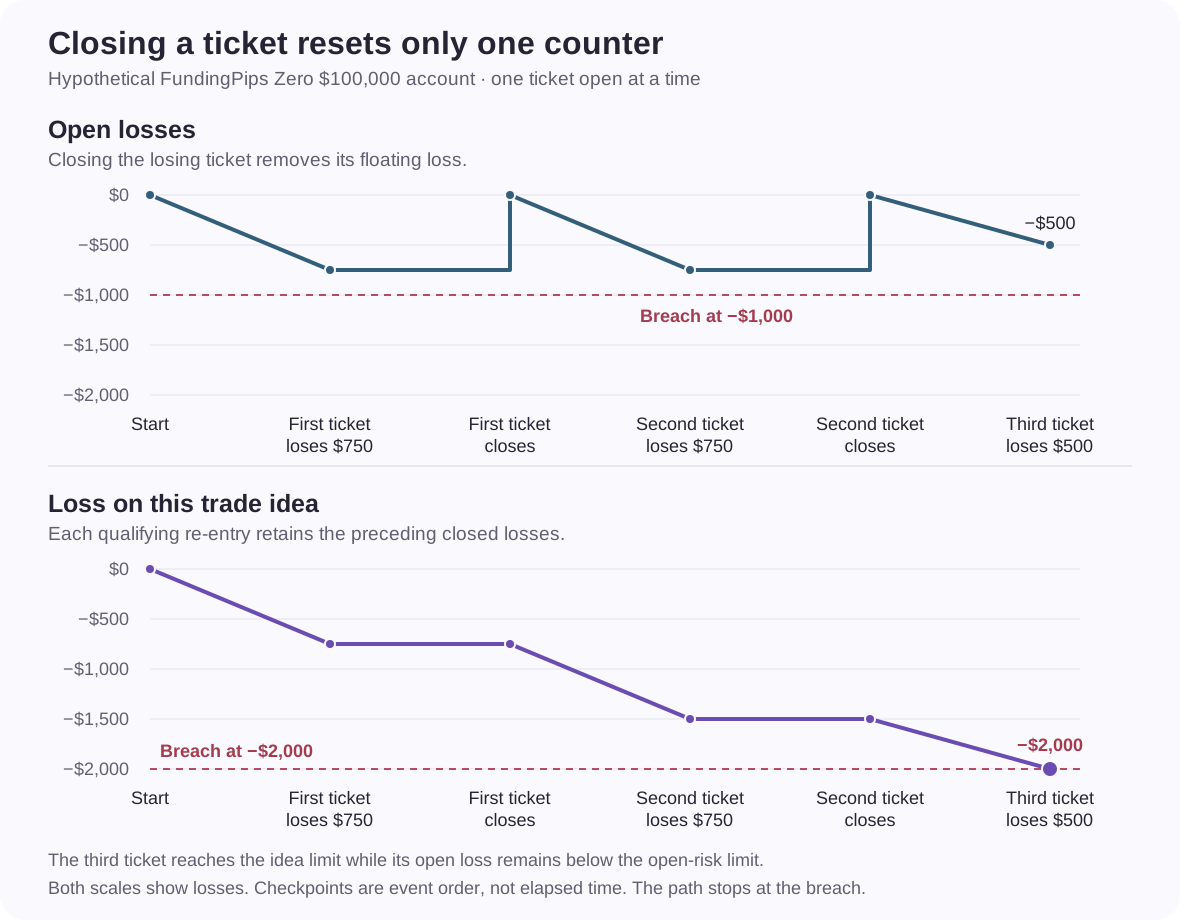
The other loss tests do not end this chosen path first. With a fresh $100,000 day-opening balance and equity, the 3% daily threshold is $97,000. The 5% overall trail starts at $95,000 and does not move because this path sets no higher equity peak. At the idea breach, equity is $98,000. Being above both equity thresholds does not keep the account valid once a different hard limit is reached. These calculations use the same Zero rules.
What changes if the first ticket stays open?
Change the sequence. Keep the first EURUSD buy open at a $750 loss and open a second buy. When the second is losing $250, the combined floating loss is $1,000. Zero's open-risk limit is reached, so the account breaches before the idea's loss reaches $2,000.
Neither ticket lost $1,000 by itself. The relevant amount is their combined open loss. This alternative path ends at that first breach; it cannot continue to the third entry in the re-entry example.
The order of events changes which rule binds first. Closing the first ticket removes it from the open-loss counter, but does not make its realized loss disappear. Keeping it open leaves both tickets in that counter. A stop or an intended closing order is not a completed close, so use the actual account state when reconstructing the sequence.
Does every trade-idea rule work this way?
The phrase alone is not enough. These official examples apply different tests and consequences:
| Scoped example | What the wording means for the trader |
|---|---|
| FundingPips 2 Step Standard, Master Account, On Demand cycle | Closed and floating loss reaching 1% on one idea triggers the Striking System. Its definition includes concurrent trades in the same direction on one instrument, or two or more new trades entered within ten minutes of a losing close. Profit from warned ideas is deducted. Warnings accumulate across reward cycles, with reduced shares before closure on the fourth warning. This is a different consequence from Zero's immediate idea-limit breach. 2 Step Standard rules. |
| E8 Markets, Classic Markets policy | Its maximum-risk FAQ says there is no general hard limit per idea. Separately, its prohibited-practices policy reserves the right to impose a 1% limit per idea or time horizon when it detects prohibited practices. Read that as a conditional restriction, not a universal 1% cap. Risk FAQ and Protective Risk Measures. |
| Alpha Capital Group, Qualified Analyst allocation | Its allocation policy can group simultaneous correlated-asset setups as the same idea across accounts. That test concerns how much account allocation supports the strategy. It does not supply a substitute percentage loss allowance. Maximum allocation rules. |
For FundingPips' reward conditions, use the On Demand explanation for the $100,000 2 Step Standard account. The three-account CFD comparison puts its consequences beside Alpha's funded risk rules. The allocation guide covers the separate cross-account question.
What should you check before re-entering?
Start with the losses already attached to the idea. In the main example, after two $750 closes, the account is flat but the idea has only $500 left before its breach point. Sizing the next entry against the full $2,000 would ignore the $1,500 already lost.
Keep a short record of the exact program, stage and size; the grouping rule; each instrument and direction; entry and closing times using one identified clock; closed losses retained; current floating losses; and the consequence at the threshold. Then check daily and overall loss room separately. The position-sizing guide explains how a proposed size translates into loss under a stated exit and cost assumption.
Zero's published wording does not explicitly settle the exact ten-minute boundary, the effect of an intervening profitable close, or the treatment of simultaneous opposite-direction positions on the same pair. If your sequence depends on one of those cases, give FundingPips support the precise timeline and request the applicable grouping treatment. Do not assign it a fresh allowance merely because it differs from the example.
The useful record follows the idea through each close and re-entry. Your open-position screen shows one part of that history; the closed trades can supply the rest.
Sources and method
Official pages checked on 5 November 2026. Rules below are scoped to the named programs and stages. The loss paths are original hypothetical examples, not observed trader results or recommended position sizes. They include assumed costs in the stated losses, test the daily and overall thresholds, and stop at the first hard breach. Reward eligibility is a separate question.
- FundingPips Zero, for grouping, the open-risk and trade-idea tests, daily and overall limits, and breach consequences.
- FundingPips 2 Step Standard, for the On Demand Striking System and cumulative warnings.
- E8 maximum-risk FAQ, for its statement about a general trade-idea limit.
- E8 Trading Policies and Prohibited Trading Strategies, for the separate conditional risk restriction under Protective Risk Measures.
- Alpha Capital's account and strategy allocation rules, for the Qualified Analyst allocation example.