LearnChoosing a program
Prop Firm Scaling Plans, Account Merging and Maximum Allocation
Capital scaling increases an account's approved allocation, merging combines eligible accounts, and maximum allocation sets a ceiling across a defined group of accounts. Each answers a different question. Before requesting a change, establish the new loss thresholds, payout terms and trading permissions, as well as the headline balance.
On this page
A larger account can have less remaining loss room than it held before a profit withdrawal. A merger can also remove access to a future scaling plan. The useful comparison is between the complete account states before and after the change.
What is actually growing or being combined?
| Term | What it changes or limits | What it does not establish |
|---|---|---|
| Capital scaling | The account allocation or starting-balance reference increases after specified conditions | The new loss room, position cap or cash payable to you |
| Account merging | Eligible accounts become one account under the provider's merger rules | That old permissions, payout progress or scaling rights survive |
| Maximum allocation | A total defined by account stage, trader, household, strategy or another stated scope | How much any one account may lose |
| Account-count limit | The number of accounts allowed within a stated scope | A dollar allocation or shared loss buffer |
Read the unit whenever a firm uses the word “scaling.” In a futures program, it may refer to an increase in permitted contracts. That is the subject of the futures contract-scaling guide. This article focuses on capital changes and account consolidation.
Also preserve the distinction between an allocation, a trading balance and withdrawable money. Where the account is simulated, a scale-up does not by itself create a live brokerage account or transfer that capital to you. The account-size guide explains why the advertised amount is not your loss allowance.
What must happen before a scale-up?
Read a scaling plan as a set of eligibility conditions followed by a defined account change. Record the profit measure, required time or activity, payout milestones, eligible plans and whether scaling requires a request. A profit target alone may be insufficient.
For FTMO's CFD Scaling Plan, eligibility covers FTMO Accounts obtained through its 1-Step or 2-Step Challenge, excluding Instant Accounts. The published conditions include at least four months under the same order, at least 10% net simulated profit above starting balance within the prior four months, two processed Rewards in that period, and a positive balance at scale-up. It describes a 25% increase and a $2 million ceiling across FTMO Accounts. The plan also gives 2-Step accounts a 90% share of simulated profits, so a scale-up can change payout terms as well as the balance. These are conditional milestones, not a forecast of growth. FTMO Scaling Plan.
Then establish what the increase is calculated from: the original allocation, the current scaled allocation, a fixed dollar addition or a published tier table. Record the basis for the next profit target separately. An increase amount and a qualifying-profit target can use different references.
Alpha Capital's published scaling example shows why individual settings need checking. Its first step moves a $100,000 starting balance to $110,000; the next account state lists $11,000 max drawdown, but the first scale does not increase the maximum lot size. Its eligible-plan list is Alpha Pro, Swing and Three. The process requires profits to be withdrawn before the new account is issued, with five trading days required before its first performance fee. Alpha Capital Scaling Plan.
Meeting a milestone is not the same event as the new parameters becoming active. Until the change is confirmed, use the account state actually in force.
What can an account merger change?
A merger changes the unit to which rules apply. Before it happens, two accounts have separate balances and loss tests. Adding their balances in a spreadsheet does not let one account borrow another's unused loss room. After an approved merger, the resulting account follows the resulting account's rules. The multiple-account worked example illustrates why separate buffers cannot be pooled informally.
Check eligibility before comparing benefits. Relevant conditions can include the account stage, product, currency, platform, add-ons, open positions, current balance and whether a trading cycle has finished. A permission to hold several accounts does not establish permission to merge them.
FTMO's CFD merger FAQ limits merging to FTMO Accounts from the same product and base currency that are unused; it says a Reward withdrawal can satisfy the unused-account condition after trading has begun. The combined account receives adjusted drawdown limits, and the merge is irreversible. Mixing Swing and Standard produces Standard; some larger Swing combinations also require Standard. That can make account-type permissions part of the decision. FTMO merging conditions.
Alpha Capital's Qualified Analyst merger rules require the same account type and platform, initial balances rather than profit or drawdown, and a combined pre-scaling size no higher than $300,000. Accounts in the Focused Trader Group cannot be merged; Alpha's scaling page says they must return to normal leverage first. The rules also state that merged accounts cannot be scaled, and vice versa. For bi-weekly accounts, the withdrawal date is available 14 days after trading starts, with at least five trading days required before the first withdrawal. Alpha Capital merging rules. Check plan exclusions too: Alpha Direct cannot be merged or scaled. Alpha Capital terms, Alpha Direct.
FundedNext's CFD merger FAQ describes merging FundedNext Accounts up to $300,000, subject to its challenge-model, platform, cycle and add-on conditions. The merged account takes the lower reward share, and already-scaled accounts cannot be merged. It also excludes merged accounts from FundedNext Pro. FundedNext merging rules. The Pro Scale-Up page confirms that exclusion. Challenge-reward treatment depends on the applicable purchase/reset cohort, so do not transfer a legacy account's benefit to a new one.
These examples make the choice concrete: fewer accounts may be easier to operate, but the resulting account can lose a benefit or start a new payout clock. Establish which change matters for your own accounts before requesting a merger.
Which maximum allocation applies?
A headline maximum needs a counting rule. Write down what counts, whose accounts count, when it is tested and whether the figure applies before or after scaling. The limit on buying evaluations can differ from the limit on active funded-stage accounts.
| Scoped official example | Published limit relevant to this comparison |
|---|---|
| FTMO, CFD account FAQ | $400,000 per trader or strategy before scaling, across the accounts and products covered by that FAQ; Premium Programme benefits can increase it. Account limits |
| Alpha Capital, Qualified Analyst accounts | $400,000 per household before capital growth, alongside a $300,000 asset-based strategy limit. Allocation rules |
| Tradeify, futures Simulated Funded Accounts | Up to five active accounts per individual and per household, including the listed Growth, Select and Lightning Funded types. This is an account count. Simulated funded account limits |
Alpha's detailed rule also addresses correlated instruments used for the same simultaneous trade idea. Different symbols are not a blanket exemption. Use its full examples to establish scope rather than treating “strategy” as a definition you can choose yourself.
Merging two $100,000 allocations into one $200,000 allocation leaves the same stated total. It does not, by arithmetic alone, create extra allocation headroom. Similarly, passing another evaluation need not make another funded account available immediately.
Check allocation eligibility separately from copying permissions. The automation and copying permission record covers who operates the accounts, the tools involved and the permitted account connections.
Worked example: a larger account with less remaining loss room
The following hypothetical USD example illustrates a payout followed by capital scaling. It is not any named firm's plan.
Assume all positions are closed, with no floating P&L, trading-account credit, fees or other adjustments. Equity therefore equals balance. The original starting reference is $100,000. Overall max loss is a static 10% of that reference, so the original equity threshold is $90,000. Touching or falling below the threshold would terminate the account. No breach occurs in this sequence.
The account has earned $4,000. The provider debits all $4,000 of profit for the reward, with an 80% trader share of $3,200; the other $800 is the provider's share. The account debit is $4,000, not $3,200. The model has no transfer charges and does not model receipt timing.
After that debit, an approved scale-up credits $25,000 and resets the starting reference to $125,000. The model explicitly retains the 10% overall max-loss rule against this new reference. It leaves the maximum position cap unchanged. Daily limits, margin requirements and payout eligibility are separate checks outside this calculation.
The 25% step matches the increases FTMO and FundedNext Pro publish, but those two scaling pages do not specify how loss limits or position limits change after a scale-up. Alpha Capital's example does show its maximum drawdown following the new balance. Here, the new threshold and the unchanged cap are this example's assumptions, not any firm's rule.
| Account field | Before reward | After reward debit | After scale-up |
|---|---|---|---|
| Starting reference used by this rule | $100,000 | $100,000 | $125,000 |
| Balance and equity | $104,000 | $100,000 | $125,000 |
| Overall equity threshold | $90,000 | $90,000 | $112,500 |
| Remaining max-loss buffer | $14,000 | $10,000 | $12,500 |
| Maximum position cap | Unchanged | Unchanged | Unchanged |
Use the current threshold at each step:
Remaining max-loss buffer = monitored equity − current overall threshold
After scaling, the threshold is $125,000 × 90% = $112,500. The remaining buffer is $125,000 − $112,500 = $12,500. Subtracting the old $90,000 threshold would incorrectly suggest $35,000 of room.
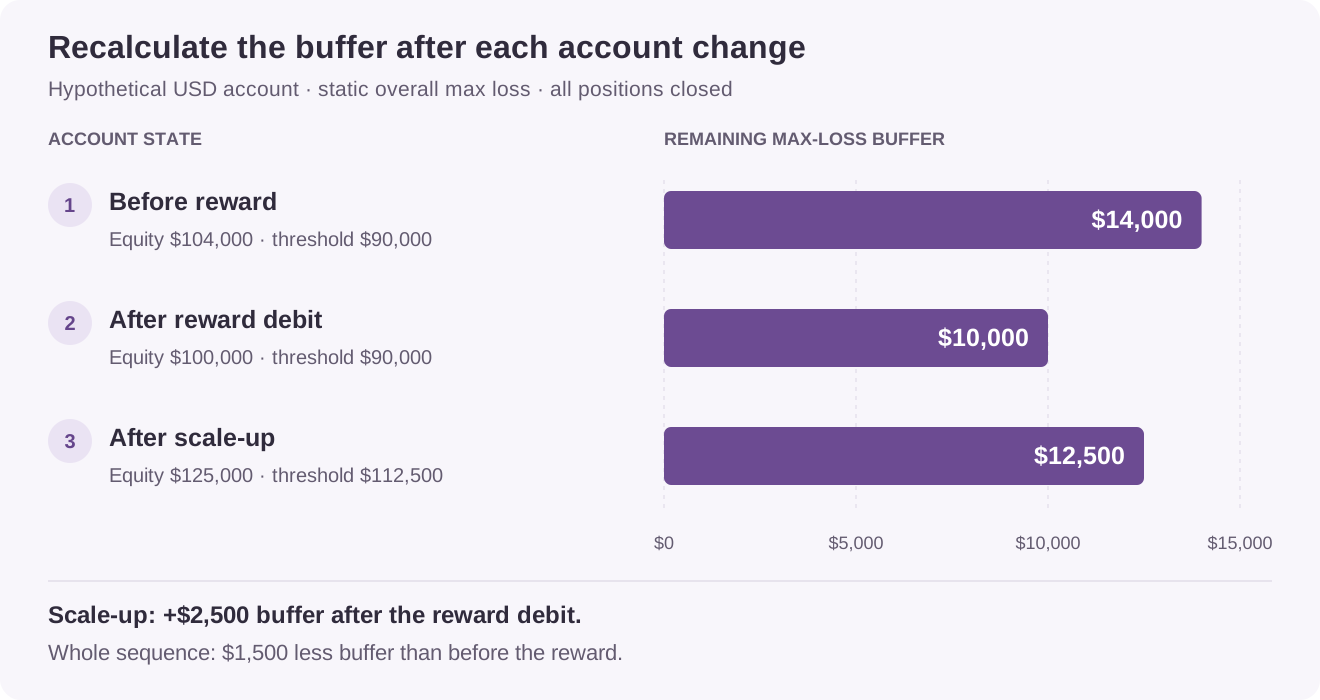
This is why both comparison points matter. The scale-up increased the defined loss allowance, while the full payout-and-scaling sequence ended with less remaining buffer than before the payout. For other withdrawal treatments, use the post-payout buffer guide. A trailing rule needs its own current reference and lock state, explained in the overall max-loss guide.
What should you record before and after the change?
Keep a before-and-after record for the actual account, including the terms that authorize the change. The evaluation-to-funded checklist uses the same approach at an earlier stage.
| Field to confirm | Before the request | Before the next trade |
|---|---|---|
| Account identity and scope | Program, stage, currency, platform, add-ons and purchase/reset cohort | Resulting account, simulation/live status and applicable account type |
| Profit and cash movements | Eligible profit, requested account debit, reward share and pending amounts | Actual debit, scaling credit, retained profit, balance, equity and separate credit |
| Loss rules | Current daily and overall references, thresholds and remaining buffers | New dollar thresholds, update timing, equality rule and any trail/lock reset |
| Trading capacity and permissions | Current lots/contracts, leverage, instruments, news/holding and automation conditions | Each confirmed change or confirmed unchanged condition |
| Payout and scaling progress | Qualifying days, cycles, milestones and existing scaling eligibility | Which counts restart, next request conditions, reward share and future scaling rights |
| Allocation and activation | Other active accounts and applicable trader/household/strategy totals | Post-change totals, approval, effective time and confirmation that the new settings are active |
Do not fill an undocumented setting by multiplying the old one by the balance increase. Record it as unresolved. Ask a specific question such as: “After the reward debit and this scale-up or merge, what will my starting reference, overall and daily thresholds, position cap, next payout conditions and scaling eligibility be?” Include the account references and the precise proposed change.
If the agreement and help page differ, first check their scope, dates and any stated precedence. Keep unresolved differences visible using the official-rule conflict record.
Before requesting the change, complete the left column. Before trading the resulting account, reconcile the right column with the activated account and applicable rules. A higher displayed balance answers only one part of that check.
Related reading
- EAs, copying and multiple accounts, for account connections and allocation scope.
- Futures contract limits and scaling, for changes in permitted contracts.
- After a payout: the remaining buffer, for the withdrawal part of an account transition.
Sources and method
Official pages checked on 13 October 2026. The examples above identify the relevant market and account stage; they are not a complete comparison of these firms or permission for a particular account.
- FTMO Scaling Plan, for eligible CFD routes, milestones, the growth ceiling and the 2-Step reward-share benefit.
- Alpha Capital Scaling Plan, for eligible plans, the first-scale example, the position-cap distinction and the normal-leverage condition.
- FTMO merging conditions, for merger eligibility, account-type changes and irreversibility.
- Alpha Capital merging rules, for qualified-account conditions, payout restart requirements and scaling exclusion.
- Alpha Capital terms and conditions, for the Alpha Direct merging/scaling exclusion.
- FundedNext merging rules, for CFD merger conditions, reward-share treatment and cohort qualifications.
- FundedNext Pro Scale-Up, for the published 25% increase and exclusion of merged accounts from that program.
- FTMO account and allocation limits, for the CFD FAQ's pre-scaling limit and Premium Programme qualification.
- Alpha Capital allocation rules, for household and asset-based strategy limits.
- Tradeify simulated funded account limits, for individual and household account-count scope.
The transition ledger, figure and knowledge check are original hypothetical illustrations, independently calculated from their stated assumptions. They do not model a named firm, predict growth or payouts, or recommend a position size. The worked buffer is distance to one specified overall loss boundary, not a combined allowance under every account rule.