LearnRisk essentials
Prop Firm Position Sizing: From Stop Distance to Remaining Loss Buffer
Size a proposed trade by calculating its loss under stated exit assumptions, then checking that loss alongside existing positions against the account's current limits. The advertised account size, available margin and maximum contract count answer different questions. None tells you how much of the remaining loss buffer to commit to one trade.
On this page
Start with the trade you intend to take: its instrument, entry, exit condition and permitted quantity increments. Translate those into money, include costs, and check the resulting account state. If the smallest permitted position exceeds the amount you have chosen to allocate, the calculation returns no position at that stop distance.
This guide uses hypothetical CFD/FX and futures accounts. CME contract specifications support the futures units; the account rules, fees and slippage assumptions are invented for the calculations. They are not recommended trade sizes or estimates of typical execution. Official documentation was checked on 25 October 2026.
How much loss room remains now?
Use the value that each rule actually monitors. For a rule that tests equity against a lower threshold:
Remaining loss buffer = current monitored equity − current equity threshold
Calculate the daily and overall buffers separately. If both rules continuously test the same equity, the smaller positive buffer is the nearer boundary at that moment. A balance-based test, a daily pause or a rule with different timing needs its own treatment. The daily-loss guide and overall max-loss guide explain those differences.
Consider this hypothetical USD account, before adding a new trade:
| Account input | Value or rule |
|---|---|
| Initial balance and advertised size | $100,000 |
| Today's opening balance | $98,500 |
| Current balance | $97,000 |
| Current floating P&L | −$650, including costs already reflected in equity |
| Current equity | $96,350; no separate account credit |
| Daily loss rule | $3,000 below today's opening balance: a $95,500 equity threshold |
| Overall max loss | Static $90,000 equity threshold |
| Enforcement | Touching either threshold is an immediate hard breach |
The daily buffer is $96,350 − $95,500 = $850. The overall buffer is $96,350 − $90,000 = $6,350. The daily rule is closer, even though the account still carries a $100,000 label.
The floating loss has already reduced equity. Subtracting that same $650 again would count it twice. What matters next is the additional loss existing positions could produce from their current values. If your platform includes separate account credit, reconcile it and its permitted treatment before using the equity figure, as explained in balance versus equity.
How much of that room would the new trade use?
The firm boundary is an account constraint. A planned loss ceiling is an amount you choose to test for this trade. Keep both separate from room deliberately left unallocated.
For the hypothetical account, choose these additional assumptions:
- Existing positions could lose another $250 from current marks to their modeled exits, including costs not yet charged.
- Leave $200 of the daily buffer unallocated after those exits and the new trade's modeled loss.
- Apply a separate $500 planned loss ceiling to the new trade, including its modeled costs.
With thresholds fixed during this scenario, the new trade's allowance is the smaller of:
Chosen ceiling = $500
Room after existing exposure and unallocated room = $850 − $250 − $200 = $400
So $400 is available to the new trade in this calculation. The $500 ceiling cannot override the nearer account boundary. If the second calculation is zero or negative, there is no positive allowance under these assumptions.
The $200 is an illustrative planning choice, not a firm requirement or protection against every possible gap. A different joint-loss scenario or a different amount left unallocated changes the result. A percentage-based personal ceiling also needs a named base: account label, current equity and remaining loss buffer are very different amounts.
How does a stop distance become a position size?
First calculate the projected loss for one lot or one contract. For a linear instrument with a constant account-currency tick value over the modeled move:
Price loss per unit = distance in ticks × value per tick
Projected loss per unit = price loss + additional slippage loss + uncounted costs
Raw quantity = new-trade allowance ÷ projected loss per unit
Round down to a permitted quantity, then recalculate the money amount. Check the minimum, increment and maximum separately. If costs include a fixed charge or a minimum commission, calculate the total cost of each candidate quantity instead of assuming everything scales proportionally.
The symbol specification supplies the units. MetaTrader 5 lists contract size, profit currency, tick size, tick value and volume restrictions. Do not substitute a familiar lot value when the actual symbol or account-currency conversion differs. MetaTrader 5 symbol specifications.
Measure the move between the prices relevant to execution. MetaTrader documents buys at Ask and sells at Bid; for its ordinary non-exchange Stop Loss conditions, a long position is checked against Bid and a short against Ask. Exchange instruments can use a different trigger basis. A chart level alone therefore may not supply both ends of the calculation. MetaTrader 5 trading principles.
When the entry-to-exit difference already uses executable prices, it already includes their spread effect. Add only costs or execution differences not counted there. The spreads and slippage guide follows that accounting through a complete trade.
CFD/FX example: fit a proposed EUR/USD trade into $400
Continue the hypothetical USD account above. The proposed trade is a EUR/USD buy. These specifications and charges are stipulated for the example, not taken from a named prop firm's offering:
| Trade input | Assumption |
|---|---|
| Entry fill | Ask 1.08000 |
| Stop trigger | Bid 1.07800, 20 pips below the entry fill |
| Contract size | 100,000 EUR per lot |
| Pip size and value | 0.0001 USD per EUR; $10 per pip per lot |
| Allowed quantities | Minimum 0.01 lot, in 0.01-lot increments |
| Round-trip commission | $7 per lot, none yet charged for this new trade |
| Modeled exit slippage | 2 pips worse than the trigger, giving a 1.07780 exit fill |
| Other conditions | Enough margin and no tighter volume cap for the illustrated quantities |
The position closes within this session, with no financing, reset, withdrawal or other adjustment. Existing positions lose the further $250 already allowed for. Equity declines to the modeled exits without an intervening lower value; both account thresholds remain fixed. The 2-pip slippage and commission are illustrative inputs, not typical rates.
At one lot, the price loss to the trigger is 20 × $10 = $200. The modeled slippage adds 2 × $10 = $20, and commission adds $7:
Projected loss per lot = $200 + $20 + $7 = $227
Raw quantity = $400 ÷ $227 = 1.762114... lots
Rounding down to the stipulated step gives 1.76 lots, with a projected loss of $399.52. The next step, 1.77 lots, would lose $401.79 under the same assumptions and exceed the $400 allowance. That is a failure of the chosen trade calculation, not an automatic firm breach.
| Modeled account state | Equity | Daily buffer | Overall buffer |
|---|---|---|---|
| Before the new trade | $96,350.00 | $850.00 | $6,350.00 |
| After both modeled exits and costs | $95,700.48 | $200.48 | $5,700.48 |
The second row is $96,350 − $250 − $399.52. It preserves slightly more than the selected $200 because quantity was rounded down.
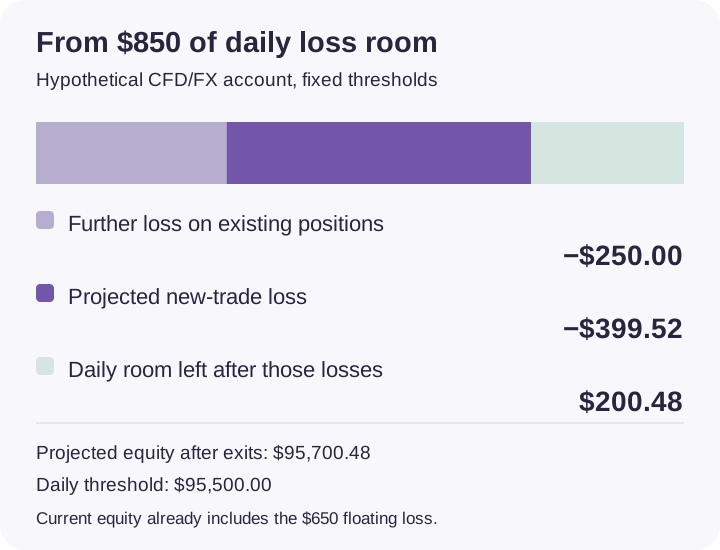
Now change only exit slippage to 5 pips. The new trade loses 1.76 × ($200 + $50 + $7) = $452.32. With the same $250 further loss on other positions, equity becomes $95,647.68 and the daily buffer falls to $147.68. This alternative remains above the assumed firm threshold, but exceeds the trade allowance and uses part of the room you intended to leave untouched.
An ordinary stop does not make the trigger price a guaranteed fill; the spreads guide's trigger section separates trigger evidence from fill evidence. CME also distinguishes stop-limit orders from stops with protection: the first becomes a limit order, while the second can execute within a protection range after triggering. A price restriction and a completed exit are separate checks. Use the actual platform's order behavior. CME futures order types.
Futures example: the money calculation and the contract cap
Use a separate hypothetical USD futures account with $50,600 balance and equity, no open positions or account credit, a $49,600 daily equity threshold and a $48,600 overall threshold. Both are fixed during this example; touching either is a hard breach. No session reset or EOD update occurs before the trade closes.
The nearer buffer is $1,000. Leave $200 unallocated and choose a $325 loss ceiling for the trade. The smaller of $325 and $1,000 − $200 is $325.
CME specifies Micro E-mini Nasdaq-100 futures, MNQ, at $2 per index point and an outright tick of 0.25 points worth $0.50. E-mini Nasdaq-100 futures, NQ, use $20 per point and a 0.25-point tick worth $5. The exchange specifications establish price sensitivity; they do not set the prop account's permitted contract count. CME Micro E-mini specifications · CME NQ contract specifications.
Model a 20-point adverse move from entry fill to the stop trigger, a further four ticks of exit slippage, and full entry and exit fees not yet charged. Assume $2 round-trip fees per MNQ contract and $6 per NQ contract. Those fees and slippage inputs are illustrative, not quotations. No other costs apply, and equity reaches the modeled exit without an earlier lower value.
| Per-contract calculation | MNQ | NQ |
|---|---|---|
| Loss over 20 index points | $40 | $400 |
| Four further ticks of slippage | $2 | $20 |
| Assumed round-trip fees | $2 | $6 |
| Projected loss per contract | $44 | $426 |
| Whole contracts within $325 | 7 | 0 |
Seven MNQ contracts would project $308 of loss. An eighth would project $352, above the allowance. Even one NQ contract exceeds it.
Now add the hypothetical program's separate cap of five MNQ contracts at this account stage. It reduces the illustrated quantity to five, projecting a $220 loss. Equity after the assumed exit is $50,380, leaving a $780 daily buffer and a $1,780 overall buffer. Margin is assumed sufficient, and there are no other positions or orders.
The cap is an invented program condition, not a CME rule. On an actual account, check product eligibility, mini/micro counting, aggregate limits, pending orders and any stage-dependent scaling. Record each of them in the futures position-size record.
What changes when other positions or orders are open?
Size against a combined account scenario. For positions already open, measure further losses from their current marks, plus unposted costs. For proposed trades and pending entries, include their full modeled loss from entry if they can become active together.
Separate tickets do not create separate loss allowances. If two positions could lose together, include both in the same scenario rather than testing each against the whole buffer. Do not assume one will offset another without a defensible joint scenario. Instrument labels alone do not establish that offset.
Also check what another order does to the existing position. MetaTrader supports both netting and hedging accounts. In netting, an opposite deal can reduce, close or reverse an existing position. An order that adds to or reverses the position also replaces its Stop Loss and Take Profit with that order's levels, and zero levels delete them. Reconcile the remaining size and stop levels after each such deal. MetaTrader 5 position accounting.
After a partial fill, addition or partial close, update the remaining quantity, costs and exit conditions. A calculation made for the original order is no longer enough if the actual exposure differs.
Can a trade fit at entry and later breach before its stop?
Yes. An entry calculation uses the thresholds that apply then. An intraday trail, a daily reset or a later account adjustment can change the comparison while the stop stays at the same price.
Consider an isolated hypothetical intraday trailing rule. Equity starts at $50,600, which is also the tracked high. The overall threshold follows the highest observed equity by $2,000, with no lock in this example. Equity is checked continuously, and touching the threshold breaches the account. There is one position, no daily rule, costs, credit, cash flows or other adjustments.
The planned stop would leave equity at $50,300, a $300 loss from the starting state. Follow this path instead:
| Event | Equity | Tracked high | Overall threshold | Remaining buffer |
|---|---|---|---|---|
| Start | $50,600 | $50,600 | $48,600 | $2,000 |
| Open profit raises the high | $52,400 | $52,400 | $50,400 | $2,000 |
| Giveback reaches the threshold | $50,400 | $52,400 | $50,400 | $0: hard breach |
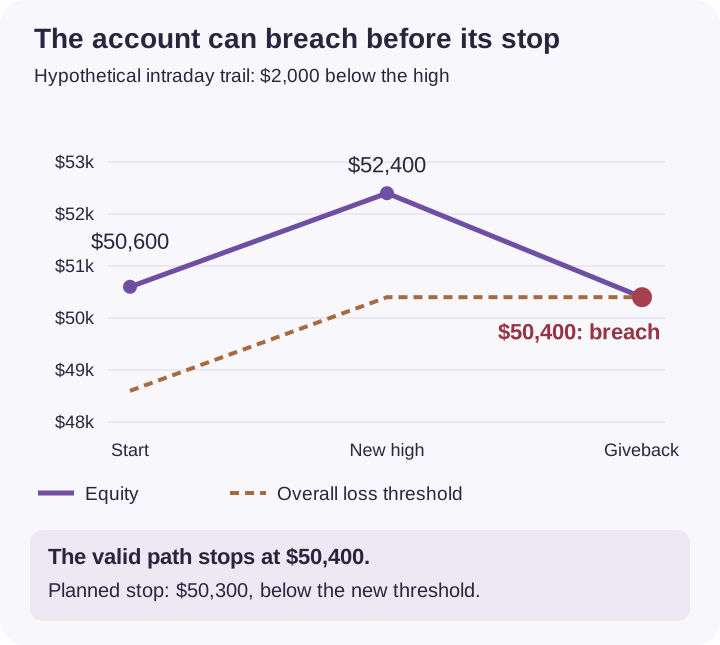
The account reaches its rule boundary before the planned stop. Its loss from the starting equity is only $200 at that point, but it has given back the full $2,000 permitted below the new high. Recheck when the overall threshold updates and whether a lock stops it rising, rather than assuming the original buffer lasts for the whole trade.
A daily reset can require a similar recalculation for a carried position. An EOD trail needs its specified end-of-day observations. Use the actual event timing and replay the account in order when testing a proposed path or reviewing what happened.
What should the pre-trade record contain?
Record enough to reproduce the size and the resulting account state:
| Record | Include |
|---|---|
| Account and rules | Exact program, stage, platform and relevant options; current daily and overall thresholds, monitored values, equality boundaries and next updates. |
| Starting state | Balance, monitored equity, credit treatment, existing positions, pending orders and costs already posted. |
| Proposed trade | Symbol, direction, executable entry assumption, stop trigger, trigger-price basis and projected exit fill. |
| Units and costs | Contract size or tick value in account currency, quantity increments, commission, financing if relevant and slippage assumptions. |
| Allocation | Chosen trade ceiling, further losses from existing exposure and the room left unallocated. |
| Result | Rounded quantity, applicable caps, projected account equity and remaining room against each rule. |
| Path checks | A worse exit scenario, changing thresholds, joint exposure and order behavior. |
Verify the symbol settings in the actual platform, then compare the applicable account conditions with the margin-and-exposure checks. After entry, reconcile the actual fill and costs with the assumptions. If they changed the result, the original quantity calculation no longer describes the current account.
Related reading
- Account size and opening loss allowance, for the difference between a tier label and permitted losses.
- Leverage, margin and loss limits, for the separate tests of buying power and loss exposure.
- Spreads, slippage and order execution, for executable prices and trading-cost accounting.
- Futures contract limits, for counting, product restrictions and stage-dependent caps.
Sources and method
Official platform and exchange documentation was checked on 25 October 2026. It supports the instrument units, specification fields, order behavior and position-accounting distinctions described beside the links. No named firm's rules, fees or permitted quantities are used as example inputs.
The three account scenarios are original hypothetical calculations. The CFD/FX and futures sizing examples hold their thresholds fixed and include the stated exit costs. The separate intraday-trailing example updates the equity high before testing the threshold, excludes costs to isolate that mechanism and stops at the first hard breach. Neither the chosen allowances nor the modeled slippage represent a recommended risk policy or a maximum possible loss.
- MetaTrader 5: Market Watch and symbol specifications, for contract size, profit currency, tick values and volume constraints.
- MetaTrader 5: Basic Principles, for executable prices, stop conditions, netting and hedging.
- CME Group: Micro E-mini Equity Index Futures FAQ, for MNQ's multiplier and outright tick specification.
- CME Group: E-mini Nasdaq-100 Futures Contract Specs, for NQ's contract unit and outright tick.
- CME Group: Futures Order Types, for the difference between stop-limit orders and stops with protection.