LearnChoosing a program
How to Read Prop Firm Reviews and Payout Claims
Prop firm reviews can help you investigate a provider, but the conclusion must stay within what the evidence actually documents. A testimonial reports someone's experience. An authenticated payment record can support a particular payout. Neither, by itself, establishes a typical trader outcome, a representative payout rate, or future reliability.
On this page
Start by turning a broad claim such as “this firm pays” into a question you can check: who received what, from whom, through which program, and when? If the claim describes many traders, also ask who was counted and who was left out.
This guide applies to CFD/FX and futures programs. Platform and consumer-guidance sources were checked on 7 October 2026. The numerical example is hypothetical and contains no firm's performance data.
What kind of evidence are you looking at?
Separate the claim from its supporting record. A statement does not become independently verified because several websites repeat it. Follow each retelling back to its original source.
| Evidence type | What it can establish | What remains to be checked |
|---|---|---|
| Testimonial | What a reviewer says happened or how they felt about it. | Identity or relevant relationship, account scope, supporting records, and any incentive. |
| Published payout claim | What the firm, affiliate, or trader publicly claims about payments. | Definitions, underlying transactions, period, recipients, and whether anyone checked the records. |
| Independently documented observation | A specific event supported by an external examiner's documented checks of relevant records. | The examiner's role and financial interests, authenticity, gaps, and whether the event is representative. |
| Evidence about a defined cohort | Outcomes for a stated group over a stated observation window, using disclosed counting and verification methods. | Coverage, missing outcomes, duplicate people/accounts, selection, and limits on applying the result elsewhere. |
A cohort is a defined group followed over time, such as everyone who bought a particular program during a specified month. A collection of people who volunteered payout screenshots is a selected group of contributors. It does not automatically represent everyone who bought the program.
“Independent” describes the relationship and checking process; it is not a substitute for explaining the method. A third party that repeats a firm's total has independently published the claim, but has not necessarily verified it. Likewise, a report called an audit needs a named scope, period, examiner, and explanation of what was tested. Read those before relying on the label.
Use the comparison guide's treatment of missing rules, reviews, and conflicting answers alongside this guide. Contract terms explain the offer; records of actual events address whether particular parts of it were delivered.
What does a payout screenshot actually prove?
A screenshot shows an image of a record. Its evidential value depends on the record's origin, authenticity, meaning, and connection to the claimed event. A professional-looking dashboard or payment certificate is not enough to settle those questions.
First identify the stage shown:
| Record shown | Narrow conclusion if the record is authentic and correctly linked | Additional evidence needed for a broader claim |
|---|---|---|
| Request in the firm's dashboard | The firm's system recorded that request. | Approval, dispatch, and receipt records if the claim is that money was paid. |
| Approval notice | The firm accepted that request, subject to any remaining payment steps. | Dispatch and receipt records if the claim is that money arrived. |
| Firm-issued payout certificate | The firm issued that statement about a payment. | The payment's status and evidence connecting it to an actual recipient and destination. |
| Transfer confirmation or transaction reference showing dispatch | The payment was sent toward the stated destination. | A credit or receipt record at that destination. A reference with only a pending or failed status does not establish dispatch. |
| Credit at a payout provider | The specified provider account received the stated credit. | Evidence of any subsequent bank or wallet receipt being claimed. |
| Completed receipt at the stated destination | That destination received the identified payment, subject to checking authenticity and attribution. | A link to the program and payout cycle, plus separate evidence for claims about other people or future payments. |
Check the sender, recipient, amount, currency, timestamp, transaction status, and any reference connecting the records. A transfer from an unrelated source does not establish a prop payout. The same transaction reposted on three platforms remains one transaction. Cropped images can omit material context, while a video can still leave the underlying records unverified.
Keep sensitive details private. A reviewer can redact account numbers and personal documents, or describe a private verification process. Redaction protects privacy but can limit what a public reader can confirm. State that limitation rather than treating either a hidden field or refusal to publish private records as proof of dishonesty.
For a speed claim, identify both endpoints. Approval-to-provider-credit is a different interval from request-to-bank-receipt. One fast observation is also different from a measured distribution of processing times. The payout stages guide separates these events; its explanation of “24-hour” and “instant” claims covers the clocks and conditions.
A received amount is not automatically the trader's net financial result. Earlier evaluation, reset, subscription, activation, and other costs may be outside the image. Use the cost inventory and payout calculation checklist when that is the question you need to answer.
How do you read a prop firm review in context?
Read the description before interpreting the rating. A helpful support conversation, successful purchase, evaluation pass, payout request, and received payment are different experiences. Praise at one stage cannot document a later stage the reviewer has not reached.
For each review that might influence your decision, check:
- Experience date and publication date. A new post may describe an old event. Note later edits or a follow-up outcome.
- Exact offer. Identify the market, program, account stage, platform, and relevant rule version. A shared brand name does not make all its products equivalent.
- What the reviewer experienced. Separate firsthand events from opinions, predictions, and information repeated from someone else.
- Supporting detail. Look for a coherent sequence of dates, stated conditions, records, and a clear final status. Detail makes a claim more checkable, not automatically true.
- Financial relationship. Look for sponsorship, referral commissions, free accounts, prizes, employment, or another connection.
- How the review was selected. Was it volunteered, requested after purchase, requested after a payout, or chosen for a promotional page? Record what is known; do not guess.
- Relevance to you. Check whether the same terms and access conditions apply to your proposed account.
For example, another trader's payout in another country does not confirm your own provider access. The country, identity, and payout-access worksheet addresses that separate question.
Read across sources and ratings, including detailed neutral reviews and follow-ups. The FTC's consumer guidance recommends checking recency and reviewer history while cautioning that appearance alone often cannot distinguish real reviews from fake ones. Suspicious patterns are reasons to investigate; fake reviews can also be negative. FTC guidance on evaluating reviews
How should sponsorship and referral links affect your reading?
A reviewer can receive a genuine payout and also earn commission when viewers buy an account. Those facts can coexist. The financial relationship matters when assessing why the review was made, what was selected, and whether the terms match an ordinary customer's experience.
Look for a clear explanation of the benefit: payment for coverage, commission on purchases, a free or discounted account, a prize, or another arrangement. A discount code alone may not explain who gets paid. Apply the same questions to comparison publishers, video creators, community administrators, and PFW.
For US advertising, the FTC's endorsement guidance explains that unexpected connections that could affect credibility should be disclosed clearly. Its examples cover affiliate commissions and benefits such as free products. This is a US guidance reference, not a legal finding about a particular reviewer or a rule for every jurisdiction. FTC endorsement guidance
Disclosure helps you interpret a relationship. It does not verify the payout, make the selected examples representative, or establish that the reviewer's costs and treatment match yours. Conversely, no visible disclosure does not establish either independence or a hidden payment. Record the relationship as unknown if it has not been established.
What do review scores and verification badges tell you?
A review score summarizes the reviews collected under that platform's method. It is not a payout-success percentage. A score of 4.8 out of 5 does not mean that 96% of purchasers received money or that a future payout has a 96% chance of arriving.
Trustpilot, for example, says its TrustScore considers review volume, age, and a weighting system. It also permits reviews of genuine experiences beyond purchases. A score can therefore reflect experiences other than completed payouts, and should not be treated as a simple payout statistic. Trustpilot's explanation of its platform and TrustScore
Read a badge's current definition on the platform that issued it. Ask what was checked: the person's identity, an interaction, a purchase, a document, or the specific payment being claimed. Do not expand the badge into a guarantee about facts outside that check. Being hosted on a third-party website is also different from an independent examination of payout records.
Review counts need context too. A business that asks for feedback at checkout is collecting observations from a different point in the journey than one asking after payout. Even if every review is authentic, those groups answer different questions. Adding more reviews from the same selected group does not, by itself, resolve the selection problem.
For an online poll or survey, ask how participants were recruited, who could respond, how duplicates were handled, and what information is missing. AAPOR distinguishes probability samples from opt-in or social-media recruitment and stresses transparent methods for interpreting the latter. Applying that distinction here, a community poll needs a defensible method before its results can be generalized to all purchasers. AAPOR survey research guidance
Worked example: 300 payouts does not mean 300 paid traders
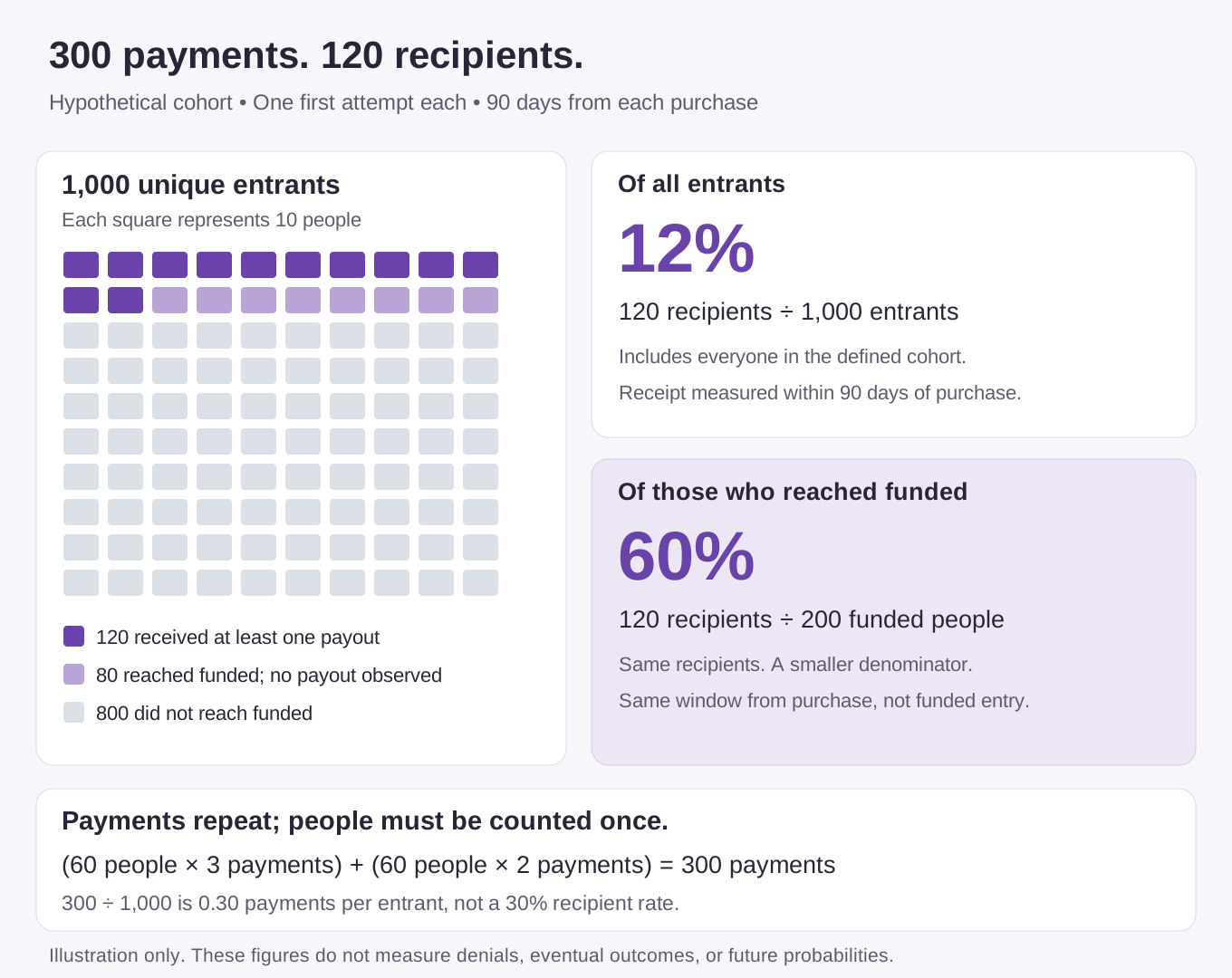
Consider an invented cohort of 1,000 people, each buying one first attempt at the same hypothetical evaluation program. Each person is followed for exactly 90 days from purchase. There are no repeat purchases or additional accounts in this example. Assume complete records for that observation window and that the counted payments have been checked through receipt at the stated destination.
Within each person's 90-day window:
- 200 people reach the simulated funded stage.
- 120 of those people receive at least one payout.
- 60 recipients receive three payments each; the other 60 receive two each.
- The resulting payment count is
(60 × 3) + (60 × 2) = 300.
| Question | Calculation | What the result means |
|---|---|---|
| What share of all entrants received at least one payout? | 120 ÷ 1,000 = 12% | 12% of this invented entry cohort received a payout within 90 days of purchase. |
| What share of those reaching funded received at least one payout? | 120 ÷ 200 = 60% | 60% of the funded subset received a payout within that same person-specific window. |
| How many payments were received per paid person? | 300 ÷ 120 = 2.5 | Paid people received an average of 2.5 payments each. |
| Can 300 payments divided by 1,000 entrants establish a 30% recipient rate? | No. 300 ÷ 1,000 = 0.30 payments per entrant. | The numerator counts payment events, not unique recipients. The recipient rate remains 12%. |
The first two percentages are both correct but answer different questions. The 60% figure leaves out the 800 people who did not reach funded during their window. It also does not mean that 40% of funded traders had a payout refused. The example supplies no request, eligibility, denial, or pending-request counts.
The window matters. Someone reaching funded on day 85 has less time to receive a payout before day 90 than someone reaching it on day 20. These are outcomes measured from purchase, not outcomes after 90 days of funded trading. “No payout observed within 90 days” is not the same as “will never receive one.”
Now suppose a promotional page selects 12 of the 120 recipients to provide testimonials. All 12 can truthfully report a payout. That does not turn the page into evidence that every purchaser gets paid. If those testimonials were the only available records, you could not reconstruct the cohort's 12% rate: the complete numerator and denominator would still be missing.
Real headline totals require the same care. Ask whether the total counts approved amounts, dispatched payments, or received funds; whether repeat recipients are counted; which programs and dates are included; and whether refunds or other transfers are mixed in. A monetary total also needs a currency and a consistent conversion method. None of these totals alone supplies a trader success rate, net profitability, or evidence of future financial capacity.
How should you assess complaints and denied-payout reports?
Apply the same evidence standard to negative and positive accounts. A complaint can reveal a concrete question that deserves attention without establishing its frequency across all traders. Equally, other people's successful payouts do not resolve a documented problem with one person's request.
Separate the event from the explanation. “My request remains unpaid as of this date” is different from “the firm refused it for this reason” or “the refusal violated my agreement.” Each claim needs its own support.
For a material dispute, look for the applicable program and agreement, the submitted request, the stated reason for a delay or denial, relevant account records, the firm's response, and any subsequent resolution. Distinguish an allegation, an acknowledged event, a contested interpretation, and a confirmed outcome. A response promising to investigate is not a resolution; a complaint disappearing from view does not establish that the issue was settled.
Several genuinely separate reports describing the same mechanism are more useful for investigation than many reposts of one report. Count distinct cases where possible, record dates, and keep unresolved accounts visible. Without a defined population and adequate coverage, a complaint count is not a complaint rate. The absence of public complaints is not proof that no problems occurred.
When evidence conflicts, preserve both accounts and identify the missing record or unanswered question. You do not need to label a firm fraudulent to decide that an essential issue remains unresolved before purchase.
When the disagreement concerns which official rule applies, use the guide to conflicting rules to compare the account scope, dates, and applicable documents before interpreting the reported event.
Build a short evidence record before relying on a claim
Choose the specific claim that matters to your decision and complete one row for each original source. Keep the record small enough to revisit when the program, provider, or evidence changes.
| Field | What to record |
|---|---|
| Exact claim | The event, amount, speed, rate, or opinion actually asserted. |
| Scope and dates | Entity, market, program, stage, relevant location/provider, experience date, publication date, and checked date. |
| Original source | Source URL, who supplied the information, and whether other posts repeat it. |
| Supporting record | What was inspected, by whom, how it connects to the claim, and any authenticity or privacy limitation. |
| Relationship | Disclosed payment, referral commission, free account, employment, other benefit, or unknown. |
| Population and counting | People versus accounts versus transfers; observation window; selection; missing records and outcomes. |
| Conclusion | What is supported, what is only reported, and what remains unresolved. |
| Next check | The precise question or record that would change your conclusion. |
A useful conclusion might read: “This source reports one received payment for the named program in this period. The public records do not allow me to authenticate it independently. They provide no denominator for estimating other traders' outcomes.” If you have inspected stronger evidence, say exactly which part it supports.
Use that record in your before-you-pay comparison worksheet. If a key claim remains unresolved, retain that status. Do not fill the gap with a star score, repeated testimonials, or an AI-generated summary.
Our study of evidence coverage across six pilot accounts applies disclosed counting rules to the evidence states in a dated dataset. It separates documented answers, unresolved questions and interpretations without using completeness as a measure of payout reliability.
Related reading
- How to compare prop firm programs, for placing the evidence record in the wider purchase decision.
- Prop firm payout rules, for the stages between a request and money received.
- Country restrictions, KYC, and payout access, for whether a payout route is available to you at all.
Sources and method
The sources below were checked on 7 October 2026. They support the stated platform, disclosure, and research-method points. They do not independently verify any prop firm's payouts. The evidence categories, checking worksheet, and 90-day cohort are PFW educational explanations; the cohort is entirely hypothetical and is not a benchmark or performance forecast. No actual trader records or firm payout datasets were examined for this article.
- FTC: How To Evaluate Online Reviews, for examining review sources, dates, reviewer history, and the limits of judging authenticity by appearance.
- FTC: Endorsement Guides, What People Are Asking, for US guidance on disclosing relationships and affiliate benefits that can affect an endorsement's credibility.
- Trustpilot Trust Centre, for Trustpilot's description of eligible experiences and the factors used in its TrustScore. This is the platform's own account of its operation.
- AAPOR: Best Practices for Survey Research, for distinctions between probability and nonprobability recruitment and the need to report methods transparently. Its survey principles are applied here to assessing claims from selected groups.