LearnChoosing a program
How to Compare Prop Firm Programs Before You Pay
To compare prop firm programs, first confirm that you can use the program and that its rules permit the way you intend to trade. Then compare the exact account's loss limits, total costs, evaluation conditions, and payout terms. Keep missing or contradictory answers marked unresolved. A lower price cannot compensate for a rule that makes a program unsuitable for your requirements.
On this page
The unit of comparison is a specific program configuration, including its market, size, platform, options, and account stage. A firm's name or headline offer is not enough. This guide brings the separate mechanics into one before-you-pay checklist, with a hypothetical comparison and a blank worksheet you can use.
Named examples use official sources checked on 1 October 2026. They illustrate why a particular question matters; they are not recommendations or complete reviews of those firms.
What must a program allow you to do?
Write down your essential requirements before looking at discounts. Separate them from preferences you could reasonably trade off.
An essential requirement might be permission to hold a position across the weekend, use a particular platform, or trade your own automated strategy. A preference might be a lower fee or a more convenient dashboard. Treating both as points in one score can hide a decisive mismatch: several attractive features do not make a prohibited trading method permitted.
| Area | Write your requirement in a form you can check |
|---|---|
| Market and instruments | The exact products you trade, including contract or symbol specifications |
| Trading hours | Sessions you can attend and whether positions must survive a daily close or weekend |
| Execution and tools | Platform, order types, automation, copying, and any required connection or data service |
| Trading pattern | Holding period, news exposure, position sizing, and how profits normally accumulate |
| Budget | Maximum cash spending under a defined purchase path, including possible repeat attempts |
| Payout access | Available payment destination and amount/timing conditions you can work with |
If your shortlist spans both markets, use the CFD/FX versus futures guide to check instrument sizing, sessions, and account status before comparing the program terms.
State these requirements honestly. If your usual method needs weekend holding, “I will just close earlier” is a change to that method. You can evaluate such a change separately, but it should not silently turn an incompatible offer into a match.
Write down the full path you are considering: evaluation phases, funded stage, and any later live-account transition. The challenge-lifecycle guide explains why passing, receiving an account, and receiving money are separate events.
Can you use the program through the stage you want?
Check eligibility before comparing trading terms. Record the requirements for purchasing, completing identity verification, receiving the relevant funded account, and receiving a payout. Being able to open a checkout page does not confirm all four.
Confirm the applicable age, citizenship/residency rules, identity documents, permitted locations while trading, and payment-provider availability. If a rule depends on your circumstances, describe those circumstances accurately when asking the firm. Do not infer permission from another trader's experience in a different country.
For example, Topstep's futures eligibility policy considers both citizenship and permanent residency. It also distinguishes countries with Express Funded Account access from those with Live Funded Account access. That makes the intended stage part of the eligibility check. Topstep eligibility
Record the business entity named in the applicable terms, its official contact details, and which entity or provider handles later account or payment arrangements. A brand name shared across products does not tell you which agreement applies to your purchase.
Use the country, identity, and payout-access worksheet to record the answer and supporting evidence at purchase, funded onboarding, and payout. Keep any remaining conditions visible before you pay.
Does the funded stage permit the same trading as the evaluation?
Check both stages, even if you have already tested the evaluation. The trading method you use to pass must also fit the account you expect to trade afterward. Use the before-and-after rule matrix to distinguish a changed condition from one that remains unresolved.
For FTMO's CFD Standard accounts, its holding policy permits overnight and weekend positions during evaluation. At the FTMO Account stage, Standard accounts must close before the weekend market close and before market breaks longer than two hours. Its Swing account type has an exception to those holding restrictions. This is a product-and-stage distinction, not a rule for every market offered by FTMO. Holding restrictions
The holding-checkpoint guide separates the session boundary, financing cutoff, daily-loss reset, news window, and weekend closure.
FTMO's CFD news policy makes a similar stage distinction. Specified news restrictions apply to Standard FTMO Accounts, including execution of stop-loss or take-profit orders on affected instruments within the restricted window. The worked news-event clock shows why avoiding new orders alone does not prevent a pending entry or protective exit from executing during that window. News restrictions
Use separate entries for these permissions:
| Permission | Detail a yes/no label can miss |
|---|---|
| Overnight or weekend holding | Which market break, instrument, stage, and account option the permission covers |
| News activity | Opening, closing, pending-order execution, holding, and any separate treatment of profits |
| Automation | Whether the specific strategy and software behavior comply with the prohibited-practices rules |
| Copying | Account ownership, copying direction, source of trading decisions, and account limits |
| Position size | Lots/contracts, aggregate exposure, scaling plans, and correlated positions |
| Account activity | Deadlines, inactivity, minimum days, and any stage-specific activity condition |
An “EAs allowed” statement is not blanket permission for every automated system. FTMO's CFD strategy FAQ, for example, allows algorithmic trading subject to its rules and separately discusses third-party EAs and platform-message limits. Read the relevant prohibited-practices terms as well as the feature label. Strategies and instruments. The prohibited-practices guide separates prohibitions, payout conditions and review triggers.
For EAs and trade copiers, check the source of the trading decisions, account ownership, the permitted connection, and any allocation cap using the automation and copying permission record.
Add the checks specific to your market
For CFD/FX, record the exact symbols, contract/lot specifications, leverage or margin requirements, commissions, spreads, swaps, and server reset clock. Check the chosen platform and account option rather than assuming a firm's other CFD offering has the same settings. Use the leverage and margin guide to separate the order's margin requirement from its price sensitivity and the account's remaining loss room. The execution record shows how to compare spreads and commissions on the same basis.
For futures, record permitted contracts, tick values, Micro/Mini sizing rules, position limits, required flat times, exchange/data access, and contract-expiry or rollover procedures. An exchange session and a firm's permitted trading session need not be the same.
For example, Topstep's Trading Combine and funded-account trading-hours page requires positions to be closed by 3:10 p.m. US Central Time on ordinary weekdays, or earlier for products that close earlier. Check special and holiday schedules separately. That is a specific program restriction, not a universal futures rule. Products and trading hours
For perpetuals, record the exact contract and its reference asset, the funding schedule and how funding reaches equity, the price used for the account's loss limits, and whether the account is simulated or live. The perpetuals record brings those checks together.
What should you compare once the essential requirements are met?
Compare the remaining offers on the same basis. Keep evaluation and funded-stage answers separate wherever the rules change. A summary row should point to the source that makes it calculable.
1. Starting value, loss allowance, and current buffer
Record the actual starting account value and whether the environment is simulated or live. Calculate the opening max-loss allowance from the applicable rule. Keep any daily loss or pause separate. The advertised account size is not cash you own or the amount you can lose.
The account-size and loss-allowance guide explains those starting values. Then record what moves the overall threshold, which value is monitored, when it is checked, whether touching it triggers a breach, and whether a trail stops at a cap. The overall max-loss comparison shows why “static,” “EOD,” and “intraday” need complete definitions.
For a daily rule, record the calculation, reset clock, open-position treatment, and consequence. A daily pause and an account-ending breach are different outcomes. Use the daily-loss checklist to capture the full rule.
If equity is monitored, check how floating P&L, charges, and any account credit enter that value. Do not assume a fee refund credited to an account also enlarges its permitted loss allowance. The balance-and-equity guide separates the accounting effect from the program's loss rules.
2. Evaluation targets and the path to qualification
Record each phase's target, minimum or qualifying days, consistency conditions, time limits, inactivity rules, and review requirements. Check whether a funded-stage target or buffer is needed before payout eligibility begins.
Compare what those conditions ask of your trading pattern. A method whose profits arrive unevenly needs to examine a consistency condition closely. A smaller profit target alone does not show that a program is easier, because the allowed loss, timing, and other conditions may differ.
Use your existing trading records to test those conditions together. The trading-history replay guide shows how to combine loss limits, session resets, consistency and qualifying days, and how to identify checks that need evidence beyond closed trades.
If the offers use different entry routes, compare one-step, two-step, three-step, and direct-entry paths through the same endpoint before treating a shorter evaluation as a cheaper or faster route to payment.
3. Total cash costs through the same endpoint
Use a common endpoint, such as funded-account activation, and write down the assumed number of paid periods and attempts. Include entry fees, renewals, resets, activation, required services, and applicable payment charges. Keep optional purchases identifiable.
Build a longer or unsuccessful path too. Do not deduct an unreceived conditional refund to make the initial purchase look cheaper. The full challenge-cost guide provides the detailed inventory and separates external cash payments from trading-account costs.
Use the subscription-versus-one-time billing table to record the next charge, cancellation cutoff, and revised calendar after a reset.
4. Payout eligibility, amount, and receipt
Compare the whole payout process: what makes a request eligible, the amount that may be requested, the trader's share, possible deductions, review, dispatch, and the available receiving method. Check the first and later payout cycles separately.
Topstep's Express Funded Account payout policy, for example, distinguishes the profit split from limits on the amount that can be requested. Its paths, account sizes, and selected options can affect the conditions. A headline split is therefore only one input. Payout policy
The withdrawal calculation guide supplies the bases and calculation order to record before comparing those amounts.
Also record what an account debit or withdrawal does to the remaining balance and loss buffer; how a payout changes the remaining loss buffer shows the calculation. The payout-process guide explains why eligibility, approval, dispatch, and money received should not be treated as one event.
Worked comparison: why the lowest fee can leave the shortlist
Consider a trader comparing three hypothetical CFD/FX programs. All advertise a $100,000 tier. The trader has three essential requirements for this initial screen:
- Weekend holding must be permitted in both evaluation and funded trading.
- Their specified automated strategy must be permitted in both stages.
- Cash fees through funded activation must be no more than $600 under the stated one-attempt path.
Assume identity, location, instruments, and platform requirements have already been confirmed for all three. All evaluation fees are one-time, with no expiry before the modeled pass. There is one purchase, no reset or renewal, no refund, and no additional cash charge through activation. Prices are hypothetical USD amounts including applicable taxes and payment charges. Other loss, performance, and payout conditions still require the detailed comparison described above.
| Check | Offer A | Offer B | Offer C |
|---|---|---|---|
| Evaluation fee | $200 | $450 | $320 |
| Activation payment | Included | $100 | Included |
| Cash fees through activation | $200 | $550 | $320 |
| Weekend holding during evaluation | Confirmed permitted | Confirmed permitted | Confirmed permitted |
| Weekend holding when funded | Confirmed prohibited | Confirmed permitted | Confirmed permitted |
| The specified automated strategy in both stages | Confirmed permitted | Confirmed permitted | Not established by the available terms |
| Result of these three checks | Does not meet requirements | Meets these requirements | Unresolved |
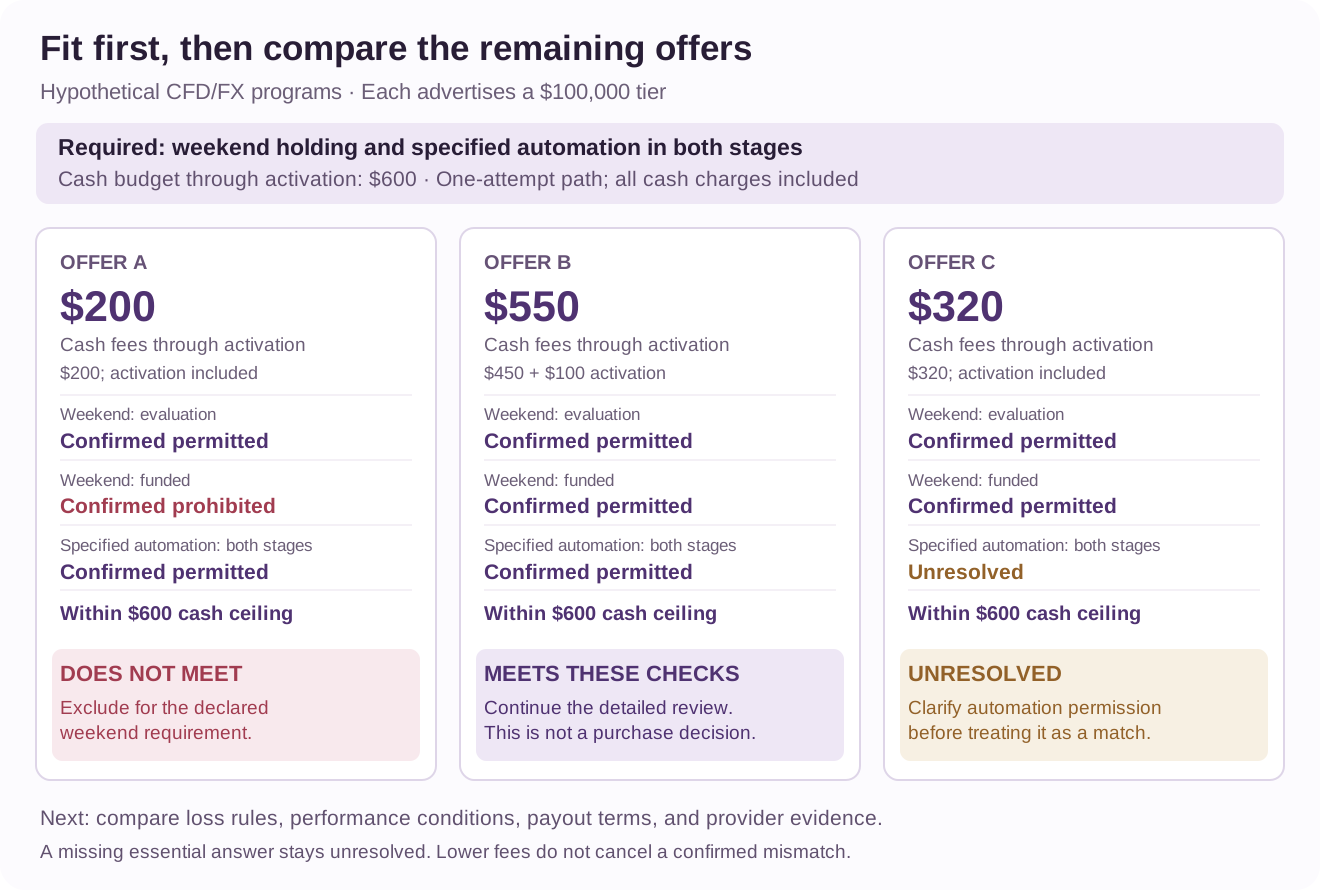
Offer A is the cheapest, but its funded-stage rule conflicts with a requirement. Offer C is cheaper than B, but an unanswered automation question cannot be treated as permission. Offer B passes this initial screen at $450 + $100 = $550, leaving $50 within the scenario's cash ceiling. That is a reason to continue examining B, not a conclusion that it should be purchased.
If C's answer is later confirmed as permitted, it can join the detailed comparison. If the trader removes weekend holding as a genuine requirement and evaluates the resulting change to their method, A can be reconsidered. Neither change should be made merely to produce a preferred winner.
To apply this screen to named accounts, see the FTMO, FundedNext, and The5ers comparison. It keeps confirmed mismatches, conditional permissions, and unresolved rules separate, without adding a points total.
How do you handle missing rules, reviews, and conflicting answers?
Keep the program's answer, the evidence supporting it, and whether it meets your requirement distinct. “No daily limit” is an answer that needs support. “I did not find a daily-limit page” is a research gap.
| Result for a requirement | What it means | What to do |
|---|---|---|
| Meets | Applicable evidence confirms that the requirement is satisfied | Retain the evidence and continue the comparison |
| Does not meet | A confirmed condition conflicts with the requirement | Exclude that configuration unless you deliberately change the requirement |
| Unresolved | Missing, contradictory, stale, or insufficiently scoped information prevents a conclusion | Identify the missing answer before treating the offer as a match |
| Not applicable | The question genuinely does not apply to this configuration or your stated use | Record why; do not use this label for information you could not find |
Start with the applicable agreement, product rules, checkout configuration, and official notices. Keep the URL, relevant wording, checked date, and the market/stage/cohort it covers. If two official pages disagree, first check whether they describe different products or dates. If that does not resolve it, keep the conflict visible and ask a precise question.
For example: “For the CFD two-step program, on this platform and account option, may my own automated strategy hold positions through the weekend in both evaluation and funded trading? Which rule governs that permission?” Keep the written response with the source record. A general support reassurance does not by itself resolve a conflicting contract clause or prove that an exception applies.
Use the conflicting-rules guide to preserve both statements, compare their scope and dates, and record the clarification needed before treating the question as resolved.
Assess the provider as well as the written rules
Clear rules help you understand an offer, but they do not prove that the provider will perform reliably. Review the identified operating entity, accessible terms, payment arrangements, support process, dated rule changes, and available evidence about delivery and disputes.
Reviews and payout screenshots can help identify questions to investigate. Record their dates, the program involved, what they actually document, and any disclosed sponsorship or referral relationship. A verified payment to one person documents that event; it does not show a representative payout rate or predict your result. A firm's published payout total is a claim to examine, not a substitute for the conditions attached to your account.
Use the review and payout-evidence worksheet to separate the claim, its supporting records, the source's relationship to the firm, and any missing population or outcome data.
Apply the same standard to comparison sites and AI summaries, including PFW: use them to organize questions, then inspect the cited evidence and its date. Do not turn a collection of favorable anecdotes into a probability estimate or let a high review score erase an unresolved essential rule.
Your before-you-pay comparison worksheet
Use one column per exact configuration, not one per brand. Where an answer changes after evaluation, enter both versions. In each offer cell, keep the answer, status, official source, and checked date together. The separate printable comparison worksheet gives you more room to complete these records.
For a ready-to-print copy, download the three-page comparison worksheet PDF.
| Field | Your requirement or comparison basis | Offer A | Offer B |
|---|---|---|---|
| Exact configuration | Market, program, size, platform, options, purchase cohort | Fill in | Fill in |
| Eligibility and receiving method | Identity/location requirements, intended stage, payout destination | Fill in | Fill in |
| Essential trading permissions | Instruments, news, holding, automation, copying, position limits | Fill in | Fill in |
| Evaluation path | Phases, targets, activity, consistency, deadlines, review | Fill in | Fill in |
| Starting account and max loss | Actual opening value, simulated/live status, complete max-loss rule | Fill in | Fill in |
| Daily rule, where applicable | Amount, reference, reset, monitored value, pause/breach | Fill in | Fill in |
| Account adjustments | Costs, account credit, withdrawals, and any threshold effects | Fill in | Fill in |
| Full cash cost | Common endpoint, attempts/periods, services, refunds kept conditional | Fill in | Fill in |
| Payout path | Eligibility, request amount, share, deductions, review, receipt | Fill in | Fill in |
| Provider and evidence | Applicable entity/terms, source dates, delivery evidence, conflicts | Fill in | Fill in |
| Open questions and decision | Which essentials meet, do not meet, or remain unresolved? | Fill in | Fill in |
There is no points total. Exclude confirmed mismatches first, resolve essential unknowns, then compare the trade-offs among the remaining offers. If none fits, the worksheet has still produced a useful result.
What should you check again at checkout?
Compare the actual checkout with your worksheet. Confirm the selected product, size, platform, options, price, renewal terms, and any discount conditions. Save the applicable terms and the completed record with the purchase date.
Recheck any unresolved or recently changed requirement. If a selection changes a loss rule, payout path, or funded-stage permission, update those rows as well as the price. Set a total spending ceiling for the path you are willing to fund. Reserve any activation fee within it, and decide what you would do after a failed attempt or another renewal.
Next step: complete the worksheet for two exact offers. For each essential requirement, show either supporting evidence, a confirmed mismatch, or the precise question still open. A purchase decision should follow those answers.
Sources and method
Official examples were checked on 1 October 2026 and are limited to the products and stages named. The three-offer comparison is hypothetical; its prices, requirements, and outcomes are invented to demonstrate the method. It is not a ranking, a proprietary PFW score, a reliability certification, or a forecast of trader performance.
- FTMO CFD: overnight/weekend holding, news restrictions, and strategies and instruments.
- Topstep futures: eligibility, products and trading hours, and payout policy.
Companion guides retain their own research dates. Recheck the terms for the exact configuration when you are ready to purchase.