LearnChoosing a program
Country Restrictions, KYC, and Payout Access Before You Pay
Before paying for a prop program, check that you can buy that exact program, complete its required identity checks, and receive payouts through a supported route. A successful checkout establishes that a payment went through. It does not establish that every later access requirement has been satisfied.
On this page
The useful question is more specific than “Does this firm accept my country?” Your residence, citizenship, account stage, platform, and payout provider can produce different answers. A firm may accept a trader on conditions, offer a simulated funded account without the same live-account access, or require another verification process before sending money.
This guide covers CFD/FX and futures programs. Official examples were checked on 8 October 2026. It provides a checking method, not a worldwide eligibility list or a determination of your legal or tax position.
What does prop firm eligibility include?
Eligibility is the set of access conditions that apply to you and the particular account. KYC, short for Know Your Customer, is the identity-verification part of that process. Confirming who you are does not, by itself, confirm that a firm or payment provider can serve you.
Start with the firm's applicable terms and program rules, then check the platform and payout provider where relevant. Record these fields separately:
| Field | What to establish |
|---|---|
| Residence | Which country, state, or territory you live in, and how the firm defines and verifies residence. |
| Citizenship | Whether nationality is relevant in addition to residence, including how multiple citizenships are treated. |
| Age | The minimum age, any higher age that applies where you live, and any separate requirement of the contracting entity or provider. |
| Location while trading | Whether travel changes permission to access the account, place trades, or use the selected platform. |
| Contracting entity | The business named in the applicable agreement, including a different entity for your region or later account stage. |
| Identity documents | Accepted document types, validity, address evidence, and any selfie or liveness check. |
| Payment method | Whether you can pay through the chosen method and meet its ownership and name-matching conditions. |
| Platform access | Whether the platform and connection are available for your location, program, and stage. |
| Payout destination | Whether the firm and provider support the intended bank account or wallet, country, and currency. |
| Tax or provider information | Any stated tax-ID, form, onboarding, or account-ownership requirement. |
A restriction based on residence is different from one based on citizenship. Neither necessarily answers whether you can trade while visiting another country. Record the basis the source actually uses rather than reducing it to a single country label.
Also distinguish not served from served on conditions. A conditional route needs its conditions recorded and satisfied. A country missing from a restriction list is not a promise of acceptance, particularly when other screening or provider requirements apply.
The broader before-you-pay eligibility screen helps you eliminate unsuitable programs. The worksheet below expands that screen into a record you can check at each stage.
Check access at purchase, onboarding, and payout
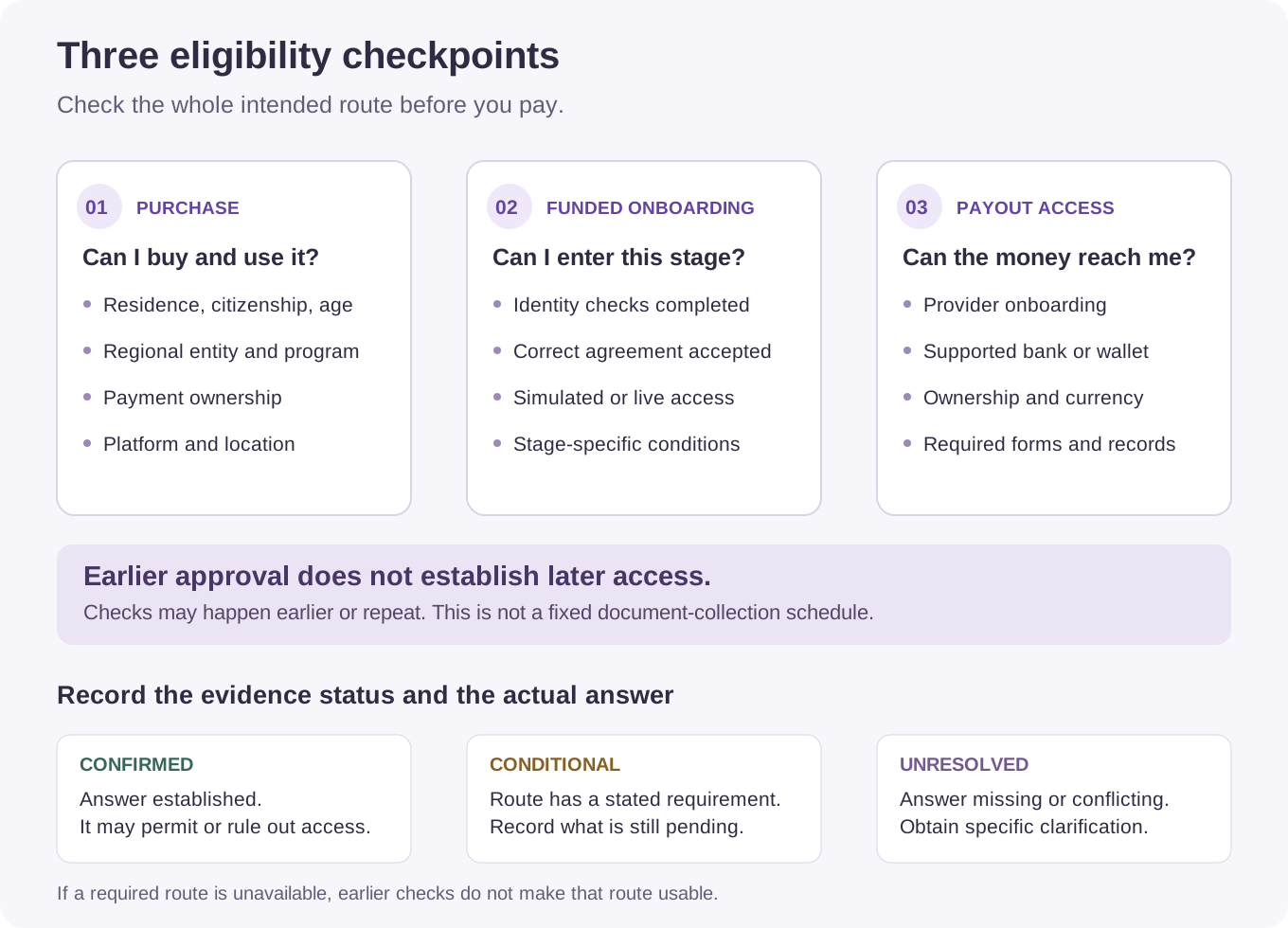
Treat these as three decision checkpoints, not a universal schedule for when firms collect documents. Some checks happen before purchase, some after an evaluation, and some are repeated. A direct-entry account may bring funded-stage checks into checkout.
Before purchase
Identify the exact market, program, stage, platform, and regional offering. Read the eligibility conditions for the path you intend to use, including the funded stage and payout route. If a necessary later check cannot be completed yet, establish its requirements now and record what remains conditional.
Confirm payment ownership as well as payment availability. For example, FundedNext's CFD payment FAQ says a cardholder's name must match the account name and that a mismatch causes order cancellation. That is a purchase condition, not confirmation of payout access. FundedNext payment methods
For costs attached to a payment route, use the full cost inventory. Keep those costs separate from the question of whether the route is available at all.
Before funded-stage activation
Check what the next agreement requires, whether identity verification is complete, and whether the incoming account has different territory or platform restrictions. Passing an evaluation does not answer those questions.
A label such as “funded” also needs a precise meaning. Record whether the incoming account is simulated or live and whether a later live transition has another eligibility check. The evaluation-to-funded transition checklist covers the trading and account changes alongside access.
Before a payout
Check the entire route: the firm, its payout provider, and your intended receiving account. Record any provider onboarding, required forms, name matching, country restrictions, and supported withdrawal method. A method accepted for buying a challenge need not be a method offered for receiving money.
Rise, which Tradeify names as its default payout provider, publishes its own restricted-country list. Its terms also require current, accurate account information and prohibit creating an account for someone else or transferring it to another person. Those are provider conditions to check alongside the prop firm's rules. Rise country coverage · Rise terms, account requirements
For a stablecoin route, also match the exact token and supported receiving network. Then establish the conversion and withdrawal steps needed to reach your intended bank currency.
Access is only one part of payout readiness. Qualifying profit, waiting periods, consistency, and approval remain separate, as explained in the payout-process guide. The payout-fee explanation covers how charges affect the amount received.
How official rules make these distinctions
These examples illustrate separate mechanisms, checked on 8 October 2026. They are not acceptance decisions for an individual reader.
The regional offering and market matter
FTMO's CFD eligibility FAQ directs clients in Australia and the United States to offerings facilitated by affiliated entities. The practical check is to identify the agreement and entity for that regional product before applying a rule from the global site. FTMO CFD eligibility
FundedNext's CFD restriction page expressly refers to both residents and citizens. Its futures page describes residence-based purchase restrictions. The shared brand does not make those statements interchangeable. The futures page also contains overlapping entries in its purchase-restricted and live-review lists, so the latter must not be treated as an independent guarantee that a listed resident may buy. FundedNext CFD restrictions · FundedNext futures restrictions
Account stage and travel are separate questions
Topstep's futures policy considers citizenship and permanent residency, with some locations eligible for Express Funded Accounts but not Live Funded Accounts. A citizen of an ineligible country who lives in an eligible one may still be able to trade: the policy asks for a government-issued photo ID proving permanent residency and a bank statement from that country, which its Trust team reviews. It also tells traders not to trade while traveling through an ineligible country and says that trading there even briefly may trigger a review. Topstep eligibility
Tradeify's restricted-country FAQ takes a different approach to travel: it describes its restriction as residence-based and permits residents of eligible countries to trade while visiting a restricted country. This does not make travel permission universal or settle the rules of another platform or provider. Read the policy for the account you actually use. Tradeify restricted-country policy
The firm and payout provider can verify you separately
Tradeify describes separate firm identity verification and payout-provider verification. Its policy places the firm check at purchase for Instant Funding and after passing for evaluation accounts, before funded activation. Crypto purchases bring that check to purchase regardless of account type. Provider verification remains another requirement before payout. Tradeify KYC and AML policy
That page's fallback wording is unresolved: it describes Rise as exclusive, also names Plane as an alternative where Rise is unavailable, and elsewhere directs readers to support to explore options. Tradeify's Risk & Compliance FAQ adds that being unable to use one provider does not establish eligibility for an alternative, and that identity verification alone does not establish geographic eligibility. If you need an alternative, obtain confirmation of the actual provider and your eligibility before relying on one. Tradeify Risk & Compliance FAQ
A payout can require a specific kind of receiving account
For US residents, FTMO Futures' eligibility FAQ requires a US tax identification number and an owned US bank account at a fully licensed and regulated bank. It excludes fintech and digital-only payment institutions for that requirement. Its payout FAQ separately requires Form W-9 before the first payout request and proof of bank-account ownership. Its general list of payout methods, which includes Wise, should therefore be read with the US bank condition. FTMO Futures eligibility · FTMO Futures payout requirements
These are the firm's stated requirements. They do not determine your tax residence, the tax treatment of a payment, or which obligations apply to you. Seek qualified advice when your own legal or tax position needs interpretation.
Worked example: the purchase succeeds, but the payout route does not
Consider a hypothetical trader, Alex, aged 34, who lives and trades in Country R and is a citizen of Country C. Alex is considering an invented CFD evaluation called Program A, followed by a simulated funded account. The firm, provider, countries, and conditions below are invented.
Assume the following:
- Program A accepts Alex's residence, citizenship, and age, and its selected platform is available in Country R.
- Alex pays with a card in Alex's legal name. The firm accepts the payment.
- Alex later passes the evaluation, completes the firm's identity check, and signs the funded-stage agreement.
- Alex satisfies the trading and amount conditions for a payout.
- Program A offers payouts only through Provider P. Provider P does not onboard residents of Country R, and no alternative provider is offered.
| Checkpoint | What happens | What it establishes |
|---|---|---|
| Purchase | The payment is accepted and the evaluation opens. | The purchase succeeded under the assumed purchase conditions. |
| Funded onboarding | The firm's identity check and agreement are completed. | Alex can enter the specified simulated funded stage. |
| Payout access | Provider P cannot onboard Alex because of residence in Country R. | The required payout route is unavailable. The earlier approvals do not resolve it. |
Checking Provider P before purchase would reveal the problem before Alex commits the fee and trading time. A different card would not change Provider P's residence condition. Another person's payout account would not establish Alex's eligibility either.
Change only one assumption: suppose the firm says an alternative provider may be available, subject to review. The result becomes conditional, not confirmed. Alex still needs the provider named, its requirements checked, and the required approval completed. If the firm cannot explain which route applies, mark the route unresolved.
This example stops at unavailable payout access. It makes no assumption about a refund, a legal entitlement to payment, or the firm's handling of an existing account. Those would require their own applicable terms and evidence.
Build your eligibility worksheet
Use one worksheet for each exact program. At the top, record the firm, market, program, platform, intended funded stage, contracting entity, and the date checked. Keep your detailed personal record private.
For every line, record an evidence status and the answer:
- Confirmed: the applicable source or required review establishes the answer. Record whether that answer permits access or rules it out.
- Conditional: the source identifies a possible route with an outstanding requirement or approval. Name the condition and who must complete it.
- Unresolved: the answer is missing, conflicting, or too broad for your circumstances. Record the exact question still open.
“Confirmed” does not mean “eligible.” A clearly unsupported territory is a confirmed negative answer. Similarly, a published verification process may be confirmed while your own verification remains pending.
| Worksheet item | Answer and evidence to record | Recheck point |
|---|---|---|
| Residence and citizenship | Both facts; the rule's basis; any regional conditions; source and check date. | Purchase, move, or policy change. |
| Age and applicant type | Required age; whether the account is personal or business; your matching circumstances. | Purchase and any entity change. |
| Contracting entity and account stage | Named entity, applicable agreement, simulated/live stage, and later-stage limits. | Purchase and each transition. |
| Identity verification | Accepted documents, expiry, address evidence, required checks, and actual approval status. | Before the required activation point. |
| Travel and platform | Permitted trading locations and the exact platform/connection for each stage. | Before travel or a platform change. |
| Purchase payment | Accepted method and relevant ownership/name conditions. | Before paying. |
| Payout provider and destination | Named provider, residence coverage, bank/wallet and currency support, account ownership, and any approved alternative. | Before purchase and before payout. |
| Provider or tax information | Stated documents, forms, or tax-ID requirements; what is submitted and what is pending. | Onboarding and when information changes. |
| Open conditions | The unresolved question, the responsible firm/provider, and the next action. | Before relying on that part of the route. |
Attach the source URL and checked date to each answer. When a support reply is needed, retain the question, your stated circumstances, the date, and the response. A general “we support your country” answer does not settle an unanswered bank, platform, or later-stage condition.
Use the platform access checklist for the detailed technical setup. For account control or third-party trading, use the automation and copying permission record. Identity verification does not grant someone else permission to operate your account.
What should you ask support before buying?
Give the firm enough context to answer the exact question. This template can be adapted without sending identity-document numbers or copies in an ordinary inquiry:
I live in [country and relevant state/territory], hold [citizenship or citizenships], and intend to trade from [location]. I am considering [market, program, platform, and account stage], purchased through [regional site/entity].
Can I purchase this program and enter the intended funded stage with these circumstances? Which identity documents and checks are required, and when?
I intend to receive payouts through [provider and method] into an account in my own name in [country and currency]. Is that route supported for this program and my residence? What separate provider approval, tax information, or account-ownership evidence is required?
If that route is unavailable, is there an alternative you can confirm for my circumstances? Please identify the applicable terms and any condition that remains pending.
Send document evidence only through the official verification channel once you have confirmed the process. If the firm's answer depends on its provider, resolve the provider's part too. Keep a conflicting or incomplete answer unresolved rather than treating a friendly reply as a waiver of another condition.
If those answers conflict with published terms, use the rule-conflict record to compare account scope, source versions, and the precise question that still needs an answer.
When should you check eligibility again?
Revisit the worksheet before a funded or live transition, before the first payout, and when you change residence, plan travel, replace documents, change legal name or applicant type, or switch a platform or payment route. Check again after a relevant notice from the firm or provider. This is a review checklist, not a claim that every change automatically makes you ineligible.
Resolve a required unavailable or unclear route before committing to a purchase that depends on it. Where verification can happen only later, record that dependency explicitly. Do not replace accurate identity or residence information with someone else's details or a different declared location.
Add the completed record to your program-comparison worksheet. It should identify the supported path you intend to use, the conditions still outstanding, and the evidence behind each answer.
Related reading
- How to compare prop firm programs, for the wider purchase decision.
- Prop firm payout rules, for eligibility, requests, approval, and receipt.
- Prop firm trading platforms, for regional access, connections, data, and tools.
- Evaluation versus funded account rules, for the account-stage transition.
Sources and method
Official pages below were checked on 8 October 2026. Examples retain their market, stage, and regional scope. Public guidance does not replace the agreement applicable to an individual account or a required identity/provider review. The worksheet, three-checkpoint framework, and Alex example are original explanatory tools. No personal eligibility application or payout was tested.
- FTMO: Who can join FTMO?, for the CFD regional offering example.
- FundedNext: restricted countries for CFDs, for residence and citizenship wording.
- FundedNext: restricted countries for futures, for purchase scope and the unresolved overlap with its live-review list.
- FundedNext: payment methods, for the CFD cardholder-name condition.
- Topstep: eligibility, for citizenship/residency, account-stage access, and travel.
- Tradeify: restricted countries, for its residence-based travel wording.
- Tradeify: KYC and AML policy, for verification timing and the unresolved alternative-provider wording.
- Tradeify: Risk & Compliance Guidelines FAQ, for its statements that one verification step or provider approval does not establish other eligibility.
- FTMO Futures: who can join, for US-specific tax-ID and bank requirements.
- FTMO Futures: withdrawing a Sim-Funded payout, for US first-payout documentation.
- Rise: supported countries and currencies, for the provider's own published restrictions. The interactive supported-country display was not used to infer acceptance.
- Rise: terms of service, for accurate account information and personal-account controls.