LearnChoosing a program
When Official Prop Firm Rules Conflict: How to Verify What Applies
When official prop firm sources disagree, match the account, rule, and effective period before deciding which statement applies. If that does not explain the difference, retain both sources and ask the firm to address the exact conflict. A newer page or a general support reply does not, by itself, establish that an existing agreement has changed.
On this page
The practical goal is a usable answer: what you may do, in which account, under which conditions, supported by which applicable record. Sometimes the answer is clear after separating two account stages. Sometimes an essential permission remains unresolved.
This guide covers CFD/FX and futures programs. Official examples were checked on 8 October 2026. The worked case is entirely hypothetical. The checking method helps establish the firm's stated position; it does not determine the legal enforceability of a term or decide a contractual dispute.
Are the sources answering the same question?
A genuine conflict remains when two statements give incompatible answers for the same relevant circumstances. Start by stating the proposed action precisely, then compare the scope of each source.
“Can I hold trades?” is too broad. “May I keep this position open through the weekly market close in my simulated funded account?” identifies an action, event, and account stage that can be checked.
| Scope field | Difference that can explain two answers |
|---|---|
| Firm and contracting entity | One brand may use different entities, regional sites, or agreements. |
| Market and program | A CFD evaluation, a futures evaluation, and a direct-entry account need not share rules. |
| Account stage | Evaluation, simulated funded, and live trading may impose different conditions. |
| Size, option, and platform | The selected tier, add-on, account type, or connection may change the answer. |
| Trader and account history | Residence, purchase cohort, reset, activation, migration, or an approved exception may matter. |
| Action and measured event | Holding versus opening a position; approval versus receipt; a daily pause versus account failure. |
| Applicable time | A general schedule, holiday notice, and later rule version may cover different periods. |
For example, FTMO's CFD holding FAQ distinguishes evaluation from the FTMO Account stage and Standard from Swing. Its Standard overnight/weekend restrictions apply at the FTMO Account stage, while the evaluation has no such restriction. Reading one statement about evaluation and another about a Standard FTMO Account does not establish a contradiction. FTMO holding FAQ
Write the distinction into your record instead of flattening it into “the firm allows weekend holding.” The evaluation-to-funded checklist helps identify conditions that need checking again when the stage changes.
Also distinguish a conflict from missing information. A page that does not mention a restriction has not necessarily stated that the activity is permitted. Likewise, two values may describe different parts of one rule, such as a base profit target and a separate consistency requirement. Read the definitions and examples before treating the numbers as alternatives.
Which official source should you use?
Start with the agreement and program documents applicable to the account, including documents they incorporate and any relevant change notices. Then use detailed official explanations and account records to understand how those requirements apply. This is a research order, not a universal legal ranking of document types.
| Source | What to use it for | What still needs checking |
|---|---|---|
| Applicable agreement and incorporated rules | Identify the stated obligations, definitions, account scope, and any conflict or amendment provisions. | Whether this is the version and entity for your account, and which later changes apply. |
| Official program policy or detailed FAQ | Understand the rule, its conditions, calculations, and exceptions. | Whether its product, stage, date, and wording match the agreement and your account. |
| Official notice or account-specific communication | Establish a stated change, temporary condition, or account-specific decision. | The effective time, affected accounts, authorization, and relationship to existing terms. |
| Checkout and account dashboard | Identify what was selected or recorded for the account. | Whether a displayed label or enabled feature establishes the permission being claimed. |
| Written support response | Clarify an identified discrepancy or direct you to the applicable document. | Whether it answers the exact question and addresses the conflicting clause. |
| Sales page or promotional summary | Identify the advertised offer and questions needing detailed verification. | Qualifications, availability, and the exact program and account stage covered. |
Preserve the sales page too. Starting with the applicable documents is not a reason to discard what was advertised or assume that advertising can never matter in a dispute. If the question becomes one of contractual rights, remedies, or enforceability, seek qualified advice for the relevant jurisdiction.
Read any stated relationship between documents rather than inventing one. Tradeify's Risk & Compliance FAQ says its guidelines supplement its agreements and policies, and that a more specific applicable rule or policy controls. That statement describes the role of those particular guidelines; it is not a universal rule that every FAQ overrides every agreement. Tradeify Risk & Compliance FAQ
Different providers may also control different requirements. A prop firm's approval does not answer every question about the payout provider's onboarding or destination support. The eligibility worksheet separates those checks.
A review, comparison table, or AI summary can help locate an issue, but does not amend a firm's rules. Use the review and payout-evidence guide to distinguish reported experiences from records that establish a particular claim. Apply the same scrutiny to PFW's explanations and their cited sources.
Does the newest page apply to an older account?
Not necessarily. A page's update date tells you when that page was changed. It does not, on its own, identify when a rule took effect or which accounts it covers.
Record the dates separately:
- Publication or update date: when the page or notice says it was issued or revised.
- Effective date and time: when the stated rule or change begins to apply, including the time zone when relevant.
- Qualifying account event: the purchase, registration, reset, activation, migration, or other event used to assign the rule.
- Action or transaction date: when the trade, request, or other activity being assessed happened.
- Checked date: when you retrieved the source. This is your research date, not the rule's effective date.
Topstep's payout policy, for example, attaches a profit-split exception to traders who joined its new dashboard before 12 January 2026. Its wording identifies joining that dashboard as the relevant event. Substituting an assumed evaluation-purchase or funded-activation date could assign the wrong treatment. Topstep payout policy
An older product can also continue into a later stage under its own rules. Apex's Legacy Products Overview states that Legacy accounts purchased before 1 March 2026 keep their Legacy rules, and that a passed Legacy Evaluation remains eligible for conversion to a Legacy Performance Account, not to one of the new Performance Accounts. A progression after that date therefore does not, by itself, bring the account under the new products' rules. Apex Legacy Products Overview
These are scoped examples of stated cohort treatment, not a promise that every firm preserves old terms. For your account, find the actual transition or amendment language. Check whether a reset or migration changes the rule set and whether a temporary offer applies to new purchases only.
If the page uses a relative label such as “updated this week,” save the retrieval date and the wording. Do not turn that label into an invented effective date. If two dated versions remain incompatible and no applicable change notice explains the difference, the date comparison has not resolved the conflict.
Build a record that someone else can check
Keep one record for one material question. Capture enough surrounding text to preserve exceptions and definitions, rather than saving two isolated numbers or sentences.
| Record field | What to retain |
|---|---|
| Exact question | The action, account, and event you need an answer for. |
| Account configuration | Entity, market, program, size, stage, platform, options, relevant location, and qualifying account dates. |
| Source A and Source B | Official URL or document name, section/clause, short relevant wording, and surrounding qualification. |
| Dates and versions | Displayed version, issue/update date, effective date if stated, and your checked date. Keep unknowns explicit. |
| Difference | The precise incompatible answers, or the scope information that is missing. |
| Supporting records | Order details, applicable agreement, official notices, and relevant account information. |
| Clarification | Your full question, ticket/reference, dated reply, and any document or exception it cites. |
| Conclusion and recheck | What is supported, what is conditional or unresolved, why, and what event would require another check. |
A saved PDF, screenshot, or text capture helps preserve what you saw. Keep the URL, capture date, visible account selection, and relevant headings with it. A capture establishes the content you retained; it does not automatically establish contractual applicability or authenticate every displayed account fact.
Keep original records when saving a corrected version. Mark your own interpretation separately from the source wording. If a page is inaccessible, record that limitation rather than filling the gap from a search snippet or an old third-party summary.
Share only what the recipient needs. Redact passwords, tokens, identity documents, payment details, and unrelated account information. Use the firm's official secure process for sensitive evidence it actually requires.
Worked example: a newer FAQ leaves a funded rule unresolved
Nora has an invented CFD Program N account: two-step evaluation, Base option, advertised $100,000 tier, and MT5. She purchased on 10 September 2026, passed the evaluation on 28 September, and accepted the simulated funded agreement on 29 September. She checks weekend holding on 6 October, before relying on that permission in the funded account.
The firm, account, documents, wording, and dates in this case are hypothetical. They are not taken from the named firms above. Assume the agreement is the applicable one for Nora's account, and no relevant amendment or exception has yet been identified.
| Record | What it says in this invented case | What it establishes |
|---|---|---|
| Sales page, retrieved 6 October; no effective date shown | Weekend holding is available. | A broad advertised feature. The statement does not identify Nora's stage and option. |
| Program N Base funded agreement, accepted 29 September | All positions must be closed before the weekly market close. | A stated restriction in the applicable funded agreement. |
| Program N FAQ, updated 5 October | Base accounts, including simulated funded accounts, may hold positions through the weekend. | A directly incompatible statement for the same stage and option; no effective date or amendment is identified. |
| Support reply, 6 October | Weekend holding is allowed during evaluation. | An answer about the earlier stage. It does not address the funded conflict. |
The sales summary lacks the detail needed to settle the question. The support reply answers a different stage. That leaves a direct conflict between the funded agreement and the FAQ. The FAQ's later update date does not tell Nora whether the agreement was changed, whether an exception applies, or whether the FAQ is wrong.
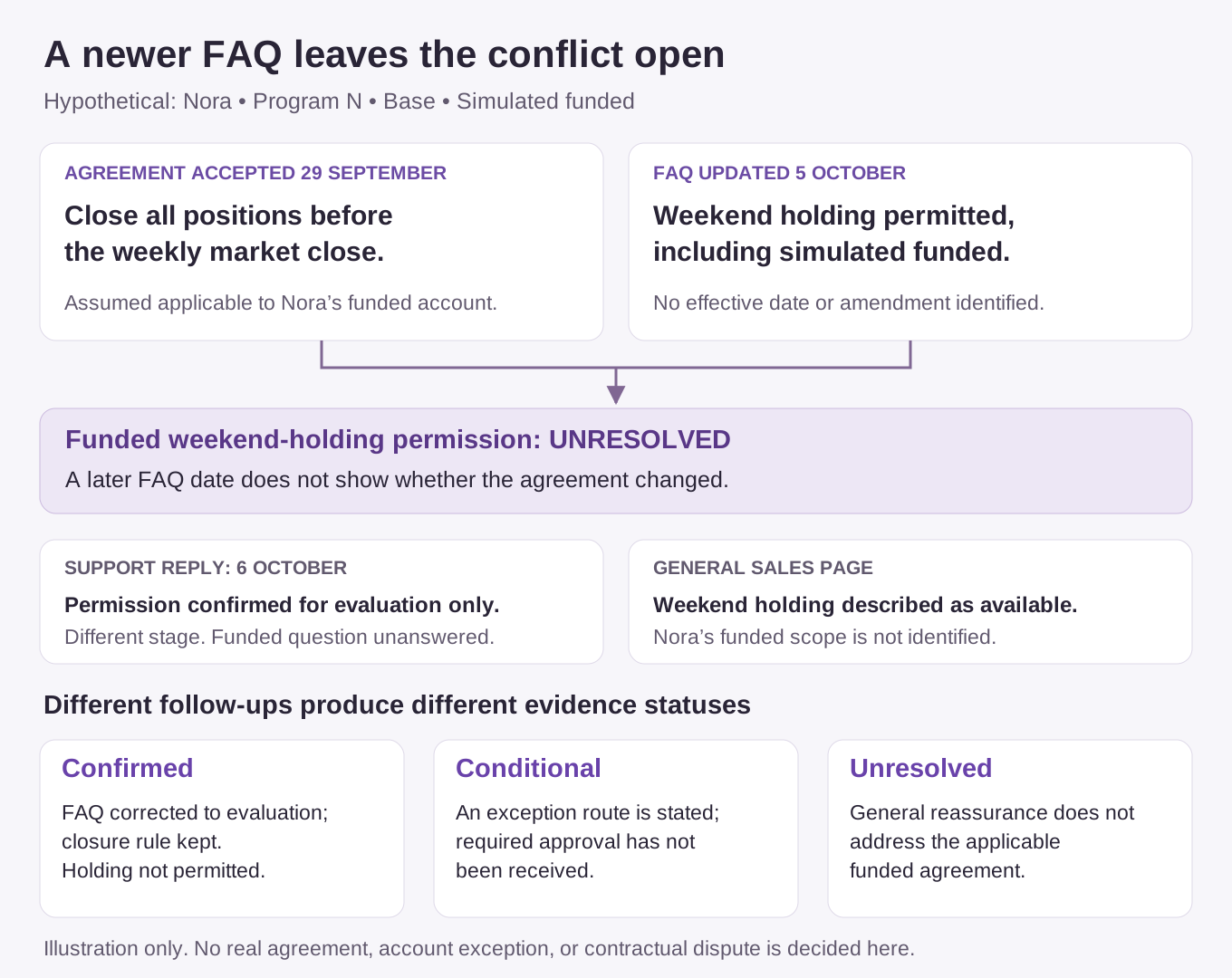
Nora records funded weekend-holding permission unresolved. She does not relabel it “allowed” or test the disputed permission with a position. The record preserves the existing restriction and asks for the precise basis of any claimed change. The holding-rule checklist covers the separate operational checks once the permission is established.
Now compare three possible follow-ups:
- A specific correction: the firm corrects the FAQ to cover evaluation only and confirms that Nora's named funded account remains subject to the agreement's closure rule, with no applicable exception. Under the example's assumptions, the record can become confirmed: weekend holding not permitted.
- A possible exception: the firm describes a written-approval process for an exception, but Nora has not received the required approval. Record conditional: exception approval pending. The condition does not yet establish permission to hold.
- General reassurance: the reply says to follow the website without addressing the dated agreement, Nora's account, or the means of changing the rule. The record remains unresolved.
A valid account-specific amendment could be another route to resolution, but its scope, authority, conditions, and effective time would need checking. Do not invent such an amendment merely to reconcile the sources. This example makes no finding about a real trader's legal rights or the outcome of a dispute.
What should you ask support?
Send one focused question with both sources and the account facts that could change the answer. Describe the activity accurately, including any third-party tool or person involved. The automation and copying permission record shows the additional details needed for an account-connection question.
You can adapt this template:
I am checking [specific action] for [entity, market, program, size, option, platform, and account stage]. My relevant purchase/activation/reset dates are [dates]. My account reference is [reference, supplied through the official support channel].
Source A is [URL or document, version, section, and date]. It states [short relevant wording]. Source B is [URL or document, section, and date]. It states [short relevant wording]. Both appear to cover [the same circumstance].
Which requirement applies to this account for [action and date]? Please explain whether the difference is an account-scope distinction, a correction, an amendment, or an exception, and identify the supporting document or notice.
If the rule changed, what is its effective date/time and which existing accounts are affected? If approval is required, what remains pending and when would that approval take effect?
Ask for the conflict to be reviewed by the team responsible for that policy when a general support response cannot resolve it. Keep the ticket and full response with the original question. A reply can only be assessed properly alongside the facts the firm was given.
Separate an explanation from an exception. “That clause concerns evaluation” explains scope if the document supports it. “We may approve your setup” describes a possibility. “Your specified account is approved for this action from this time under this recorded exception” is a more specific record, but it still needs to satisfy any applicable authorization or amendment requirements.
Do not assume that an automated chat answer, a moderator's comment, or repeated reassurance overrides another document. Equally, do not dismiss a formal account-specific decision just because it arrived by email. Its content, authority, applicability, and relationship to the account documents are what need checking.
What counts as resolved?
Keep the evidence status separate from the practical answer. A fully supported answer may be “not permitted.” A favorable answer may still have an outstanding condition.
| Status | When to use it | What the record should say |
|---|---|---|
| Confirmed | Applicable evidence answers the question and explains the material discrepancy. | The answer, account scope, source, effective period, and why the other wording no longer conflicts. |
| Conditional | A documented route depends on an unmet requirement, approval, or future effective date. | The exact condition, who must satisfy it, and the permission that has not yet become available. |
| Unresolved | The wording remains incompatible, necessary evidence is missing, or the reply does not address the applicable account. | Both statements, the missing fact, and the specific question still open. |
The open rows in our six-account evidence study show why missing information, conflicting sources and an interpretation need separate labels. The study preserves those states as of its data release; current account pages may reflect later clarification.
Do not average conflicting numerical limits or combine the most favorable parts of different rule sets. “Use the stricter number” is not a general reconciliation method either: two numbers can use different bases, clocks, or consequences. You need a coherent applicable rule before calculating the result.
Before buying, leave a purchase that depends on an essential unresolved permission undecided. For an existing account, identify the known restrictions and relevant deadlines while seeking clarification. An unanswered question does not establish permission to test a disputed activity, suspend other obligations, or ignore an approaching deadline.
If the disagreement concerns an existing breach, denied payment, or claimed contractual entitlement, keep the event records as well as the rule sources. A checking worksheet cannot adjudicate that dispute or replace any formal complaint process and applicable time limits.
When should you revisit or report the discrepancy?
Recheck after a relevant official notice, new agreement, reset, stage transition, account migration, platform change, or approved exception. Review a temporary condition again before its expiry. Update the answer and its evidence together, while preserving the earlier version for the period it described.
For a purchase decision, add the result to the program-comparison worksheet. Record a source-check date separately from a rule's effective date and your account's qualifying date.
If a PFW explanation or comparison appears inconsistent with an official source, report the discrepancy to help@propfirmwiz.com. Include the PFW page, exact configuration, official URLs or document references, relevant wording and dates, and the question you think needs correction. Avoid sending credentials or identity documents. A useful report identifies the difference without assuming which side is correct.
Related reading
- How to compare prop firm programs, for keeping unresolved answers visible in a comparison.
- Country restrictions, KYC, and payout access, for eligibility questions that depend on the firm and its providers.
- How to read prop firm reviews and payout claims, for separating reported experiences from documented events.
Sources and method
The official sources below were checked on 8 October 2026. They illustrate specific differences in scope, account history, and document roles. They are not presented as examples of wrongdoing or as a universal order of legal precedence. The conflict record, response template, status framework, and Nora case are original educational explanations. No private agreement, actual support ticket, or individual dispute was adjudicated.
- FTMO: Do I have to close my positions overnight or before the weekend?, for the CFD distinction between evaluation and FTMO Account stages and between Standard and Swing.
- Tradeify: Risk & Compliance Guidelines FAQ, for its stated relationship between those guidelines, applicable agreements, and more specific rules or policies.
- Topstep: Payout Policy, for the profit-split cohort defined by joining the new dashboard before 12 January 2026. Other payout conditions remain separate.
- Apex Trader Funding: Legacy Products Overview, for the stated treatment of existing pre-1 March 2026 Legacy accounts and their progression into Legacy Performance Accounts. This article does not determine current availability of new Legacy purchases.