LearnFees and costs
The Full Cost of a Prop Firm Challenge
The full cost of a prop firm challenge can include the entry fee, subscription renewals, resets, funded-account activation, and any data or platform charges. Trading costs and payout deductions also affect the result, but they belong in separate records. A conditional fee refund reduces your cash cost only when the money is actually returned.
On this page
To compare two offers, calculate spending through the same endpoint, such as funded-account activation or the end of the first funded billing period. Then check the trading rules attached to each price. A lower entry fee alone does not tell you which offer will cost less along your actual path.
This guide covers selected CFD/FX and futures examples, with official sources checked on 30 September 2026. All worked amounts are hypothetical USD figures. They illustrate fee structures, not current firm prices or likely trader outcomes.
Which costs belong in the comparison?
Keep three records: cash fees you pay from outside the trading account, charges within the account, and deductions from a payout. This makes it possible to see both what you must fund yourself and what reduces the eventual result without counting the same charge twice.
The challenge fee buys access under the program's terms. It is not the advertised trading balance, and a simulated account loss is not automatically an additional payment from your bank account. The challenge-lifecycle guide explains what the purchase provides.
Use this inventory for the exact program and account stage:
| When it can arise | Cost to check | What makes it payable? |
|---|---|---|
| Purchase | Evaluation or direct-entry fee | The selected program, tier, platform, and options |
| Continued evaluation | Subscription renewal | An active subscription reaching its next billing date |
| Another attempt | Reset or replacement-account fee | Choosing and qualifying for another attempt; an included reset credit may apply |
| After passing | Funded-account activation | The fee path selected at purchase and the account being activated |
| Continued funded trading | Account subscription, if present | The funded-stage billing terms, which may differ from evaluation |
| Platform access | Platform license, connection, or service charge | The selected platform and whether access is included at that stage |
| Market access | Exchange or market-data charge | The data package, exchanges, professional status, and billing calendar |
| Optional support | Charting tools, journal, VPS, or other services | Your own selection and the service's separate renewal terms |
| Buying or receiving money | Applicable checkout taxes, payment fees, and currency conversion | Your location, payment method, billing currency, and provider's actual charges |
| Trading and payout | Commissions, financing, execution effects, and transfer deductions | Trading activity and the account or payment method; record where each amount is charged |
For every line, distinguish required, conditional, and optional. Separately mark whether the amount is verified, included at no extra charge, not applicable, or unknown. A fee can be required but still unknown; leaving it blank should not turn it into zero.
Costs can change at a stage transition. For example, Topstep's Live Funded Account cost guide addresses professional exchange data, brokerage trading costs, and platform licensing. That is a separate cost check from buying a Trading Combine or activating an Express Funded Account. Live Funded Account costs
For platform and market-data charges, use the setup and data-fee guide to check what is included, which connection supplies it, and whether the billing period changes the amount payable.
Does a one-time fee or a failed challenge stop future charges?
A one-time fee describes that payment. A subscription follows its own cancellation rules. Check what the original payment covers and which later events can create another charge.
For FTMO's CFD 2-Step, the one-time evaluation fee covers both the Challenge and Verification, with no recurring evaluation fee. That does not turn a separate future purchase into part of the original payment. FTMO fee explanation
For Topstep's futures Trading Combine, the subscription rebills every 30 days until the relevant account passes or is canceled. Breaching max loss does not automatically cancel billing. Passing closes that account's subscription, while other active Combines can continue to renew. Trading Combine subscriptions
The difference matters when counting costs. “Three paid billing periods” means the initial charge and two renewals. It does not mean three renewals on top of the first payment. A 30-day cycle also need not land on the same calendar date every month.
A reset can change the billing calendar
Check whether a paid reset, an included reset credit, and a new purchase have different effects. Record the new billing date as well as the reset price.
Topstep's Trading Combine reset documentation says a reset moves the rebill date out by 30 days. It also describes reset credits issued with renewals and restrictions on their use. These credits provide a reset on an eligible active subscription; they are a service entitlement, not cash, an addition to trading equity, or credit toward buying a new Trading Combine. A model that simply adds a paid reset while retaining every old renewal date can therefore count charges that do not occur on that schedule. What is a Reset?
An evaluation reset and reactivation of a lost funded account are also different products. Do not use one price as a substitute for the other. For a failed account, confirm both whether the next attempt is valid and whether the old billing arrangement is still active.
Passing can create a new payment obligation
Topstep's Express Funded Account activation depends on the Trading Combine path selected: the Standard path has an activation charge, while the No Activation Fee path does not. The relevant comparison includes the evaluation payments and the activation terms together. XFA activation
Do not assume that every CFD/FX program uses a one-time fee or that every futures program uses a subscription. Read the selected offer's billing structure.
How do you compare a one-time fee with a monthly subscription?
Choose an endpoint and vary the number of paid periods. Do not assume a passing time or present one path as the expected cost without evidence.
Consider two hypothetical offers, compared through funded-account activation:
- Offer A: a $360 one-time evaluation fee, with activation included.
- Offer B: $79 per evaluation billing period, followed by $129 for activation after passing.
Assume one evaluation purchase under each offer, no failed attempt or reset, no promotion or reimbursement, and no additional cash fee through activation. Amounts include any applicable purchase taxes. Offer A remains valid through the modeled periods; Offer B stops renewing once passed. Each row assumes passing after that many paid periods. Other trading and payout terms are outside this price-only comparison.
| Paid evaluation periods before passing | Offer A: cash paid through activation | Offer B: cash paid through activation |
|---|---|---|
| 1 | $360 | $79 + $129 = $208 |
| 2 | $360 | 2 × $79 + $129 = $287 |
| 3 | $360 | 3 × $79 + $129 = $366 |
| 6 | $360 | 6 × $79 + $129 = $603 |
Offer B costs less through activation in the first two rows. By the third paid period, it costs $6 more than A. Six paid periods include the first charge and five renewals.
Offer B cost through activation = $79 × paid periods + $129
This is a conditional cost comparison, not a claim that either offer is easier to pass. If the account never passes, there is no activation fee in this model, but the evaluation payments already made remain expenses. If a failed attempt requires a new purchase, extend the record to include it.
The three dated billing scenarios retain these hypothetical prices and demonstrate an alternative reset rule that moves the next renewal date.
For a dated application to named accounts, the study of costs at different completion dates counts entry payments, renewals and required funded-stage fees across a successful attempt.
A meaningful product comparison must also consider what the payments buy. The account-size and loss-allowance guide shows why equal advertised balances can provide different room for losses. The worked program comparison shows how a cheaper offer can fail an essential trading requirement.
Worked example: how does a $79 entry price become $455 paid?
Now extend hypothetical Offer B into a separate path. The trader pays for three evaluation periods, purchases one $49 reset after a failed attempt, passes, and pays $129 to activate the funded account. The reset starts a new valid attempt. In this invented program, it does not move the renewal dates and no free reset credit applies.
The trader then buys one optional $30 data period. Separate payment and currency-conversion charges across the purchases total $10. These are the complete external cash charges through the end of the first funded billing period in this model. All amounts are USD equivalents, applicable purchase taxes are already included, and there are no refunds or payouts by that endpoint.
| Cost item | Cash charge | Running subtotal |
|---|---|---|
| Initial evaluation payment | $79 | $79 |
| First renewal | $79 | $158 |
| Paid reset starts a new attempt | $49 | $207 |
| Second renewal | $79 | $286 |
| Funded-account activation | $129 | $415 |
| One optional data period | $30 | $445 |
| Separate payment/FX charges, grouped for reporting | $10 | $455 |
Cash fees = 3 × $79 + $49 + $129 + $30 + $10 = $455
The payment/FX row groups charges that arose alongside earlier payments; it is not an additional billing event after the data purchase. The ledger's final total is unchanged by when those charges were collected.
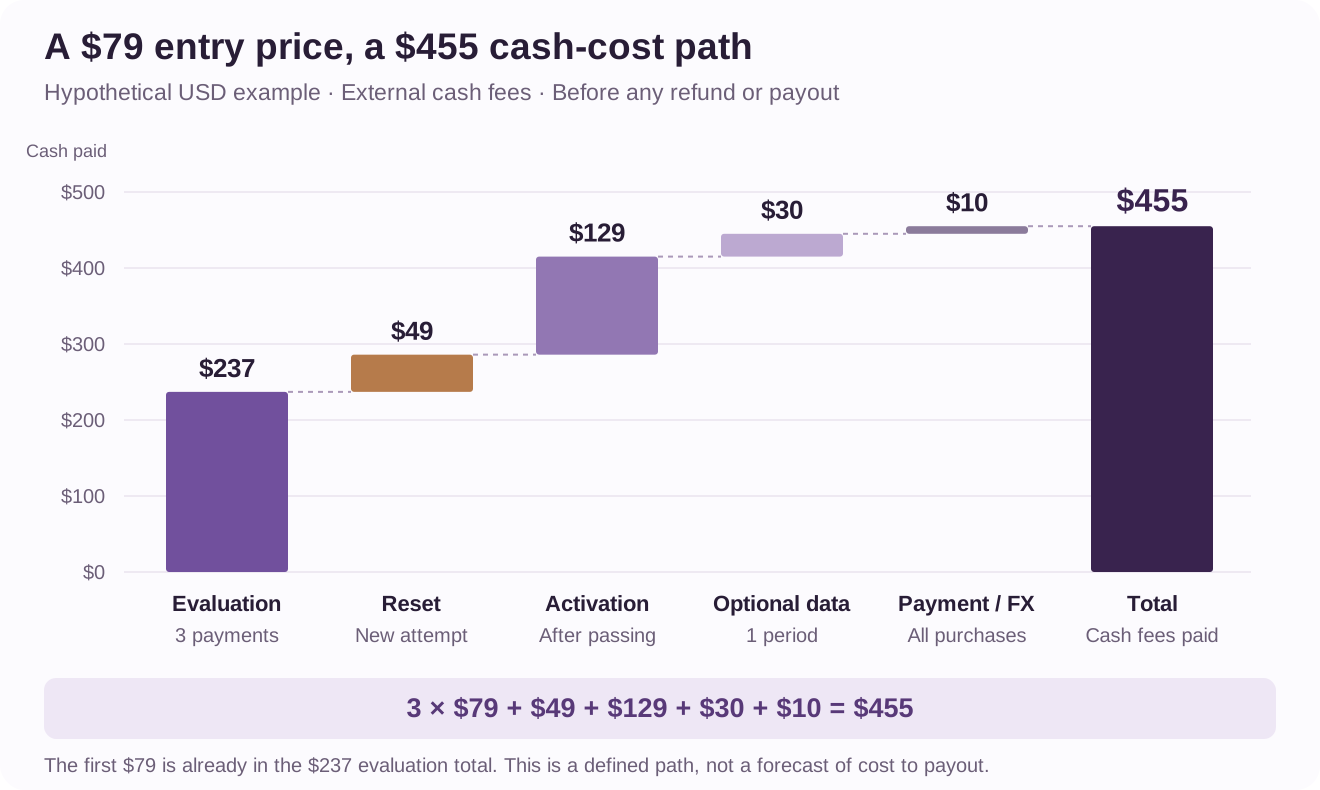
There are two useful totals here: $415 in program charges through activation, before the separately reported payment/FX costs, and $455 in all external cash fees through the chosen funded-period endpoint. Neither is the cost of a single advertised $79 purchase.
If another data period is charged before the first payout, add it. If a further reset or new account is purchased, add that payment too. Use the stop, reset, or replacement budget to compare the next attempt and reserve any activation payment. The cost record should follow actual events or clearly stated scenarios, rather than stopping when the original entry fee has been counted.
Where do trading costs and payout deductions fit?
Trading-account charges affect performance and loss room even when they do not create a separate card payment. Keep them visible without combining them indiscriminately with the cash-fee ledger.
| Record | Examples | How to avoid double counting |
|---|---|---|
| External cash fees | Purchases, renewals, paid resets, activation, separately billed data, bank or card charges | Count the actual debit once; include taxes and conversion charges only where they are not already part of that debit |
| Trading-account results | Commissions, exchange and regulatory charges, swaps or financing; spread and execution effects within P&L | Establish whether the displayed result is gross or net and where each charge is recorded |
| Payout statement | Transfer, provider, or conversion fees withheld from the payment | Reconcile the gross amount and actual receipt; do not subtract a withheld fee again from an already-net receipt |
For example, TopstepX's commission schedule distinguishes per-side charges from a round turn covering entry and exit. A quoted per-side amount should not be mistaken for the full cost of a completed trade. Rates also depend on the instrument and applicable schedule. TopstepX commissions and fees
In CFD/FX accounts, check commission timing and any overnight financing. Financing can be a charge or positive swap, and a spread already reflected in the marked or realized P&L should not be deducted again. The worked order-to-fill example separates the quote-side spread effect, slippage against each order's reference and the commission that is charged separately. The balance-and-equity guide explains how to reconcile these entries.
This distinction is especially important during simulated trading: a simulated commission reduces that account's result, but it is not automatically a matching withdrawal from your personal bank account. When assessing a real cash outcome, trace the payments and receipts that actually occurred. Do not subtract an account's entire simulated loss as if you personally deposited that amount.
The firm's retained profit share also affects what you receive. Record it alongside payout conditions, while keeping it separate from the purchase-fee total. A positive funded-account result does not mean that a payout is available or has arrived; the payout-process guide follows those separate milestones.
For the deductions between an approved request and the trader's receipt, see how payout processing fees enter the withdrawal calculation.
Data, platform access, and add-ons need their own clock
Check whether a data package is included, optional for your use, or required for a particular platform or market. A calendar-month charge may be payable in full even if access starts partway through the month.
For the Trading Combine and Express Funded Account, Topstep's pricing page distinguishes included Level 1 data from a paid Level 2 package and states that the latter is not prorated. Its Live Funded Account has a separate professional-data policy. Do not carry one stage's included services into another stage's budget without checking. Pricing and data information
For your own tools, record whether billing is per user, account, platform, or exchange. Include a VPS, journal, or charting subscription only if you choose or need it for the scenario. Optional services should be visible without being presented as fees every trader must pay.
When does a fee refund reduce the cost?
Show the original spending first, then record any recovery with its condition, form, and receipt date. A fee described as refundable can remain a cash expense throughout evaluation and funded trading until the refund conditions are met and payment is received.
FTMO's CFD refund FAQ distinguishes its products: the 1-Step entry fee is not refunded, while the 2-Step entry fee may be refunded with the first reward withdrawal, using the original payment method. Passing alone is therefore not the refund event for that 2-Step arrangement. Record the reimbursement as a cash recovery when it reaches that payment method. Entry-fee refund policy
Cash received, a refund added to trading-account equity, and purchase credit have different effects. Record the form actually provided:
| Form of return | Effect on the cost record |
|---|---|
| Cash reimbursement received | Reduces the net cash fees for the purchases it reimburses |
| Refund added to trading-account equity | Changes the account state; record separately until an allowed withdrawal actually returns cash |
| Purchase credit, such as Store or Hub credit | May reduce a later checkout payment when redeemed; it does not repay the original cash expense |
| Conditional refund not yet received | Show as a possible future recovery, with no reduction to cash already spent |
For The5ers' High Stakes, the policy distinguishes a refundable portion added to funded-account equity from nonwithdrawable Hub Credits usable toward another challenge. The refund calculation also distinguishes external payments from amounts paid with Hub Credit. This makes the payment method and form of return part of the cost calculation. High Stakes payout and Hub Credit policy
The policy's statement that a refund increases equity does not, by itself, identify the platform posting field. See account credit and its effect on equity for the MT5 distinction.
A simple refund calculation
In a separate hypothetical example, a trader pays a $300 evaluation fee and $40 for an optional service. The program later returns the full $300 evaluation fee in cash. The service payment is not refundable, and there are no other charges.
Cash paid before reimbursement = $300 + $40 = $340
Net cash fees after reimbursement is received = $340 − $300 = $40
Before receipt, the cash outlay is still $340. If the $300 instead arrives as purchase credit, the original $340 has not been returned in cash. Do not subtract the credit from the first purchase and then also count the reduced payment on a later purchase as a second saving.
A cancellation refund is a different question from a reimbursement earned after meeting trading and payout conditions. Read the applicable cancellation policy separately; one promise does not confirm the other.
Check what a discount actually changes
Record the checkout price, the normal renewal price, and whether a code applies to the first payment, later renewals, resets, or activation. Topstep's pricing guidance, for example, says promotional pricing applies to the first month unless stated otherwise. It also describes a separate recurring discount linked to selecting a daily loss limit. Those are different offers. Pricing and promotion terms
If a discount changes an account rule, compare both the price and that condition. The daily-loss guide explains why the amount, calculation, reset, and consequence all matter.
Build the cost record before choosing a program
Use the official terms and checkout for the exact market, program, size, stage, platform, selected options, and purchase cohort. A firm's lowest advertised price may describe a different configuration.
| Field | What to record |
|---|---|
| Endpoint | Purchase, funded activation, a specified funded period, or an actual payout receipt |
| First payment | Discounted price, currency, taxes included or added, and the final amount debited |
| Renewal | Normal price, billing interval, next charge date, and the event that stops billing |
| Repeat attempts | Reset/new-purchase price, included credits, what restarts, and any change to the billing date |
| Funded stage | Activation, reactivation, recurring charges, and what differs from evaluation |
| Services | Included and paid data/platform access; optional tools; number of chargeable periods |
| Trading and payout | Where commissions, financing, and payment deductions appear; gross or net presentation |
| Refund or credit | Which payment qualifies, percentage basis, conditions, cash or credit, and actual receipt |
| Evidence and uncertainty | Official URLs, checked date, saved checkout terms, and unresolved amounts |
Build at least a short and a longer payment scenario. Include a no-payout outcome so a conditional reimbursement is not doing the work of an assured refund. If using past account records, include failed attempts and abandoned subscriptions rather than reporting only the fee on the successful account.
These totals show spending under stated conditions. They do not predict a pass rate or profitability, or show that one program is better merely because its modeled fees are lower.
Next step: fill in the checklist for one exact offer, count the payments through your chosen endpoint, and keep possible refunds on a separate line until they are received. Then use the before-you-pay comparison checklist to compare that cost with the loss limits, trading permissions, and payout conditions you would be accepting.
Sources and method
Official sources were checked on 30 September 2026. Named examples are limited to the products and stages identified in the text. The numerical comparisons and cost ledger are hypothetical and independently recomputed; they are not firm price quotes, observed trader results, or forecasts of the number of attempts needed.
- FTMO CFD: one-time fees and entry-fee refunds.
- Topstep futures: subscriptions, resets, XFA activation, pricing and data, TopstepX trading charges, and Live Funded Account costs.
- The5ers High Stakes: payout and Hub Credit policy.
The checkout and terms attached to the specific purchase are the inputs to a personal cost record. Recheck them when the program, options, or purchase date changes.
The FTMO 2-Step refund method and Topstep reset-credit entitlement were rechecked on 1 October 2026. Other source checks retain the date above.