LearnPayout conditions
Profit Splits, Payout Caps, and Retained Buffers: Calculating a Withdrawal
The profit split tells you how an eligible amount is shared; it does not tell you how much profit you can access in a payout cycle. A withdrawal limit, required retained balance, dollar cap, or processing fee can reduce the cash received. The calculation order determines how those conditions combine.
On this page
Keep three amounts separate: the request approved by the firm, the amount deducted from the trading account, and the cash delivered to the trader. A dashboard can use “payout” for more than one of them.
This guide covers payout arithmetic for retail CFD/FX and futures prop programs. Named examples were checked on 3 October 2026. The main worked example is hypothetical. It assumes all eligibility conditions have been met; the payout-process guide explains the stages from eligibility through receipt.
Which initial profit share applies to your account?
A profit split allocates a defined profit or withdrawal amount between the trader and the firm. At a 90% trader share, an eligible $1,000 allocation gives the trader $900 before any separately deducted fees. The other $100 is the firm's share.
Use the rate that applies to the account now. An advertised maximum may require scaling, a paid option, a particular program, or an earlier purchase date. Record both the starting rate and the event that changes it.
For example, FTMO's CFD/FX reward FAQ distinguishes its 1-Step route's 90% share from its 2-Step route's initial 80%, which can rise to 90% under Scaling Plan or Premium Programme conditions. Those are different starting entitlements. FTMO reward FAQ
Topstep also distinguishes cohorts: traders who joined its new dashboard before 12 January 2026 receive 100% of their first $10,000 in lifetime profits before the usual 90/10 split; Legacy dashboard payouts do not count toward that allowance. Do not apply that historical provision to every new account. Topstep Payout Policy
When a rate changes at a threshold, check whether the threshold is per account or per trader, whether it measures gross profit or paid rewards, and how a withdrawal crossing it is divided. A headline percentage cannot answer those questions.
How can a 90% profit split provide access to only 45% of profit?
Consider a hypothetical account with $4,000 of eligible net profit. Its rule allows a gross request of at most 50% of that profit, then pays the trader 90% of the approved request. Assume no retained-buffer requirement, additional dollar cap, fees, or other adjustments, and that the maximum request is approved.
| Step | Calculation | Result |
|---|---|---|
| Maximum gross request | $4,000 × 50% | $2,000 |
| Trader's share | $2,000 × 90% | $1,800 |
| Cash as a fraction of the starting profit | $1,800 ÷ $4,000 | 45% |
90% × 50% = 45% of this profit base accessible in this cycle, before other deductions. The contractual profit split is still 90%. The 50% restriction limits the amount to which that split applies.
If the full $2,000 request is debited from the account, $2,000 remains there and $200 goes to the firm. The retained amount has not become an extra firm fee. It also is not guaranteed future cash: later eligibility, trading results, account closure, transition, and lifetime-payout conditions still matter.
This 45% figure is specific to the declared bases and order. It is neither a new contractual split nor a lifetime return estimate.
What does a payout cap limit?
A cap is an upper bound. It can restrict a percentage of a balance, a fixed amount per request, or a total across a longer period. Identify the object being capped before entering a number into a calculator.
| Rule wording to resolve | Question that changes the calculation |
|---|---|
| Percentage withdrawal limit | Percentage of total accumulated profit, current-cycle profit, account balance, or profit above a retained level? |
| Maximum payout per request | Gross requested amount or the trader's share after the split? |
| Cycle, monthly, or lifetime cap | When does the allowance reset, and does it cover one account or the trader's accounts together? |
| First-payout or staged cap | Which payout number applies, and what unlocks the next limit? |
For Topstep's futures $50K XFA Standard path without the enhanced DLL cap, the policy limits a request to the lower of 50% of account balance and $2,000. Other sizes, paths, and qualifying checkout options have different dollar caps. Topstep Payout Policy
The nominal account label is not automatically the percentage base. A “$50K” label does not mean that a 50% rule allows a $25,000 request. Use the account value defined in the payout rule.
A maximum also does not remove a minimum. If the rules permit at most $180 but require a gross request of at least $250, there is no valid request at that snapshot. “At least $250” includes exactly $250; a rule requiring more than that amount does not.
How does a required retained buffer affect the request?
A payout buffer can require part of the account value to remain after a withdrawal. First establish whether the quoted number is an absolute account-balance level or an amount of profit to retain.
In a hypothetical account starting at $100,000, retaining $2,000 of profit means leaving a balance of at least $102,000, assuming no other account adjustments. If current balance is $108,000, the amount above that level is $6,000. Other caps and eligibility rules can reduce the request further.
FundedNext Futures illustrates an absolute level: its $50K Rapid Daily FundedNext Account lists a $52,100 payout buffer, with requests restricted to profit above it. The policy also imposes cycle-profit and withdrawal conditions. Rapid Daily eligibility rules
Its reward-share example starts with $3,000 growth on that account. A $900 withdrawal reduces the balance from $53,000 to $52,100, while the trader's 90% reward is $810 before any separate payment charges. FundedNext reward-share example
The example exposes the distinction: $900 leaves the account, but the trader receives a smaller share. It also shows why a payout-retention level should not be treated as the account's breach threshold. The remaining distance to a loss threshold is a separate calculation.
Worked withdrawal: how does $8,000 of profit become $2,225 in cash?
The following hypothetical contract deliberately combines a buffer, percentage limit, dollar cap, split, and fee. It is not the rule set of any named firm.
Assume a USD account starting at $100,000 has $8,000 in realized, credited net trading profit, giving a pre-withdrawal balance of $108,000. Trading charges are already deducted. All positions are closed, all eligibility and account-compliance conditions are satisfied, and no additional trading or adjustments occur during processing. There are no prior withdrawals, credits, deposits, refunds, taxes, currency conversion, or external charges in the model.
The invented rule requires $2,000 of profit to remain, then allows 50% of the profit above that retained amount, subject to a $2,500 gross cap per request. The minimum gross request is $250, including equality. The trader receives 90% of the approved request, with a $25 fee deducted afterward. The account is debited by the full gross approved request, with no further account adjustment. The trader requests the maximum, and that amount is approved and paid.
| Step | Calculation | Result and meaning |
|---|---|---|
| 1. Start with net profit | $108,000 − $100,000 | $8,000 profit, with trading charges already included |
| 2. Retain the required amount | $8,000 − $2,000 | $6,000 above the retained-profit requirement |
| 3. Apply the percentage limit | $6,000 × 50% | $3,000 before the dollar cap |
| 4. Apply the gross dollar cap | Lower of $3,000 and $2,500 | $2,500 maximum request; it exceeds the $250 minimum |
| 5. Apply the trader's split | $2,500 × 90% | $2,250 trader share; $250 firm share |
| 6. Deduct the processing fee | $2,250 − $25 | $2,225 cash received |
| 7. Record the account debit | $108,000 − $2,500 | $105,500 remaining balance |
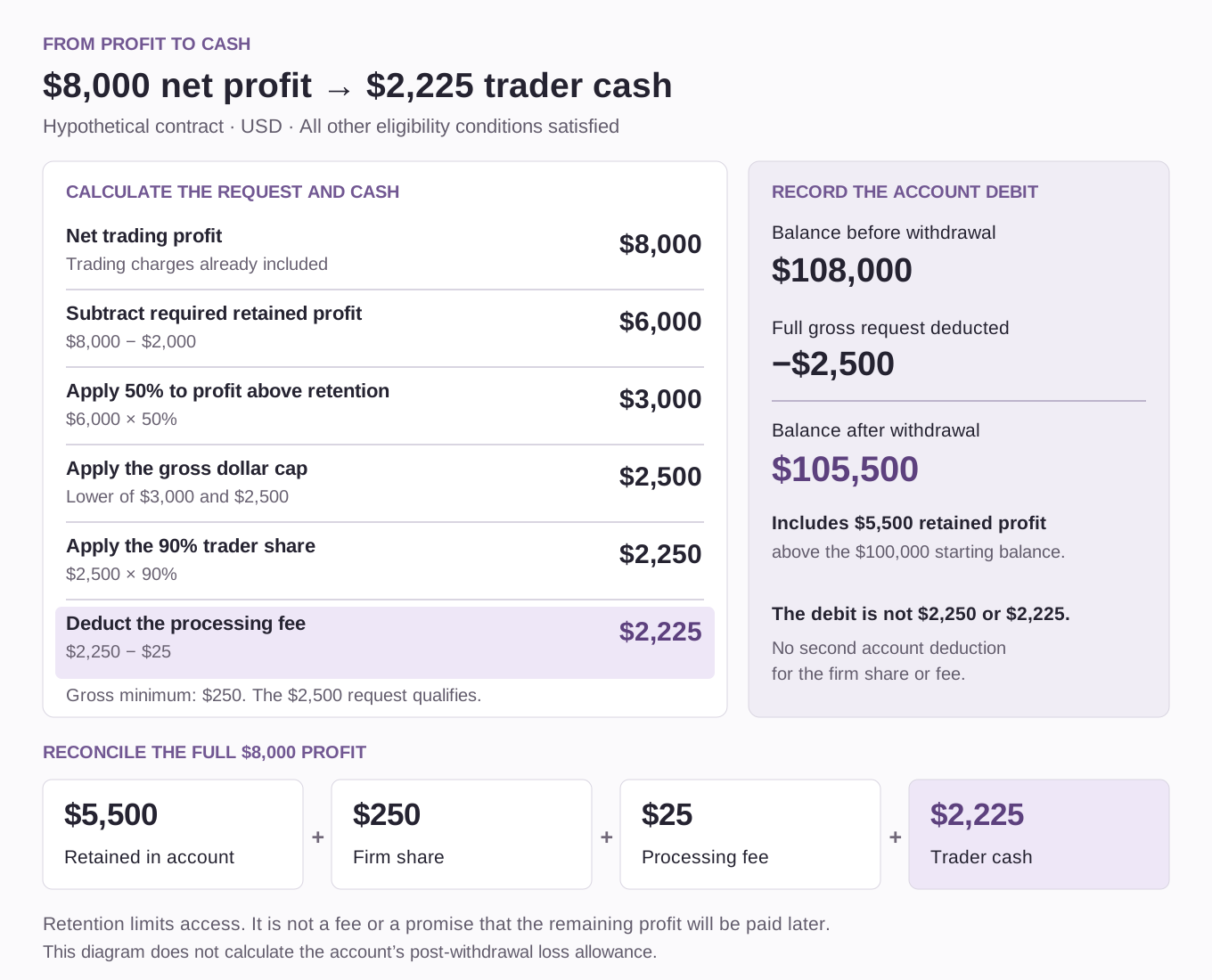
The complete reconciliation is:
$8,000 original profit = $5,500 retained profit + $250 firm share + $25 fee + $2,225 trader cash.
Only $2,000 was explicitly required as retained profit. The other limits leave an additional $3,500 in the account at this withdrawal. That remaining amount is not a processing charge or a realized trading loss.
For this contract only, let P be net profit, R required retained profit, w the withdrawal percentage, C the gross dollar cap, M the gross minimum, s the trader share, and f the fee deducted from that share:
- Amount above retention:
A = max(P − R, 0). - Maximum gross request:
Qmax = min(w × A, C). - A valid chosen request must satisfy
M ≤ Q ≤ Qmax. IfQmax < M, no request qualifies. - Trader cash:
s × Q − f, provided the fee and payment-method conditions permit that transfer. - Account debit:
Q, because this example explicitly defines it that way.
Do not reuse this formula unchanged for a program that applies its percentage to another base, caps the net reward, or handles the account debit differently.
Varying only net profit. Keep the hypothetical contract above unchanged and vary profit from $0 to $12,000 in $250 steps. Each amount is a separate pre-withdrawal snapshot. If the arithmetic maximum request is below the $250 minimum, no payout is processed: the account has no debit and the split and processing fee are not applied. At $7,000 profit, the percentage limit and dollar cap both allow $2,500; above that point, the dollar cap limits the request.
| Net profit | Arithmetic maximum gross request | Cash received in the model | Balance after the modeled outcome |
|---|---|---|---|
| $2,250 | $125, below the minimum | No payout processed | $102,250 |
| $2,500 | $250 | $200 | $102,250 |
| $7,000 | $2,500 | $2,225 | $104,500 |
| $8,000 | $2,500 | $2,225 | $105,500 |
| $10,000 | $2,500 | $2,225 | $107,500 |
The balance column uses the full approved gross request as the debit. It does not measure the remaining loss buffer; that also requires the account's post-payout loss threshold.
Follow profit through the withdrawal calculation
- Net profit$8,000
- Above the $2,000 retained$6,000
- 50% of that$3,000
- Maximum gross request, after the $2,500 cap: the $2,500 cap sets it$2,500
- $250 minimum requestMet
- Trader share, 90% of the approved request$2,250
- Processing fee−$25
- Account debit
- $2,500
- Trader cash
- $2,225
- Balance after
- $105,500
- Profit kept in the account
- $5,500
- Firm share
- $250
The request meets the modeled minimum
$8,000 profit = $5,500 kept in the account + $250 firm share + $25 fee + $2,225 trader cash.
A request below the minimum is not processed: no debit, split, or payout fee is applied. These calculations do not establish an actual account's payout eligibility.
Why does calculation order change the answer?
The same percentages and caps can produce different amounts when they attach to different stages. These are hypothetical comparisons, with all other conditions satisfied. They are not alternative ways to interpret an ambiguous contract.
| Inputs | Rule A | Rule B |
|---|---|---|
| $8,000 profit, $2,000 retention, 50% limit; no dollar cap | Apply 50% after retention: 50% × ($8,000 − $2,000) = $3,000 gross request | Apply 50% to total profit, then preserve retention: lower of $4,000 and $6,000 = $4,000 gross request |
| $4,000 eligible allocation, 90% split, $2,000 cap; no fees or other limits | Cap the gross request first: 90% × $2,000 = $1,800 trader cash | Cap the trader's share: lower of $3,600 and $2,000 = $2,000 trader cash |
| $1,000 gross request, 90% split, $25 fee; no other charges | Deduct fee from trader share: $900 − $25 = $875 trader cash | Deduct fee before sharing: 90% × $975 = $877.50 trader cash |
These comparisons establish cash or request amounts only. The account debit still requires its own rule. In particular, a cap on the trader's net share does not reveal what the firm removes from the trading account.
Ask for a worked example if the terms use “payout,” “withdrawal,” and “reward” without defining their bases. The decisive evidence is a calculation showing the request, trader share, charges, and account balance afterward.
For an application to named accounts, the first-payout study of $50K futures setups applies the recorded request limits before each trader share and shows how the allocation changes at four hypothetical profit levels.
How do payout processing fees affect cash received?
Separate trading costs from payment costs. Commissions and other trading charges already included in net profit must not be deducted a second time. A payout fee can instead be a fixed charge, a percentage, a payment-method charge, or a cost imposed by a bank or transfer provider.
Topstep's published ACH example applies the deductions in this order: a $500 request, less $50 firm share, less $30 processing fee, gives $420 received. Its method table also distinguishes firm charges from possible provider charges. Topstep Payout Policy
FTMO charges no additional commission for reward withdrawals. Its FAQ nevertheless requires at least $20 in closed profit for a bank-wire withdrawal and $50 for a cryptocurrency withdrawal to cover transaction costs. These are minimum-profit requirements, not a stated flat withdrawal fee. A firm's own zero-fee statement does not establish every external receiving cost. FTMO reward FAQ
For a fixed $25 fee, two otherwise identical approved transfers incur $50 in fees, while one incurs $25. That arithmetic alone does not determine a sensible withdrawal schedule: eligibility windows, caps, account risk, and access needs also matter.
Record the payment currency and any conversion spread or receiving-bank deduction separately. If those costs are unknown, label the result “before external fees and conversion” rather than presenting it as exact cash received. Keep any challenge-fee refund on a separate line; the challenge-cost guide explains conditional refunds and credits.
What amount leaves the trading account?
The account debit is the amount removed from the trading ledger. It can differ from both the trader's share before fees and the eventual bank receipt. Confirm it from the program's rules or a worked account example.
In the main hypothetical withdrawal, subtracting $2,225 from balance would be wrong. The debit is $2,500, so the remaining balance is $105,500. The $250 firm share and $25 payment fee are already inside that gross amount; neither should be subtracted from the account again.
Record the debit event separately from approval, dispatch, and receipt. If the account can trade while the request is pending, later trading changes may affect the displayed balance or eligibility. The worked example freezes those changes so the calculation can be reconciled.
Remaining balance alone does not establish the remaining loss allowance. Check whether the payout changes a loss threshold or account status before evaluating the account after withdrawal. The overall max-loss guide explains why threshold behavior matters.
The post-payout buffer comparison follows this account debit through three loss-threshold rules and shows how much loss room remains.
What should you record before calculating a withdrawal?
Use the current rules for the exact account, payout number, and purchase cohort. Confirm qualifying trading days and any consistency requirement separately. Passing the arithmetic check does not establish eligibility.
| Field | Record this before calculating |
|---|---|
| Applicable account | Firm, market, program, phase, size, options, cohort, and payout number |
| Profit base | Closed or other eligible profit, included trading charges, measurement window, and treatment of credits or adjustments |
| Initial profit share | Current trader percentage, later tiers, threshold basis, and change conditions |
| Retention | Required amount or absolute account level, measurement time, and whether it must remain after the debit |
| Percentage limit | Exact base and whether retention is applied before or after it |
| Dollar and cumulative caps | Gross or net basis, period, account scope, payout-count limits, and reset conditions |
| Minimum request | Amount, gross or net basis, equality, and rounding |
| Fees and conversion | Fixed or variable charges, who bears them, deduction order, payment route, and unknown external costs |
| Account debit | Exact amount removed, timing, separate adjustments, and resulting account status |
| Final outputs | Gross approved request, firm share, trader cash, and balance after debit |
Transfer these fields to the before-you-pay comparison worksheet. For each program, calculate the same declared profit snapshot and show the full reconciliation. That reveals what the advertised split means for the amount accessible under those particular conditions.
Sources and method
Official sources checked on 3 October 2026:
- FTMO reward FAQ, scoped to CFD/FX reward shares, conditional increases, withdrawal commissions, and method-specific minimum closed profit.
- Topstep Payout Policy, for the scoped cohort distinction, XFA request cap, and ACH deduction example.
- FundedNext Futures Rapid Daily eligibility rules, for the named account's retained-balance requirement.
- FundedNext Futures reward-share examples, for the distinction between account debit and trader reward.
The 45% illustration, main withdrawal ledger, profit-variation table, and order comparisons are original hypothetical calculations, independently recalculated from the stated assumptions. Named examples explain selected mechanisms, not every eligibility or account condition. The checked date records research, not a contractual effective date or a promise of payment.