LearnFees and costs
Resets, Retries, and Activation Fees: Building a Challenge Budget
A challenge budget should cover the next valid attempt and any required payment after passing, while keeping every earlier fee in the spending total. A reset may restore account conditions, but it does not return the money already spent. Before paying again, compare stopping, resetting, and buying a replacement through the same endpoint.
On this page
The immediate reset price is only part of that decision. The reset may preserve a renewal date, move it, or require you to repeat an earlier phase. A replacement purchase may start a new subscription while the old one continues unless canceled. Each difference changes what another attempt actually requires.
This guide covers CFD/FX and futures program mechanics, with selected official sources checked on 4 October 2026. All worked budgets are hypothetical USD examples. They model possible payment paths, not likely attempts, passing probabilities, or expected earnings. For the broader fee inventory, see the full challenge-cost guide.
What is the difference between a reset, a retry, and activation?
These labels describe different events, and firms do not always use them consistently. Identify the event and its terms before comparing prices.
| Event | What you need to establish | What goes in the cash record |
|---|---|---|
| Paid reset | Which account conditions restart, which phase resumes, and whether the account becomes eligible again | The actual reset payment, plus any renewal it does not replace |
| Free or discounted retry | Whether the exact account qualifies, how the retry is granted, and whether an existing subscription continues | Any amount actually charged; a zero retry charge does not erase earlier payments |
| Replacement purchase | Whether you receive a new account, which terms apply, and what happens to the old subscription | The new purchase and any uncanceled charges on the old account |
| Activation after passing | Whether a separate payment is required to open the next account stage | The activation charge when due; reserve it before spending the rest of the budget |
| Funded-account reactivation | Whether a lost funded account can be restored under a separate offer | Its own fee and conditions, separately from evaluation resets |
An activation payment is also separate from a payout. Passing, opening the next account, qualifying to request a reward, and receiving money are different milestones. Before using the new account, complete the first-trade transition checks. The payout-process guide explains that later sequence.
What actually restarts when you reset?
Check three records: the trading account, the evaluation progress, and the billing calendar. A change in one does not establish what happens to the others.
| Record | Questions to answer before confirming |
|---|---|
| Trading account | Do balance, loss thresholds, and tracked highs return to their starting states? Are new credentials or connections needed? |
| Evaluation progress | Do profit progress, qualifying days, and consistency measurements restart? Do you return to the same phase or an earlier one? |
| Billing calendar | Is the existing subscription still active? What is the next charge date after the reset? Does applying a credit change that date? |
Two official examples show why the distinction matters:
- Topstep, futures Trading Combine: its reset guide identifies account balance, Maximum Loss Limit, consistency target, and trading days as restarting. It also says a reset changes the rebill date. Those are separate effects. Topstep reset guide
- FundedNext, CFD Stellar 2-Step and Stellar Lite: resetting a Phase 2 challenge sends the trader to a new Phase 1 account. Its general reset page also lists availability exceptions for certain platform and account-size combinations. A reset price alone therefore does not tell you how much evaluation remains or whether that option is available for your account. FundedNext challenge reset rules
For a breached account, verify when a valid attempt becomes available again. Access to a platform is not by itself proof of renewed eligibility. Topstep, for example, says a breached Trading Combine can remain available for practice while it is ineligible for funding until reset. Its subscription keeps renewing until the applicable pass or cancellation event. Trading Combine subscriptions
Worked budget: stop, reset, or buy a replacement?
Consider a trader whose first attempt fails on 21 October 2026, after purchasing on 1 October. The trader has already paid $79. Three choices now produce different spending paths.
This hypothetical model uses the full-cost guide's Offer B prices and unchanged-renewal reset rule. It adds an explicit replacement-purchase option. The separate subscription-versus-one-time guide uses the same prices with a reset that moves the renewal date; that is a different, clearly labeled billing assumption.
Assumptions for this example
- Initial purchase and each renewal cost $79. Each subscription renews every 30 calendar days while active.
- A paid reset costs $49. It restores a valid attempt from the beginning but leaves the existing renewal date unchanged.
- A replacement costs $79, starts a fresh valid attempt and a new 30-day billing schedule. The old subscription is canceled immediately, before another charge.
- Activation costs $129, paid once after passing all required phases and checks. A recognized pass stops the relevant subscription immediately.
- Cancellation stops future renewals and gives no refund. There are no credits, discounts, reimbursements, additional cash fees, or other active accounts. All amounts include applicable purchase taxes; no currency-conversion charge applies.
- In the two continuing paths, the pass is recognized and activation occurs on 15 November. This date is a scenario assumption, not a prediction. No qualifying progress is carried over from the failed attempt.
Neither the prices nor these invented terms describe a named firm's offer. Both restart methods are assumed to provide the same trading rules after restarting. The failed attempt ends on 21 October; the continuing paths resume only after a valid reset or replacement.
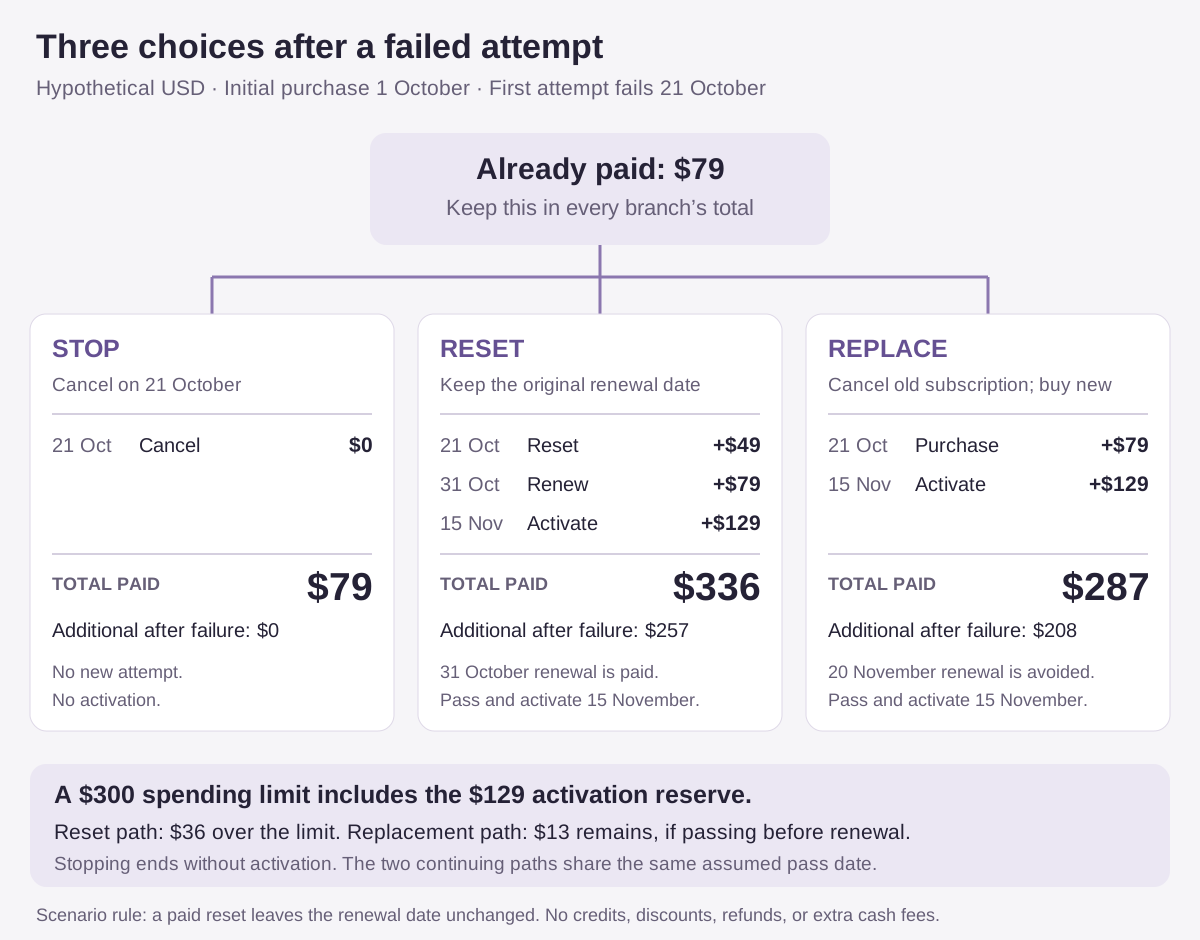
| Date and event | Stop | Reset existing subscription | Cancel and repurchase |
|---|---|---|---|
| 1 October: initial purchase | $79 | $79 | $79 |
| 21 October: first attempt fails | $0 | $0 | $0 |
| 21 October: chosen action | Cancel; $0 | Reset; $49 | Cancel old account; new purchase $79 |
| 31 October: original renewal date | $0; canceled | $79; date unchanged | $0; old subscription canceled |
| 15 November: recognized pass and activation | Not applicable | $129 | $129 |
| Total cash paid at each branch's endpoint | $79 | $336 | $287 |
| Additional cash after the failed attempt | $0 | $257 | $208 |
The replacement's first renewal would be 20 November, 30 days after its 21 October purchase. The assumed 15 November pass comes first, so that charge never occurs.
The reset costs $30 less on the day of the decision, yet the reset path costs $49 more through activation ($336 against $287). Its preserved renewal date adds another $79 before the modeled pass:
Reset path: $79 already paid + $49 reset + $79 renewal + $129 activation = $336
Replacement path: $79 already paid + $79 replacement + $129 activation = $287
The difference is the time before the next charge. The reset keeps 31 October, 10 days after the decision; the replacement's first renewal falls 30 days later, on 20 November.
This result depends on the calendar and cancellation rules. If the reset instead moved the next renewal beyond the pass date, its total would be $257, making it $30 less than the replacement. If the old subscription were left active after replacement, add its actual subsequent charges. Compare the payment events your terms create, including the effect of any existing reset credit.
Stopping leaves $79 spent and no future account benefit in this model. That is a valid budget outcome. It should not be presented as a cheaper way to reach activation, because activation never happens on that branch.
Set a total spending limit before paying again
A fixed budget needs two views: total cash already paid and remaining money available for future charges. The next reset may be small enough to pay immediately while the full route exceeds the budget.
Suppose the trader sets a $300 total limit through activation before the first purchase. At the 21 October failure, $79 is already spent. Reserving the $129 activation payment leaves:
Available for evaluation charges = $300 limit - $79 already paid - $129 activation reserve = $92
That $92 must cover all further reset, replacement, and renewal charges in the selected path. The reserve is a planning allocation, not a payment already made.
| Choice at the failed attempt | Further evaluation charges on the modeled path | Activation reserve | Total including the $79 already spent | Within $300? |
|---|---|---|---|---|
| Reset; then the 31 October renewal occurs | $49 + $79 = $128 | $129 | $336 | No; exceeds the limit by $36 |
| Replace; pass before the 20 November renewal | $79 | $129 | $287 | Yes; $13 remains |
Buying the $49 reset alone fits inside the available $92. Paying the later renewal would leave too little for activation. This is why the budget must include the required next-stage payment from the start.
Within this limit, the reset path works only if a recognized pass arrives before the 31 October renewal. Otherwise the trader would need to cancel before that charge, leaving $128 actually spent.
The replacement path also has a boundary. If it has not passed and the 20 November renewal is charged, the cost through a later activation becomes $366, exceeding the limit by $66. To keep this particular budget intact, the trader would need to cancel before that charge if a recognized pass has not stopped billing. At that point, stopping leaves $158 actually spent, and the unpaid activation reserve remains unspent.
The spending limit controls purchases and renewals. It does not create a passing deadline the trader must meet by increasing trading risk. An unresolved budget, unclear renewal timing, or unknown mandatory fee means the path is not yet fully costed.
Do not enlarge the limit merely because earlier fees have already been paid. Keep those fees in the historical total, but assess another purchase on its future cost, eligibility, and fit. A past payment does not establish that another attempt will recover it.
How should you count reset credits and free retries?
Record cash payments and service entitlements separately. A credit can remove a particular reset charge without refunding the payment that created the credit or covering unrelated charges.
Topstep adds a Reset Credit on monthly rebill. An eligible credit can reset an active subscription of the same size and type (Standard, No Activation Fee, or DLL); it cannot purchase a new Trading Combine. Credits issued from 11 December 2025 expire one year after they are added, so check the date before counting one in the plan. Record the paid renewal and the credit's use separately, without inventing a second cash payment. Topstep Reset Credit rules
For any advertised free retry, check what makes the account eligible, whether the offer is automatic or must be claimed, which phase restarts, and whether a subscription charge still falls due. A free retry, a discount code, a fee reimbursement, and credit in a trading account have different effects on the budget.
Practice access is another separate category. FTMO describes its Free Trial as a shortened preparation experience; completing it does not qualify a trader for an FTMO Account. Use practice to inspect the relevant mechanics without counting it as a purchased evaluation attempt or a completed qualification stage. FTMO Free Trial explanation
Reserve activation costs and keep refunds conditional
Look for payments triggered by passing, not just payments triggered by failure. Record their amount, deadline, exact account stage, and whether tax or a selected option changes the checkout total.
For example, Topstep's published base pricing lists a $149 activation fee per Express Funded Account earned on its Standard Path, while its No Activation Fee Path carries no activation charge and a higher evaluation subscription price. Options or discounts can change the amount, and applicable purchase taxes may be added. Check the selected path and checkout rather than applying one activation figure to every account. Topstep pricing and payment questions
For a named-account example, the Bootcamp calculation in our completion-time study separates the entry payment from the required second payment and shows the total cash needed through funding.
A later funded-account reactivation is a separate decision with its own eligibility and fee. Do not reuse an evaluation reset price for it. Topstep's pricing page, for example, treats Express Funded Account reactivation separately from initial activation. Activation and reactivation pricing
For budgeting, retain gross cash paid, cash reimbursements actually received, and conditional future reimbursements as separate entries. A refund dependent on a later reward does not fund the next charge today. Verify whether eligibility covers the original fee, a reset payment, the successful purchase only, or something else. Do not assume all failed-attempt fees are returned. The refunds-and-credits explanation covers the accounting distinctions.
Before paying again, complete this decision record
| Field | Your record |
|---|---|
| Program and account | Firm, market, program, stage, size, platform, options, and applicable purchase cohort |
| Why the attempt ended | Exact rule or event, and what you need to understand before another attempt |
| Spending limit and endpoint | Maximum total cash budget; whether it ends at activation or a later funded period |
| Money already paid | Purchases, renewals, resets, and other external charges across the attempts in scope |
| Options actually available | Stop, eligible credit, granted retry, paid reset, or new purchase |
| Progress after restarting | Starting phase, account conditions, qualifying days, and any new connection requirements |
| Next cash events | Amounts and dates for the chosen action, renewal, activation, and other mandatory fees |
| Subscription handling | Which account renews, what changes its charge date, and confirmation of any cancellation |
| No-pass branch | What you will do before the next charge if the account has not passed |
| Final check | Whether the whole stated path fits the limit, including checkout taxes and payment costs |
Before choosing another purchase, revisit the before-you-pay comparison worksheet. Check that the program still fits the trading requirements that matter to you, then fill in the restart budget. An affordable retry is useful only if its rules and payment path are understood.
Sources and method
Official pages checked on 4 October 2026:
- Topstep: What is a Reset?, for Trading Combine resets, rebilling, and Reset Credit eligibility and expiry.
- Topstep: Trading Combine Subscriptions, for subscription status after breach, passing, and cancellation.
- Topstep: Pricing and Payment Questions, for path-specific activation, reactivation, and checkout conditions.
- FundedNext: Can I Reset My Account Anytime?, for CFD challenge resets, phase transitions, and availability exceptions.
- FTMO: Do You Offer a Free Trial?, for preparation access and its qualification limits.
The worked budgets are original hypothetical illustrations, independently recalculated from their stated assumptions. Each cash event, date, branch total, and spending-limit boundary was checked. The reset and replacement paths are compared through the same assumed activation date. No passing-time estimate, expected-attempt model, program ranking, or proprietary score is calculated. Official examples illustrate selected mechanisms and should be rechecked for the exact account before payment.