LearnChoosing a program
Evaluation vs. Funded Account Rules: What to Recheck After Passing
Passing a prop firm evaluation does not establish that the next account has the same starting values, trading permissions, or payout conditions. Before its first trade, compare the rules of the account you completed with the rules of the exact account you are receiving. Mark each relevant condition as changed, confirmed unchanged, or unresolved.
On this page
Some evaluation requirements may disappear. Other conditions may begin only at the funded stage. Even a rule that stays the same can produce a different remaining loss buffer when a new account starts with a fresh balance.
This guide covers CFD/FX and futures programs, using selected official examples checked on 4 October 2026 and a clearly labeled hypothetical transition. It is a method for checking the handoff, not a claim that all funded accounts are stricter or that passing guarantees account access or a payout.
Which transition have you actually completed?
First identify the outgoing and incoming stages. Moving from Phase 1 to Phase 2, moving from evaluation to a simulated funded account, and moving from simulated funding to a live account are different transitions.
| Transition | What you need to establish |
|---|---|
| Evaluation phase to another evaluation phase | New target, starting values, activity requirements, and whether any prior progress carries forward |
| Final evaluation to a funded-stage account | Confirmed review outcome, onboarding, agreement, activation, account status, and the next stage's complete rules |
| Simulated funded to live | Whether a separate selection or call-up applies, and the live account's capital, risk controls, platform, costs, and payment terms |
For example, FTMO's CFD 2-Step process sends a successfully reviewed Challenge account to Verification. Only after Verification and its review does the process move to identity verification and the FTMO Account Agreement, with account provision subject to the required steps. Completing the first evaluation phase is not completion of the whole route. FTMO's instructions after passing
Follow the provider's actual confirmation and account instructions. A profit target reached on a screen is one observation; an approved transition and an active next-stage account are separate states. The challenge-lifecycle guide explains those milestones, while the evaluation-route comparison separates phase count from the rest of the program.
Also confirm what “funded” means for this account. Topstep's Express Funded Account is simulated, starts with a displayed $0 balance, and can qualify for real payouts under its terms. Its displayed balance should not be read as a zero loss allowance or as proof that the advertised account tier has disappeared. Express Funded Account parameters
What should you compare between evaluation and funded stages?
Create two columns for the exact configuration: firm, market, program, account size, platform, selected options, and applicable purchase cohort. Then compare the following fields. A matching rule name is not enough to mark a row unchanged.
| Area | What to record at both stages | Why it affects the next trade or decision |
|---|---|---|
| Account status and opening values | Simulated/live status, actual opening balance, any account credit, and treatment of earlier profits | The new account may start from different values even when its advertised tier is unchanged |
| Overall max loss | Amount, reference, static/trailing behavior, update timing, monitored value, equality boundary, and consequence | The same percentage or label may conceal a different calculation or remaining buffer |
| Daily loss or daily pause | Whether present, amount/reference, reset clock, floating P&L and charges, and breach versus pause | A daily constraint remains separate from the overall loss limit |
| Targets and qualifying activity | Profit target, trading-day or profitable-day definition, consistency, inactivity, and the event that starts each count | Evaluation progress does not by itself establish funded-stage eligibility |
| Trading permissions | News actions, overnight/weekend holding, instruments, automation, copying, and prohibited practices | A method used during evaluation may need different handling afterward |
| Position size and platform | Leverage/margin, lot or contract limits, aggregation, scaling, symbol specifications, and available tools | The old order size or saved platform setup may no longer fit |
| Costs and account access | Subscription status, activation, required data/platform charges, identity checks, agreement, and access date | Passing may end one charge while another becomes due |
| Payout conditions | Eligible profit, qualifying period, request rules, share, retained amount, caps, fees, and later-cycle changes | A trading account can be active before its first payout is available |
Keep the source and applicable date beside each answer. For a trading method you intend to use, an unresolved permission remains a question to settle before using that method on the new account. It does not become permission because the evaluation allowed it. The rule-and-consequence distinction helps identify whether the incoming account adds a prohibition, an eligibility condition or a review trigger.
The overall max-loss guide explains the loss mechanics. Use the daily-loss guide for the separate daily calculation and reset clock. This transition check needs the applicable answers, without assuming every program uses the same formulas.
Three more rows have their own guides. For trading permissions, recheck any EA or copier's account pair, stage, and allocation conditions with the automation and copying permission record. For costs and account access, the platform and market-data guide shows how data entitlements and charges can change with the stage. For position size in a futures account, record the funded account's starting contract allowance and scaling schedule; passing an evaluation does not establish that its maximum position remains available.
Worked transition: what changes when a fresh account starts?
Consider a hypothetical two-phase CFD-style program. We join the trader at the end of the final evaluation phase. The earlier phase, all required activity, and the review requirements have been completed successfully.
The final evaluation phase began at $100,000 and required $5,000 of net profit. It finishes at $105,000, with no open positions or separate account credit. All trading charges are already included in that balance. The new simulated funded account starts afresh at $100,000. Evaluation profits do not transfer or produce a payment in this model.
Both stages use the same static $90,000 overall equity threshold, derived from a $10,000 max-loss amount against each account's $100,000 initial balance. It never trails or locks at a different value. Equity is monitored continuously, and touching or falling below $90,000 would be a hard breach in this invented rule. No breach occurs in the example. Daily constraints are separate and are not calculated here; no withdrawal is modeled.
The permission changes below are also invented. They demonstrate how to record a transition and are not a complete offer or a description of any named firm.
| Field | Completed final evaluation | New funded-stage account | Finding |
|---|---|---|---|
| Trading environment | Simulated | Simulated | Unchanged |
| Balance at these two checkpoints | $105,000 after completing the target | Fresh $100,000 opening balance | Changed |
| Overall max-loss threshold | Static $90,000 | Static $90,000, with the same monitoring and boundary | Unchanged |
| Evaluation profit target | $5,000, met | No evaluation profit target; payout eligibility is separate | Changed |
| Selected news-event activity | No additional event restriction beyond the program's general trading rules | Defined event restrictions now apply to affected instruments and actions | Changed |
| Weekend holding | Permitted | Positions must be closed before the specified weekend cutoff | Changed |
| Permission for the trader's automated strategy | Confirmed for the evaluation | Available funded-stage evidence does not answer it | Unresolved |
“Unchanged” describes the rule or field, not every consequence of the transition. Here, balance and equity are equal at both checkpoints, so the distance to the overall threshold is:
Final evaluation distance = $105,000 equity - $90,000 threshold = $15,000
New funded-account distance = $100,000 equity - $90,000 threshold = $10,000
The new account begins $5,000 closer to the same threshold because the evaluation's accumulated profit did not transfer. There was no tightening of the hypothetical max-loss rule and no withdrawal. The former $15,000 distance belonged to the completed evaluation account; it is not the new account's buffer.
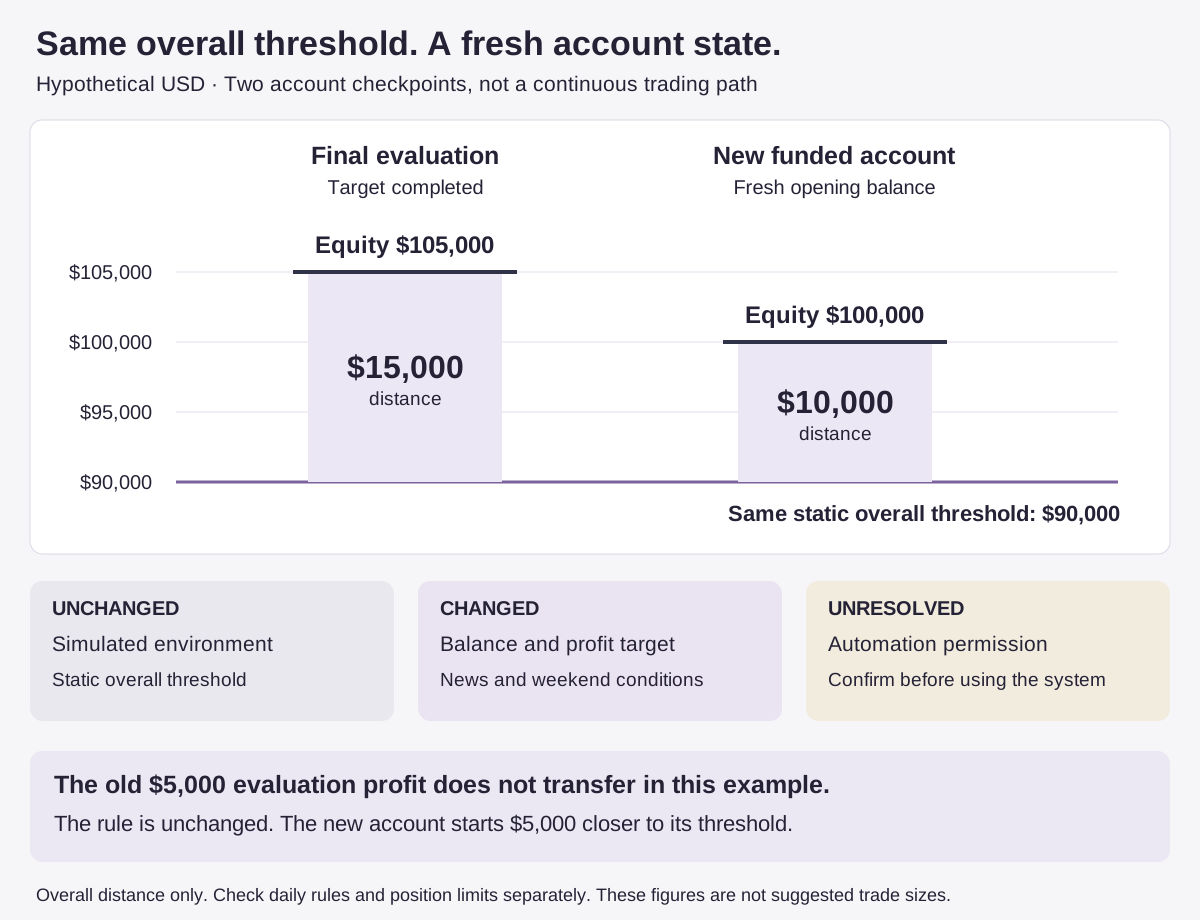
The practical actions follow the findings. Recalculate from the new balance. Update news and weekend procedures for the specified restrictions. Resolve the automation question before using that system. Passing the evaluation has answered none of those funded-stage questions by itself.
What do actual program rules show about these changes?
The following examples illustrate different parts of the transition. They are deliberately scoped by product and stage, and do not establish a firm-wide ranking or a complete compatibility assessment.
FTMO: some objectives end while other rules continue
For FTMO's CFD 2-Step route, its Trading Objectives page applies the 5% Maximum Daily Loss amount and 10% static Maximum Loss amount to Challenge, Verification, and the subsequent FTMO Account. The evaluation profit targets and minimum-trading-day objective do not continue as those same objectives on that FTMO Account. The daily rule still has its own balance reference and reset mechanism; “5%” alone does not describe the full calculation. FTMO Trading Objectives
Permissions can change even where those loss amounts continue. Standard FTMO Accounts have selected-news restrictions that do not apply during evaluation. The restriction covers specified actions on affected instruments, including relevant pending-order executions; the news-event order timeline separates an order's placement from its later execution, including an automatic protective exit. Swing accounts have an exception. FTMO news policy
The Standard holding policy also changes at the FTMO Account stage: positions must be closed before the weekend market close and before market breaks longer than two hours. This is not a blanket ban on every overnight position. Swing accounts have an exception to those restrictions. Use the holding checklist to confirm the instrument's schedule, charges, loss resets, and weekend permission on the incoming account. FTMO holding policy
Topstep: account size, position limits, and payout path are separate
For Topstep's futures Express Funded Account, the Scaling Plan makes maximum position size depend on account balance. Increases do not become available mid-session. A familiar account tier therefore does not establish the contracts available for the next order; check the applicable limit. Topstep Scaling Plan
At activation, the Express Funded Account trader chooses a Standard or Consistency payout path, each with different qualifying conditions. The account's selected payout path must be recorded separately from the Trading Combine purchase path that determines activation-fee treatment. Similar labels do not establish the same choice or rule. Express Funded Account parameters
FundedNext: “allowed” can still have a different profit treatment
For FundedNext's CFD Stellar 2-Step, the news guide permits news activity in both the Challenge and FundedNext Account. At the FundedNext Account stage, however, it applies a separate adjustment to profits from trades opened or closed in the specified news window, while losses remain fully counted. A single “news allowed” label would miss this stage difference. Read the exact event, instrument, order, and profit-treatment rules together. Stellar 2-Step news policy
These examples support a row-by-row comparison. They do not support assuming that every condition becomes stricter, that every unchanged headline has the same mechanics, or that an exception in one product applies to another.
Does an active funded account mean you can request a payout?
An active funded-stage account establishes that the relevant access has been provided. A payout request requires its own conditions to be satisfied. Record the event that starts each waiting period or qualifying-day count, and which account's activity is counted.
Keep three records separate:
- Evaluation completion: the requirements fulfilled on the account that qualified for the next stage.
- Funded-account activation: review, verification, agreement, any required payment, and usable account access.
- Payout eligibility: the new account's applicable profit, day-count, consistency, request, and other conditions.
Do not assume evaluation profits, trading days, or an earlier best-day measurement carry into the funded record. If a program provides a separate reward linked to evaluation performance, record that entitlement and its payment conditions explicitly. It is not evidence that the evaluation balance or activity has transferred into the next account.
The qualifying-days guide separates different day definitions, and the consistency guide explains why the relevant period and profit basis matter. The payout-process guide then separates eligibility, request, review, dispatch, and receipt.
Check the cash record at the same transition. Confirm which subscription has stopped, whether another account still renews, and what activation, data, or platform payment is due. Keep an anticipated fee reimbursement conditional until its actual requirements are met and money or credit is received. The restart and activation budget explains how to reserve the required payment and keep different credits separate.
What should you confirm before placing the first funded-stage trade?
Use the comparison to update a short operating record for the new account. The goal is to turn the applicable terms into settings and actions you can actually follow.
| Check | Record before the first trade |
|---|---|
| Correct account and stage | Account identifier, active status, market, program, size, platform, options, and applicable agreement |
| Opening state | Actual balance/equity, any separate credit, displayed loss thresholds, the applicable opening loss allowance, and which earlier profits or counts do not transfer. Record the starting value and loss allowance separately. |
| Risk controls | Overall and daily rules, reset clock and timezone, alert values, position limits, and aggregate exposure |
| Strategy permissions | Evidence for intended instruments, news actions, holding periods, automation, and copying; precise unresolved questions |
| Platform setup | Correct account selected in order panels, default quantity, symbols, brackets, copier connections, and account-specific controls |
| Costs and activity | Activation/access confirmed, next external charge if any, inactivity conditions, and any required account activity |
| Payout record | Selected payout path, applicable qualifying period, and the event that starts the first cycle |
Keep the official terms, relevant account instructions, and any clarification with the date and configuration they address. If the dashboard and published description disagree, record both and ask the provider to resolve the exact account-level question. Avoid filling an unknown with a convenient rule from another product.
Then confirm that saved platform settings match the new account. A copied order template, old alert, or connected trading system may retain values from the evaluation. Platform access and a technically available button do not by themselves establish permission under the account terms.
If a material condition for the intended trade remains unresolved, settle it before placing that trade. Use the before-you-pay comparison worksheet to keep the two stages side by side, and retain the same record for the first funded session.
When should you repeat the check?
Repeat the relevant rows when the account moves to another stage, changes size or options, is replaced, or receives a rule change that applies to it. After a payout, recheck any affected threshold, remaining buffer, and qualifying period using the post-payout account guide. A capital scale-up or merger also needs a before-and-after account record, including any restarted payout counts or lost scaling eligibility.
A later live transition deserves its own review. Topstep's program overview describes the Live Funded Account as a separate Risk Team call-up after the Express stage. Topstep program overview
Platform capabilities can also differ at that boundary. The TopstepX built-in Trade Copier is available for Trading Combine and Express Funded Accounts, but not for Live Funded Accounts, according to its platform documentation. That is a statement about this particular tool and these account stages, not a universal statement about every form of copying. TopstepX Trade Copier documentation
Treat each transition as a new comparison between documented account states. Preserve what is confirmed unchanged, update what changes, and keep unanswered questions visible until they are resolved.
Sources and method
Official pages checked on 4 October 2026:
- FTMO: I Have Successfully Passed, What to Do Now?, for review and onboarding by CFD evaluation route.
- FTMO: Trading Objectives, for objectives across the CFD 2-Step stages.
- FTMO: Can I Trade News?, for product, account-type, and stage scope of news restrictions.
- FTMO: Overnight and Weekend Holding, for Standard and Swing holding conditions.
- Topstep: Express Funded Account Parameters, for account status, starting balance, and payout-path selection at activation.
- Topstep: What Is the Scaling Plan?, for Express-stage position limits and update timing.
- FundedNext: News Trading in the Stellar 2-Step Account, for stage-specific treatment of news-related profits.
- Topstep: Program Overview, for the distinction between evaluation, Express, and live stages.
- TopstepX: Platform Documentation, for availability of the built-in Trade Copier by stage.
The worked matrix and account-state calculations are original hypothetical illustrations, independently recalculated from their stated assumptions. Its balances, boundary convention, and permissions are declared assumptions. No passing probability, payout forecast, universal ranking, or proprietary score is calculated. Named examples are limited to their cited mechanisms and should be rechecked against the specific account and current applicable terms.