ResearchCosts
What Does Reaching a Funded Account Cost as Completion Takes Longer?
In this study, a longer successful evaluation increases subscription spending, while one-time and staged fees stay fixed. The difference can change which of two pricing paths requires less cash. In the dated Topstep records, the Standard path first has a lower base cost than No Activation Fee after four subscription payments at $50K, three at $100K and five at $150K. For The5ers Bootcamp $100K, the $95 entry payment becomes $300 through funding once the second fee is included.
- Data
- Release pfw-release-2026-10-13-pilot-2.
The figures describe that release and stay as published; a later release does not change them.
- Supporting data
- Cost inputs for the 18 study accounts (CSV, 12 KB)
- Release source references for the study inputs (CSV, 83 KB)
On this page
These are calculations from the prices recorded in PFW's approved 13 October 2026 snapshot. They cover a successful attempt and any required funded-stage fee, before unverified buyer-specific taxes or payment charges. They are not observed average spending, a prediction of passing time, or a ranking of accounts.
Which accounts are included?
The study selects 18 exact configurations from a release containing 112 accounts at five firms. The selection is designed to expose billing differences, rather than represent the whole industry. Several sizes of the same program remain related observations.
| Group | Exact scope | Accounts |
|---|---|---|
| Main futures comparison | $50K FTMO Growth and Pro; FundedNext Flex, Rapid Daily and Rapid Pro; The5ers Day Trade and Swing; Topstep Trading Combine No Activation Fee and Standard | 9 |
| Topstep size check | Both Trading Combine pricing paths at $100K and $150K | 4 |
| Separate CFD/FX comparison | $100K FTMO 2-Step Standard, FundedNext Stellar 2-Step Standard payout route, FundingPips 2 Step Standard, The5ers Bootcamp and High Stakes New | 5 |
The named variants matter. Topstep is modeled without Responsible Trading Advantage; FundedNext Rapid Pro without the Daily Loss Limit add-on; FundingPips 2 Step Standard with its standard 5% daily loss option. The other accounts also use the base configurations recorded in the data release. Optional platform upgrades and add-ons are excluded.
The data release checked these configurations on MT5 for CFD/FX; Tradovate for FTMO and FundedNext futures; BlackArrow for The5ers futures; and TopstepX for Topstep. These are the checked setups, not claims that each firm offers only that platform. The platform can change the price: FundingPips' $652 is its checkout total with MetaTrader 5 or MatchTrader, and cTrader adds $20.
The account label does not establish equal loss capacity, passing requirements or payout access. Bootcamp's $100K label is the eventual funded tier: its three evaluations use growing $25K, $50K and $75K balances. Futures and CFD/FX results therefore stay in separate tables. The existing $50K futures comparison and $100K CFD/FX comparison examine other differences in the original pilot accounts.
For a different question, the study of account size, fees and opening loss allowance keeps the selected program and options fixed while changing size tiers. It reports a separate 16 October 2026 snapshot; the completion-time calculations here retain their 13 October snapshot.
What exactly is being calculated?
The measured amount is advertised base cash outlay through funded activation: entry and renewal payments, plus any required payment to obtain the funded account. A funded-stage label does not itself mean a live brokerage account or cash the trader owns.
For a subscription, the calculation is:
Base outlay = payment amount × number of paid subscription charges + required funded-stage fee.
For a one-time route, it is:
Base outlay = entry fee + required funded-stage fee.
All selected configurations record no mandatory platform/data fee for their base setup. That documented absence is included in the calculation. Unknown checkout charges are excluded and remain unknown; the totals are not verified checkout quotes.
Every scenario assumes one account, one successful attempt, no reset or replacement, continuing compliance and sufficient trading activity to avoid inactivity closure. Targets, qualifying days and consistency requirements must all be met. No profit path or probability of success is estimated. Prices, the selected options and billing rules are held constant throughout the hypothetical timeline.
The endpoint includes a required activation payment even when it falls after the evaluation has passed. It does not include later trading costs, withdrawal fees or the cost of reaching a first payout. Evaluation commissions and spreads can affect how hard it is to pass, but they are not added again as separate buyer cash fees. The full cost inventory explains those distinctions.
How the completion dates become payments
The hypothetical purchase date is 15 October 2026. The dates below are when the firm is assumed to have recognized the successful pass and ended evaluation billing. They are not the date of the final profitable trade, and they do not promise that identity checks or funded-account setup finish that day. Any required funded-stage fee is then added to the total.
| Pass recognized on | Elapsed calendar days | FTMO subscription charges | Topstep subscription charges |
|---|---|---|---|
| 30 October 2026 | 15 | 1 | 1 |
| 30 November 2026 | 46 | 2 | 2 |
| 30 December 2026 | 76 | 3 | 3 |
| 29 January 2027 | 106 | 4 | 4 |
| 30 March 2027 | 166 | 6 | 6 |
The purchase is the first charge. Six charges therefore mean the initial payment plus five renewals, not six renewals.
The two calendars are different even though the selected completion dates produce the same counts. Supplemental official-source checks on 15 October 2026: FTMO's payment FAQ describes a charge on the same date each month and cancellation once the evaluation is evaluated as passed. Topstep's subscription rules use 30-day intervals and require the dashboard to show a pass before the rebill date.
For this purchase date, FTMO's next three scheduled charges are 15 November, 15 December and 15 January. Topstep's are 14 November, 14 December and 13 January. The model counts scheduled charges, rather than dividing elapsed days by an assumed month. It deliberately avoids a pass-recognition event on a billing date; the exact outcome near a renewal requires the applicable cutoff and recorded account status.
Longer scenarios also assume ongoing eligible activity. In a separate 15 October check, The5ers' evaluation time-limit FAQ allows an open-ended evaluation but requires a trade within each 14-calendar-day inactivity window. A flat entry fee is not permission to leave an account unused indefinitely.
Subscription costs at five completion dates
The following $50K futures totals include the required funded-stage payment. Columns correspond to the calendar above. All amounts are US dollars at the snapshot's list prices, before unverified taxes or payment charges.
| Exact $50K futures account | 1 charge | 2 charges | 3 charges | 4 charges | 6 charges |
|---|---|---|---|---|---|
| FTMO Growth | $119 | $238 | $357 | $476 | $714 |
| FTMO Pro | $139 | $278 | $417 | $556 | $834 |
| Topstep Trading Combine No Activation Fee | $95 | $190 | $285 | $380 | $570 |
| Topstep Trading Combine Standard | $198 | $247 | $296 | $345 | $443 |
At Topstep Standard $50K, one paid subscription period followed by activation costs $49 + $149 = $198. After four paid periods, the same endpoint costs 4 × $49 + $149 = $345. The activation fee is counted once in each successful scenario.
For FTMO Growth $50K, moving from one to six charges adds five payments of $119, or $595. For Pro $50K, it adds $695. Those are the extra fees associated with these chosen successful timelines, not the expected cost of an unsuccessful trader's retries.
When Topstep's two paths cross over
Topstep's Standard path has the lower recurring payment and a $149 activation fee at each of the three sizes. No Activation Fee has the higher recurring payment and no activation charge. The size-dependent difference between those recurring payments determines how many charges it takes to offset $149.
Both paths below exclude Responsible Trading Advantage. The pricing path is chosen at purchase; this is a comparison between alternative purchases, not a plan to switch paths during an evaluation.
| Topstep Trading Combine size and pricing paths | Standard per 30 days | No Activation Fee per 30 days | Standard activation | First charge count with lower Standard total | Totals at that count: Standard / No Activation Fee |
|---|---|---|---|---|---|
| $50K: Standard / No Activation Fee | $49 | $95 | $149 | 4 | $345 / $380 |
| $100K: Standard / No Activation Fee | $99 | $149 | $149 | 3 | $446 / $447 |
| $150K: Standard / No Activation Fee | $199 | $229 | $149 | 5 | $1,144 / $1,145 |
For $50K, the recurring difference is $95 − $49 = $46. The Standard total becomes lower when $46 × the number of payments exceeds $149. After three payments, Standard is still $296 against $285. After four, it is $345 against $380. Subscription payments are discrete, so the relevant result is four paid charges, not a fractional-month break-even claim.
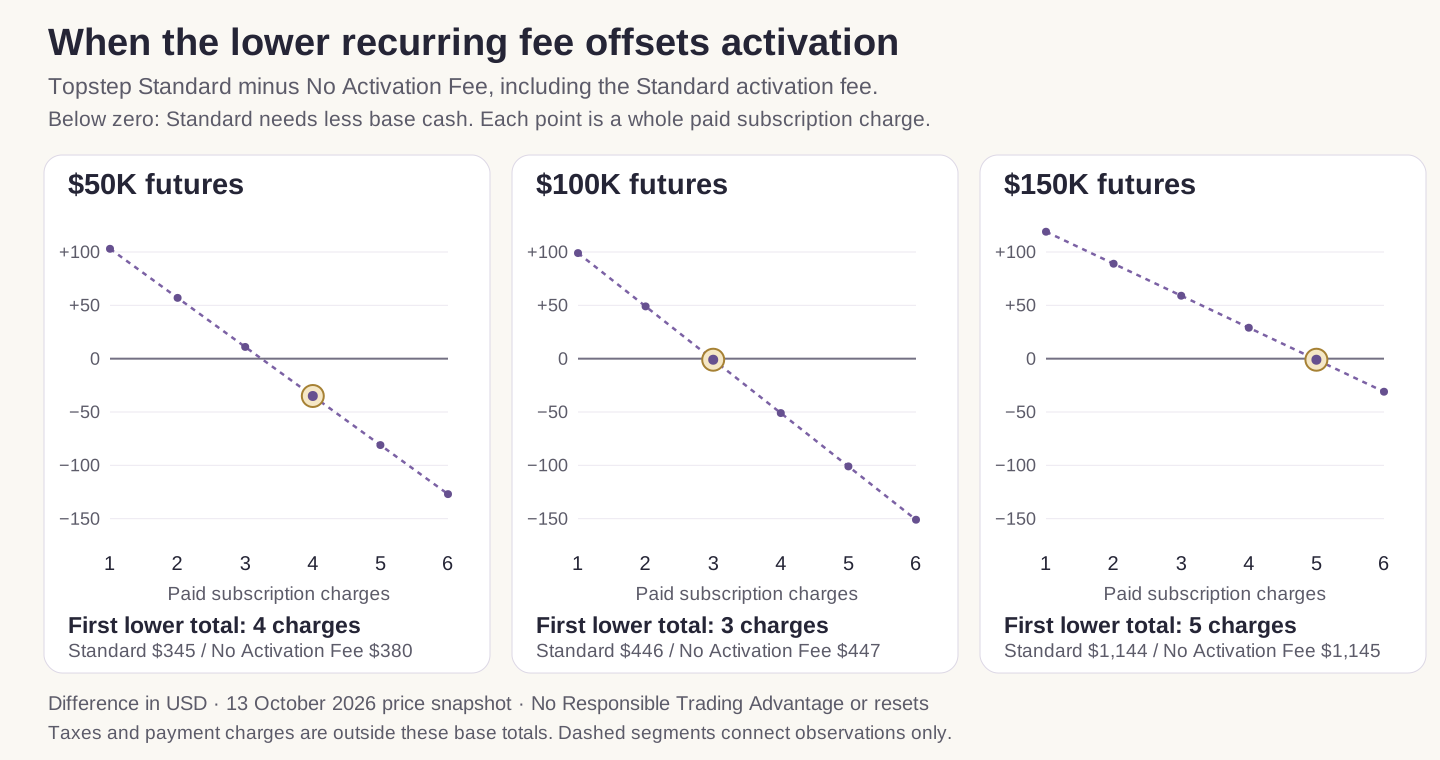
At $100K and $150K, the first lower Standard total is lower by just $1. That narrow difference should not be mistaken for a robust buying recommendation. Checkout charges, optional features and the account's other terms remain outside this comparison. For the general calculation, see subscription versus one-time fee scenarios.
The one-time futures accounts
These five $50K configurations require the same base outlay at every completion date in the model. Each has one entry payment and no required funded-stage fee in the snapshot.
| Exact $50K futures account | Entry payment | Required funded-stage fee | Base total at every modeled date |
|---|---|---|---|
| FundedNext Flex | $133.99 | None | $133.99 |
| FundedNext Rapid Daily | $299.98 | None | $299.98 |
| FundedNext Rapid Pro | $299.98 | None | $299.98 |
| The5ers Day Trade | $100 | None | $100 |
| The5ers Swing | $120 | None | $120 |
Later source reading: on 15 October 2026, FundedNext's Flex Challenge rules and its futures pricing page listed a $141.99 account price at $50K. The snapshot's $133.99 was read on 9 October 2026, and neither page says when the price changed. The table keeps the snapshot's price, so it is not a current purchase quote. The account page will show the newer price once a later data release records it.
The fixed totals depend on maintaining the same valid attempt. Buying another account after a breach would add another payment. A reset, optional feature or change of configuration would require a different calculation. No temporary offer is used, even where an official page also advertises a discounted purchase price.
CFD/FX fees and Bootcamp's second payment
For these five CFD/FX routes, elapsed time alone adds no recurring fee in the model. The relevant difference is whether the required cash is collected entirely at purchase or in stages. Amounts remain in the currency charged; FTMO's euro price is not silently converted into dollars.
| Exact CFD/FX account, $100K funded label | Entry payment | Required second payment | Base total through funding |
|---|---|---|---|
| FTMO 2-Step Standard | €540 | None | €540 |
| FundedNext Stellar 2-Step Standard payout route | $549.99 | None | $549.99 |
| FundingPips 2 Step Standard | $652 | None | $652 |
| The5ers Bootcamp | $95 | $205 | $300 |
| The5ers High Stakes New | $405 | None | $405 |
For Bootcamp, showing only the entry price would omit $205 of the required cash through funding. Completing the evaluations faster does not remove that second payment. Its timing changes when the cash is needed, while the modeled total remains $300.
The other four rows collect their base fee at entry. Their phase counts, targets and qualifying-day requirements still differ. The model assumes those requirements are met, including activation and inactivity conditions; it does not treat the same completion date as equally achievable on every route. The activation-fee budgeting guide explains how to reserve a second payment before beginning.
Why refunds do not reduce these totals
A refund tied to a later reward does not finance the earlier purchase or activation. These totals measure cash paid through funding, so they do not subtract a possible future refund.
For example, the snapshot's FTMO 2-Step and FundedNext Stellar 2-Step records tie a fee refund to the first reward. FundingPips 2 Step Standard ties it to the fourth reward. Among the futures accounts, The5ers Day Trade and Swing refund the fee with the third payout. Those are later milestones than the endpoint studied here.
The5ers High Stakes New also separates Hub credit from a component added to funded-account equity and withdrawable under conditions. Hub credit cannot be withdrawn as cash. Bootcamp's Hub credit bonus likewise does not replace the required second payment in this model. A refund or credit should be recorded in the form and at the milestone actually established, as explained in refunds and credits.
What these results leave unresolved
The study isolates billing and required entry-to-funded fees. It does not measure the trading skill, risk or time needed to meet the account's rules. There are no pass-rate data, failure distributions or observed customer histories behind the scenarios. A cheaper modeled fee path can still be unsuitable for a trader's intended method.
No final buyer-specific checkout total is verified in the data release. Taxes, payment-method charges and currency conversion by a bank or provider can change actual spending. The study also excludes temporary promotions, optional data or platform features, resets, replacement accounts, later scaling and payouts. Accounts bought directly into a funded stage are outside the cohort because they have no evaluation-completion timeline to compare.
Resets particularly need their own event schedule. The data release records that a Topstep reset moves the next charge 30 days later. It holds no equivalent rule for FTMO; in a separate 15 October reading, FTMO's payment FAQ says a reset does not change the billing day. Neither rule adds a reset to the successful-attempt scenarios above.
The useful buying question is therefore specific: for the exact account and options being considered, how many payments could fall due before the pass is recognized, and what additional fee is required afterward? Use the current comparison tool to inspect the maintained account records. Account links in this study open current pages, which may differ from its dated inputs.
Related reading
- The full cost of a prop firm challenge, for the costs excluded from a headline price.
- Subscription versus one-time fees, for billing events, cancellation and hypothetical cost models.
- Resets, retries and activation fees, for budgeting after a failed attempt.
- What we could verify across six pilot accounts, for the distinction between a recorded evidence state and a complete answer.
- Profit split vs. first payout: what the caps change calculates the first-request trader allocation for an overlapping set of futures accounts, before payment fees.
Sources and method
The fee amounts, account identities, variants and documented base-fee states come from PFW's approved 13 October 2026 data release. Its source references span 19 September to 13 October. This is a purposive 18-account study. The published input and source-reference CSVs preserve selected values from that release unchanged, with no new prices, offers or currency conversions.
The five completion dates are hypothetical. For each account, the calculation counts the purchase and any scheduled renewals before the recognized pass, then adds the required funded-stage fee. Each total was independently reconciled to a payment-event ledger. The Topstep size analysis checks both the payment count immediately before the crossover and the first whole payment count after it. The formulas and calendar above allow the calculations to be reproduced from the input files.
The following official pages were checked separately on 15 October 2026 for billing mechanics and the feasibility assumptions behind a continuing evaluation. These checks supplement the snapshot; they do not advance its underlying check dates or replace its prices. No claim is made that every pricing page was reread for this study.
- FTMO: evaluation payments and subscriptions, for monthly billing, the stopping event and reset treatment.
- FTMO: time to become an FTMO Trader, for evaluation duration, confirmation of objectives and subsequent account setup.
- Topstep: Trading Combine subscriptions, for 30-day renewals, the dashboard pass condition and automatic cancellation.
- FundedNext: Flex Challenge rules, for the open-ended evaluation and the later price reading identified above.
- FundedNext: futures challenges and pricing, for the same later Flex price.
- FundedNext: Rapid Pro Challenge rules, for evaluation duration under the selected base route.
- FundedNext: Rapid Daily Challenge rules, for evaluation duration under that path.
- The5ers: evaluation time limits and activity, for evaluation duration and inactivity requirements.
- PFW's approach to numbers and evidence, for scope, unresolved inputs and the treatment of dated figures.