LearnFees and costs
Subscription vs. One-Time Prop Firm Fees: Three Cost Scenarios
Whether a prop firm subscription costs less than a one-time fee depends on the billing path you actually follow. Compare the initial charge, renewals, any reset or replacement purchase, and activation through the same endpoint. A one-time evaluation fee removes that evaluation's recurring charge; it does not promise unlimited attempts or make every later service free.
On this page
The decisive unit is a billing event. “Two months to pass” can hide whether the initial payment was followed by one renewal or two, whether a reset moved the next charge, and when the firm recognized the pass.
This guide compares hypothetical offers through funded-account activation, then shows how selected official rules affect the record. Named sources were checked on 3 October 2026. For the broader inventory of entry, platform, data, trading, and payout costs, start with the full challenge-cost guide.
Compare the cost of reaching the same endpoint
First choose what the total is meant to cover. Purchase, completion of all evaluation phases, funded-account activation, and receipt of a first payout are different endpoints.
For an activation comparison, include all cash payments required to reach an active funded-stage account under the stated path. If one offer includes activation while another charges after passing, stopping the calculation at the evaluation result leaves out a payment needed for the comparison.
Keep the cash record separate from the trading ledger. An evaluation purchase is money paid by the customer. A simulated trading commission can affect account P&L and the ability to pass without being another card charge. Likewise, an advertised account balance is not a cash refund of the purchase price.
Compare programs that meet your requirements before comparing their totals. The guide to one-step, two-step, and instant routes explains why route labels do not establish everything that must be paid. Different targets, loss rules, instruments, and permissions can make two similarly priced offers materially different products.
What do “monthly” and “one-time” actually mean?
| Billing term | What to record |
|---|---|
| One-time evaluation fee | Which attempt and phases the payment covers; any separate activation or service charge |
| Recurring evaluation fee | Initial charge, renewal amount, exact next billing date, and event that stops renewal |
| No time limit | Any inactivity, access, or cancellation conditions; whether billing continues during unused time |
| Reset fee | What is restored, whether a credit is available, and whether the reset changes the next charge date |
| Activation fee | When it becomes payable and whether it is included in the selected purchase path |
Do not infer the model from the firm name or market alone. FTMO's CFD Challenge 1-Step and 2-Step use one-time fees; the 2-Step payment covers both evaluation phases. Its separate FTMO Futures Evaluation uses a monthly subscription, billed on the same date each month, and its payment FAQ states that there is no activation fee. CFD fee structure · Futures billing
Topstep's Trading Combine, a futures evaluation, is also recurring. Its Standard and No Activation Fee paths combine different monthly and activation charges. The pricing page says the path cannot be changed after purchase. Treat the selected path as a package when calculating its cost. Topstep pricing and payment questions
These examples establish billing mechanisms, not interchangeable offers or a price ranking. Check the current agreement and checkout for the precise program, size, options, and buyer location.
Three scenarios: before renewal, after two renewals, and after a reset
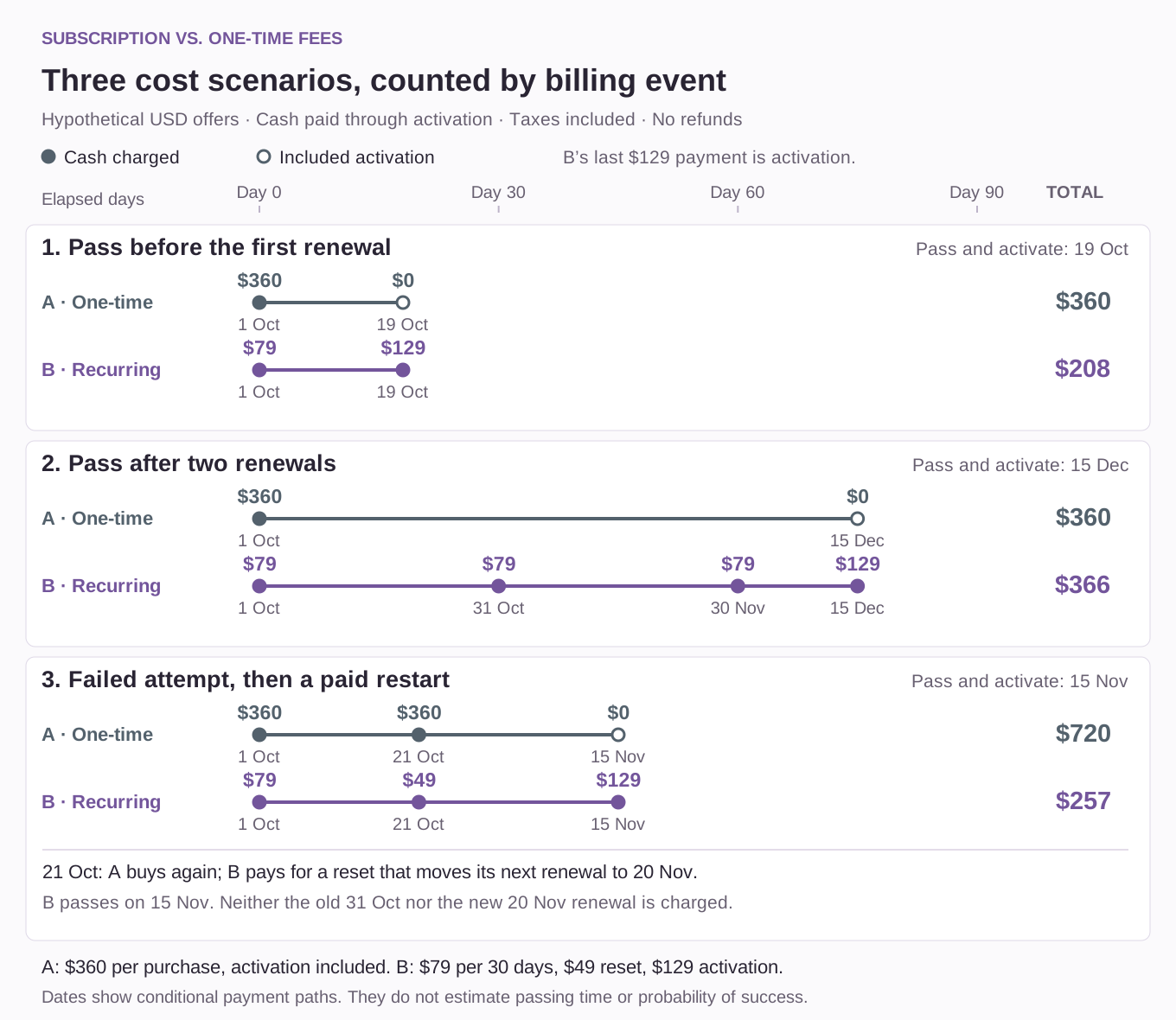
The following hypothetical USD offers retain the full-cost guide's prices: A costs $360 per purchase; B costs $79 initially and at renewal, $49 for a paid reset, and $129 for activation. This guide deliberately changes one billing assumption: B's reset moves the next renewal date, while the full-cost guide's ledger leaves it unchanged. The prices and calendar rules are invented; neither offer represents FTMO, Topstep, or another named program.
| Input | Offer A: one-time fee | Offer B: subscription |
|---|---|---|
| Initial evaluation payment | $360 per purchase | $79 |
| Scheduled renewals | None | $79 every 30 calendar days while active |
| Activation after passing all required phases | Included | $129, paid once in each modeled successful route |
| Response to a failed attempt in Scenario 3 | New $360 purchase | Paid $49 reset |
| Effect of that reset on billing | Not applicable | Next renewal moves to 30 days after the reset |
| Reset credits, refunds, and discounts | None | None |
Both offers remain valid through the modeled dates. All amounts include applicable purchase taxes. There are no additional cash charges through activation, currency conversion costs, or other active subscriptions. The offers are assumed to satisfy the reader's requirements, but no identical trading rules or probability of success is implied.
Each scenario starts with a purchase on 1 October 2026, Day 0. Dates are an illustrative calendar, not a forecast. Passing means that all required phases and checks have been completed and the provider has recognized the result. For this model, recognition stops B's subscription immediately; activation is completed on that same date. There is no prorated refund of unused paid time. Scenarios 1 and 2 have no failure or reset.
Replay the charges in each billing path
Cash paid through activation
- A: charged at this event
- $0 · activation included
- B: charged at this event
- $129 · activation
- A: cash paid through activation
- $360
- B: cash paid through activation
- $366
- B's evaluation charges
- 3
- B's activation
- $129 paid
- B's next renewal if still active
- None: passing stopped renewal
Both paths have reached activation
Passing stops B's subscription before another renewal, and B pays $129 to activate; A's activation is included. Through this endpoint, B costs $6 more than A.
Each scenario is a separate billing path through activation. The costs do not estimate pass probability or make the offers equivalent. A reset here changes the renewal date; some companion examples deliberately use another rule.
Scenario 1: pass before the first renewal
Both offers pass and activate on 19 October, Day 18. B's first scheduled renewal was 31 October, so it is never charged.
| Date | Event | A: cash paid | B: cash paid |
|---|---|---|---|
| 1 October | Initial purchase | $360 | $79 |
| 19 October | Recognized pass and activation | $0 | $129 |
| Total through activation | $360 | $208 |
B requires $281 less at purchase, but its total advantage is $152 after the activation payment. That difference between entry price and completed-path cost is the reason to use a common endpoint.
Scenario 2: pass after two renewals
Both offers pass and activate on 15 December, Day 75. B has already renewed on 31 October, Day 30, and 30 November, Day 60.
| Date | Event | A: cash paid | B: cash paid |
|---|---|---|---|
| 1 October | Initial purchase | $360 | $79 |
| 31 October | First renewal | $0 | $79 |
| 30 November | Second renewal | $0 | $79 |
| 15 December | Recognized pass and activation | $0 | $129 |
| Total through activation | $360 | $366 |
Two renewals produce three evaluation charges, not two. B now costs $6 more than A. Its next scheduled charge would have been 30 December, but passing on 15 December stops the subscription in this model.
Scenario 3: a failed attempt, then a paid restart
On 21 October, Day 20, the first attempt fails under both offers and stops being eligible to pass. The scenario then assumes a new A purchase or a paid B reset that day. Trading toward the eventual pass resumes only after the replacement or reset restores a valid attempt. Both reach activation on 15 November, Day 45.
| Date | Event | A: cash paid | B: cash paid |
|---|---|---|---|
| 1 October | Initial purchase | $360 | $79 |
| 21 October | Failed attempt, then new purchase or paid reset | $360 | $49 |
| 31 October | B's old renewal date, displaced by its reset | $0 | $0 |
| 15 November | Recognized pass and activation | $0 | $129 |
| Total through activation | $720 | $257 |
The 21 October reset moves B's next charge to 20 November, Day 50. Passing on 15 November comes first, so neither the old 31 October renewal nor the replacement 20 November renewal is paid.
B's $257 total is its initial $79, paid reset of $49, and activation of $129. Adding the old renewal would incorrectly produce $336. A's one-time fee applies to each purchase, so two purchases cost $720. The $463 difference follows from these declared restart terms; it is not evidence that either program is easier to pass.
The billing effect is a real question to investigate. Topstep's reset documentation says a reset, including application of an eligible reset credit, moves the Trading Combine rebill date. Its page says “30 days” but illustrates 25 August to 25 September, a 31-day interval. Use the dashboard's actual next charge date to resolve that discrepancy. Our hypothetical offer uses exactly 30 days. Topstep reset rules
Topstep also adds one Reset Credit to the profile's Reset Bank with each monthly rebill. A trader can wait for that credit rather than buy an immediate reset. An eligible credit works on an active subscription of the matching size and type and also moves the rebill date. It is a service entitlement, not cash or trading-account equity. Record the renewal payment and credit application separately; add a cash reset charge only if one was purchased. The hypothetical offers above explicitly exclude credits. Reset Credit rules
After an actual failed attempt, compare the remaining options against your total budget. The reset, replacement, and stopping example uses the full-cost guide's reset rule instead, which keeps the old renewal date: there the 31 October renewal is still paid, so the cheaper reset becomes the more expensive path. It also shows how to keep the activation payment reserved.
When does the subscription become more expensive?
For one purchase, no resets, identical initial and renewal prices, and a pass followed by activation, let n be the number of evaluation charges already paid, including the initial payment.
Subscription cost through activation = n × recurring price + activation fee
In the example:
B cost = 79 × n + 129
79 × n + 129 = 360, so n = (360 − 129) ÷ 79 ≈ 2.924.
That is an algebraic crossover, not a bill for 2.924 periods. The modeled provider charges whole periods with no proration. At two evaluation charges, B totals $287. At three, it totals $366. The one-time offer becomes cheaper in the third paid period, conditional on this successful path.
| Evaluation charges paid before passing | A through activation | B through activation | Lower cash total |
|---|---|---|---|
| 1 | $360 | $208 | B by $152 |
| 2 | $360 | $287 | B by $73 |
| 3 | $360 | $366 | A by $6 |
| 4 | $360 | $445 | A by $85 |
The simple formula cannot represent Scenario 3 by treating every payment as an unchanged renewal. A reset, promotion, replacement purchase, or separate service can alter the amount or calendar. For those paths, sum the dated charges in the ledger.
This is a sensitivity calculation, not an expected-cost estimate. Estimating expected cost would require defensible evidence about outcomes and timing for the relevant population. These scenarios supply neither a pass rate nor a prediction of how long a reader will need.
The Topstep size analysis in our completion-time study applies the same whole-payment comparison to Topstep's two pricing paths at three sizes, using a dated data release, and finds the first payment count at which the lower monthly fee offsets the activation fee.
Which event actually stops the renewal?
Record the next charge date and the provider's cutoff, including the relevant time zone. A calendar-month subscription and a 30-day subscription can produce different renewal dates. An account can also be unused, failed, or waiting for a result while its billing remains active.
For Topstep's Trading Combine, the subscription page says failure does not automatically cancel billing and subscriptions cannot be paused. It also says the dashboard must show a pass before the rebill date; a passed account's subscription cancels automatically, while other active Trading Combines keep renewing. Trading Combine subscriptions
That makes “I reached the target” an insufficient billing record. Establish when the provider recognizes completion, whether anything remains under review, and which subscription has actually ended. If the charge and pass fall near the same cutoff, obtain the account-specific result instead of assuming a refund.
Cancellation needs its own check. Confirm its effective date, what happens to access and progress, whether it is reversible, and whether any outstanding charge remains. Keep the confirmation and check every active account. Treat a failed payment as a payment problem, not proof that cancellation is complete.
Keep discounts and refunds separate from the base comparison
A first-period discount changes one charge
Suppose B's first payment falls to $39, while renewals remain $79 and activation remains $129. This is another hypothetical variation, with no reset.
Discounted B cost = 39 + (n − 1) × 79 + 129
At three evaluation charges, the total is $326. At four, it is $405. Compared with A's unchanged $360, the first more-expensive whole-period result moves from the third charge to the fourth. The discount saves $40 once; multiplying $39 by every period would overstate the saving.
A price reduction may also depend on accepting a different rule. Topstep's pricing page distinguishes first-month promotional pricing, unless otherwise stated, from the recurring discount for adding a Daily Loss Limit at purchase to a No Activation Fee Trading Combine. That DLL is fixed and carries into the Express Funded Account after passing. Record both the payment change and the changed account conditions. Promotion and option terms
A possible future refund does not reduce today's payment
Show cash paid through the endpoint before subtracting a conditional reimbursement that has not arrived. FTMO's CFD refund FAQ distinguishes its nonrefundable 1-Step entry fee from a 2-Step fee that may be refunded with the first Reward withdrawal. Passing and activating alone are therefore not the documented refund event. Entry-fee refund terms
If a hypothetical $360 fee is later fully returned in cash, the net fee cost after receipt is $0. The customer still needed $360 at purchase. A discount on a future purchase or a service credit is different from cash returned. Keep each in its own column and attach the eligibility conditions.
What if you stop without passing?
Use a separate unsuccessful path. Do not add an activation fee that never becomes payable, and do not invent a payout or refund to offset spending.
If the trader in Scenario 3 instead stops on 21 October, buys no replacement or reset, and B's cancellation is effective before its first renewal, cash paid is $360 under A and $79 under B. Neither account reaches activation. This row compares the cost of stopping, not the cost of obtaining a funded account.
A spending limit can also be tested before purchase. With a hypothetical $400 total fee budget reserved through activation, B's base-price path fits three evaluation charges plus activation at $366. A fourth would take it to $445. That limit requires canceling before the fourth charge if the account has not passed, subject to the provider's cancellation cutoff. Resets or other fees consume part of the same budget and require a new calculation.
The three-charge limit is a budget boundary, not a deadline for forcing a pass. Already-paid fees do not change the terms or cost of the next purchase. Record the next payment and what it buys before choosing whether to continue.
Build your own billing comparison
Fill in the table from the selected checkout, billing dashboard, and applicable terms. Use the same currency and endpoint for both offers. Leave unresolved amounts marked unknown rather than treating them as zero.
| Field | Offer A | Offer B |
|---|---|---|
| Exact program, size, route, options, and source-check date | Record | Record |
| Comparison endpoint | Same endpoint | Same endpoint |
| Initial buyer total, including applicable taxes and payment costs | Amount and date | Amount and date |
| Renewal amount, interval, next date, time zone, and cutoff | Terms or not applicable | Terms or not applicable |
| Reset or replacement charge and its effect on billing | Amount and revised dates | Amount and revised dates |
| Activation and required services through the endpoint | Amount and trigger | Amount and trigger |
| Pass recognition and cancellation rules | Exact event and confirmation | Exact event and confirmation |
| Three successful paths | Before renewal; later completion; restart | Matching paths |
| Stop-without-passing path | Cash paid and cancellation result | Cash paid and cancellation result |
| Discount or refund | Scope, conditions, and actual receipt | Scope, conditions, and actual receipt |
| Spending limit and next review date | Set before purchase | Set before purchase |
Carry these totals into the before-you-pay comparison worksheet. The billing table supplies the cost scenarios; the worksheet checks whether the program also meets the trading and access requirements that make its price relevant.
For a comparison of named accounts, see FTMO Growth, FundedNext Flex and The5ers Day Trade. It places monthly and one-time evaluation billing alongside the separate reward-linked and cancellation-refund records, including their unresolved conditions.
Sources and method
Official fee, subscription, reset, and refund pages linked beside the relevant claims were checked on 3 October 2026. They establish specific mechanisms, not current buyer quotes or a recommendation between firms. Your applicable agreement, configuration, checkout total, and dashboard date still need to agree.
The three scenarios use invented event dates and preserve the full-cost guide's $360 purchase, $79 subscription, $49 reset, and $129 activation prices. Scenario 3 deliberately uses an alternative reset rule that moves the next renewal date. All successful totals stop at activation. The stop-without-passing and discount examples are separately labeled variations. Cash charges are counted when due under the stated rules; there are no assumed payouts, success probabilities, or unreceived refunds in the base totals.
- FTMO CFD Challenge fee structure, for one-time fees and the two evaluation phases covered by the 2-Step purchase.
- FTMO CFD entry-fee refunds, for the different 1-Step and 2-Step refund terms.
- FTMO Futures Evaluation billing, for calendar-month renewal and no activation fee in that separate product.
- Topstep pricing and payment questions, for purchase paths, promotion scope, and the No Activation Fee Trading Combine DLL discount.
- Topstep Trading Combine subscriptions, for failure, pass recognition, cancellation, and continuing charges on other active subscriptions.
- Topstep reset rules, for rebill-date changes, monthly Reset Credits, and their eligibility conditions.