LearnChoosing a program
One-Step, Two-Step, Three-Step, and Instant Funding: Comparing the Full Path
One-step, two-step, and three-step challenges require one, two, or three evaluation phases. An instant-funding or direct-entry offer can remove the separate evaluation. None of those labels, by itself, tells you the complete cost, the rules of the account you will trade, or when you can receive a payout.
On this page
The useful comparison follows each offer through the same endpoint. If your endpoint is the first payout, include everything between paying for access and receiving that money: qualification, account review and setup, funded-stage trading, payout eligibility, and payment processing.
This guide explains how to compare those paths, using scoped official examples and four hypothetical offers. It does not rank the routes or estimate your chance of passing. Official sources were checked on 2 October 2026. For the basic purchase-to-payout sequence, see the challenge-lifecycle guide.
What do one-step, two-step, three-step, and instant funding mean?
The labels describe the entry route. Read the product's terms to establish what happens after entry.
| Route | Evaluation structure | What you still need to establish |
|---|---|---|
| One-step | One evaluation phase with its applicable objectives | Review and onboarding, the next account's rules, and payout conditions |
| Two-step | Two successive evaluation phases, each with its own objectives | What changes between phases, what resets, and the conditions after the second phase |
| Three-step | Three successive evaluation phases, each with its own objectives | Each phase's starting balance and rules, payments due at transitions, and conditions after the third phase |
| Instant funding or direct entry | Entry without a separate evaluation in products using that structure | When reward-eligible trading begins, account restrictions, and the conditions for payment |
For example, FTMO's CFD Challenge products distinguish a single Challenge phase from the Challenge-plus-Verification route. FTMO also states that these products have different objectives and other parameters. One is therefore not simply the other with a screen removed. FTMO's route comparison
Three-step is also an offered structure: The5ers Bootcamp and FXIFY's Three Phase program both use it. The shared phase count does not establish identical fees, balances, or trading conditions. Bootcamp program · FXIFY Three Phase
Funded Trading Plus's Instant program illustrates direct entry: its product page describes a simulated account without challenge stages. Its help page still requires compliance with the program rules, and a valid KYC profile and researcher contract before payment. Removing evaluation does not remove those obligations. Instant product · Instant program conditions
Treat “instant” as a product description to verify. Ask exactly what becomes available immediately: credentials, permission to trade, access to a reward-bearing account, or eligibility to submit a request. Those are different events.
Evaluation phases are not all the stages in the journey
Also separate evaluation count from account status. “Funded” does not, by itself, establish that you are trading live capital or own the displayed account balance.
For a futures example, Topstep distinguishes the Trading Combine, Express Funded Account, and a later Live Funded Account. Its overview places payout activity in the Express stage and describes a Risk Team call-up for live trading. Counting those three program stages as three evaluation phases would misdescribe the route. Topstep program overview
Write down the actual account you receive at each transition, including its opening value and treatment of earlier profits. If the offers span markets, check the CFD/FX and futures mechanics as well as their entry labels.
Compare the rules at every stage
Create separate entries for each evaluation phase and the funded stage. A favorable answer during evaluation cannot fill the funded-stage cell unless the source covers both. The first-trade checklist turns those entries into a record to check before the next account's first trade.
Start with the target, overall max loss, daily constraint, required activity, and permitted trading. For loss rules, record how the threshold moves and what triggers a breach. A percentage alone is incomplete.
FTMO's CFD objectives show why this matters even within one provider:
| Selected objective, checked 2 October 2026 | CFD 1-Step | CFD 2-Step |
|---|---|---|
| Evaluation profit target | 10% of initial simulated capital | 10% in Challenge; 5% in Verification |
| Maximum daily loss amount | 3% of initial simulated capital | 5% of initial simulated capital |
| Overall max-loss model | Trails the higher of initial capital or the highest recorded midnight balance, with a fixed 10% initial-capital gap | Static threshold 10% below initial simulated capital |
These are selected differences, not a complete rule sheet or a difficulty ranking. Other objectives and funded-stage conditions still apply. Consult the complete FTMO Trading Objectives for the exact product. The overall max-loss guide explains the mechanics; the daily-loss checklist covers daily references, resets, and consequences.
A strategy can also face different permissions after qualification. FTMO's CFD Standard accounts have selected-news restrictions at the FTMO Account stage that do not apply during evaluation. Swing accounts have an exception to that restriction. That is a reason to inspect the stage and account type before assuming a method used to pass remains permitted afterward. FTMO news policy
Do the same for overnight and weekend holding, automation, copying, position limits, consistency conditions, and inactivity. Keep three answers distinct: permitted, prohibited, and not established. A missing rule is not permission.
Do not collapse several targets into one continuous return
Suppose a hypothetical two-step program resets each phase to a fresh $100,000 simulated balance. An 8% first target and a 5% second target require $8,000 and $5,000 in their respective phases.
The sum is $13,000 of evaluation profit across separate accounts. It is not a compounded return on one continuously growing account, a funded opening balance of $113,000, or a cash payout. What carries forward depends on the program's transition rules.
Nor does the sum reveal pass probability. Compare each phase's profit target with its opening loss allowance, then check how the loss boundary and other conditions affect the path. The account-size and loss-allowance guide helps separate the advertised tier from the room available for losses.
A three-step example: The5ers Bootcamp
In The5ers' CFD Bootcamp $20K plan, the three evaluation steps start at $5,000, $10,000, and $15,000. Each has a 6% target, followed by a $20,000 Pro Trader account. The plan also separates an entry payment from a further payment after success. Bootcamp's program table, checked 2 October 2026
Those evaluation targets are $300, $600, and $900, calculated from each step's own starting balance. Their $1,800 total spans separate stages; it is not an 18% return on one $20,000 account. Record both the changing target basis and the payments due along the route. These are features of this plan, not defining features of every three-step program.
Compare cash costs through the same endpoint
Choose an endpoint before comparing prices. “Cost to purchase,” “cost to activate the funded account,” and “cash position after the first payout” answer different questions.
For the selected path, record entry fees, recurring charges, resets or replacement attempts, activation charges, required services, and relevant payment costs. Keep an optional add-on separate unless you are actually comparing the configuration that includes it. The challenge-cost guide provides the full inventory.
Cash paid before the endpoint is real even when a later reimbursement is possible. Do not subtract a conditional refund from the amount needed to start. Record its trigger and show a separate outcome after that trigger has actually been met.
For a current example, FTMO's CFD fee policy says the 1-Step entry fee is not refunded, while the 2-Step fee may be refunded with the first Reward withdrawal. Merely passing the evaluation is not the reimbursement event stated there. FTMO entry-fee policy
Time can also change cash cost. Topstep's Trading Combine uses a monthly subscription, while its Express Funded Account has no monthly subscription under the cited overview. A purchase price alone therefore cannot describe every possible path through the evaluation. This does not establish whether a separate activation charge applies to the configuration you select. Topstep program overview
The monthly-versus-one-time cost scenarios show how a quick pass, two renewals, or a paid restart changes cash required through activation.
Worked comparison: four routes to the first payout
Consider four hypothetical CFD-style offers, all using a $100,000 simulated starting balance. These are invented products, not copies of the named programs or a market price survey. In particular, the three-step example below does not reproduce Bootcamp's changing balances.
Every new evaluation phase and funded account starts afresh at $100,000. Evaluation profits are neither paid out nor carried into the funded account. The figures below are net of simulated trading charges. The example assumes continuous compliance with every applicable loss and trading rule, successful reviews, and completed identity checks and agreements. It does not simulate a trading path or assess breach risk.
| Requirement | Offer A: one-step | Offer B: two-step | Offer C: three-step | Offer D: direct entry |
|---|---|---|---|---|
| Entry fee | $250 | $200 (both phases) | $75 (all three phases) | $650 |
| Activation fee after qualification | None | $50 | $125 | None |
| Evaluation targets | 8%, or $8,000 | 8%, or $8,000; then 5%, or $5,000 | 5%, or $5,000, in each of three phases | No evaluation |
| Minimum evaluation activity | 5 trading days | 5 trading days in each phase | 5 trading days in each phase | Not applicable |
| Weekend holding | Evaluation: yes · Funded: no | Evaluation and funded: yes | Evaluation and funded: yes | No (from entry) |
| First-payout activity | 5 qualifying funded days | 5 qualifying funded days | 5 qualifying funded days | 10 qualifying funded days |
| Conditional fee reimbursement | None | The successful attempt's $200 entry fee, paid with the first payout | None | None |
In this model, an evaluation trading day means a day with at least one opened trade. A qualifying funded day requires at least $100 of closed net profit; the qualifying days need not be consecutive. Evaluation days do not count toward funded-day requirements. There is no additional calendar wait, consistency condition, profit buffer, or payout cap in this simplified example. No price, day count, or permission in the table is a general property of the route named above it.
Assume each offer eventually reaches $1,000 of eligible funded-stage profit and satisfies its activity conditions. All positions are closed, the full $1,000 is approved for distribution, and the trader receives an 80% share. The payment is received successfully. There are no renewals, retries, other cash charges, currency conversions, transfer fees, or taxes in this first comparison.
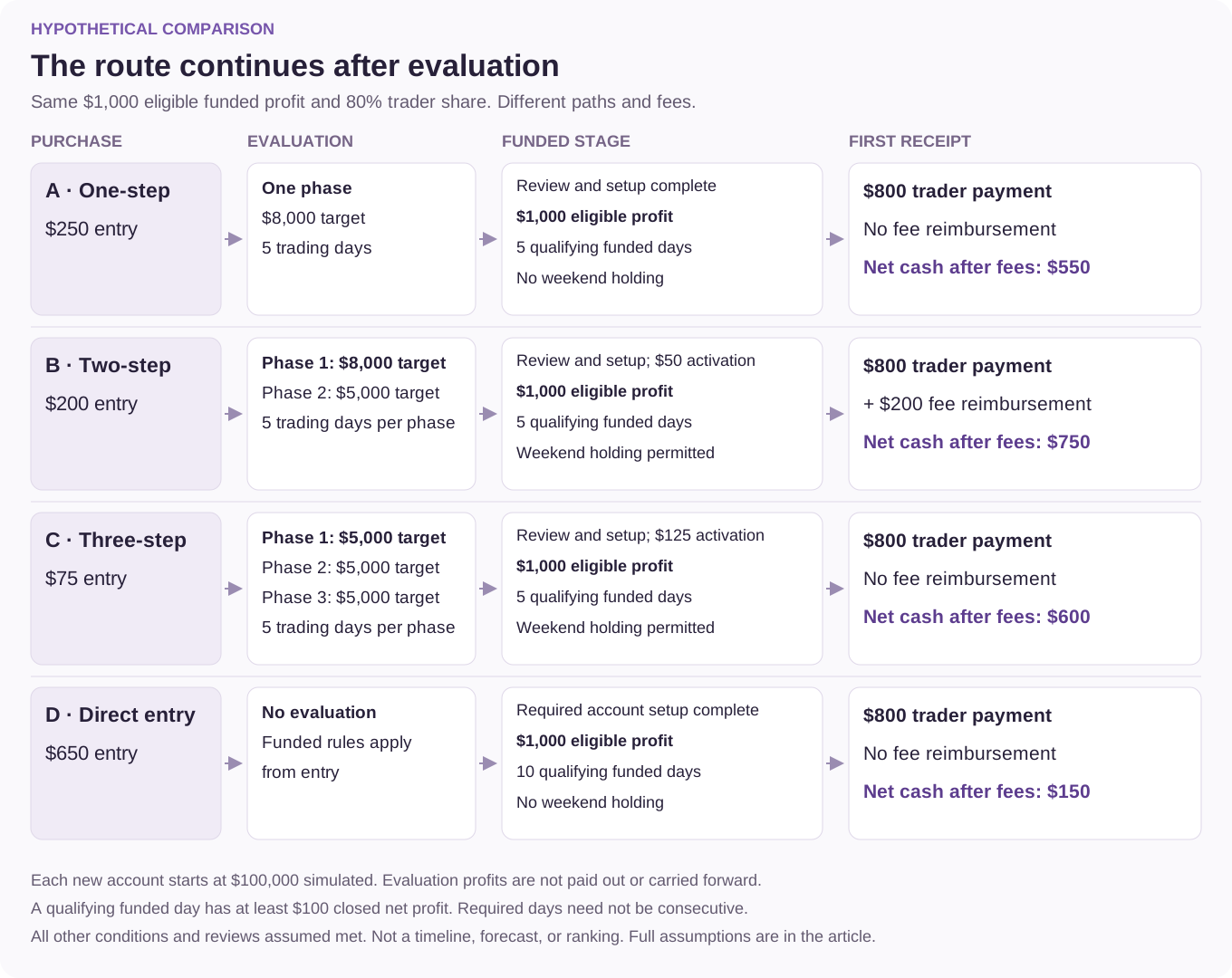
The same payout can leave a different cash result
The trader's payment from profit is the same in all four cases:
Trader payment = $1,000 eligible profit × 80% = $800
Then calculate the cash position through receipt:
Net cash after fees = trader payment + cash fee reimbursement − cash fees paid
| Cash item through first receipt | Offer A | Offer B | Offer C | Offer D |
|---|---|---|---|---|
| Fees paid before the first payout | $250 | $250 | $200 | $650 |
| Trader payment from profit | $800 | $800 | $800 | $800 |
| Cash entry-fee reimbursement | $0 | $200 | $0 | $0 |
| Net cash after fees | $550 | $750 | $600 | $150 |
Offer B's $750 is 800 + 200 − (200 + 50). Its conditional reimbursement does not eliminate the need to pay $250 beforehand.
Offer C starts at $75, but reaching the funded stage costs $200 after its $125 activation payment. Its three $5,000 evaluation targets are separate from the $1,000 funded profit. Offer D removes evaluation but still requires ten qualifying funded days in this invented offer and leaves $150 after its higher fee.
These are conditional cash outcomes, not expected returns or a ranking. They exclude the value of time and the probability of reaching payment. If weekend holding is essential to the trader's method, A (once funded) and D (from entry) fail that requirement, regardless of their phase count or cash result.
A failed attempt changes the comparison
Now change only Offer B's path: one evaluation attempt fails before activation, and the trader buys a second attempt that follows the successful path above. Only the successful attempt's entry fee is reimbursed.
Total fees = $200 failed attempt + $200 successful attempt + $50 activation = $450
Net cash after fees = $800 + $200 − $450 = $550
The refund has not erased the failed attempt. If a path ends without a payout or reimbursement, the relevant cash result instead reflects the fees already paid. Set a spending ceiling for attempts and renewals before purchasing; a stage label cannot supply that budget for you.
Do fewer evaluation stages mean a faster payout?
Fewer evaluation stages mean fewer evaluation phases to complete. They do not establish the time from purchase to money received. The remaining requirements can differ, and the time needed to generate compliant results is unknown.
Check the starting event for each clock. Evaluation days, funded trading days, profitable days, calendar waits, and processing days are different counts. Two activity requirements might run together, while a new funded-day count may begin only after the funded account is issued. Do not add or overlap them without the product's rules.
Passing can also be followed by review and onboarding. FTMO's CFD after-passing instructions distinguish result review from identity verification and the account agreement. Its two-step route also has a reviewed transition from Challenge to Verification. FTMO after passing
Request eligibility is a further event. FTMO's CFD reward policy allows a request on the 14th or a later day after the first trade on the relevant account, subject to its conditions, and describes subsequent review and payment steps. That is not a promise of receipt fourteen days after buying a challenge. FTMO reward process
An instant program can have a much earlier request window while retaining other conditions. Funded Trading Plus's Instant help page permits a request from day one when the account is in profit and the minimum conditions are met, subject to review and processing. That wording does not mean that purchase itself produces a payable profit or an immediate transfer. Instant request conditions
Use the payout-process guide to separate qualifying activity, request, approval, dispatch, and receipt. Compare published conditions without turning them into a personal earnings timetable.
How should you choose a route?
Start with two exact offers that your trading method and location can use. Then explain each complete path in ordinary language before comparing the fee.
| Question | What a usable answer includes |
|---|---|
| What must I complete before reward-bearing trading? | Each phase, target, required activity, review, and account transition |
| Can my method operate throughout the route? | Loss rules, instruments, holding, news, automation, and position limits at every relevant stage |
| What must I pay before the same endpoint? | Fees, assumed attempts and paid periods, activation, and required extras |
| What account do I actually receive? | Simulated/live status, opening value, carried or reset balances, and the applicable agreement |
| What remains before the first money arrives? | Eligible profit, qualifying days, other conditions, request window, review, and receiving method |
| What if the path stops early? | Fees already spent, cancellation or renewal duties, and the cost and scope of another attempt |
A one-step offer can fit when its single evaluation and subsequent rules fit your method. A two-step or three-step offer can remain worth comparing when its additional phases come with conditions you value. A lower entry payment matters only alongside later charges and the obligations at every stage. Direct entry can be relevant when you are willing to pay its actual price for bypassing evaluation and can work within its immediate account and payout rules. None of these is an automatic recommendation for beginners or experienced traders.
Next step: complete the before-you-pay comparison worksheet for two exact configurations. Use the same endpoint and explicit assumptions for both. Keep unanswered conditions visible, and recheck the selected product, options, and applicable terms at checkout.
Sources and method
Official examples were checked on 2 October 2026. They establish only the products, stages, and conditions described beside each link. The four-offer model and its fees, targets, permissions, activity rules, and cash outcomes are hypothetical. No pass rates, expected earnings, or proprietary PFW scores have been calculated.
- FTMO, CFD: route definitions, trading objectives, news policy, fee reimbursement, after passing, and reward process.
- Funded Trading Plus, Instant: product description and program conditions.
- Topstep, futures: program overview.
- The5ers, CFD Bootcamp: program structure and selected stage balances.
- FXIFY: Three Phase program.