LearnPayout conditions
Where Does Your Simulated Profit Go When a Futures Firm Moves You to Live Trading?
A move to live trading does not mean that all accumulated simulated profit becomes immediately tradable or withdrawable. The transition can cap what carries forward, hold part in reserve, or leave profit available for a separate payout. The new account also has its own loss rules.
On this page
Topstep's Express Funded Account (XFA) and My Funded Futures' regular Rapid Sim Funded route illustrate different outcomes. Topstep divides a capped transfer between live trading balance and reserve. Rapid can allocate profit to reserve and withdrawal eligibility while the new live balance starts at $0. These are selected futures examples checked on 13 November 2026, not a ranking or a rule for every program. Topstep parameters · Rapid Live.
Which amounts need separate entries?
Start with a reconciliation of the outgoing account, then open a new record for the incoming account. An advertised account tier is a program label; it is not a substitute for either record.
| Entry | What it tells you |
|---|---|
| Accumulated simulated profit | The amount still recorded on the old account at the transition checkpoint. Previous payouts have already left it. |
| Eligible transfer or allocation pool | The part accepted into the transition, after applicable eligibility rules and caps. |
| Forfeited amount | Profit removed under an explicit transition rule. Keep it separate from profit still held conditionally. |
| Reserve | An allocation whose use or release depends on later events. Record those events. |
| Opening tradable balance | The actual starting value on the live trading ledger. |
| Withdrawal-eligible amount | Profit available to enter the applicable payout process, before any remaining conditions, split or fees. |
| Remaining loss room | The distance from the value monitored for max loss to its current threshold. Calculate it separately from cash access. |
Avoid counting one allocation twice. If part of the old profit is reserved, it cannot also be counted as available in the new trading balance unless the rules explicitly credit it there. Likewise, an amount available to request is not yet cash received.
This guide starts at simulated funded to live. Moving from an evaluation to a simulated funded account is an earlier transition with its own treatment of profits and activity. Use the evaluation-to-funded checklist for that broader comparison.
What triggers the move, and what happens to the old account?
Topstep's call-up is discretionary. A trader cannot decline it and continue in the XFA; all XFAs close on the move to live. Its separate Pro Account remains simulated and serves traders in jurisdictions where live access is limited. Confirm which destination you are actually receiving. Call-up process · Live account parameters · Pro Account.
For regular Rapid, My Funded Futures identifies two routes: $10,000 net profit in one trading session, which initiates an automatic transition and forfeits that day's excess above $10,000; or a Risk Management Team decision. The old Sim Funded account becomes dormant, and simulated trading and additional purchases are suspended while live. Rapid transition criteria and process.
A discretionary call-up with $7,000 accumulated across sessions therefore does not require a $10,000 day. Equally, the automatic threshold is not an invitation to plan a larger one-day profit and assume all of it survives the transition.
The Rapid examples below use the live parameters My Funded Futures publishes for Rapid at $25K to $150K, with one $50K account for the loss-room calculation. Its Rapid EOD guides say live transition at $25K and $50K follows the same rules as standard Rapid at those sizes. The examples do not describe Builder, Pro or other plans. Rapid EOD 50K · Rapid EOD 25K.
Topstep: reconcile the cap before applying the split
Topstep generally averages eligible XFA tiers with at least one payout, rounding up to the next live tier; if none has had a payout, its stated exception includes all active eligible XFAs. The transfer is capped at that live tier. Account-size rules and worked example.
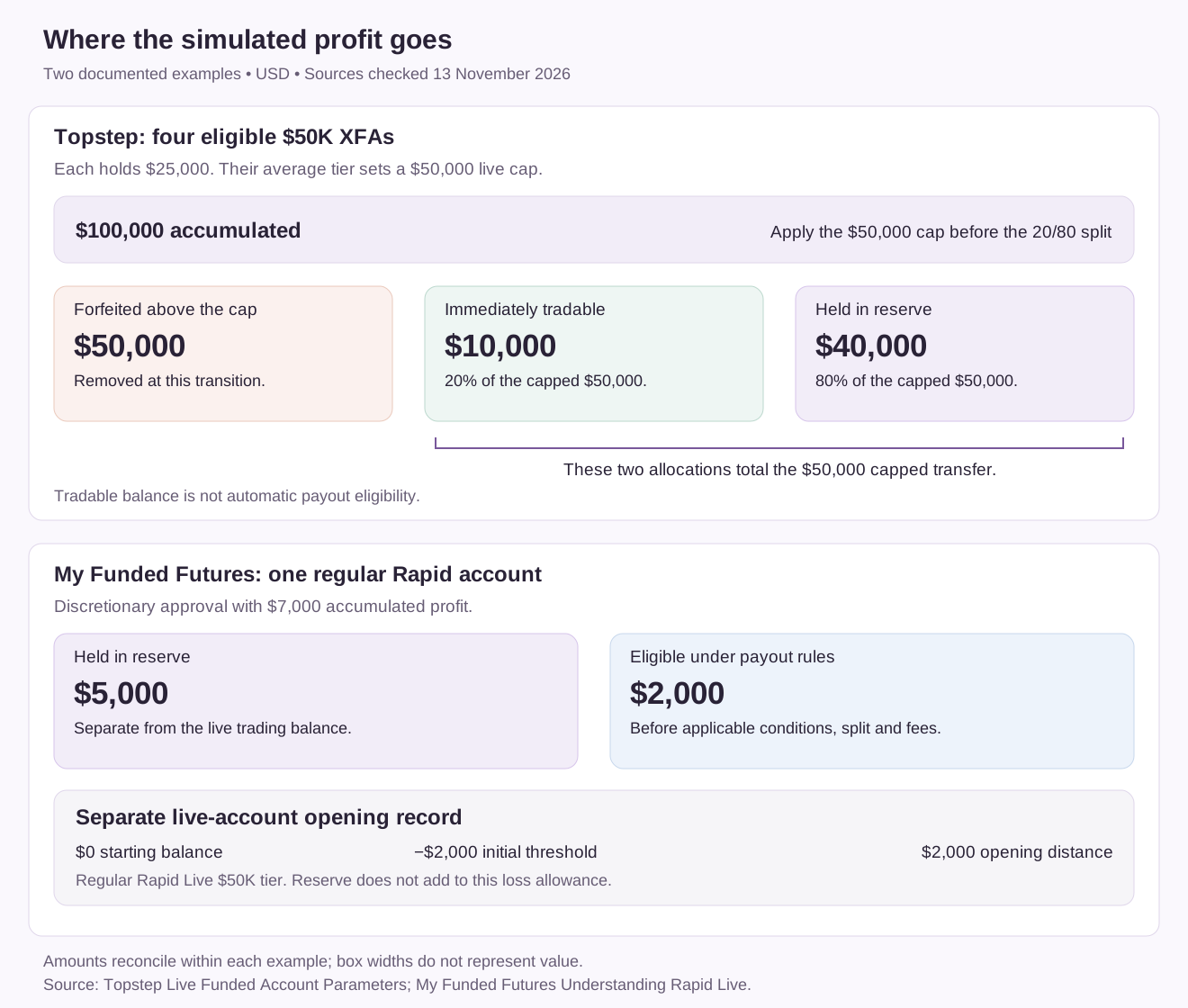
Use Topstep's published example: four eligible $50K XFAs, each holding $25,000. These are remaining balances, not lifetime earnings. At this checkpoint, there is no additional trade or payout to model.
| Calculation | Amount |
|---|---|
| Accumulated balance: 4 × $25,000 | $100,000 |
| Live tier: average of four $50K tiers | $50,000 |
| Capped transfer | $50,000 |
| Excess forfeited: $100,000 − $50,000 | $50,000 |
| Immediately tradable: 20% × $50,000 | $10,000 |
| Reserve: 80% × $50,000 | $40,000 |
The reconciliation is $100,000 = $50,000 forfeited + $10,000 tradable + $40,000 reserve. Applying 20% to the full $100,000 would produce the wrong opening balance. Adding reserve to tradable balance would describe the capped allocation, not the amount available for the next trade.
Topstep's call-up FAQ answers "No" when asked whether XFA funds are forfeited, because they set the live starting balance up to the account size; the parameters example calls the part above that cap forfeited.
Payout eligibility remains separate. Topstep's live policy initially requires five qualifying $150-plus net-profit days per cycle and permits requests up to 50% of balance, without the XFA dollar cap. Later daily access requires 30 qualifying live days; XFA days do not count. Payouts use unlocked balance, and withdrawing the full balance closes the account. These conditions do not make the $40,000 reserve immediately withdrawable. Live payout policy.
What if 20% is below the stated starting minimum?
The ordinary split above lands exactly on Topstep's $10,000 minimum. Its parameters set a $5,000 minimum for the $25K live tier instead. When 20% of the capped amount is below $10,000, the call-up page says Topstep adds funds to reach that minimum. Its next sentence says: "The remaining 80% is held in Reserve." Starting-balance parameters · Call-up instructions.
Read together, those two sentences give this ledger for a hypothetical $30,000 capped transfer at the $50K tier:
| Hypothetical $30,000 capped transfer | Amount |
|---|---|
| 20% of the capped transfer | $6,000 |
| Added by Topstep to reach the minimum | $4,000 |
| Opening tradable balance | $10,000 |
| Reserve: 80% of the capped transfer | $24,000 |
This is PFW's reading of the two sentences, not a Topstep example; the page gives no worked example below the minimum. The resulting $34,000 allocation combines the $30,000 transfer and $4,000 added by Topstep. Check that your transition notice shows the added amount and the reserve as separate lines.
My Funded Futures Rapid: reserve and withdrawal eligibility are separate from the live balance
My Funded Futures' own discretionary-transition example starts with $7,000 accumulated profit: $5,000 goes to reserve and $2,000 becomes available under the usual payout rules. The new Rapid Live balance starts at $0. Rapid Live, Example 2.
| Entry at the transition checkpoint | Amount | How to use it |
|---|---|---|
| Accumulated simulated profit | $7,000 | Reconcile the old account's allocation. |
| Reserve allocation | $5,000 | Record it separately from the live ledger. |
| Excess eligible under payout rules | $2,000 | Follow the applicable request and profit-sharing terms; this is not a stated net receipt. |
| Opening Rapid Live balance | $0 | Start the new account's trading record here. |
Here $7,000 = $5,000 reserve + $2,000 withdrawal-eligible excess. The $0 opening live balance is a separate entry, not a third deduction from the $7,000. The example shows no forfeiture; the one-day excess rule belongs to the automatic trigger described earlier.
How can a live account start at zero and still have loss room?
Regular Rapid Live at $50K starts with a $2,000 EOD trailing max-loss allowance. Its threshold stops rising at $0; the initial threshold is therefore −$2,000. Reaching max loss closes the account. A negative balance before the threshold reaches zero is permitted, and Rapid Live has no payout-buffer requirement. Live operating rules.
At a flat opening checkpoint, with no separate credit or other adjustment:
Opening distance = $0 − (−$2,000) = $2,000.
For a separate hypothetical flat checkpoint, suppose $600 of net losses have been realized, all charges are included, no earlier breach occurred, and the threshold is still −$2,000 because no higher EOD reference has moved it. Balance and equity are −$600, so the distance is −$600 − (−$2,000) = $1,400. The account has a negative balance and remains above the stated threshold.
This does not add the $5,000 reserve to the $1,400 distance. Nor does the word EOD establish that the threshold can be crossed safely during the day. EOD describes the reference used to move the limit; the source says reaching max loss closes the account. Use the live account's current threshold when assessing a new trade.
For Topstep's example, the $10,000 tradable balance likewise is not a $10,000 per-trade allowance. Daily limits, position controls and closure provisions still apply. After a payout, recalculate from the resulting account state using the remaining-loss-buffer guide.
How can reserve become available later?
The two reserve programs serve different functions. Topstep describes four 25% releases, tied to targets and Monday reviews. A large win cannot skip multiple releases. Below $1,000, its general paragraph says the account may be liquidated immediately and closed at the end of the trading day; the FAQ says it will be. Both passages send the remaining balance as a final payout. The example says "Unlocked reserve is forfeited". Ask Topstep to reconcile that wording with the final payout and confirm each reserve component, rather than replacing "unlocked" with "locked." Capital expansion and closure FAQ.
For one regular Rapid account, My Funded Futures' reserve page requires both 20 profitable live trading days and $10,000 in cumulative gross live payouts for a performance bonus equal to the remaining reserve. Those are live milestones, not previous simulated results. Reserve program.
Following a Rapid Live max-loss breach, reserve first offsets any negative live balance; the remainder returns to the dormant Sim Funded account for withdrawal-only handling. The page separately describes retained Sim Funded buffer withdrawals and their conditions. A returned ledger amount therefore should not be labeled final cash received without reconciling those terms. The same page imposes a 21-calendar-day cooldown after that live breach. This is not a reset rule for evaluation or Sim Funded failures.
The reserve instructions above do not increase the active Rapid account's published max-loss allowance.
What should your transition confirmation contain?
Before the first live order, match the firm, exact program, incoming stage, tier, platform and applicable cohort. Then reconcile these three records:
- Outgoing account: closing simulated profit, earlier payouts already deducted, eligible accounts, cap, forfeiture and dormant or closed status.
- New trading account: actual opening balance, any separate credit, max-loss threshold and its update rule, daily controls, position allowance and remaining loss room.
- Reserve and payments: amount held, release event, closure treatment, withdrawal-eligible excess, applicable split and fees, and which activity counts toward a new payout cycle.
For a supplemented Topstep start, ask for the amount Topstep added and the reserve as separate lines. For Rapid, request separate lines for reserve, any retained Sim Funded buffer and withdrawal-eligible excess. A response saying only "you keep your profit" does not answer those accounting questions.
Keep the transition notice, dated terms and opening account statement together. If the figures disagree, reconcile them with the firm's live team before treating the larger number as available. Check subscription cancellation, live data and platform charges separately; the billing guide explains why account status and payment status need their own records.
Related reading
- Evaluation versus funded rules, for the earlier transition and a full account-rule checklist.
- Payouts and remaining loss buffer, for the state of the trading account after a debit.
- Topstep, Lucid Trading and Tradeify at $50K, for selected evaluation and simulated funded routes before a later live call-up.
Sources and method
Official help pages were read on 13 November 2026. The Topstep and $7,000 Rapid allocations reproduce the providers' documented examples with PFW reconciliation tables. The $30,000 minimum case, changed-input check and $600 loss checkpoint are labeled calculations or hypothetical cases. They are not observed trader outcomes.
- Topstep: Live Funded Account Parameters, call-up and call-down process, Payout Policy and Pro Account.
- My Funded Futures: Understanding Rapid Live, Reserve Program and Performance Bonus Structure and the Rapid EOD 50K and Rapid EOD 25K guides.
The source-check date records when these passages were checked, not when a rule took effect or which contract applies to a particular trader. Multiple Rapid accounts, complete live payout calculations and other program variants are outside these examples. The $30,000 ledger reads two sentences of Topstep's call-up page together; Topstep gives no worked example below the minimum.