ResearchFutures accounts
Topstep vs Lucid Trading vs Tradeify: Three $50K Futures Accounts Compared
These three accounts start with the same opening loss allowance, but their purchase costs, daily pauses and funded payout conditions differ. Topstep Standard renews until you pass or cancel. LucidFlex and Tradeify Growth charge once. Growth permits an evaluation result concentrated in one day, then adds consistency requirements in the funded stage. LucidFlex removes its evaluation consistency test after passing, while Topstep offers a choice of funded payout paths.
- Compares
- Lucid Trading · LucidFlex (DLL on) · $50,000
- Topstep · Trading Combine Standard · $50,000
- Tradeify · Growth · $50,000
Only these three accounts. Other programs, options and sizes can have different rules and costs.
- Values
- Quoted from the account pages, with sources checked 13–31 October 2026. Each value’s information button opens its conditions and sources.
- Side by side
- Compare these accounts
On this page
This comparison follows Topstep Trading Combine Standard without Responsible Trading Advantage, LucidFlex with the daily loss limit on and standard consistency, and Tradeify Growth, each at the $50,000 tier. It covers the evaluation and the simulated funded stage reached after passing. The tier label is not cash you can withdraw.
Which exact accounts are being compared?
The tables use alphabetical account order. Each selection follows an evaluation route, with the purchase settings retained through the comparison.
| Account | Selected route |
|---|---|
| Lucid Trading · LucidFlex (DLL on) · $50,000 | LucidFlex $50,000 with the Daily Loss Limit on and the standard 40% consistency, chosen at purchase: an evaluation, then a simulated funded account with On Demand Payouts. The plan card's price is the one for this configuration; Lucid calls it the cheapest version of LucidFlex, and the limit off and the 50% consistency add-on cost more. Read on Tradovate; every Lucid account works on every listed platform. |
| Topstep · Trading Combine Standard · $50,000 | Trading Combine on the Standard path, without the Responsible Trading Advantage: the Trading Combine, then an Express Funded Account on the Standard or Consistency payout path, chosen at activation. The path cannot be changed after purchase; the Responsible Trading Advantage is an option at checkout, and a Live Funded Account follows only if Topstep's Risk Team calls the trader up. |
| Tradeify · Growth · $50,000 | Growth $50,000, Tradeify futures: one evaluation, then a simulated funded account with Growth's fixed payout policy. |
LucidFlex lets us examine the change from evaluation consistency to funded qualifying days. LucidPro and LucidDaily are separate alternatives. The DLL-off setting and the paid consistency add-on are outside this comparison; both cost more than the selected configuration.
Topstep Standard supplies a subscription-plus-activation example. No Activation Fee is a separate initial purchase alternative. The Standard purchase route and Standard funded payout path are different choices: buying Standard does not select the funded payout path for you.
Growth supplies a fixed funded payout policy. Select offers a different evaluation route, while Lightning Funded starts at the simulated funded stage. Tradeify's Growth evaluation explanation distinguishes Growth from Select, including the latter's payout choice after passing (checked 1 November 2026). These selections are a defined comparison, not a ranking of the firms' full catalogs.
What must you achieve in the evaluation?
| Evaluation measure | LucidFlex, DLL on | Topstep Standard | Tradeify Growth |
|---|---|---|---|
| Opening loss allowance | $2,000 | $2,000 | $2,000 |
| Base profit target | 6% | 6% | 6% |
| Difficulty ratio | 1.50 | 1.50 | 1.50 |
The matching base targets and Difficulty ratios do not describe how profit may be distributed across days. In the targets' conditions, LucidFlex tests the largest day against total evaluation profit, while Topstep can raise the target when the best day is too large. Growth has no evaluation consistency test. A concentrated winning day can therefore finish Growth's evaluation while leaving work to do on the other two.
| Account | Passing time and activity requirements |
|---|---|
| LucidFlex, DLL on | None stated: Lucid says the evaluation can be passed in as few as 3 days with the 40% consistency rule, or 2 days with the 50% consistency add-on, and it has no time limit. An account with no trade (a net profit or loss of at least $1) for 30 calendar days is deleted. |
| Topstep Standard | No time limit for passing: the Trading Combine subscription stays active until you pass or cancel. You cannot pass in one day; you can pass in as few as two days. An Express Funded Account with no trading activity for more than 30 days may be closed. |
| Tradeify Growth | A minimum of 1 trading day and no time limit. At least one trade a week (Monday to Friday) is needed on each account, or it can be closed for inactivity after an email warning. |
The shortest permitted path is not an expected completion time. A slower attempt also has to remain active: an unlimited passing period does not remove an inactivity rule or stop subscription billing. The evaluation-to-funded checklist explains why passing conditions should be recorded separately from the rules that begin afterward.
How do trailing loss limits, daily pauses and contract caps differ?
All three use an end-of-day reference for the selected account's trailing max-loss rule. Their lock behavior and funded balance conventions differ.
| Account | Overall loss rule |
|---|---|
| LucidFlex, DLL on | A $2,000 end-of-day trailing max loss limit in the evaluation and on the funded account: it starts at $48,000, rises with the highest end-of-day balance and locks at $50,100 once the account closes above $52,100. After a payout request it moves to $50,100 at once. Reaching it breaches the account. |
| Topstep Standard | Maximum Loss Limit of $2,000, trailing the end-of-day balance. In the Trading Combine it starts at $48,000, rises with the end-of-day balance and locks at the $50,000 starting balance. The Express Funded Account's balance starts at $0, so its limit starts at -$2,000 and locks at $0; after the first payout it is $0. It is monitored in real time, open positions included: touching it closes the Trading Combine until a reset, and the Express Funded Account for good. |
| Tradeify Growth | An end-of-day trailing max drawdown of $2,000: it trails the highest end-of-day balance, never moves down, and is enforced in real time against net liquidation value; touching it fails the account. On the funded account it locks at $50,100 once the end-of-day balance reaches $52,100, or at the first payout request; it never locks on the evaluation. |
Topstep's Express Funded Account starts its displayed balance at zero, while LucidFlex uses the nominal account balance in its threshold wording. Comparing those threshold numbers without their starting balances would misstate the room available. Growth's evaluation trail does not lock, even though its funded trail can.
End-of-day describes when the reference updates. It does not give permission to cross a loss threshold during the session. Topstep and Growth explicitly monitor open risk in real time. The LucidFlex rule we have recorded says reaching the threshold breaches the account, but it does not establish how open-position P&L counts. Confirm that basis before using a balance-only check while a trade is open.
| Account | Daily loss and contract limits, by stage |
|---|---|
| LucidFlex, DLL on | A daily loss limit of $1,200 in the evaluation and on the funded account, where the plan card's funded rules give it as "DLL (Below Initial Trail) $1,200" and state no limit above the initial trail balance of $52,100. Reaching it stops trading until the next session without breaching the account. At most 4 minis or 40 micros in the evaluation; on the funded account a scaling plan sets the limit by profit, updated at the end of each session: 2 minis up to $999, 3 from $1,000 and 4 from $2,000 of profit. |
| Topstep Standard | No daily loss limit in either stage unless the trader adds one at checkout, when buying the Trading Combine (the Responsible Trading Advantage) or activating the Express Funded Account: $1,000, fixed. Up to 5 minis or 50 micros at a time in the Trading Combine (10 micros count as one mini); in the Express Funded Account the Scaling Plan sets the limit by the current balance, which starts at $0. Topstep sets lower limits on some volatile products. |
| Tradeify Growth | A daily loss limit of $1,250 in the evaluation and the funded account, a soft breach: trading pauses until the next session (6:00 PM ET) and the account stays active. It is not a hard stop: losses may exceed it before trading pauses. Once the account is 6% in profit, it rises to $2,000 from the next session. Up to 4 minis / 40 micros. |
For the selected Topstep configuration, the overall loss rule binds without an added daily limit; Topstep's optional one, which can also be added when the funded account is activated, is not assumed here. LucidFlex and Growth can stop trading for the session while leaving the account active. That pause does not replenish the max-loss room already consumed. Growth also warns that losses can exceed its daily limit before protection triggers, so the daily limit is not a guaranteed exit price.
A funded LucidFlex or Topstep account can allow fewer contracts than its evaluation. Tradeify's rules overview says Growth uses its maximum position size from day one (checked 1 November 2026). Check the funded limit before copying the position size used to pass. The contract-scaling guide explains the stage change; the separate risk check explains why an allowed contract count can still be too large for the remaining loss room.
What changes if reaching funding takes longer?
| Charge | LucidFlex, DLL on | Topstep Standard | Tradeify Growth |
|---|---|---|---|
| Purchase price and billing | $115 one-time | $49 per month | $145 one-time |
| Activation fee | None | $149 | None |
| Base platform and data fee | None | None | None |
Read the price conditions before using a discounted plan card as the purchase price. Optional services and trading commissions are separate from these base charges. Tradeify's platform row below also explains the non-professional data agreement and the charge that may apply without it.
Two hypothetical completion dates
Assume one account is purchased on 4 January 2027, with no resets or extra accounts. In the quicker case, the dashboard records the pass and the funded account is activated on 22 January 2027. In the slower case, both happen on 22 March 2027. Assume all required activity continues, the account remains valid, and the currently quoted billing rules remain in force. These are invented successful completion dates, not forecasts.
Topstep's price conditions specify a 30-day renewal cycle. Its subscription policy also confirms that passing cancels the subscription and that the dashboard must show the pass before the next renewal date (checked 1 November 2026). Activation is a separate payment event on the Standard purchase route.
| Scenario | Purchases and activation charges |
|---|---|
| Pass and activate on 22 January | LucidFlex and Growth: one purchase each. Topstep Standard: the 4 January subscription payment, then one activation fee. |
| Pass and activate on 22 March | LucidFlex and Growth: one purchase each. Topstep Standard: subscription payments on 4 January, 3 February and 5 March, then one activation fee. |
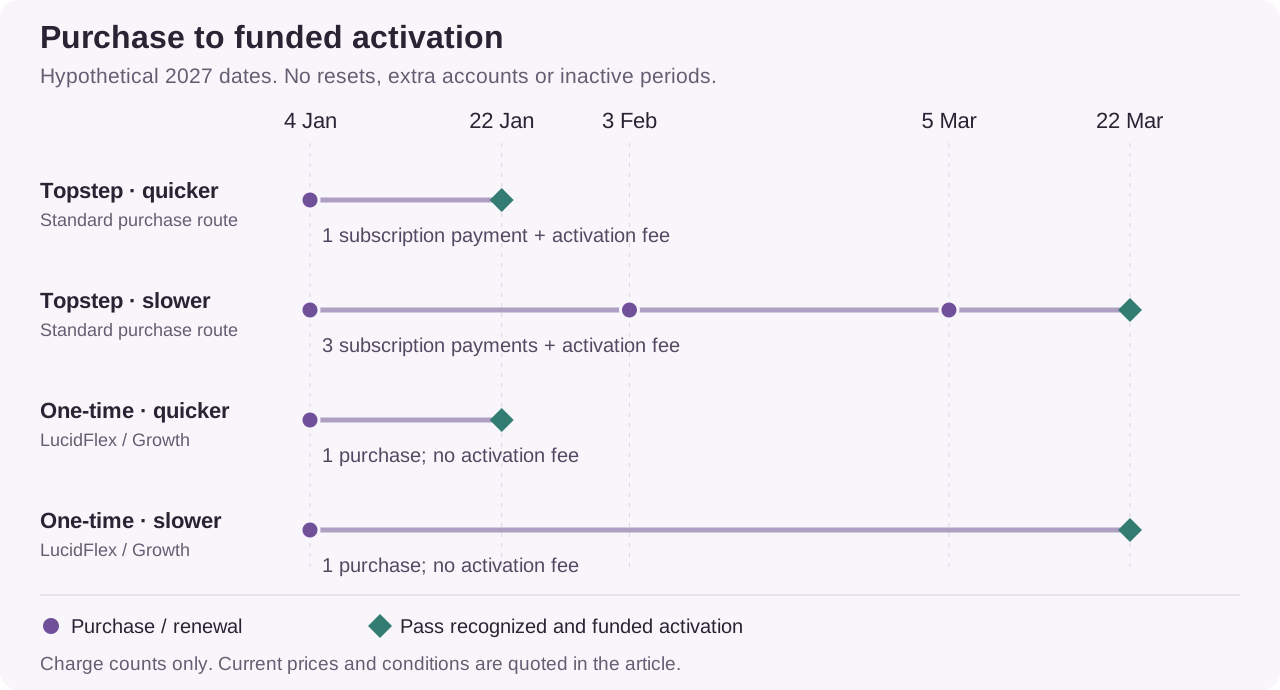
For each successful Topstep Standard case, multiply the quoted subscription price by the payment count and add the quoted activation fee. For each one-time route, the purchase charge does not repeat merely because the attempt takes longer. Taxes, optional services, resets and trading costs are outside this calendar.
The No Activation Fee alternative changes the trade-off between recurring and later charges. Use the separate account's current prices with the same payment count and endpoint. If you stop without passing, no activation charge becomes payable, so a comparison that assumes success answers a different cost question. Learn's stopping-without-passing example explains that distinction. The dated cost-to-funded study shows the purchase-path crossover using its own frozen inputs.
Do refunds reduce the purchase cost?
| Account | Fee refund with funding or payout | Cancellation terms |
|---|---|---|
| LucidFlex, DLL on | None: no refund of the fee once the account has been traded. | No refund once the account has been traded; for an account never traded Lucid may consider a refund at its sole discretion. |
| Topstep Standard | None: once funding is earned, Topstep counts the subscription and all fees as used in full. | The subscription can be cancelled at any time from the Billing page, and fees are generally not refunded. Exceptions: up to one monthly renewal payment back within the first 14 days of a trader's first-ever Trading Combine if it has not been passed, and a forgotten rebill refunded if asked within 28 days of the charge and the account has not traded since. |
| Tradeify Growth | None stated: no page offers the fee back with a payout, and all sales are final. | None: all sales are final, including account purchases and resets, and the service is considered rendered once access is granted. A promo code that was not applied is corrected separately by support. |
The calendar counts gross charges paid to reach activation. A cancellation exception has its own conditions; it is not an automatic discount on a completed attempt.
What must happen before the first payout request?
Passing the evaluation does not satisfy the funded payout conditions. In particular, Growth introduces a profit-distribution test after its evaluation, while LucidFlex removes its evaluation consistency test. Topstep makes the funded payout path a choice at activation.
| Account | Funded qualifying activity | Funded consistency and related conditions |
|---|---|---|
| LucidFlex, DLL on | No fixed wait: a payout can be requested once $150 or more has been made on 5 separate days in the cycle, with positive net profit; the count starts again after each approved payout. With the Daily Loss Limit on, payouts are on demand: a request can be made during the trading session, from profit made that session (6:00 PM to 3:45 PM ET); an account with a hedging violation cannot request one during the session. | None on the funded account (40% in the evaluation only, or 50% with the consistency add-on). |
| Topstep Standard purchase route | Standard path: 5 winning days of at least $150 net P&L (not necessarily in a row) before each request, and net profit since the last payout (except before the first). Consistency path: 3 trading days with at least one trade each, with the largest single day at most 40% of the total net profit. The count restarts after each payout. | Standard path: no consistency rule. Consistency path: no single day may make up more than 40% of the total net profit in each payout window, which starts again after each payout. |
| Tradeify Growth | No calendar wait: each payout needs 5 trading days with a profit greater than $150 since the last payout (the count resets after each one), the 35% consistency rule and a balance of at least $53,000. | 35% consistency rule on the funded account: the biggest day's profit must be at or below 35% of total profit since the last payout. To request a payout, over 50% of trades must last longer than 10 seconds and over 50% of profit must come from trades held longer than 10 seconds; the funded trader agreement asks only that 50% or more of profit come from such trades, and says Help Center rules prevail on trading rules. |
On LucidFlex, on-demand describes when an eligible request can be made. The qualifying days still have to be earned, and a hedging violation removes intraday request access. On Growth, profitable days are only part of the test: the balance, consistency and trade-duration requirements also matter. The boundaries differ: a qualifying Growth day must be above its quoted amount, while LucidFlex and Topstep's Standard payout path also count a day equal to it.
Topstep's Consistency payout path can reach its day-count requirement sooner than its Standard payout path, but it also tests profit concentration. The Topstep first-payout Answer applies both paths to the same short profit history. It also separates the funded choice from the Standard purchase route.
| Account | Request minimum and cap | Initial profit share |
|---|---|---|
| LucidFlex, DLL on | Each request at least $500 and at most $2,000, for every payout (no buffer); up to 5 payouts, after which the account moves to Lucid's live program. The article's text limits a request to 50% of the account balance, its table to 50% of profit; which one applies is not resolved. | 90% |
| Topstep Standard purchase route | At least $125 per request and at most 50% of the balance, capped at $2,000 per request on the Standard path or $3,000 on the Consistency path; the 90% share then applies. | 90% |
| Tradeify Growth | Minimum payout $500. Caps per payout request: $1,500 for the first, $2,000 for the second, $2,500 for the third, $3,000 for the fourth and later payouts. These are on the amount requested; the trader receives 90% of it. | 90% |
The ordinary quoted share is the same, but access to profit differs. Topstep's share conditions retain a different treatment for the stated earlier-dashboard cohort. Topstep's two funded payout paths have different caps. Growth's cap changes with payout number. Lucid's payout page conflicts over whether the percentage limit uses account balance or profit. Its request minimum and dollar cap are stated; the percentage basis remains unresolved. Ask Lucid to confirm that basis for the exact account before planning a withdrawal around it.
What changes at the request, debit and payment stages?
| Account | Account state after requesting or receiving a payout |
|---|---|
| LucidFlex, DLL on | Once the payout is approved, the amount is deducted from the account within minutes. The loss limit moves to $50,100 at the first request. After a request made during the trading session, trading on the account is paused until the end of the trading day. The 5 days of minimum profit must be earned again after every approved payout. After 5 payouts the account moves to Lucid's live program. |
| Topstep Standard purchase route | The payout comes out of the balance and the Maximum Loss Limit is set to $0 for good, so the remaining balance is the room left to lose; the winning-day count or consistency window restarts, and a lower balance can lower the Scaling Plan's contract limit. After a payout the account can no longer be reactivated through Back2Funded. |
| Tradeify Growth | The drawdown floor locks at $50,100 at the first payout request, if it has not already. The trading-day count and the consistency period reset after each payout. Tradeify may move the trader to an Elite Live account after a payout. |
A request can change the loss rule before cash reaches you. LucidFlex and Growth can lock the threshold at the first request; LucidFlex also pauses trading after an intraday request. The LucidFlex first-request Answer works through the room remaining after the debit for the DLL-on account. At Topstep, the payout itself fixes the loss limit at zero for good, so the balance left after the debit is the whole room to lose, and a lower balance can also lower the funded contract limit.
Keep those events separate when planning the next trade. A payout debit can reduce the account value without lowering a locked loss threshold. The post-payout buffer guide explains the mechanism.
| Account | Recorded processing time | Payout fees and methods |
|---|---|---|
| LucidFlex, DLL on | Once approved, the amount is deducted from the account within minutes and paid to the payout method within 2 business days. | No Lucid fee is stated for payouts; they are paid by Plaid (US), WorkMarket by ADP (bank transfer or PayPal) or, for international traders, cryptocurrency. |
| Topstep Standard purchase route | Internal approval can take 1 to 3 business days. Aeropay then pays instantly after approval (US banks that support real-time payments), Prop-to-Brokerage the same day if requested by 12 PM CT, Wise and ACH in 1 to 3 business days, and wire/SWIFT in 5 to 10 business days. | No Topstep fee for Prop-to-Brokerage (US), Aeropay (US banks) or Wise (China, Canada and the UK), though banks or those services may charge their own; $30 for ACH (US banks) and for wire/SWIFT (international). |
| Tradeify Growth | Payment within 24 hours after an approved payout is withdrawn from the account, once Rise onboarding is complete; requests outside business hours (Monday to Friday, 8:00 AM to 5:00 PM ET) and on federal holidays may take up to 72 hours. | Not stated by Tradeify for futures: no page names a payout fee; Tradeify's Rise article says Rise's "Receive Payments" account is free. |
These clocks start at different events. Lucid's quoted payment clock starts after approval. Tradeify's starts after an approved payout is withdrawn from the account and requires Rise onboarding. Topstep separates internal approval from the selected payment method. A shorter stated processing interval does not establish an earlier first payout from the day you buy. Where no firm fee is stated, that wording does not establish that every receiving bank or provider is free.
Can your trading method use the account?
| Account | News and holding positions |
|---|---|
| LucidFlex, DLL on | News trading is allowed at every stage. Positions must be closed by 4:45 PM ET, Monday to Friday; Lucid closes any still open at that time, which does not fail the account. Trading reopens at 6:00 PM ET, Sunday to Thursday. |
| Topstep Standard | News trading is allowed in both stages: Topstep does not require flattening for economic releases, but trading the full Maximum Position Size into a scheduled major news event is prohibited. All positions must be closed by 3:10 PM CT each weekday, or earlier for products that close earlier, so nothing is held overnight or over the weekend. |
| Tradeify Growth | News: no restrictions in either stage. Overnight: not allowed. All positions must be closed by 4:45 PM ET (12:59 PM ET on holiday early closes); positions still open at the close are closed automatically, without failing the account. A position may be held across midnight within one session (6:00 PM to 4:45 PM ET), but never into the next session or over the weekend. |
All three require positions to close before the next trading session. A strategy that needs to carry the same position across the session break does not fit these selected accounts. News access is a separate question: Topstep's allowance carries a position-size restriction around scheduled major news. Keep each firm's stated clock and early-close qualification when checking a session against your schedule.
| Account | Automation and copying |
|---|---|
| LucidFlex, DLL on | Automated trading systems and trade copiers are allowed if they follow Lucid's rules; high-frequency trading is prohibited, and so is holding opposite positions in the same or correlated contracts across accounts (hedging). Profits mostly from trades of 5 seconds or less are flagged as microscalping. |
| Topstep Standard | Automated strategies are allowed with conditions: Topstep does not help set them up and makes no exceptions for errant trades or malfunctions, and unfair technology or strategies that exploit simulated fills are prohibited. Copying between your own Trading Combine and Express Funded Accounts with the Trade Copier is allowed (up to $750,000 of buying power across Express Funded Accounts); hedging across accounts and trading in concert with others are prohibited. |
| Tradeify Growth | Bots and algorithms are allowed if you are their sole owner, use them only at Tradeify (not across firms) and they are not high-frequency; Tradeify may ask for a live video of you enabling the code. Group trading and copying only between accounts you own and manage; copying others, team trading and hedging, in one account or across accounts, are prohibited. |
Tradeify's bot permission depends on ownership and use only at Tradeify. Topstep's stated copier permission concerns your own accounts in its specified stages. Lucid's allowance remains subject to its trading restrictions. A compatible copier or connection does not extend these permissions to an unaddressed external master or another trader's signals.
| Account | Platform and data setup |
|---|---|
| LucidFlex, DLL on | Every Lucid account works on every listed platform: NinjaTrader, Tradovate and TradingView on CQG; Quantower, Tradesea, MotiveWave, Sierra Chart, Jigsaw, Bookmap, ATAS, R|Trader Pro and MultiCharts on Rithmic. |
| Topstep Standard | TopstepX, Topstep's own platform, is the only trading platform. Quantower can connect to Trading Combine and Express Funded Accounts through TopstepX, and API access for automated strategies and third-party tools is billed separately by ProjectX. |
| Tradeify Growth | One broker connection, chosen at checkout at the same price: Tradovate (with NinjaTrader and TradingView), Rithmic (with Tradesea, Quantower, Sierra Chart and R|Trader) or WealthCharts. Level 1 CME data is included; on Tradovate the Non-Professional Data Agreement must be signed at first login, or a $300 a month professional data fee may apply. Level 2 and EUREX data are paid Tradovate add-ons. |
Choose the setup before purchasing. Topstep's outside connection still runs through TopstepX; Tradeify asks for a broker connection at checkout; Lucid lists account compatibility across its supported platforms. The platform workflow test helps check the order-entry, data and tool setup you actually intend to use.
Which differences should decide your shortlist?
| Your requirement | What the comparison establishes |
|---|---|
| The attempt may take several billing periods | LucidFlex and Growth avoid recurring evaluation purchase charges. Topstep Standard adds subscription payments until passing or cancellation. Compare its other purchase route using the same success or stopping outcome. |
| Your evaluation profit can be concentrated in one day | Growth accommodates that distribution in evaluation, but its funded payout conditions add consistency and trade-duration tests. LucidFlex and Topstep already constrain the evaluation's distribution. |
| You want funded payouts without a best-day consistency test | LucidFlex and Topstep's Standard funded payout path offer that structure, while retaining qualifying-day and request-size requirements. Topstep's Consistency path and Growth use their stated percentage tests. |
| You need the same position capacity after passing | Recheck the funded scaling rules at LucidFlex and Topstep. Growth's stated cap is simpler, but the daily pause and remaining max-loss room still constrain trading. |
| You want to request during a LucidFlex session | The selected DLL-on configuration provides that access once the payout conditions are met. The request pauses trading for the rest of that trading day and can lock the loss threshold immediately. |
Use the comparison of these three accounts to inspect the rows that affect your method. None of these differences establishes a pass rate or an overall winner.
What access questions remain before purchase?
| Account | Eligibility and location conditions |
|---|---|
| LucidFlex, DLL on | Tradovate, one of the platforms every Lucid account works on; 18 or over; citizens and residents of 77 listed countries and five listed regions of Ukraine are not eligible; up to 5 funded and 10 evaluation accounts per household. The terms also say the website is "for use only by persons located in the United States", which the help centre's worldwide country list does not reflect. |
| Topstep Standard | TopstepX only (Quantower can connect through TopstepX); the Trading Combine and the Express Funded Account are simulated accounts. Traders must be 18 or over and complete identity verification before a second purchase; citizens and residents of listed countries are excluded, and traders from some countries cannot move to a Live Funded Account. |
| Tradeify Growth | Tradovate (with NinjaTrader and TradingView), Rithmic (with Tradesea, Quantower, Sierra Chart and R|Trader) or WealthCharts, chosen at checkout at the same price. Not available to residents of the restricted countries (see Who can trade). Sources differ on travel: the help centre goes by residence, while the funded trader agreement excludes citizens and residents of, and people located in, those countries. Residents of ten countries must complete KYC before a funded account. |
Lucid's worldwide help-center country list and the US-only wording in its terms of use remain inconsistent. Tradeify's help center and agreement use different location criteria, which matters if you travel. Resolve the applicable location and identity-verification requirements before paying; a supported platform alone does not settle access. The eligibility checkpoints separate purchase, funded trading and payout access.
Related reading
- FTMO, The5ers and FundedNext at $50K futures: another defined set of evaluation routes.
- Cost to a funded account by completion time: dated charges and the Topstep purchase-path crossover.
- Subscription versus one-time fees: successful attempts, retries and stopping without passing.
- Consistency rules: how the profit basis changes the calculation.
Sources and method
This comparison selects one $50,000 futures evaluation route at each named firm and follows it into the simulated funded stage. Values and their conditions are quoted from the account pages, and the header gives the span of their sources' check dates. The matching opening allowance and Difficulty ratio are comparison measures, not estimates of passing probability or recommended trade risk.
The billing example assumes the current charging rules continue into its hypothetical 2027 dates. It counts purchases and activation events without freezing live price totals. It assumes successful, continuously valid attempts with no resets, optional services or extra accounts. It does not model trading results or payout eligibility. The separate completion-time study retains its own historical inputs.
Three official pages were checked on 1 November 2026 for additional context: Topstep's subscription policy, for dashboard passing status and cancellation of billing; Tradeify's Growth evaluation explanation, for the distinction from Select; and Tradeify's rules overview, for Growth's position size from day one. The account facts retain their own recorded check dates. Unresolved payout wording, monitoring detail and location scope remain beside the affected decisions above.