LearnPayout conditions
After a Payout: What Happens to Your Drawdown Buffer?
Your remaining loss buffer after a payout is the account value used for breach testing minus the applicable post-payout loss threshold. The withdrawal can reduce that account value while the threshold stays fixed, moves, locks, or resets with a new account. The cash received does not tell you which treatment applies.
On this page
An account can therefore remain profitable after a payout while having less room for the next loss. Completing a payout cycle also does not, by itself, restore the original loss allowance.
This guide covers the account state after a payout in retail CFD/FX and futures prop programs. Named rules were checked on 3 October 2026. The worked comparison is hypothetical and isolates overall max loss. For the amount paid to the trader, use the profit-split, payout-cap, and fee calculation.
What can change when a payout is processed?
Record the account debit and the loss-rule update as separate events, even when the firm processes them together. Then check whether the same account remains active.
| Item | What to establish |
|---|---|
| Trading-account debit | The full amount removed from the account ledger, including how the firm's share is handled |
| Monitored account value | Balance, equity, or another explicitly defined value used to test the loss rule |
| Loss threshold | The actual account value at which the rule is triggered after the payout |
| Trailing reference | Whether the previous high remains relevant, is adjusted, or is replaced |
| Account status | Continuing account, new account, closed account, or transition to another stage |
| Other limits and counters | Daily loss or pause conditions, position limits, activity days, and payout-cycle requirements |
“Reset” needs an object. A profitable-day counter restarting does not establish that the loss threshold also restarts. A threshold being set to the starting balance is different from a new account receiving its original allowance.
Keep processing timestamps separate too. A request, approval, account debit, provider transfer, and bank receipt can happen at different times. Use the payout stages to identify which event the dashboard actually confirms.
How do you calculate the remaining loss buffer?
Use the account value monitored by the rule and the threshold applicable at the same moment:
Remaining overall-loss buffer = monitored account value − overall-loss threshold.
For a flat account with no separate credit or other adjustments, equity equals balance. A post-payout balance of $105,500 and a threshold of $100,000 therefore leave a $5,500 distance to the threshold. That distance is not the account's advertised size, withdrawable cash, or a recommended amount to risk on a trade.
If the same account continues, and the debit is the only change to its monitored value, the relationship can also be written:
buffer_after = buffer_before − account_debit − threshold_change
Here, threshold_change means the new threshold minus the old one. An increase in the threshold reduces the buffer further. This formula assumes no simultaneous trading result, credit change, separately charged fee, or other account adjustment. A replacement account needs its own opening ledger.
For example, if the account loses $2,500 through a payout debit and its threshold rises by $1,000, the buffer falls by $3,500. If the threshold stays unchanged, the same debit reduces the buffer by $2,500.
The overall max-loss guide separates how a threshold is updated from how a breach is tested. An end-of-day reference does not necessarily mean that open losses are ignored during the session.
Worked comparison: the same payout, three different loss rules
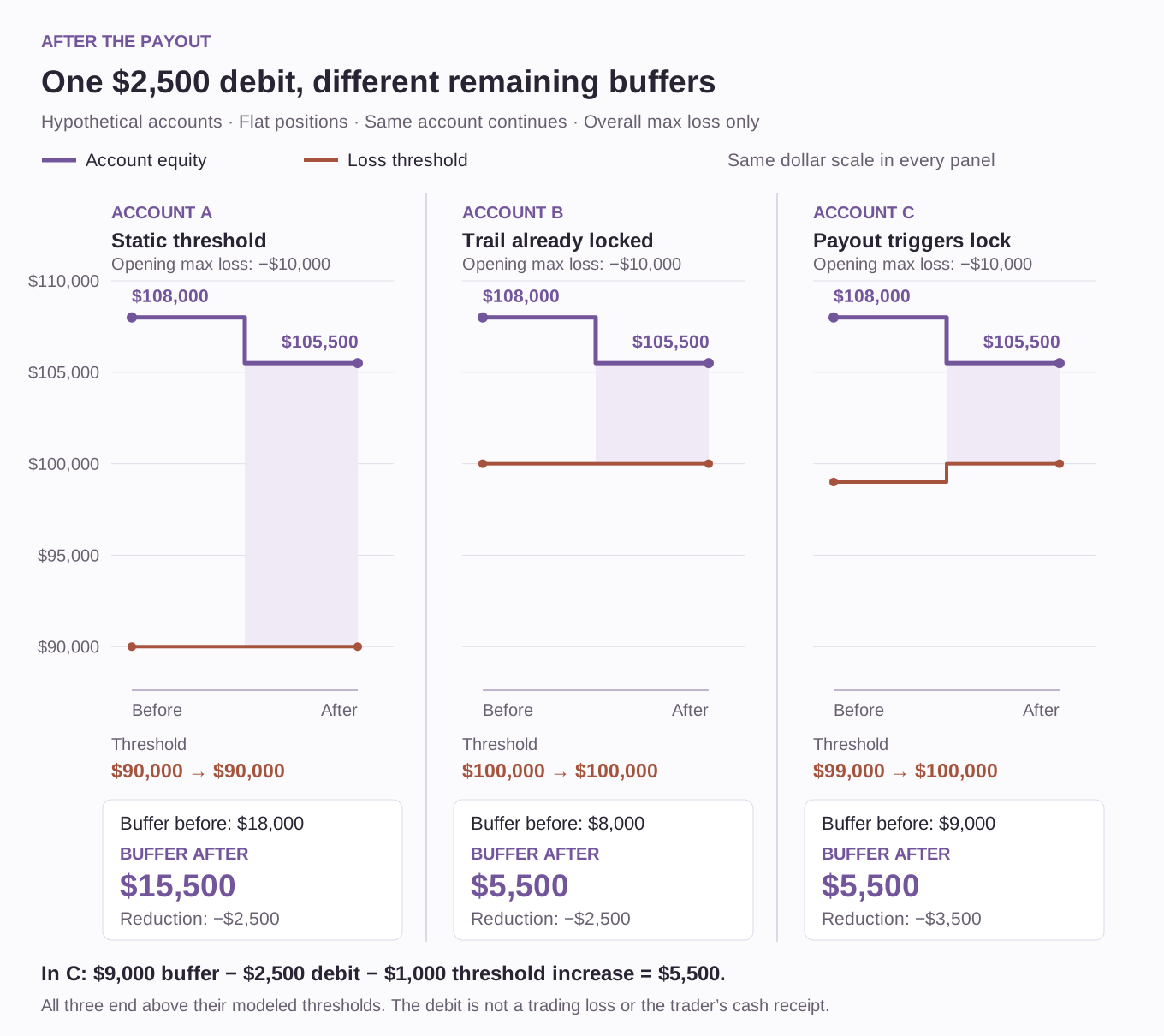
Continue the hypothetical withdrawal used in the amount-calculation guide. Before the debit, the account has $108,000 in balance and equity. The approved gross request removes $2,500 from the trading account, leaving $105,500. Under that example's split and fee assumptions, the trader receives $2,225. The loss-buffer calculation uses the $2,500 account debit.
Now apply that same debit to three invented account configurations. Each began at $100,000 with a $10,000 opening overall-loss allowance. Their rule histories differ, so their thresholds at the pre-payout snapshot differ too:
- A, static threshold: the threshold remains at $90,000 throughout.
- B, trail already locked: an earlier qualifying end-of-day high of $110,000 raised the threshold to its $100,000 cap. It stays there after the payout.
- C, lock triggered by payout: the prior qualifying high was $109,000, leaving a $99,000 threshold. This invented rule moves it to $100,000 and locks it when the first payout is processed.
The two trailing configurations use a fixed $10,000 gap below their qualifying high before the cap or payout lock applies. The prior highs are historical reference values, not the current balance. The current $108,000 value is below both highs.
All positions are closed, charges are already in balance, and there is no separate account credit. All payout requirements are assumed satisfied. No trading, additional fees, refunds, or other adjustments occur during processing. Apply the debit and any stipulated threshold update, then check the resulting state. The same account continues in each case; touching or falling below its threshold is a hard breach. The table models overall max loss only, without a separate daily-loss calculation.
| Configuration | Equity before | Threshold before | Buffer before | Account debit | Threshold after | Equity after | Buffer after |
|---|---|---|---|---|---|---|---|
| A. Static threshold | $108,000 | $90,000 | $18,000 | −$2,500 | $90,000 | $105,500 | $15,500 |
| B. Trail already locked | $108,000 | $100,000 | $8,000 | −$2,500 | $100,000 | $105,500 | $5,500 |
| C. Payout triggers lock | $108,000 | $99,000 | $9,000 | −$2,500 | $100,000 | $105,500 | $5,500 |
Varying the debit. These are separate hypothetical snapshots from the same pre-payout state, not additional withdrawals in one account. With no payout processed, the original thresholds stay in place, including C's $99,000 threshold. If a hypothetical $8,000 account debit and the stated payout adjustments were processed, equity would become $100,000. A would retain $10,000 of buffer; B and C would touch their $100,000 thresholds and breach under this model. This illustrates the boundary, not permission to withdraw that amount. The explorer does not calculate payout eligibility or cash received.
See what the same account debit leaves behind
Before processing: the planned $2,500 debit is not yet applied.
A. Static threshold
Above the modeled threshold
- Equity
- $108,000
- Threshold
- $90,000
- Threshold change
- $0
- Buffer reduction
- $0
B. Trail already locked
Above the modeled threshold
- Equity
- $108,000
- Threshold
- $100,000
- Threshold change
- $0
- Buffer reduction
- $0
C. Payout triggers lock
Above the modeled threshold
- Equity
- $108,000
- Threshold
- $99,000
- Threshold change
- $0
- Buffer reduction
- $0
Each amount is a separate hypothetical snapshot from the same starting state, not another withdrawal from the same account. Moving the slider back does not reverse a payout or revive a breached account. This does not calculate payout eligibility or the cash received.
At the article's original $2,500 account debit, all three accounts remain above their modeled thresholds. For C, the complete calculation is $9,000 − $2,500 − $1,000 = $5,500. Treating its pre-payout $99,000 threshold as still valid would overstate the buffer by $1,000.
This is a comparison of rule mechanics under declared histories, not a ranking of programs or a simulation of their complete trading conditions.
Does a locked trailing limit protect the remaining balance?
A lock stops the threshold moving under the specified rule. It does not stop the account value falling toward that threshold.
In configuration B, the locked threshold remains $100,000 before and after the withdrawal. The debit lowers equity from $108,000 to $105,500, reducing the distance from $8,000 to $5,500. The original $10,000 allowance is not automatically replenished.
LucidFlex's first payout request illustrates a request-triggered loss-threshold lock.
An unlocked trail also does not necessarily move down after a withdrawal. If the contract retains the prior high and permits the threshold to move only upward, a debit is not a new, lower high-water mark. Confirm any cash-flow adjustment explicitly rather than assuming the threshold falls by the same amount as the account balance.
Likewise, retaining profit is not universally equivalent to gaining the same amount of additional loss room. If another qualifying high raises an unlocked threshold, some or all of the account-value increase can be offset by that threshold movement. Once a threshold is genuinely fixed, an increase in the monitored value increases the distance, with other components unchanged.
How do actual programs handle the post-payout threshold?
These examples show distinct treatments. They are selected rules for the named account stages, not complete payout specifications.
Topstep: the first XFA payout sets the threshold to zero
Topstep's futures Express Funded Account starts with a displayed balance of $0; the account-size label represents buying power. Its Maximum Loss Limit page says the first payout sets the threshold to $0 regardless of its previous level. Reaching the limit closes the XFA. Topstep Maximum Loss Limit
The relevant distance is therefore from the remaining monitored account value to zero, not from the advertised account-size label. If the threshold was still negative before that first payout, setting it to zero also removes that remaining below-zero allowance.
FundedNext: payout retention and the breach threshold are separate
For the $50K Rapid Daily FundedNext Account, the published payout-retention level is $52,100. Its first-withdrawal instructions set the Maximum Loss Limit to $50,100. Rapid Daily eligibility · First-withdrawal adjustments
If that continuing account is flat at $52,100 after the first withdrawal, with no other adjustments, its calculated overall-loss distance is $52,100 − $50,100 = $2,000. The $2,100 above the original $50,000 balance is not the same distance. Nor is the payout-retention level itself the breach threshold. Other account constraints still apply.
FTMO: 1-Step account resets and 2-Step reward rollover
FTMO's CFD/FX FTMO Account (1-Step) has an end-of-day trailing Maximum Loss Limit. Its objectives state that when a reward is withdrawn and a new FTMO Account is provided, the limit resets to 90% of initial simulated capital for the first day. With $100,000 initial simulated capital, that threshold is $90,000. FTMO Trading Objectives
This is an explicit new-account reset. Use the replacement account's balance and rules to calculate its buffer. Do not carry forward an old account's post-debit value merely because the account-size label is unchanged. The cited treatment is specific to the 1-Step route; it is not a rule for every FTMO product.
The CFD/FX 2-Step route illustrates a different choice. FTMO's reward FAQ allows a trader to leave a reward on that account to increase its balance and drawdown buffer, subject to a minimum rollover amount. The 1-Step route does not allow rewards to remain on the account. Check the route's rollover permission before assuming retained profit can provide extra loss room. FTMO reward FAQ
What if trades or account adjustments occur around the payout?
A balance-only calculation can overstate the distance when the rule monitors equity. Include floating P&L, relevant trading charges, and any separate account credit under the platform's accounting and the program's loss-rule treatment.
In a separate hypothetical snapshot of configuration B after its payout, suppose balance is still $105,500 but an open position shows a net floating loss of $800. There is no credit and no charge to deduct again. Equity is $104,700, so the current overall-loss buffer is $104,700 − $100,000 = $4,700. The $5,500 balance-to-threshold distance would overstate the available distance by $800.
This snapshot does not assume that a firm permits positions to remain open during a payout. It could arise after trading resumes. Check the actual position and pending-request rules before combining those events.
Separate credit changes from withdrawals too. Removing a credit can reduce equity; moving the same amount from a separate credit field into balance can leave total equity unchanged. Whether the program counts that credit toward its permitted loss distance is a further rule question. The account-credit explanation covers that distinction.
Reconcile the account history when the final value differs from a forecast. A payout debit, a commission posted later, a trade result, and a credit removal are different ledger entries. Deduct each once and identify which entry, if any, changes the loss threshold.
Can a profitable account reach zero buffer after a payout?
Yes. Profit relative to the original balance and distance to the current threshold measure different things. A threshold that has risen above the initial balance can be reached while the account still shows cumulative profit. For example, a hypothetical account that began at $100,000 and now has $101,000 of equity against a $101,000 threshold shows $1,000 above its starting value but zero distance to the threshold.
Under the main example's touch-is-a-breach rule, a zero buffer is terminal. Consider this separate loss path for configuration B after the payout. Assume no additional threshold movement or other constraints, and net losses that include all charges. No earlier intratrade movement touches the threshold before the final event shown.
| Event | Equity | Locked threshold | Remaining buffer | Status under the modeled rule |
|---|---|---|---|---|
| Payout processed | $105,500 | $100,000 | $5,500 | Above threshold |
| First net loss of $2,000 | $103,500 | $100,000 | $3,500 | Above threshold |
| Further net loss of $3,500 | $100,000 | $100,000 | $0 | Hard breach at the touch; path ends |
The total post-payout loss is $5,500. That uses the remaining buffer, even though the configuration began with a $10,000 opening allowance. No later recovery is shown because the modeled account has already breached.
Apply the actual equality rule. FTMO's cited 1-Step objectives describe violation when equity falls below the limit, while Topstep explicitly includes touching it. Zero distance still leaves no cushion for a further unfavorable change. FTMO Trading Objectives · Topstep Maximum Loss Limit
A payout can also end an account by its own terms rather than through a later trading loss. After 30 winning days of at least $150 net P&L in a Topstep Live Funded Account, daily payouts become available. Its policy states that requesting a full 100% payout closes the LFA because its balance reaches the Maximum Loss Limit. Winning days from the XFA do not count toward that 30-day requirement. FundedNext's Rapid Daily rules conclude the account after the fifth reward and final settlement. These are different stages and closure mechanisms. Topstep Payout Policy · Rapid Daily eligibility
The FTMO Pro diagnostic in the first-payout study shows a request admitted by the percentage and monetary caps that would leave the balance exactly at the loss floor, which FTMO's futures rules treat as a breach.
What should you check before trading again?
Start with the account that is actually active after processing. Confirm its balance, current equity, relevant high, absolute loss threshold, and status. A payout approval notice alone may not contain all five.
Check the daily rule separately. The overall-loss distance in this guide is not automatically the amount available today. A daily-loss threshold, daily pause, position limit, or account restriction can become binding first. The daily-loss guide explains that separate calculation; its trading-day clock explains the reset boundary.
Also check the next payout window. Activity counts, consistency measurements, or required new profit may restart even when the loss threshold stays fixed. Use the day-count reset guide to keep those counters separate from the monetary buffer.
There is no universal amount to leave after a payout. The useful calculation is the actual post-debit state under the relevant rules. A withdrawal that is permitted by a payout cap can still leave less room than the trader expects, and a positive overall buffer does not establish compliance with every other constraint.
What belongs in a post-payout account record?
Keep one before-and-after record for the actual processing event. Leave unconfirmed fields unresolved instead of importing a rule from another stage or program.
| Field | Before payout | After payout |
|---|---|---|
| Account identity and status | Program, size, stage, cohort, and account ID | Same active account, replacement, transition, or closure |
| Monitored value | Balance/equity, floating P&L, credit, and included charges | Reconciled value after all actual entries |
| Payout amount | Approved gross request and expected debit | Actual debit, separately from trader cash |
| Overall-loss threshold | Absolute level and equality rule | Absolute level after the required update |
| Trailing reference | Relevant high, update clock, and lock state | Retained, adjusted, locked, or restarted reference |
| Remaining distance | Monitored value minus current threshold | Recalculated distance using the new state |
| Other constraints | Daily conditions, position permissions, and active restrictions | What applies before the next trade |
| Payout counters | Current activity, consistency, and profit window | Exact reset event and next-window requirements |
| Evidence | Applicable official rules and a timestamped account snapshot | Debit history, threshold/status record, and unresolved differences |
Add the verified post-withdrawal treatment to the before-you-pay comparison worksheet. Compare the resulting account state alongside the cash payout. Both are needed to understand what one withdrawal cycle leaves behind.
Sources and method
Official sources checked on 3 October 2026:
- Topstep Maximum Loss Limit, for the XFA starting display, first-payout threshold treatment, and touch-based breach rule.
- Topstep Payout Policy, for the 30-winning-day condition that unlocks daily LFA payouts and the full-payout closure rule.
- FundedNext Futures Rapid Daily eligibility, for the scoped payout-retention level and account-conclusion condition.
- FundedNext Futures withdrawal instructions, for the first-withdrawal loss-threshold adjustment.
- FTMO Trading Objectives, scoped here to the CFD/FX 1-Step trailing rule, new-account reset, and below-limit wording.
- FTMO reward FAQ, for the CFD/FX 2-Step rollover option and the 1-Step restriction.
The three-account comparison, open-loss snapshot, and terminal loss path are original hypothetical illustrations, independently recalculated from their stated assumptions. They do not model every condition of a named account or establish a suitable withdrawal or position size. The explorer also varies the hypothetical account debit while preserving the stated account histories and threshold treatments. Each selected amount is a separate snapshot, and the zero-debit and boundary cases are explained beside it. The checked date records research, not an agreement's effective date.