ResearchAccount size
Bigger Prop Accounts: How Do Fees and Opening Loss Allowances Scale?
Across the 18 configurations studied, larger account tiers cost more to enter, but their fee per dollar of opening loss allowance does not fall at every step. Both CFD/FX programs have an increase at the $25K tier. In both futures programs, moving from $50K to $100K doubles the initial profit target while increasing the opening loss allowance from $2,000 to $3,000.
- Data
- Release pfw-release-2026-10-16-pilot-2.
The figures describe that release and stay as published; a later release does not change them.
- Supporting data
On this page
The useful comparison is between adjacent sizes of the same program, with the platform and options held constant. That reveals what the extra fee buys, how much more profit the evaluation requires, and which constraints still apply. It does not establish which firm you should choose.
The accounts studied
The cohort contains four program variants and every size tier exported for those variants: 11 CFD/FX configurations and seven futures configurations. Firms and sizes appear in alphabetical and ascending-size order, respectively. The sample was chosen to examine size changes within programs, not to represent the whole market or rank providers.
CFD/FX configurations
| Firm and program | Advertised sizes | Configuration held constant |
|---|---|---|
| Alpha Capital Group · Alpha Pro 8% | $5K, $10K, $25K, $50K, $100K, $200K | MT5, Standard spreads, On-Demand payout schedule, standard 80% split, no add-ons |
| FundingPips · 2 Step Standard | $5K, $10K, $25K, $50K, $100K | MT5, 5% daily loss option, no add-ons |
Futures configurations
| Firm and program | Advertised sizes | Configuration held constant |
|---|---|---|
| Lucid Trading · LucidFlex | $25K, $50K, $100K, $150K | Tradovate, Daily Loss Limit off, the snapshot's 50% evaluation consistency rule |
| Topstep · Trading Combine | $50K, $100K, $150K | Standard pricing path, TopstepX, no Responsible Trading Advantage, included Level 1 data |
These choices matter. Switching Alpha's payout schedule, FundingPips' platform, Lucid's Daily Loss Limit option or Topstep's pricing path would introduce another price change. Here, the size tier is the variable. The account file identifies all 18 configurations; the account-rule file preserves their route and fee conditions.
Later source observation, read 21 October 2026: Lucid's current customization page lists 40% consistency as standard and 50% as a paid add-on. PFW's current account pages also show this choice. The study retains the earlier snapshot's 50% rule and recorded prices. Its Lucid figures are not a quote for today's checkout.
Later price change, first read 20 October 2026: FundingPips now sells the 2 Step Standard $5K, $10K and $25K accounts for $39, $72 and $195, down from the snapshot's $44, $80 and $216, as PFW's change record sets out. At the new prices their fee per $1,000 of opening risk is $78.00, $72.00 and $78.00: the rise at $25K remains, from $72.00 to $78.00, but it is smaller. The $50K and $100K prices are unchanged. The study's tables keep the snapshot's prices.
How the figures are calculated
All amounts are in US dollars. The results use PFW's approved snapshot of 16 October 2026, exported on 17 October. The source checks behind the selected metric rows range from 10 to 16 October; a release date does not mean every source was read that day.
Three existing PFW measures describe different parts of the purchase:
| Measure | Calculation | What it describes |
|---|---|---|
| Opening loss allowance | Opening balance minus the opening total-loss threshold in each required evaluation phase; take the smallest result | The starting distance to the overall loss boundary |
| Difficulty ratio | Divide each phase's initial profit target by that phase's opening loss allowance, then add the results | Required target relative to allowance across the evaluation route |
| Fee per $1,000 of opening risk | Base cost of the defined 30-day attempt ÷ opening loss allowance × 1,000 | The fee relative to the starting overall allowance |
The opening-loss calculation uses the loss boundary, not the advertised size as its denominator. It is not an amount to risk on one trade. The Difficulty ratio describes the initial target structure, not the probability of passing.
For the three one-time-fee variants, the fee metric uses the recorded entry fee. For Topstep Standard, it includes one or two subscription charges within the release's 30-day scenario, plus the $149 activation fee payable after passing. The lower endpoint uses one subscription charge; the upper endpoint uses two. Activation is included in that scenario total, even though it is not paid at entry.
There are no resets or repeat attempts in this calculation. It excludes offers, optional purchases, conditional refunds, taxes and buyer-specific payment or conversion charges. Commissions, spreads and swaps are trading costs, not extra items in this fee numerator; they can still reduce the trading account's buffer. The selected configurations have no additional required platform or data fee included by the snapshot.
Calculations use unrounded inputs, with displayed fees rounded to cents. The tables reproduce the exported metric values. No new composite score is introduced.
CFD/FX: a larger tier does not always reduce the fee per unit of allowance
For Alpha Pro 8%, opening loss allowance remains 8% of size across all six tiers. For FundingPips 2 Step Standard, it remains 10% across all five. The allowance therefore grows in direct proportion to size within each selected program. Entry prices follow a less even pattern.
CFD/FX snapshot results. One-time fees, selected options above, amounts in USD.
| Firm · program | Size | Entry fee | Opening loss allowance | Fee per $1,000 of opening risk |
|---|---|---|---|---|
| Alpha Capital Group · Alpha Pro 8% | $5K | $37 | $400 | $92.50 |
| Alpha Capital Group · Alpha Pro 8% | $10K | $57 | $800 | $71.25 |
| Alpha Capital Group · Alpha Pro 8% | $25K | $177 | $2,000 | $88.50 |
| Alpha Capital Group · Alpha Pro 8% | $50K | $297 | $4,000 | $74.25 |
| Alpha Capital Group · Alpha Pro 8% | $100K | $527 | $8,000 | $65.88 |
| Alpha Capital Group · Alpha Pro 8% | $200K | $997 | $16,000 | $62.31 |
| FundingPips · 2 Step Standard | $5K | $44 | $500 | $88.00 |
| FundingPips · 2 Step Standard | $10K | $80 | $1,000 | $80.00 |
| FundingPips · 2 Step Standard | $25K | $216 | $2,500 | $86.40 |
| FundingPips · 2 Step Standard | $50K | $349 | $5,000 | $69.80 |
| FundingPips · 2 Step Standard | $100K | $652 | $10,000 | $65.20 |
Source: the snapshot's list-price, opening-risk and fee-per-1000-risk records. Alpha metric sources checked 14 October; FundingPips checked 10 October 2026.
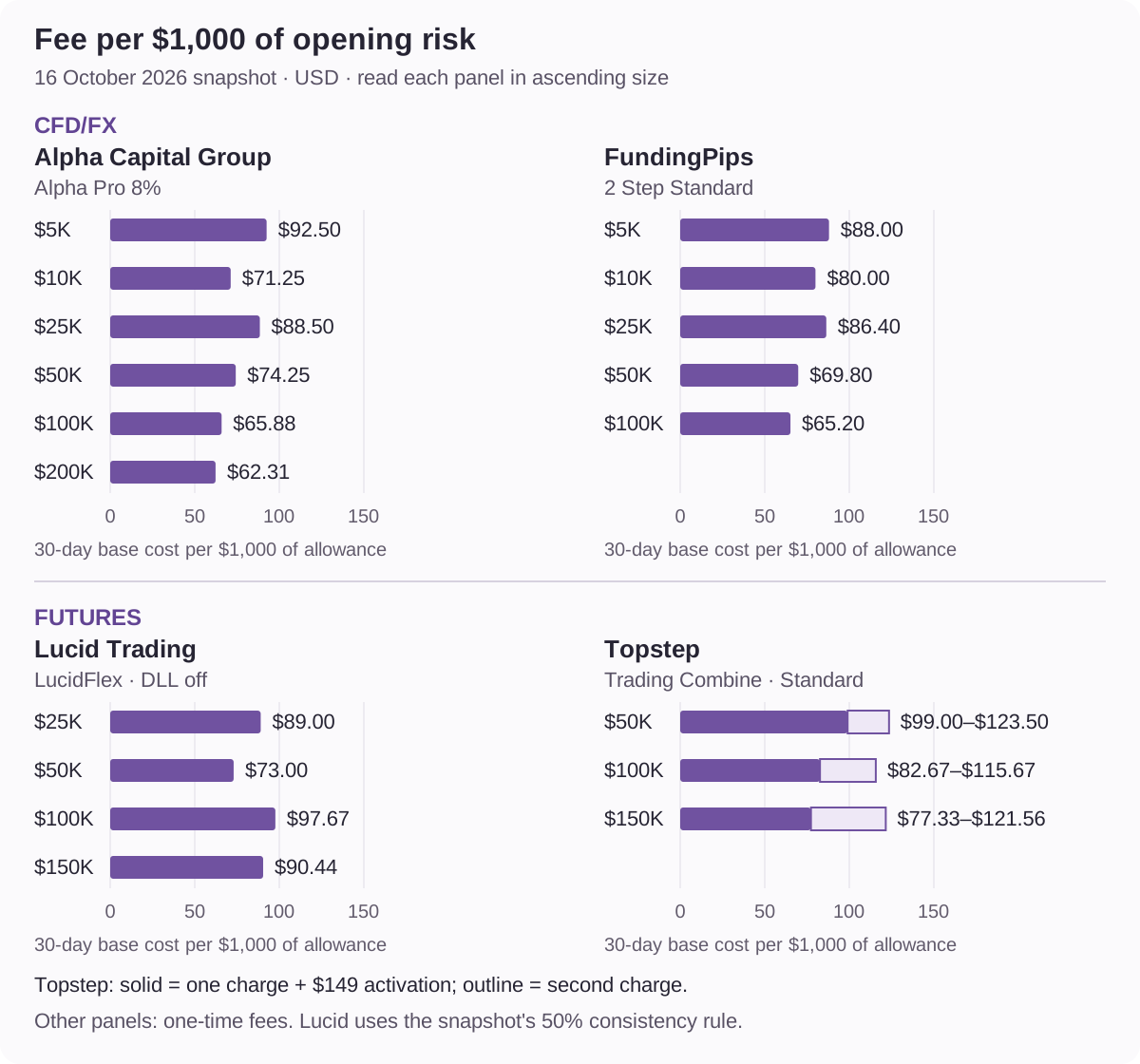
The $10K-to-$25K step is the exception to a simple volume-discount story in both programs. Alpha's entry fee rises from $57 to $177 while the allowance rises from $800 to $2,000. Its normalized fee rises from $71.25 to $88.50. FundingPips' fee rises from $80 to $216 while allowance rises from $1,000 to $2,500, taking the normalized fee from $80.00 to $86.40.
Larger steps can lower the normalized fee while still requiring substantially more cash. Moving from Alpha's $50K to $100K tier adds $230 to the purchase price and $4,000 to the opening allowance:
$297 ÷ $4,000 × 1,000 = $74.25
$527 ÷ $8,000 × 1,000 = $65.875, displayed as $65.88
The $100K tier has a lower fee per unit of allowance, but the trader still pays $527 rather than $297. That distinction matters when the purchase budget, rather than the normalized fee, is the limiting factor.
Neither selected CFD/FX program changes its initial Difficulty ratio as size rises. Alpha's two phases require 8% and 5% against an 8% opening allowance in each phase: 8 ÷ 8 + 5 ÷ 8 = 1.625. FundingPips requires the same target percentages against a 10% allowance in each phase: 8 ÷ 10 + 5 ÷ 10 = 1.30. Each phase has its own allowance; the formula does not pool losses across phases.
Futures: the label can grow faster than the allowance
The two selected futures programs share the same opening allowances at $50K, $100K and $150K: $2,000, $3,000 and $4,500. The $50K-to-$100K label doubles, but the allowance grows by 50%. At the same time, the initial target doubles from $3,000 to $6,000, so the Difficulty ratio rises from 1.50 to 2.00.
Lucid also has a $25K tier in the cohort. Its $1,250 initial target and $1,000 opening allowance produce a ratio of 1.25. The following figures retain the snapshot's Lucid configuration, including its 50% consistency rule.
Futures snapshot results. Topstep's entry column is a recurring subscription; its normalized-fee range also includes $149 activation after passing. Lucid fees are one-time.
| Firm · program | Size | Entry charge | Opening loss allowance | Fee per $1,000 of opening risk | Difficulty ratio |
|---|---|---|---|---|---|
| Lucid Trading · LucidFlex, DLL off | $25K | $89 once | $1,000 | $89.00 | 1.25 |
| Lucid Trading · LucidFlex, DLL off | $50K | $146 once | $2,000 | $73.00 | 1.50 |
| Lucid Trading · LucidFlex, DLL off | $100K | $293 once | $3,000 | $97.67 | 2.00 |
| Lucid Trading · LucidFlex, DLL off | $150K | $407 once | $4,500 | $90.44 | 2.00 |
| Topstep · Trading Combine, Standard | $50K | $49/month | $2,000 | $99.00 to $123.50 | 1.50 |
| Topstep · Trading Combine, Standard | $100K | $99/month | $3,000 | $82.67 to $115.67 | 2.00 |
| Topstep · Trading Combine, Standard | $150K | $199/month | $4,500 | $77.33 to $121.56 | 2.00 |
Source: the snapshot's price, allowance, fee and target records. Lucid metric sources checked 16 October; Topstep checked 13 October 2026. DLL means Daily Loss Limit.
For Lucid's $50K-to-$100K step, the purchase price rises from $146 to $293 while opening allowance rises from $2,000 to $3,000. The normalized fee increases from $73.00 to $97.67. The larger tier adds $1,000 of opening allowance and $3,000 of required initial profit for an additional $147 entry fee.
Topstep's fixed activation fee changes the arithmetic. At $50K, its scenario totals are $198 or $247: one or two $49 subscriptions, plus $149 activation. At $100K, they are $248 or $347. Dividing those totals by the larger allowance lowers the normalized fee at both endpoints, despite the higher monthly subscription.
The next size step depends on the billing endpoint. With one charge, Topstep's normalized fee falls from $82.67 at $100K to $77.33 at $150K. With two charges, it rises from $115.67 to $121.56:
($99 × 2 + $149) ÷ $3,000 × 1,000 = $115.666…, displayed as $115.67
($199 × 2 + $149) ÷ $4,500 × 1,000 = $121.555…, displayed as $121.56
Comparing one tier's one-charge endpoint with another tier's two-charge endpoint would mix billing assumptions. The study of completion time and cost examines longer timelines and pricing-path changes separately.
The pattern across size tiers
The figure makes the reversals easier to see. Read each program from its smallest tier to its largest. Every panel uses the same dollar scale; it is a view of one fee metric, not a ranking of account quality.
Which constraints change with size?
A larger opening allowance describes the starting overall boundary. Daily limits, position limits, moving thresholds and consistency rules determine how that allowance can be used.
For the selected CFD/FX variants, the daily-loss percentages stay unchanged across sizes: Alpha Pro 8% uses 4% of the day's starting balance, while FundingPips uses 5% of the higher opening balance or equity. Those reference formulas are different. A higher overall allowance does not remove the separate daily boundary; the daily-loss formulas explain why the same account label can produce different session headroom.
The selected futures configurations have their optional daily limit off. Their maximum evaluation position sizes still change by tier:
Futures evaluation limits in the snapshot. These are ceilings, not recommended position sizes.
| Program and selected option | Size tiers, in order | Maximum minis, in the same order | Maximum micros, in the same order |
|---|---|---|---|
| LucidFlex, DLL off | $25K / $50K / $100K / $150K | 2 / 4 / 6 / 10 | 20 / 40 / 60 / 100 |
| Trading Combine, Standard, no Responsible Trading Advantage | $50K / $100K / $150K | 5 / 10 / 15 | 50 / 100 / 150 |
Source: daily-limit-contracts records. Mini and micro amounts are alternative equivalent limits, not additive allowances. Topstep also sets lower limits on some volatile products.
At Topstep's $50K-to-$100K step, the headline mini-contract ceiling doubles from five to ten while opening loss allowance grows only from $2,000 to $3,000. Using the full ceiling would increase exposure faster than the allowance. An allowed position maximum therefore cannot substitute for a calculation of contract count and price sensitivity.
The snapshot's Lucid evaluation rule allows no single day to exceed 50% of profit. Topstep's initial target is subject to a 55% Consistency Target: a best day above 55% of the target raises the target to that day's profit divided by 0.55. The table's Difficulty ratios use the initial targets, before any such increase. The Lucid source change noted above must also be checked before a new purchase.
Finally, the selected CFD/FX overall limits are static, while the futures limits trail end-of-day balances. The same opening allowance does not describe the same later path. Gains can raise a trailing threshold, so a subsequent return to the opening balance can leave less buffer than the account started with. This study compares the opening state, not the full sequence of gains, losses and withdrawals. These rule descriptions are preserved in the snapshot's target and loss-limit records.
What the study cannot tell you
The 18 rows are related size tiers from four deliberately selected variants. They are not 18 independent observations of the industry. There is no market-wide average, significance test or inference about the firms omitted from the sample.
All primary price and metric inputs used here are Documented in the snapshot. That does not make every possible buyer charge known, nor does it make every other rule fully documented. The supporting file retains each original evidence state, condition, source and check date rather than treating missing information as zero.
The results describe purchases and opening evaluation conditions. They do not estimate pass rates, trader returns, expected lifetime spending, payout amounts or provider reliability. The fee measure is a defined base-cost scenario, not an all-in bill. Eligibility and the ability to use a selected platform also need checking before purchase.
The study is fixed to its dated evidence. PFW account pages use the live release and can later differ from these tables. Current official pages can also change, as the Lucid and FundingPips observations demonstrate; a current checkout should be matched to its current rules rather than to a historical price row.
Before choosing a larger tier
Compare the two sizes you are actually considering within one program. Keep the platform, billing path, daily-limit option and add-ons the same, then record:
- The additional entry payment and any change in recurring charges or activation.
- The additional opening loss allowance in each required phase.
- The additional profit target and whether the Difficulty ratio changes.
- The daily boundary, position ceiling, consistency rule and threshold movement that constrain the larger tier.
A lower fee per $1,000 of opening risk means the defined fee buys proportionally more opening allowance. It can still require a larger cash commitment and a larger dollar target. A higher normalized fee identifies a different trade-off: the extra size label has become more expensive relative to its opening allowance.
Start with the account-size worksheet, then use PFW's account comparison to inspect the current rules for the two exact configurations. If a current row differs from this study, use the current source for the purchase decision and retain the study as evidence of the earlier snapshot.
Sources and corrections
The main numerical evidence is the 16 October 2026 approved PFW data snapshot, supplied in the 17 October authoring export. The two supporting CSVs preserve the original selected account and account-rule records without added or changed values. Their source columns contain the underlying official URLs and original check dates.
Official pages revisited on 21 October 2026 provide a separate check on the described mechanisms. They do not replace the frozen prices or rules:
- Alpha Pro 8%/10%, for phase targets and static and daily loss percentages.
- FundingPips 2 Step Standard, for the evaluation route, target percentages and loss rules.
- LucidFlex Evaluation Account and LucidFlex Drawdown, for the size-specific targets, allowances, position ceilings and end-of-day mechanism.
- LucidFlex Customization, for the separately dated observation that 40% consistency is standard and 50% is a paid add-on.
- Topstep Pricing and Payment Questions and Maximum Loss Limit, for Standard-path billing, activation and size-specific overall loss limits.
For a correction, identify the account, selected options, affected value and applicable source date through PFW's corrections process. A change after the snapshot should be distinguished from an error in the original record.