ResearchPayouts
Profit Split vs. First Payout: What the Caps Change
A profit split applies to the allowed request, which can be much smaller than the profit on the account. With a hypothetical $2,500 of profit, the recorded FTMO Growth $50K rules allow a $1,250 gross request. Its 90% trader share then produces a $1,125 allocation before payment fees: 45% of that modeled profit. The percentage limit has already reduced the request before the split is applied.
- Data
- Release pfw-release-2026-10-13-pilot-2.
The figures describe that release and stay as published; a later release does not change them.
- Supporting data
- Payout inputs for the six study configurations (CSV, 10 KB)
- Release source references for the study inputs (CSV, 24 KB)
On this page
This study calculates first-payout amounts for six exact futures configurations, with Topstep's two payout paths shown separately. It uses PFW's approved 13 October 2026 snapshot and identifies additional official-source checks separately. The results describe request-and-share arithmetic, subject to eligibility, account state and approval. They are not observed receipts or an account ranking.
The accounts and payout setups
The cohort is purposive: it includes $50K futures configurations with explicit request limits and a recorded initial trader share. The selection spans percentage limits, fixed per-request caps and alternative payout paths. Six configuration records come from a release covering 112 accounts at five firms. They are related observations selected to study payout mechanics, not a representative sample of the industry.
| Exact $50K payout setup | Recorded first-request gate | Gross request ceiling | Initial trader share |
|---|---|---|---|
| FTMO Growth | 4 qualifying days, each at least $150 closed profit | 50% of profit, capped at $2,500 | 90% |
| FTMO Pro | 5 qualifying days, each at least $200 closed profit | 100% of profit, capped at $5,000; loss-floor check still required | 90% |
| FundedNext Flex | 5 benchmark days, each at least $200; cycle net profit at least $500 | 50% of profit, capped at $1,500 | 95% |
| The5ers Day Trade | Account at least 14 days old; at least $2,000 profit; best-trade consistency rule | $1,500, equal to 3% of the initial balance | 80% |
| The5ers Swing | Account at least 14 days old; at least $2,000 profit; best-trade consistency rule | $1,500, equal to 3% of the initial balance | 80% |
| Topstep Trading Combine Standard purchase route, then XFA Consistency payout path | 3 trading days with at least one trade each; largest day at most 40% of total net profit | 50% of XFA balance, capped at $3,000 | 90% |
| Topstep Trading Combine Standard purchase route, then XFA Standard payout path | 5 winning days, each at least $150 net profit | 50% of XFA balance, capped at $2,000 | 90% |
Topstep's purchase route and payout path are separate choices. The two rows are alternative payout paths for one configuration, not two additional accounts or two payouts from the same account. The data release records the same payout rules for both purchase routes, so the No Activation Fee route is not counted again. The model uses the 90% share for new traders and excludes Responsible Trading Advantage, doubled promotional caps and the older lifetime-profit exception.
The checked configurations use Tradovate for FTMO and FundedNext, BlackArrow for The5ers, and TopstepX for Topstep. All results concern the first funded stage and first payout, before any live-account transition. The $50K labels do not imply equal account balances, loss capacity or difficulty. Three of these accounts, FTMO Growth, FundedNext Flex and The5ers Day Trade, are also in the $50K futures comparison, which sets out their payout access and the account after a payout rule by rule.
The hypothetical profit history
Every scenario begins with hypothetical funded activation on 1 October 2026. The account then completes five trading sessions ending on 5, 6, 7, 8 and 9 October, followed by a request on 19 October after the relevant sessions have finalized. No trading takes place on the request date. This supplies an 18-calendar-day account age without estimating the fastest possible payout.
The four separate profit scenarios are $1,000, $2,000, $2,500 and $6,000. Each has five equal profitable days, with two equal closed trades per day. Profits are net of trading costs. The best day is therefore 20% of total profit and the best trade 10%. At the lowest profit level, each day makes $200; the qualifying-day amounts in the table are met.
All positions are closed within their sessions. There are no prior payouts, carried profits, credits, fee refunds, losses or open-position adjustments. The model assumes compliant trading and no intraday limit violation; it does not simulate market prices, fills or the probability of producing this history. All profit is new, satisfying FTMO's new-profit requirement for these requests. The recorded request minimums of $20 at FTMO, $250 at Flex and $125 at Topstep do not bind the numerical results.
Two boundaries prevent a number from being shown. The5ers' $1,000 scenario fails its $2,000 profit requirement. Its $6,000 scenario is outside the initial-tier model: in a supplemental check on 15 October 2026, the official futures page described scaling at a 10% profit milestone, or $5,000 on the initial $50K account. The study does not assume that the original tier and payout clock continue unchanged beyond that point.
The5ers' current consistency pages also differ at the exact 40% boundary. The hypothetical best trade is 10%, so neither reading changes these calculations. That boundary remains a source issue, not a reason to silently rewrite the release.
The calculation order
For a scenario within scope and satisfying the stated gates, the calculation has two steps:
Gross request = the smaller of the percentage allowance and the monetary cap.
Trader allocation before payment fees = gross request × initial trader share.
The5ers' recorded first-tier limit is a monetary cap derived from initial account size; it has no additional 50%-of-profit restriction in these inputs. Its cap applies before the 80% split. For Topstep, the allowance is based on XFA balance, rather than the nominal $50K label. The XFA starts at zero, so its balance equals the accumulated profit in this first-payout scenario. That equality would need to be reconsidered after a payout or adjustment.
The trader allocation is the amount attributable to the trader after the split and before method fees. It is not a verified cash receipt. Nor does the cap formula establish that withdrawing that amount leaves a usable account. That requires the separate account-state check below. For the general calculation method, see profit splits, payout caps and calculation order.
Results at four profit levels
The table reports the trader allocation before payment fees, using the largest request admitted by the recorded percentage and monetary limits. FundedNext and The5ers values remain cap-and-share calculations because their exact debit mechanics are unresolved in this study. They do not establish a post-payout balance or an approved withdrawal. FTMO and Topstep's numerical cases also pass the modeled loss-floor check.
| Payout setup, all $50K | $1,000 profit | $2,000 profit | $2,500 profit | $6,000 profit |
|---|---|---|---|---|
| FTMO Growth | $450 | $900 | $1,125 | $2,250 |
| FTMO Pro | $900 | $1,800 | $2,250 | $4,500 |
| FundedNext Flex | $475 | $950 | $1,187.50 | $1,425 |
| The5ers Day Trade | Below profit requirement | $1,200 | $1,200 | Outside initial-tier model |
| The5ers Swing | Below profit requirement | $1,200 | $1,200 | Outside initial-tier model |
| Topstep XFA: Consistency | $450 | $900 | $1,125 | $2,700 |
| Topstep XFA: Standard | $450 | $900 | $1,125 | $1,800 |
The shared $2,500 scenario makes the denominator visible. The chart partitions that profit into the trader allocation, the firm's share of the gross request, and profit outside this request. The last category does not assert that the amount remains available as a trading buffer or can eventually be paid.
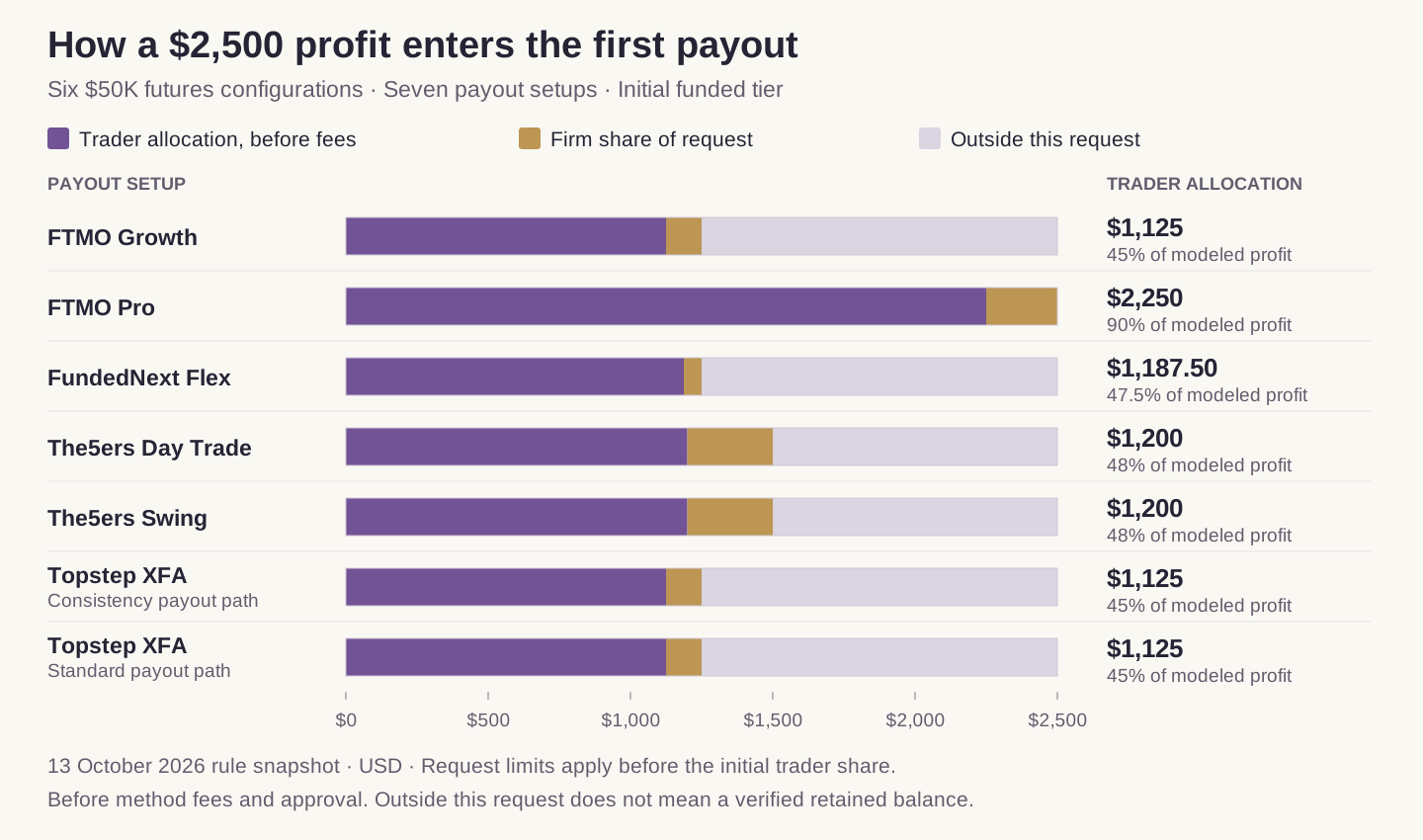
What the caps change
At $2,500 profit, FTMO Growth and both Topstep paths allocate 45% of the modeled profit to the trader: a 50% request allowance followed by a 90% split, the payout-cap guide's general example applied to named accounts. Flex allocates 47.5%, from 50% followed by 95%. Each The5ers setup allocates 48%, because its $1,500 cap is followed by an 80% split. FTMO Pro's $2,250 allocation is 90%, but its modeled remaining loss buffer is only $500.
These percentages describe this profit scenario. They are not new profit-split rates or scores. A lower headline share can produce a larger first-request allocation at one profit level because the request allowance differs; the order can change at another level. Account risk, eligibility and payment costs still differ.
The monetary caps also create plateaus. Flex reaches its $1,500 gross cap at $3,000 profit, producing a $1,425 trader allocation before fees. At $6,000 profit that allocation is still $1,425, or 23.75% of the modeled profit. This does not mean the other 76.25% has been forfeited; the study has not established its eventual treatment.
Topstep's two caps produce the same allocation through $4,000 profit under this qualifying history. Above that point, the Standard path's $2,000 cap binds while Consistency can admit a larger request, up to its $3,000 cap. At $6,000 profit the respective trader allocations are $1,800 and $2,700. These are alternative paths with different eligibility rules, not a recommendation to select one.
The5ers' $1,500 gross cap is already binding at the first eligible $2,000 profit level. Increasing profit to $2,500 leaves the first-request allocation at $1,200. Extending that plateau through a scaling event would require a different account-state model.
What remains in the account
A request deducts an amount from the trading account; the trader's allocation can be smaller. For FTMO and Topstep, the recorded rules support subtracting the gross request. The following checks use the shared $2,500 profit history, after all end-of-day floor updates and with no open positions or additional trading.
| Payout setup | Balance before request | Gross account debit | Balance after request | Loss floor after request | Remaining loss buffer |
|---|---|---|---|---|---|
| FTMO Growth | $52,500 | $1,250 | $51,250 | $50,000 | $1,250 |
| FTMO Pro | $52,500 | $2,500 | $50,000 | $49,500 | $500 |
| Topstep XFA: Consistency | $2,500 | $1,250 | $1,250 | $0 | $1,250 |
| Topstep XFA: Standard | $2,500 | $1,250 | $1,250 | $0 | $1,250 |
FTMO's floor trails finalized end-of-day balances, stops rising at the initial balance, and does not fall with the request. Topstep's first payout fixes its XFA floor at zero. The buffer is the post-request balance minus the applicable floor; it is separate from the trader allocation. Equal buffers would not establish otherwise equivalent accounts.
A cap-only request can also fail the loss-floor check. Consider a separate FTMO Pro history ending with $4,000 profit after the same five equal sessions. Its floor has reached $50,000. The percentage and cap formula would admit a $4,000 request, but deducting it from $54,000 would leave exactly $50,000. FTMO's futures rules treat touching the floor as a breach: "If equity hits this limit, the rule is considered violated and the account is terminated." The model stops at that unsafe proposed request and does not count a trader payment. A smaller request would need its own check.
This diagnostic is consistent with FTMO's official payout warning, checked on 15 October 2026, that requesting a full withdrawal on a Pro Sim-Funded Account can violate the Maximum Drawdown. The cap formula alone is therefore insufficient even when qualifying days are complete.
For Flex, the release establishes a $50,100 floor after the first reward and an account ending after five rewards. It does not establish the precise debit and retained-profit treatment needed here. For The5ers, it establishes a floor reset to 96% of the new balance, but not an unambiguous bridge from the pre-split request through all deductions to that new balance. Those missing balances stay uncalculated. The guide to the post-payout buffer explains why a known floor rule alone is insufficient.
Payment fees and receipt gaps
The main table stops before payment-method fees. The release records FTMO's futures method fees as Partly unknown; a free-payout assumption would be unsupported. It records FundedNext charges of up to 3.5%, without enough detail to price every route exactly. The5ers records a 3.5% cash-payout fee, but this study does not resolve its assessment base and deduction order. Fee-free Hub credit is not a cash withdrawal.
Supplemental official-source checks on 15 October 2026 add one bounded fee example. Topstep's payout policy gives an ACH example in which its 90/10 split is applied before a $30 fee. Applying that sequence to the $6,000-profit Standard-path case gives a $2,000 gross request, $1,800 trader allocation and $1,770 after the listed Topstep fee. ACH is a US-only route. That amount excludes any further bank, currency-conversion or tax charges and is not evidence that a payment was received.
Method limits can also block a route even when the account-level arithmetic works. FundedNext's method-limits page, read on the same date, lists a $1,000 bank-transfer minimum. A lower table value is therefore not a promise of bank-transfer availability. The study does not assume one universally available payment method or quote a net receipt for every account.
Limits of the study
The unit is one hypothetical first request from one exact configuration and payout path. The study excludes later cycles, scaling payouts, live-account transitions, fees paid to reach funding, payment eligibility by country, and the likelihood of reaching any profit level. The equal-profit history is a controlled arithmetic example, not a trading strategy or a claim about typical performance.
The figures use the approved snapshot. Additional source readings constrain or explain the scenario; they do not silently replace release values. Live account pages may reflect a later release and differ from this study. Documented inputs support a calculation only within their scope. Partly unknown mechanics and Sources differ at a policy boundary must remain visible. PFW's guides to types of evidence and conflicting rules explain those distinctions.
A first-payout cap is not an estimate of lifetime withdrawals. Multiplying Flex's first allocation by its five-reward limit would ignore future qualifying profit, account debits, resets of payout windows and possible account transitions. Similarly, profit outside a request is not automatically cash owned by the trader, usable loss capacity or a permanent loss.
Before using a number for a real request, check the exact account and payout path, current eligible profit, method limits and charges, and the resulting balance against its loss floor. The approval, dispatch and receipt stages remain separate from this calculation.
Related reading
- Profit splits, payout caps and retained buffers explains the calculation components.
- After a payout: the remaining drawdown buffer explains account debits and loss floors.
- Prop firm payout rules: from eligibility to money received separates the request clock from approval and receipt.
- What does reaching a funded account cost as completion takes longer? covers the fees paid before this first payout, for an overlapping set of accounts.
Sources and method
The supporting files are unchanged row projections of the approved release: six account-input rows and the associated release source references. Their original wording, evidence states and check dates are preserved. The first-payout calculations and hypothetical profit histories are derived analysis; they are not new release fields or observed trader outcomes. All amounts are USD. Decimal arithmetic is checked independently in cents, and the chart uses the same results as the table.
Supplemental official pages were read on 15 October 2026. FTMO's Growth rules and Pro rules were used to check floor-lock behavior. Topstep's XFA parameters confirm the zero opening balance and separate payout-path choice. FundedNext's Flex funded-account rules confirm request-then-share wording and request-day restrictions, while leaving the full debit calculation unresolved here.
The5ers' consistency definition and calculation page differ on equality at 40%. Its post-withdrawal example and payment-method page were also reviewed; the example does not establish the complete pre-split request-to-receipt sequence. The dated scaling, payout-warning and method-limit observations are cited where they affect the analysis.
Corrections should identify the exact configuration, source wording and affected calculation. PFW's approach to numbers explains how sourced values and derived examples are kept distinct.