ResearchCFD/FX accounts
One Step or Two? What Changes on a $100K CFD Challenge?
One evaluation phase does not consistently buy a lower fee or a smaller profit target relative to the loss allowance. In this study, FTMO's one-step account costs less than its two-step account and starts with the same overall loss room. FundedNext's one-step account costs more than either of its two-step alternatives and starts with less room. The exact program decides most of these comparisons. The clearest pattern in this selection is whether the overall loss threshold trails: one-phase accounts usually trail, while two-phase accounts are usually static.
- Data
- Release pfw-release-2026-11-12-pilot-4.
The figures describe that release and stay as published; a later release does not change them.
- Supporting data
- The 29 accounts in the study (CSV, 7 KB)
- 174 account-rule records, with sources and check dates (CSV, 120 KB)
- 395 source citations behind the account rules (CSV, 165 KB)
On this page
We compared 29 reviewed $100,000 CFD/FX accounts at seven firms: thirteen one-phase and sixteen two-phase accounts. These are the prices, targets and loss rules recorded in PFW's 12 November 2026 release, not a quote for today's checkout. Every qualifying variant is included, so the result does not depend on choosing one convenient pair at each firm.
Which accounts are in the study?
The selection rule is simple: a firm must have at least one reviewed one-phase and at least one reviewed two-phase $100,000 CFD/FX evaluation account in the release. We then include every account in those two groups at that firm.
| Firm | One-phase accounts | Two-phase accounts |
|---|---|---|
| Alpha Capital Group | 3 | 4 |
| Blue Guardian | 3 | 2 |
| FTMO | 1 | 1 |
| FundedNext | 1 | 2 |
| FundingPips | 1 | 3 |
| FXIFY | 3 | 3 |
| Tradeify, CFD/FX programs | 1 | 1 |
| Total | 13 | 16 |
E8 Markets has only one-phase accounts in this size and market selection. The5ers has two-phase and three-phase routes, but no qualifying one-phase account. Neither meets the rule. Accounts bought without an evaluation are outside the study, as is FXIFY's Three Phase route. Blue Guardian's futures accounts are outside the CFD/FX market. These exclusions describe this release's reviewed coverage, not every product that exists in the market.
The $100,000 label holds the advertised size constant. It is not the amount you can lose or withdraw. This study compares the evaluation's entry price, targets and loss rules; it does not rank the firms or measure trader pass rates. The full-path guide explains why passing an evaluation and reaching a payout are separate parts of the journey.
What do the prices and targets show?
The tables show one-time list payments for the recorded configurations. Blue Guardian's Buy Now Pay Later splits the cost between checkout and activation, so both payments are shown. FTMO stays in euros because a later dollar conversion would introduce evidence outside this snapshot. Discount-code prices, contingent refunds, retries and trading costs are not netted into these amounts.
Two PFW measures help read the tables. Opening loss allowance is the smallest opening overall loss allowance across the required evaluation phases. Difficulty ratio adds each phase's profit target divided by that phase's opening allowance. It does not divide every phase by the route's smallest allowance, and it is not a pass probability. The tables preserve the release's published precision, including 1.667 and 1.625. The metric guide explains the calculation.
Account names link to maintained account records, which may now show a later release. The downloadable account-rule file preserves the exact values and conditions used here.
Alpha Capital Group: equal prices can buy different rules
These are the MT5 configurations with Standard spreads, the standard 80% split, On-Demand payouts and no add-ons. Alpha One's three target variants, Alpha Pro's three variants and Alpha Swing remain separate accounts.
| Account, all $100K | Phases | List payment(s) | Phase targets | Opening loss allowance | Difficulty ratio |
|---|---|---|---|---|---|
| Alpha One 6% | 1 | $397 | 6% ($6,000) | $4,000 | 1.50 |
| Alpha One 10% | 1 | $477 | 10% ($10,000) | $6,000 | 1.667 |
| Alpha One 12% | 1 | $587 | 12% ($12,000) | $8,000 | 1.50 |
| Alpha Pro 6% | 2 | $397 | 6% ($6,000) then 6% ($6,000) | $6,000 | 2.00 |
| Alpha Pro 8% | 2 | $527 | 8% ($8,000) then 5% ($5,000) | $8,000 | 1.625 |
| Alpha Pro 10% | 2 | $447 | 10% ($10,000) then 5% ($5,000) | $10,000 | 1.50 |
| Alpha Swing | 2 | $577 | 10% ($10,000) then 5% ($5,000) | $10,000 | 1.50 |
At the same $397 list price, Alpha One 6% has one $6,000 target and $4,000 of opening allowance. Alpha Pro 6% has two $6,000 targets and $6,000 of allowance in each phase. The extra phase comes with more opening room, while the published Difficulty ratio rises from 1.50 to 2.00.
The loss mechanics also change. Alpha One trails the highest balance, with opening allowances of $4,000, $6,000 and $8,000. Each overall threshold stops at the $100,000 starting balance once the balance reaches $104,000, $106,000 or $108,000, respectively. Alpha Pro and Alpha Swing instead have static overall thresholds: $94,000 for Pro 6%, $92,000 for Pro 8%, and $90,000 for Pro 10% and Swing.
The evaluation daily limits are 3%, 4% and 5% for the respective Alpha One variants, calculated from the higher of the day's opening balance or equity. Pro 6% also uses the higher of those two values at 3%. Pro 8% uses 4% of the day's starting balance; Pro 10% and Swing use 5%. The day starts at 00:00 broker time. Alpha One 6%'s daily limit later changes to 4% on the Qualified Analyst account; that funded-stage percentage is not used in this evaluation comparison. The sources include Alpha One 6%/10%/12%, Alpha Pro 6%, Alpha Pro 8%/10%, Alpha Swing, Maximum Total Loss and the daily risk limits.
Blue Guardian: a deferred fee changes the price comparison
These are Blue Guardian's simulated CFD/FX accounts, read for MT5. The Nano and Standard configurations have no add-ons. All five evaluations have no time limit.
| Account, all $100K | Phases | List payment(s) | Phase targets | Opening loss allowance | Difficulty ratio |
|---|---|---|---|---|---|
| 1 Step Nano | 1 | $320 | 10% ($10,000) | $6,000 | 1.667 |
| 1 Step Standard | 1 | $398 | 9% ($9,000) | $6,000 | 1.50 |
| Buy Now Pay Later | 1 | $10 checkout + $686 after passing, before activation; $696 total if activated | 4% ($4,000) | $8,000 | 0.50 |
| 2 Step Nano | 2 | $239 | 8% ($8,000) then 5% ($5,000) | $10,000 | 1.30 |
| 2 Step Standard | 2 | $463 | 8% ($8,000) then 4% ($4,000) | $8,000 | 1.50 |
Buy Now Pay Later's $10 is the checkout payment, not the full cost to reach an activated funded account. A one-time $686 Activation Fee follows after passing, before activation. Those two stated payments total $696 if you pass and activate. The plan page also shows $915.00 struck through and $549.00 for this size without saying what they represent, and uses "$5" to start in places. The study uses the recorded $10 checkout and $686 activation amounts; confirm both before buying.
The 0.50 Difficulty ratio on Buy Now Pay Later is the lowest in this cohort: a $4,000 target against $8,000 of opening allowance. It does not account for the later payment or the moving loss threshold. Among the Nano routes, one step costs $320 versus $239 for two steps and opens with $6,000 rather than $10,000 of loss room. The Standard price comparison goes the other way: $398 for one step versus $463 for two.
Blue Guardian's three one-phase accounts trail the highest closed balance. The Nano and Standard overall thresholds begin at $94,000 and lock at $100,000 when the balance reaches $106,000; Buy Now Pay Later begins at $92,000 and locks at $100,000 at a $108,000 balance. The two-phase Nano and Standard thresholds are static at $90,000 and $92,000, respectively.
The daily amount is fixed from the initial balance: $4,000 for each included account except 2 Step Nano, which uses $3,000. At the reset, recorded as 5 PM EST, that amount sits below the higher of balance or equity. It is not a fresh 4% or 3% calculation on that higher daily value. The sources include the Nano one-step, Standard one-step, Buy Now Pay Later, Nano two-step and Standard two-step rules. The Guardian Shield restrictions recorded for some funded accounts are separate from this evaluation comparison.
FTMO: the same opening allowance, a different moving threshold
Both accounts use the Standard type, without Swing or add-ons.
| Account, all $100K | Phases | List payment(s) | Phase targets | Opening loss allowance | Difficulty ratio |
|---|---|---|---|---|---|
| 1-Step Standard | 1 | €499 | 10% ($10,000); best day at most 50% of total profit (orders from 12 October 2026) | $10,000 | 1.00 |
| 2-Step Standard | 2 | €540 | 10% ($10,000) then 5% ($5,000) | $10,000 | 1.50 |
The one-step route is €41 cheaper and removes the second target. Both open with $10,000 of overall loss allowance and a $90,000 overall threshold, but 1-Step trails the highest balance at the end of each day, while 2-Step keeps a static overall threshold. The released daily limits are 3% and 5%, respectively. Equal opening room therefore does not mean that later profits leave the same room available.
FTMO 1-Step also requires the best day to be at most 50% of total profit. Exceeding that share means more profit is needed, even if the $10,000 base target has been reached. Accounts ordered before 12 October 2026 keep the earlier Best Day Rule, which measures the best day against the profit of all positive days instead. See the recorded sources for 1-Step and the trading objectives.
FundedNext: fewer phases, a higher fee and ratio
The Stellar accounts have no add-ons. Stellar 2-Step uses the Standard payout route, excluding Lifetime Reward; Stellar Lite uses the standard 10-business-day payout cycle.
| Account, all $100K | Phases | List payment(s) | Phase targets | Opening loss allowance | Difficulty ratio |
|---|---|---|---|---|---|
| Stellar 1-Step | 1 | $569.99 | 10% ($10,000) | $6,000 | 1.667 |
| Stellar 2-Step Standard payout route | 2 | $549.99 | 8% ($8,000) then 5% ($5,000) | $10,000 | 1.30 |
| Stellar Lite | 2 | $399.99 | 8% ($8,000) then 4% ($4,000) | $8,000 | 1.50 |
Stellar 1-Step costs $20 more than Stellar 2-Step Standard and $170 more than Stellar Lite. It opens with $6,000 of overall loss allowance, compared with $10,000 and $8,000. Its Difficulty ratio of 1.667 is higher than both two-phase figures, even though its single $10,000 target is smaller than either route's sum of phase targets.
All three have static overall loss thresholds: $94,000 for 1-Step, $90,000 for 2-Step Standard and $92,000 for Lite. The released daily limits are 3%, 5% and 4%. All three daily limits are a share of the initial balance: $3,000, $5,000 and $4,000 at $100,000. The source records include Stellar 1-Step, Stellar 2-Step rules and Stellar Lite.
FundingPips: the choice of two-step variant changes the comparison
The recorded 1 Step Flex uses the 3% daily-loss option. The 2 Step Standard uses 5% daily loss; 2 Step Flex uses the Biweekly 80% reward split. All four configurations have no add-ons. Other daily-limit, split, Swing and Swap Free options are not substituted into these rows.
| Account, all $100K | Phases | List payment(s) | Phase targets | Opening loss allowance | Difficulty ratio |
|---|---|---|---|---|---|
| 1 Step Flex | 1 | $666 | 12% ($12,000) | $12,000 | 1.00 |
| 2 Step Flex | 2 | $555 | 10% ($10,000) then 8% ($8,000); FundingPips' terms give 6% for phase 2, see below | $12,000 | 1.50 |
| 2 Step Pro | 2 | $466 | 6% ($6,000) then 6% ($6,000) | $6,000 | 2.00 |
| 2 Step Standard | 2 | $652 | 8% ($8,000) then 5% ($5,000) | $10,000 | 1.30 |
The $666 one-phase account costs more than all three two-phase alternatives. Its $12,000 opening allowance matches 2 Step Flex, exceeds Standard's $10,000 and doubles Pro's $6,000. Comparing only with Standard would miss both the equal-allowance option and the smaller-allowance option.
FundingPips' documents give two phase-two targets for 2 Step Flex. Its checkout and its 2 Step Flex help article give 8% ($8,000), the target this study uses. Its terms, effective 15 May 2026, give 6%. Check which target your account shows before relying on the second phase.
All four overall loss rules are static. Their daily percentages are 3% for 1 Step Flex, 4% for 2 Step Flex, 3% for Pro and 5% for Standard, measured from the higher of the day's opening balance or equity. The daily limit resets at 00:00 platform time: 21:00 UTC in summer time, 22:00 UTC in winter time. Touching either applicable loss limit closes the account. The program sources are 1 Step Flex, 2 Step Flex, Pro and Standard.
FXIFY: two steps can trail too, and one step can carry a deadline
Five of these accounts are read for MT5 with Raw spreads and no add-ons. Two Phase Classic uses its 14-day, 80% payout option. Crypto Standard (1 Step) trades crypto only, on DXTrade, with Raw spreads and the 80% bi-weekly payout option. PFW classifies that account in CFD/FX, so it meets the study's market rule; it is not an FX-trading substitute for the other accounts.
| Account, all $100K | Phases | List payment(s) | Phase targets | Opening loss allowance | Difficulty ratio |
|---|---|---|---|---|---|
| Crypto Standard (1 Step) | 1 | $999 | 9% ($9,000); no evaluation consistency rule | $6,000 | 1.50 |
| Lightning Challenge | 1 | $399 | 5% ($5,000); within 5 trading days of the first trade, with 30% consistency met; missing either is a hard breach | $4,000 | 1.25 |
| One Phase | 1 | $549 | 10% ($10,000); at least 5 trading days | $6,000 | 1.667 |
| Two Phase Classic | 2 | $549 | 5% ($5,000) then 10% ($10,000); lower target first; no evaluation consistency rule | $10,000 | 1.50 |
| Two Phase Pro | 2 | $599 | 4% ($4,000) then 8% ($8,000); at least 3 profitable trading days per phase | $8,000 | 1.50 |
| Two Phase Standard | 2 | $549 | 10% ($10,000) then 5% ($5,000); at least 5 trading days per phase | $10,000 | 1.50 |
One Phase, Two Phase Classic and Two Phase Standard all list at $549. One Phase opens with $6,000 of allowance and a 1.667 ratio; both two-phase accounts open with $10,000 and show 1.50. Yet Classic keeps a static overall threshold while Two Phase Standard trails, making Standard the exception to the predominantly static two-phase group. Classic puts 5% before 10%; Pro puts 4% before 8%.
Lightning's lower $5,000 target comes with two immediate conditions: it must be reached within five trading days of the first trade, with the 30% consistency rule met. Missing either is a hard breach. That differs from FTMO 1-Step and Tradeify Daily, where the stated best-day condition can require more profit. Lightning also requires a stop loss on every trade. By contrast, One Phase and each phase of Two Phase Standard require at least five trading days even when the target is reached sooner; Pro requires at least three profitable trading days per phase. See the Lightning Challenge, One Phase and Two Phase sources.
All three one-phase accounts and Two Phase Standard trail the highest closed balance. Their opening gaps are $6,000 for Crypto Standard and One Phase, $4,000 for Lightning and $10,000 for Two Phase Standard. Each threshold locks at $100,000 once the account is up by that gap; the funded-stage terms also lock it when a payout is processed. Classic's overall threshold stays at $90,000, and Pro's at $92,000.
The daily amounts are 3% of initial balance ($3,000) for the one-phase accounts and 4% ($4,000) for the two-phase accounts, measured below the previous day's closing balance, recorded at 5 PM EST. These daily limits remain separate from the overall trail or static threshold. The source records include the Crypto account's trailing rule, the Lightning trailing rule and the Two Phase static account.
Tradeify: a cheaper one-step route with less room and a consistency test
These are Tradeify FX's CFD accounts on MT5, Daily and Classic, with no add-ons and the standard 80% reward share. They are separate from Tradeify's futures programs.
| Account, all $100K | Phases | List payment(s) | Phase targets | Opening loss allowance | Difficulty ratio |
|---|---|---|---|---|---|
| Daily | 1 | $429 | 10% ($10,000); 50% evaluation consistency | $4,000 | 2.50 |
| Classic | 2 | $749 | 5% ($5,000) then 10% ($10,000); no consistency rule | $10,000 | 1.50 |
Daily costs $320 less, but starts with $4,000 of overall loss allowance against Classic's $10,000. Its 2.50 Difficulty ratio is the highest in this study; Classic's is 1.50. Classic also puts the smaller target first: 5% ($5,000), then 10% ($10,000).
Daily has no daily loss limit, and its overall threshold is static at $96,000, giving $4,000 of opening loss allowance. The threshold does not move with profits, losses or payouts. Live equity is still checked for breach, so an open losing trade can end the account. Classic has a static $10,000 overall allowance and a $3,000 daily limit from its 22:00 UTC snapshot, also monitored against live equity.
Daily's evaluation has a 50% consistency rule: the best day may contribute no more than 50% of total profit. Being above that share is not a breach; trading continues until the condition is met. Classic has no consistency rule. Removing a daily loss limit therefore does not remove the other conditions on passing. Daily accounts bought before 10 November 2026 keep the earlier rules: a 5% trailing maximum loss and a 40% consistency limit. See the recorded Daily guide and Classic guide, and PFW's change record for Daily's new rules.
Does one step always mean less loss room?
No. The one-phase opening allowances run from $4,000 to $12,000 in this selection; the two-phase allowances run from $6,000 to $12,000. Those overlapping ranges already prevent a simple rule based on phase count. The within-firm comparisons are more useful than an average across the catalogue.
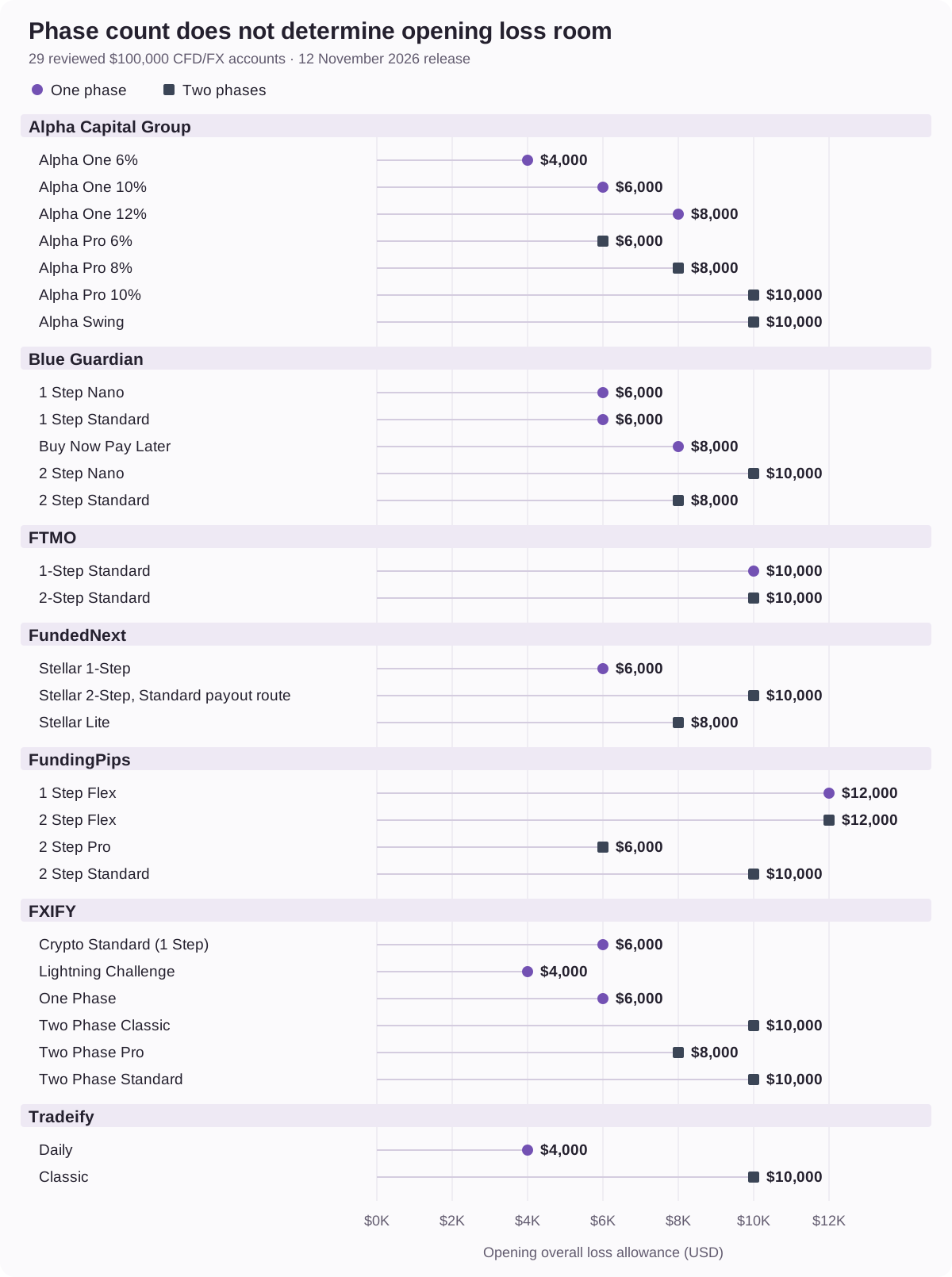
FTMO matches at $10,000. FundingPips' one-phase account matches or exceeds every included two-phase variant. Alpha's ranges overlap: Alpha One 12%'s $8,000 exceeds Alpha Pro 6%'s $6,000 and matches Alpha Pro 8%'s $8,000. At FundedNext, FXIFY and Tradeify, every included one-phase option has less opening room than each two-phase alternative at the same firm. Blue Guardian's one-phase allowances are no larger than its two-phase allowances: Buy Now Pay Later matches 2 Step Standard at $8,000, while both one-step Nano and Standard open with $6,000.
The movement rule is the clearest pattern associated with phase count here. Ten of the thirteen one-phase accounts trail a recorded high; Stellar 1-Step, 1 Step Flex and Tradeify Daily are static. Fifteen of the sixteen two-phase accounts keep a static overall threshold; FXIFY Two Phase Standard trails. This is a strong pattern in these 29 accounts, with named exceptions, rather than a rule of one-step or two-step routes.
The trailing accounts also differ from one another. Alpha One trails the highest balance and stops at $100,000; FTMO 1-Step moves at the end of each day. Blue Guardian's and FXIFY's trailing accounts follow the highest closed balance and stop at $100,000 once the account is up by its allowance; FXIFY's also stop when a funded payout is processed. A shared opening amount cannot describe that later behavior. The drawdown guide explains the models; the account-size study asks a different question, how fees and allowance change when the size tier changes.
What does the Difficulty ratio leave out?
FundedNext shows why counting phases is insufficient. Stellar 1-Step's calculation is 10,000 ÷ 6,000, published as 1.667. Stellar 2-Step Standard's is 8,000 ÷ 10,000 + 5,000 ÷ 10,000, published as 1.30. The two-step route asks for more profit across its separate targets, yet less profit relative to the allowance in each phase.
The ratio starts with the base targets and opening overall allowances. It does not price in a trailing threshold, a tighter daily limit, required trading activity, strategy restrictions or a best-day condition that raises the profit required. FTMO 1-Step's 1.00 and Tradeify Daily's 2.50 do not change in these tables when a particular trading history fails their consistency tests; the trader's additional profit requirement is a separate calculation.
An equal ratio can also conceal different structures. Alpha One 12%, Alpha Pro 10% and Alpha Swing each show 1.50, as does Alpha One 6%. Alpha One 12% combines a $12,000 target with an $8,000 trailing allowance; Alpha One 6% pairs a $6,000 target with $4,000 of trailing room. The two-phase accounts combine $10,000 and $5,000 targets with a $10,000 static allowance in each phase. The ratio summarizes those opening inputs; it does not make their paths interchangeable.
How should you use these findings?
Choose the exact alternatives before comparing them. At Alpha, selecting Pro 6% rather than Pro 10% changes the price, allowance and ratio. At FundingPips, choosing Flex, Pro or Standard changes the apparent one-step trade-off. At FTMO, equal opening allowances still require a choice between moving and static overall thresholds. At FXIFY, the same choice separates two two-phase accounts at $549: Classic is static and Standard trails. At Blue Guardian, a $10 checkout can leave a $686 activation payment still to come.
For a shortlist, record the list fee, every phase target and its conditions, the opening allowance, and how both loss limits are calculated and enforced. Then check what changes after passing: trading permissions, payout conditions and any refund. The FTMO, FundingPips and Alpha Capital Group comparison and the FTMO, The5ers and FundedNext comparison follow selected two-step accounts into those later decisions.
Use PFW's account comparison to inspect the current records for the configurations you are considering, and confirm the applicable terms before paying. If a current record differs from this study, use the current terms for the purchase. A lower entry fee, fewer phases or a lower ratio can each matter to your decision; none answers all of it.
Sources and method
This is a frozen study of PFW's 12 November 2026 approved release, exported the same day. The records' source-check dates run from 19 September to 12 November 2026.
- The 29 accounts in the study, for exact account names, configuration identifiers, markets, sizes, phase counts and account paths.
- 174 account-rule records, for each account's list price, route, targets, opening loss allowance, Difficulty ratio and loss-limit wording, with conditions, sources and check dates.
- 395 source citations, for the official references attached to those rule records. These are citation records, not 395 distinct documents.
The selection was applied to reviewed accounts in that release; firms appear alphabetically, then one phase before two. Every qualifying variant is retained. The three downloads are the study's records exactly as exported, with no values added or changed. We recounted the accounts and rule records and recalculated every opening allowance and Difficulty ratio from them.
The analysis preserves native list currencies and the released precision of the Difficulty ratio. Opening amounts are not current remaining buffers. Daily percentages are described only to the level documented in these exported rows; no missing reset, equality or enforcement detail has been inferred. For 2 Step Flex, the study uses the 8% phase-two target that FundingPips' checkout and help article give, and shows its terms' 6% beside it.
This evidence set contains no trader outcomes, market-wide sampling frame or attempt histories. It can describe the included offers and reproduce their starting arithmetic; it cannot estimate the chance of passing, the expected cost of repeated attempts or the time to a payout. Later catalogue releases may support an update or a new edition, but do not silently rewrite this one.