LearnMax-loss rules
Overall Max Loss: Static vs. EOD and Intraday Trailing
A static overall max-loss threshold stays fixed. A trailing overall max-loss threshold rises when its specified reference reaches a new high. End-of-day (EOD) and intraday trailing differ in when that reference updates. Breach enforcement is a separate question: an EOD threshold can still be enforced throughout the trading day.
On this page
Firms may call an overall max-loss rule Maximum Loss, Maximum Loss Limit, or Trailing Drawdown, as the official examples below show. Those labels do not identify the complete formula: check the reference value, update timing, and breach test.
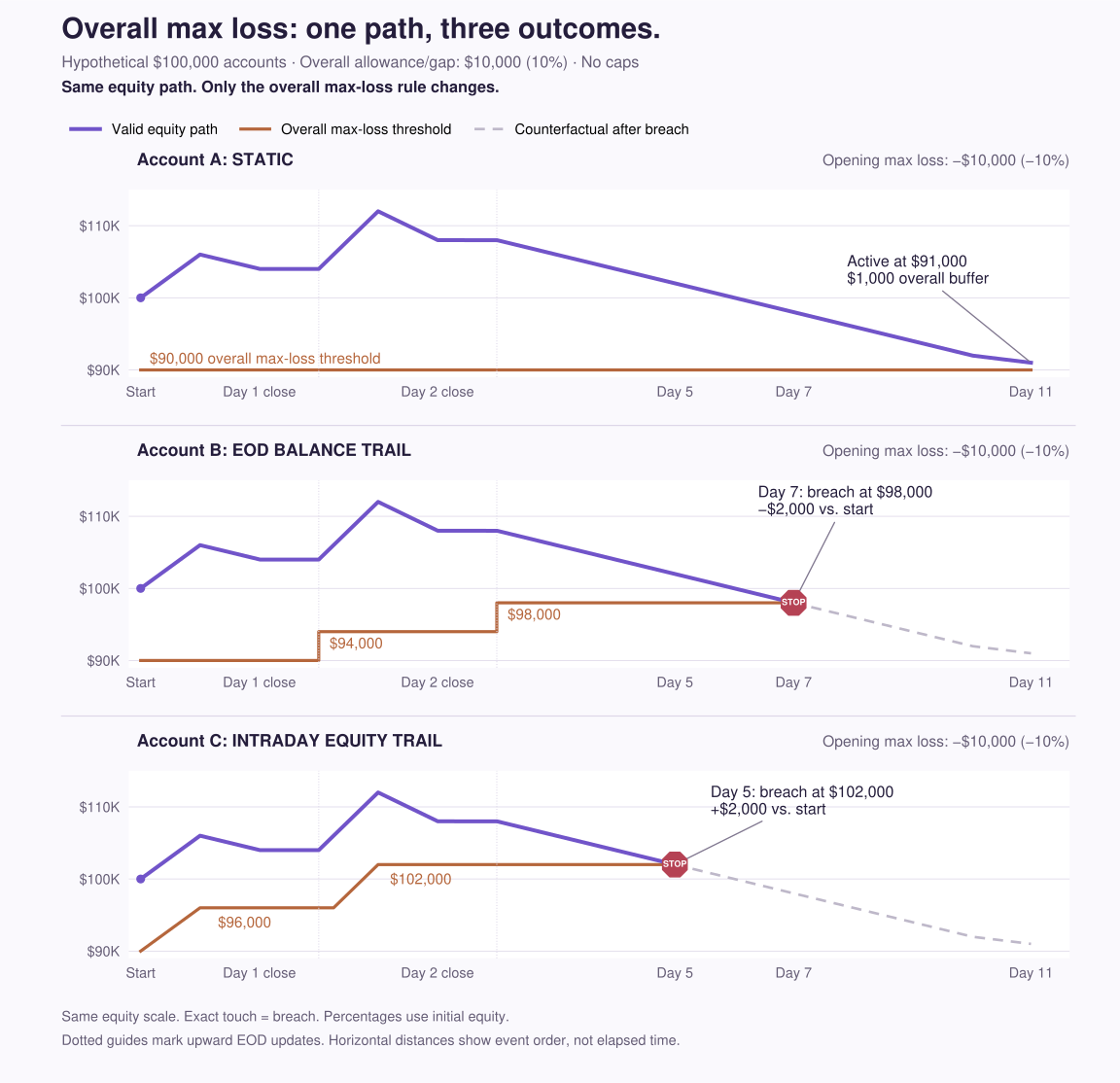
This guide follows one equity path through three hypothetical $100,000 accounts, each with a $10,000 overall loss allowance. Only the method for setting the overall threshold changes. The result shows why the same trades can leave one model active while two others have already breached.
How do static, EOD, and intraday overall max loss differ?
Keep three quantities separate: the overall loss allowance, the equity threshold at which the rule can trigger, and the remaining buffer above that threshold.
For the starting calculation, see how to calculate an account’s opening loss allowance.
For example, an account starting at $100,000 with a static overall max loss of $10,000 has a $90,000 threshold. At $102,000 equity, its remaining overall buffer is $12,000. The initial loss allowance is still $10,000; accumulated profit has increased the distance to the unchanged threshold.
The following models all use a fixed dollar amount. A percentage of a changing reference requires a different formula.
| Model | What sets the max-loss threshold? | When can it rise? | What a gain changes |
|---|---|---|---|
| Static overall max loss | Starting value minus the fixed loss amount | It does not rise in this model | Profit adds distance above the unchanged threshold |
| EOD trailing overall max loss, based on balance | Highest completed day-end balance, including the initial value as a minimum reference, minus the fixed gap | At the specified day-end update | A higher closing balance can raise the next session's threshold |
| Intraday trailing overall max loss, based on equity | Highest equity reached since inception minus the fixed gap | Immediately when equity reaches a new high | An unrealized gain can raise the threshold before the trade closes |
EOD is a timing description, not a synonym for static. A threshold can stay unchanged all session and still trail upward between sessions.
In the two trailing models above, losses do not pull the high-water mark down. A losing close therefore does not automatically lower an EOD threshold. A retreat from an intraday peak does not lower an equity-trailing threshold either. Locks, resets, and account replacements can modify those rules; they must be specified separately.
Can you breach an EOD overall max-loss limit during the day?
Yes, if the established threshold is enforced intraday. “Calculated at day-end” tells you when a boundary is updated. It does not tell you when crossing it becomes a violation.
Think of two independent clocks:
| Clock | Question to ask |
|---|---|
| Update clock | When does a new balance or equity high change the threshold? |
| Enforcement clock | When is the monitored account value tested against the threshold? |
Topstep's Maximum Loss Limit documentation explicitly separates day-end updates from real-time monitoring, including unrealized P&L. Apex's EOD documentation likewise describes a threshold set at the close and enforced during the following session.
A hypothetical EOD account with a current $98,000 threshold cannot rely on finishing the day above $98,000 if touching that level during the session is already a breach. A later price recovery occurs after the decisive event. It does not reverse that event.
This distinction also explains why a closed-trade statement may be insufficient to reconstruct an account's outcome. If the rule monitors open losses, the path between entry and exit matters.
The balance-versus-equity guide explains how a balance reference can coexist with a breach test that includes open P&L.
Worked example: one path, three overall max-loss outcomes
All three accounts begin with $100,000 balance and equity and an overall loss allowance of $10,000 (10%). The trailing models keep a fixed $10,000 gap, rather than calculating 10% of each new high.
The 10% overall amount matches the cited FTMO CFD/FX 2-Step and 1-Step rules. Holding the amount constant isolates how the threshold moves. These are hypothetical models, not three complete program replicas; the actual futures examples later in the article use their published smaller allowances.
Assumptions: Only overall max loss is modeled. Equity is monitored continuously, and touching the threshold is a hard breach. There are no threshold caps, costs, cash flows, or profit-target stops. Positions close before each EOD balance snapshot. Each losing session declines steadily from its opening balance, with no deeper unshown loss. Hypothetical liquidation occurs exactly at the trigger. Day labels are trading sessions. Actual programs may impose additional stopping rules.
Define the three overall thresholds
Model A: Static overall max loss:
Overall threshold = $100,000 − $10,000 = $90,000
Model B: EOD trailing overall max loss, based on balance:
Overall threshold for the next session = highest completed day-end balance − $10,000
Start the day-end reference at $100,000 and raise it only when a completed closing balance exceeds the previous reference. The closing trade is processed before the snapshot. A lower close does not lower this overall threshold.
Model C: Intraday trailing overall max loss, based on equity:
Overall threshold now = highest equity reached so far − $10,000
Update that high immediately, including unrealized gains. For all three accounts:
Overall buffer = current equity − current overall threshold
A positive overall buffer means the account is above its threshold. A zero buffer is the breach point under this example's touch-as-breach convention.
Follow the events
Day 1 peaks at $106,000 and closes at $104,000. Day 2 peaks at $112,000 and closes at $108,000. The attempted path then loses $2,000 per session on Days 3–10, followed by $1,000 on Day 11.
Step through the same path, one event at a time
A: Static
B: EOD trailing
C: Intraday trailing
The table applies that path to each model only while its account remains valid. Later checkpoints are counterfactual for an account that has already breached.
| Event | Equity on the attempted path | A: static overall threshold | B: EOD overall threshold | C: intraday overall threshold |
|---|---|---|---|---|
| Day 1 opens | $100,000 | $90,000 | $90,000 | $90,000 |
| Day 1 open trade reaches its peak | $106,000 | $90,000 | $90,000 | $96,000 |
| Day 1 closes; before the EOD update | $104,000 | $90,000 | $90,000 | $96,000 |
| Day 1 snapshot applies for the next session | $104,000 | $90,000 | $94,000 | $96,000 |
| Day 2 open trade reaches its peak | $112,000 | $90,000 | $94,000 | $102,000 |
| Day 2 closes; before the EOD update | $108,000 | $90,000 | $94,000 | $102,000 |
| Day 2 snapshot applies for the next session | $108,000 | $90,000 | $98,000 | $102,000 |
| Day 3 closes | $106,000 | $90,000; active | $98,000; active | $102,000; active |
| Day 4 closes | $104,000 | $90,000; active | $98,000; active | $102,000; active |
| Day 5 reaches $102,000 | $102,000 | $90,000; active | $98,000; active | Threshold touched; C ends |
| Day 6 closes | $100,000 | $90,000; active | $98,000; active | Ended at $102,000 |
| Day 7 reaches $98,000 | $98,000 | $90,000; active | Threshold touched; B ends | Ended at $102,000 |
| Days 8–10 close | $96,000 → $94,000 → $92,000 | $90,000; active | Ended at $98,000 | Ended at $102,000 |
| A closes Day 11 | $91,000 | $90,000; active | Ended at $98,000 | Ended at $102,000 |
Why did the accounts stop at different points?
A remains active at $91,000 on Day 11. Its overall threshold stays at $90,000, leaving a $1,000 overall buffer. It is $9,000 below its initial equity.
B breaches at $98,000 on Day 7. Its highest completed closing balance was $108,000. Subtracting the fixed $10,000 gap produces the overall threshold. The $112,000 intraday peak did not enter this EOD calculation.
C breaches at $102,000 on Day 5. Its $112,000 equity peak moved the overall threshold to $102,000. Closing Day 2 at $108,000 did not move that threshold down.
| Overall max-loss model | Relevant reference | First breach / end state | Change from initial $100,000 |
|---|---|---|---|
| A: Static | Initial $100,000 | Active at $91,000 on Day 11; $1,000 overall buffer | −$9,000 |
| B: EOD trailing | Highest close: $108,000 | Breach at $98,000 on Day 7 | −$2,000 |
| C: Intraday trailing | Highest equity: $112,000 | Breach at $102,000 on Day 5 | +$2,000 |
A trailing account can breach while still above its starting value. Model C constrains the $10,000 retreat from its tracked high. It does not need to lose $10,000 relative to its original $100,000. This outcome depends on the uncapped trail; a lock can change it substantially.
What changes the result?
A lock can stop the threshold rising
Suppose a separate hypothetical version of Model C caps its threshold at $100,000. At the same $112,000 equity high:
Capped threshold = min($112,000 − $10,000, $100,000) = $100,000
At $102,000 equity, that version still has $2,000 of buffer. It would breach later, when the decline reaches $100,000. The uncapped version breaches at $102,000.
Once a cap is reached, further gains can expand the distance above the locked boundary. But “trailing stops” does not specify the lock value, when it activates, or how a withdrawal affects it. Those are separate fields to verify.
A fixed dollar gap differs from a percentage below the high
Our $10,000 overall gap is 10% of the initial $100,000. It stays $10,000 when the account reaches $112,000.
A different rule set at 10% below the current high would produce:
$112,000 × 90% = $100,800
That is an $11,200 gap, not $10,000. The label “10% trailing drawdown” is incomplete until the percentage basis is known.
Balance and equity can set different references
In the main example, Day 2 opens with a $104,000 balance. An open gain of $8,000 takes equity to $112,000. The trade later closes with a $4,000 gain, leaving balance and equity at $108,000.
The intraday equity model records $112,000. The EOD balance model records $108,000 at the close. An intraday balance trail would be a third specification: it would update when booked transactions raise balance, rather than following the same open-profit peak.
Always ask two questions: What moves the threshold, and what is checked against it? A balance-based reference can coexist with equity-based enforcement.
Withdrawals, costs, and fills change the account state
A fresh hypothetical snapshot with $108,000 equity and a fixed $98,000 overall threshold has $10,000 of overall buffer. If an authorized withdrawal debits $2,000 and that threshold stays unchanged, equity becomes $106,000 and the overall buffer becomes $8,000.
That arithmetic does not establish a firm's withdrawal policy. A payout may also lock, reset, or replace the threshold or account. The amount debited need not equal the trader's cash receipt.
The post-payout buffer comparison shows how the same account debit produces different remaining loss room when the threshold stays fixed, is already locked, or changes at payout.
The payout-process guide explains the separate steps between eligibility, a request, and receipt of money.
Include charges in the monitored value according to the actual rule without subtracting them twice. A trigger is also distinct from an execution price: Topstep explains that a liquidation fill can end above or below the triggering risk level. The main simulation assumes exact fills only to make its arithmetic inspectable.
Which programs use these overall max-loss mechanisms?
These are selected official rule descriptions checked on 26 September 2026. They illustrate the mechanism in the named configuration; they are not complete terms or a ranking. The $10,000 model allowance reflects the cited FTMO CFD/FX products. The cited futures products have smaller dollar allowances, so the shared example should not be read as their actual configuration.
| Firm and scope | Published overall max-loss mechanism | Detail that changes the interpretation |
|---|---|---|
| FTMO: CFD/FX 2-Step, including Verification and the subsequent 2-Step account | 10% of initial capital: $10,000 on $100K, with a static $90,000 overall threshold | FTMO specifies equity falling below the boundary; our model uses exact touch. Objectives |
| FTMO: CFD/FX 1-Step and subsequent 1-Step account | Highest preceding midnight balance, or initial capital if higher, minus 10% of initial capital: a $10,000 EOD gap on $100K | Recalculated at 00:00 CE(S)T. The threshold can rise with a new closing high and does not fall after a losing close. When a reward is withdrawn and a new account is provided, the limit resets. Objectives; what to check for the next payout. |
| Topstep: $100K Trading Combine | $3,000 gap from the EOD balance high; starts at $97,000 and locks at $100,000 | Intraday enforcement includes unrealized P&L. A breach removes funding eligibility until reset; practice access is not restoration of a compliant attempt. Maximum Loss Limit |
| Apex: $100K Intraday Trailing Drawdown Evaluation on Tradovate | $3,000 gap, updated in real time using realized and unrealized gains | The cited explanation says Tradovate evaluations keep trailing without a fixed stop; other platforms/stages have different lock descriptions. Touching the threshold fails the evaluation. Intraday explanation |
A firm's name alone cannot determine the formula. Record the product, stage, platform, and lock alongside it. Do not transfer a CFD/FX rule to futures, or an evaluation rule to a funded stage, without checking the relevant terms.
For how those stages fit together, see the challenge journey from purchase through funded trading and payout.
An overall allowance of 5% also exists: FundingPips Zero uses a trailing amount equal to 5% of initial account size and locks the threshold at the initial balance once equity gains 5%. The amount, reference, and lock must all be checked for the specific program.
Rule comparison: which model gives more room for losses?
With the same initial value, fixed overall dollar gap, equity path, no caps, and no cash flows, the static model in this example keeps the lowest overall threshold. The EOD model's threshold is no higher than the intraday equity model's threshold because all positions are closed at each EOD snapshot, making closing balance equal to equity under the stated assumptions. Each closing balance is therefore included in the equity path's observed highs. If a loss remains open at the snapshot, balance can exceed equity, so this ordering is not guaranteed.
That is a conditional comparison of these rules. It does not identify the best program. The before-you-pay comparison guide puts the loss rule alongside your other requirements. Different allowances, prices, trading restrictions, and payout terms can change the overall decision. Nor does this example estimate anyone's probability of passing.
Use the following worksheet to reconstruct the rule before comparing it:
| Field | What to record from the official terms |
|---|---|
| 1. Exact account | Market, program, stage, size, platform, options, and applicable cohort |
| 2. Amount and basis | Fixed dollars or percentage; percentage of which value? |
| 3. Reference | Initial value, balance high, equity high, or completed closing high |
| 4. Update clock | Intraday or at a defined session boundary; timezone and daylight-saving treatment |
| 5. Enforcement | Monitored value, continuous or scheduled checks, and touch-versus-below wording |
| 6. Lock and adjustments | Cap, activation conditions, withdrawals, resets, and account replacement |
| 7. Consequence | What happens at breach; distinguish failure of this attempt from practice access or a new account |
| 8. Evidence | Official source, checked date, applicable terms, and unresolved questions |
Next step: fill in those eight fields for the account you are evaluating, then replay a short path that includes an open-profit peak, a lower close, and a losing session. A closed-trade list alone cannot reconstruct an intraday equity trail if the open-position highs and lows are missing. Mark missing inputs as unknown rather than treating the replay as complete.
Daily limits are a separate topic. See the daily-loss guide for the formulas, reset times, overnight positions, and pause or breach consequences.
Sources and method
Official sources read on 25–26 September 2026:
- FTMO Trading Objectives.
- Topstep: What is the Maximum Loss Limit?.
- Apex: Intraday Trailing Drawdown Explained.
- Apex: EOD Drawdown Explained.
- FundingPips: Zero.
The comparison combines desk research with an original hypothetical event simulation. Its chart and tables use the same calculated states. The example is not an execution test, an observed trader result, or evidence that one model produces a particular pass rate. Program rules and their applicability can change; the checked date does not establish a contractual effective date.
The FTMO 1-Step reward-and-new-account reset statement was rechecked on 1 October 2026. Other source checks retain the date above.