LearnMax-loss rules
Profit Targets vs. Loss Limits: Reading Challenge Difficulty
Compare the profit a challenge requires with the losses it permits, using dollar amounts for the same evaluation phase. Dividing the target by the opening overall loss allowance describes that relationship. It does not measure your chance of passing or account for rules that change the path.
On this page
A 5% target can require more profit per dollar of opening loss allowance than an 8% target. Two challenges with identical opening ratios can also respond differently to the same trading results. Both points matter when a headline percentage makes one offer appear easier.
This guide explains the calculation, changes one input at a time, and shows where the calculation stops being informative. The worked models are hypothetical. The original official examples were checked on 2 October 2026. FTMO's two phase targets and overall allowance were rechecked on 3 October 2026 for the route calculation below.
Put the target and loss allowance on the same basis
Start with one exact evaluation phase. Record its currency, actual starting value, required profit, and initial overall max-loss threshold. The advertised account size is context, not automatically the amount available for losses.
Use these definitions:
| Input | Meaning |
|---|---|
| Profit target | The net profit required for that phase under the product's target definition |
| Opening overall loss allowance | The difference between the opening monitored account value and its initial overall max-loss threshold |
| Current remaining buffer | The difference between the monitored value now and the applicable threshold now |
The last two values can differ after trading begins. The account-size and loss-allowance guide explains the starting calculation in more detail.
For a simple fresh account with no credit or other adjustments:
Opening overall loss allowance = starting equity − initial overall max-loss threshold
Then calculate:
Target-to-opening-loss ratio = phase profit target ÷ opening overall loss allowance
Use positive dollar magnitudes in the division. A $10,000 allowance is the distance from $100,000 to a $90,000 threshold; the denominator is $10,000, not $90,000. This distance is not permission to touch a boundary where the rules treat equality as a breach.
If the target and allowance are percentages of the same starting value, dividing the percentages gives the same answer. If their bases differ, convert them separately to dollars first. Do not substitute the daily loss amount or a later funded account's allowance for the evaluation's overall allowance.
Also check what counts toward the target and what is monitored for a breach. Closed profit and floating equity are different measurements. A floating gain can leave the target unsatisfied while a floating loss consumes the permitted buffer. See the balance-versus-equity guide.
Two official starting-point examples
These selected figures illustrate the inputs, not a ranking across markets. The ratios below are our arithmetic using the cited published amounts.
| Configuration and stage | Base profit target | Opening overall loss allowance | Opening ratio |
|---|---|---|---|
| FTMO CFD Challenge: 2-Step, $100,000 account, first Challenge phase | $10,000 | $10,000, with a static overall threshold | 1.00 |
| FTMO CFD Challenge: 2-Step, $100,000 account, Verification phase | $5,000 | $10,000, with a static overall threshold | 0.50 |
| Topstep futures, $50K Trading Combine | $3,000 | $2,000, with an EOD trailing overall threshold | 1.50 |
FTMO inputs were rechecked on 3 October 2026; the Topstep example retains its 2 October 2026 check date. For the full FTMO 2-Step route, the Difficulty ratio on PFW comparison pages is 1.00 + 0.50 = 1.50. Topstep's single evaluation phase also gives 1.50. Equal totals do not establish equal trading conditions.
Sources: FTMO Trading Objectives · Topstep target table · Topstep Maximum Loss Limit.
FTMO's cited objectives require the target to be met with positions closed. Topstep's remaining buffer depends on subsequent trading and threshold movement, and its consistency condition can increase the total profit required. These qualifications belong beside the ratio. A 1.50 ratio does not mean a 50% lower pass rate than a 1.00 ratio.
Can a smaller target ask for more relative to the allowance?
Yes. Consider two hypothetical evaluations, each starting at $100,000. Both have static overall max-loss thresholds. The comparison below isolates the target and opening overall allowance; it does not claim that either complete program is easier.
| Input | Evaluation A | Evaluation B |
|---|---|---|
| Profit target | 8%, or $8,000 | 5%, or $5,000 |
| Opening overall loss allowance | 10%, or $10,000 | 4%, or $4,000 |
| Initial overall max-loss threshold | $90,000 | $96,000 |
| Target-to-opening-loss ratio | 8,000 ÷ 10,000 = 0.80 | 5,000 ÷ 4,000 = 1.25 |
A asks for $0.80 of profit per $1 of opening overall allowance. B asks for $1.25. B's smaller target sits alongside a proportionally smaller loss allowance.
That interpretation is the useful result. The numbers do not establish how many trades you need, how much to risk per trade, or whether your trading method fits either set of rules. The denominator is also not the trader's purchase fee or personal cash deposit.
A ratio above 1 means the required profit exceeds the opening allowance. A ratio below 1 means it is smaller. There is no universal cutoff here that makes a challenge easy, safe, or suitable. This is a descriptive calculation. PFW's comparison pages add the per-phase calculations across the required evaluation phases as the Difficulty ratio. Neither the phase ratio nor that total is a pass probability, a normalized score, or a trade's reward-to-risk ratio.
How PFW's comparison pages summarize a route
PFW's Difficulty ratio adds each required evaluation phase's profit target divided by that phase's opening overall loss allowance:
Difficulty ratio = sum of (phase profit target ÷ phase opening overall loss allowance)
For the FTMO CFD 2-Step $100,000 example, that is 10,000 ÷ 10,000 + 5,000 ÷ 10,000 = 1.50. A higher total means a larger sum of required profit relative to opening allowance across the route. Keep the phase breakdown beside it: the total does not show resets, trailing movement, daily rules, activity or consistency conditions, or the chance of passing.
For three named accounts, the FTMO, FundedNext, and The5ers comparison places PFW's Difficulty ratio beside each route's targets and opening loss allowance. Its loss-rule and permission checks explain why the ratio alone cannot select an account.
Change one condition at a time
Use a separate hypothetical baseline: a fresh $100,000 evaluation, an $8,000 target, a static $10,000 overall allowance, a $2,000 daily loss amount, and five required trading days. For this comparison, the daily threshold is the session's opening balance minus that fixed daily amount. A day counts when at least one position is opened; it need not be profitable. Hold the other conditions unchanged in each row.
| Single change from the baseline | Target | Opening overall allowance | Opening ratio |
|---|---|---|---|
| None | $8,000 | $10,000 | 0.80 |
| Lower the target to $6,000 | $6,000 | $10,000 | 0.60 |
| Reduce the overall allowance to $5,000 | $8,000 | $5,000 | 1.60 |
| Reduce the daily loss amount to $1,000 | $8,000 | $10,000 | 0.80 |
| Replace the static threshold with an EOD trail using the same opening gap | $8,000 | $10,000 | 0.80 |
| Increase required trading days from five to ten | $8,000 | $10,000 | 0.80 |
The first two changes affect the calculation directly. The last three do not, even though they change conditions the trader must satisfy. This is why a ratio works as one comparison field but cannot replace the rule sheet.
The daily amount is not added to the overall allowance. A program with $10,000 of overall allowance and a $2,000 daily limit does not provide $12,000 to lose. The daily condition is an additional constraint within the route.
The same opening ratio can hide a moving loss limit
Now isolate the overall-loss mechanism in a separate hypothetical path. Both accounts start at $100,000, require $8,000 of closed net profit, and initially place the max-loss threshold at $90,000. Both therefore open at 0.80.
- Static account: the threshold stays at $90,000.
- EOD trailing account: after each session closes, the threshold becomes the higher of its previous level or the closing balance minus $10,000. It is capped at the initial $100,000 balance. That cap is not reached in this path.
Both accounts monitor equity continuously and treat touching the threshold as a hard breach. At a session close, record the closing balance, update the trailing threshold, and check the account against that new threshold before the next trade. The values are net of trading charges, with no separate credit, payments, or withdrawals. There is no daily rule, minimum activity, or consistency condition in this mechanics-only model. It does not reproduce either named firm's complete program.
Day 1 closes at $105,000 with all positions closed. The target has not been met. After the EOD update, the trailing threshold rises to $95,000 while the static threshold stays at $90,000.
During Day 2, balance remains $105,000 while floating losses take equity down through $100,000 to its first touch of $95,000. The table stops there.
| Checkpoint | Equity | Static threshold / remaining buffer | EOD threshold / remaining buffer |
|---|---|---|---|
| Start | $100,000 | $90,000 / $10,000 | $90,000 / $10,000 |
| Day 1 close, before update | $105,000 | $90,000 / $15,000 | $90,000 / $15,000 |
| After the EOD update | $105,000 | $90,000 / $15,000 | $95,000 / $10,000 |
| Day 2, earlier intraday mark | $100,000 | $90,000 / $10,000 | $95,000 / $5,000 |
| Day 2, first touch of $95,000 | $95,000 | $90,000 / $5,000; active | $95,000 / $0; hard breach |
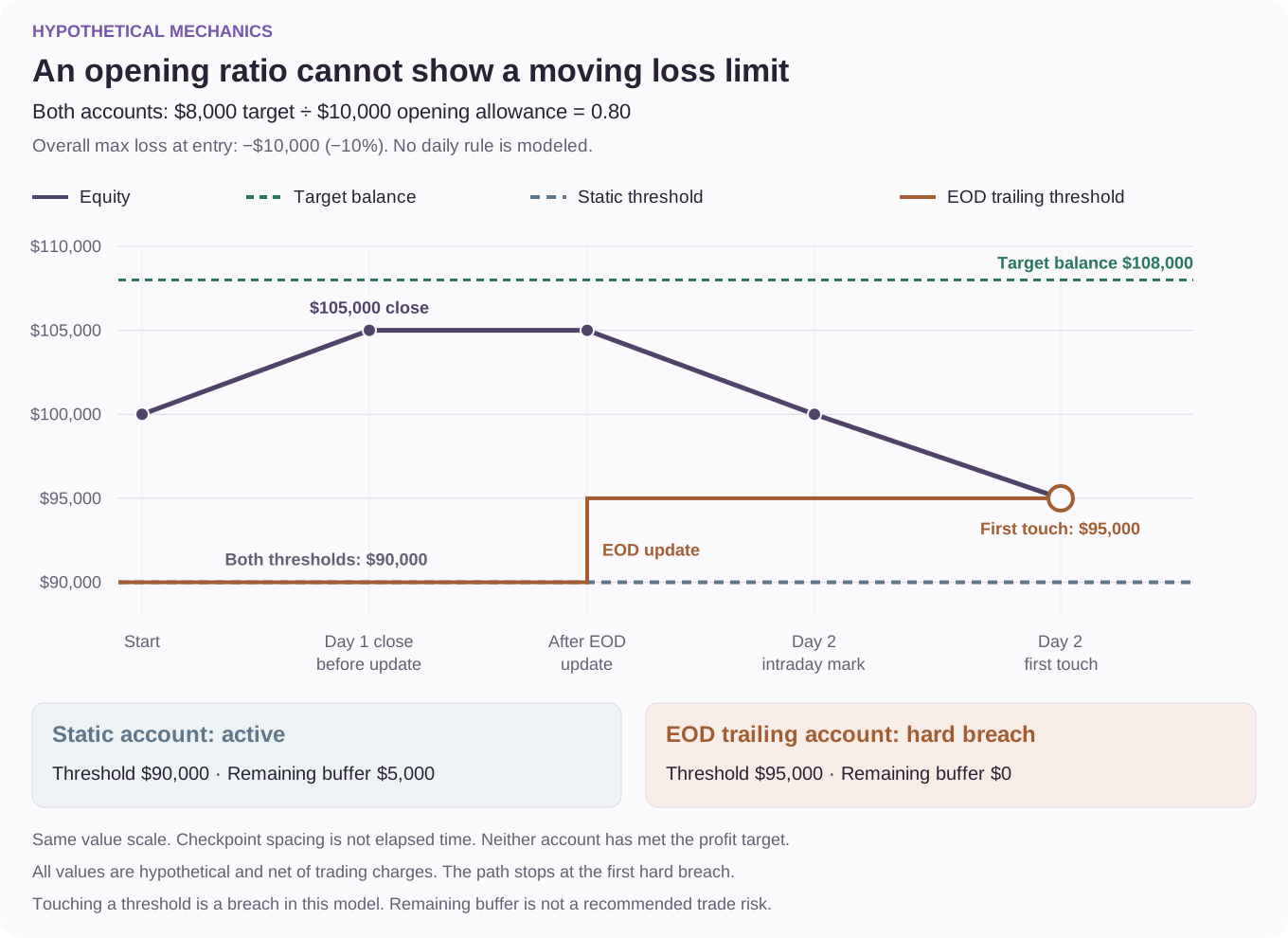
At the final checkpoint, the EOD account has breached before reaching its target. The static account remains active under the modeled rule, but it has not passed. No recovery after the trailing breach is shown or counted as valid trading.
In a real example, Topstep describes an overall limit that updates from end-of-day balances but is monitored during the session, including unrealized P&L. Updating at EOD does not mean breaches are checked only at EOD. Its detailed rules and consequences remain separate from this invented path. Topstep Maximum Loss Limit
The static, EOD, and intraday max-loss guide provides the fuller mechanism comparison. Here the point is narrower: the opening ratio cannot describe how the loss boundary moves after profit has been made.
What else does the ratio leave out?
Daily limits and temporary pauses
An account can have room above its overall threshold and still reach a daily restriction. Check the daily amount, its reference value, the reset time, and whether the consequence is a hard breach or a temporary pause. A pause can end the session without ending the account; that distinction cannot be recovered from the overall ratio.
Use the daily-loss checklist to record those conditions separately. Do not reduce two different constraints to whichever percentage looks most favorable.
Target eligibility and required activity
Reaching a headline profit number may leave other objectives incomplete. FTMO's CFD 2-Step objectives, for example, include four trading days in each evaluation phase. Topstep's Trading Combine also has a consistency objective alongside the profit target. The exact definitions matter. FTMO objectives · Topstep evaluation parameters
Ask whether the target uses closed net profit, whether all positions must be closed, how a qualifying day is defined, and whether concentrated profits can increase the amount needed. Keep review and account transition requirements visible as well. A target-to-loss calculation does not certify completion.
For a worked daily ledger and the effect of a losing day, see how consistency rules change the profit calculation. To distinguish a day with an opened trade from a session that meets a minimum-profit threshold, see how trading days and profitable days are counted.
One, two, or three evaluation phases
Calculate each phase separately using its own target, starting value, and loss rules. A hypothetical first phase at 0.80 followed by a fresh second phase at 0.50 gives a route total of 1.30. That is how PFW's Difficulty ratio summarizes a route. Keep each phase's ratio beside the total, because the total hides the reset between phases and their separate obligations.
For a three-step plan, record all three phases. Do not assume their account balances or rule definitions stay constant, and do not turn their ratios into a pass probability. The one-step, two-step, three-step, and instant-funding comparison follows those routes through fees, account transitions, and the first payout.
If a direct-entry product has no separate evaluation target, mark this evaluation ratio not applicable. Assigning zero would imply an evaluation comparison where none exists. Funded-stage profit requirements and payout conditions still need their own analysis.
The trading method and its execution
The ratio contains no information about the trader's results, trade sizing, sequence of wins and losses, intraday excursions, or costs. Two traders facing the same program do not acquire the same pass probability because the inputs to this ratio match.
Check permitted instruments, holding periods, news restrictions, position limits, and the actual cost of execution. When replaying historical trades against rules, retain enough intraday data to test intraday breaches. A series of daily closing balances cannot establish that no intraday boundary was crossed. A replay describes those recorded trades under stated assumptions; it does not promise future results.
Use the ratio as the start of a comparison
For each offer, write one short record that another reader could verify:
- Identify the configuration. Name the firm, market, program, phase, size, relevant options, and applicable terms.
- Calculate the opening relationship. Record the target, starting value, initial overall threshold, dollar allowance, and ratio. State any different percentage bases.
- Describe the path constraints. Add how the overall threshold moves, what value triggers a breach, the equality boundary, the daily rule, and any lock or cap.
- List the remaining objectives. Include target eligibility, trading-day and consistency conditions, and the separate requirements of later phases.
- Check fit and cost separately. Compare the rules with the method you intend to use, and price the same purchase-to-payout endpoint for both offers.
If the source does not establish an input, record it as unknown. Do not turn an absent loss rule into unlimited allowance or fill a missing condition from a different program.
Next step: add the target, opening allowance, ratio, and rule notes to the before-you-pay comparison worksheet. The useful result is a comparison you can explain and verify, including the conditions that could change it.
The futures size-tier results show an applied example: in the selected LucidFlex and Topstep Trading Combine configurations, moving from a $50K to a $100K evaluation doubles the initial target while increasing the opening loss allowance by 50%. The study states the snapshot and options behind those figures.
Sources and method
The original official examples were checked on 2 October 2026 and apply only to the configurations and stages identified. FTMO's 2-Step targets and overall allowance were rechecked on 3 October 2026 when the Verification phase and full-route calculation were added. The controlled comparisons, sensitivity rows, and shared path are hypothetical calculations, with their assumptions stated before use. They do not estimate pass rates, prescribe trade sizing, or produce a score or pass probability.
- FTMO, CFD: Trading Objectives, for the selected 2-Step Challenge and Verification targets, overall allowance, target-completion condition, and minimum trading days.
- Topstep, futures: Consistency at Topstep, for the Trading Combine's published base target and the possibility of an increased requirement.
- Topstep, futures: Maximum Loss Limit, for the selected opening allowance, trailing update, and intraday monitoring.
- Topstep, futures: Trading Combine parameters, for its separate evaluation objectives.