LearnFees and costs
CFD Swap Charges: From the Displayed Rate to the Cost of a Hold
A swap rate becomes a money amount only after you apply its calculation mode, position size, charging schedule and any currency conversion. A displayed value of −6.4 is not automatically a $6.40 debit. In the hypothetical example below, it produces a £12.80 debit across three posting events.
On this page
The overnight and weekend holding checklist covers permission and the inputs to collect; this guide uses those inputs to calculate the financing amount.
The field names here follow MetaTrader 5. Other platforms can use different labels or methods. The worked specification is invented for this guide and is not a live quote from a prop firm.
How do swap points become money?
In MT5, open the symbol's Specification from Market Watch. Open it in the terminal logged into the account you will trade: the window shows that server's settings, which can differ from another broker's or another account type's. The swap type determines the unit of the long and short values; long applies to a buy position, short to a sell. The same window supplies contract details and weekday multipliers. MetaTrader 5 specification help.
Start with this hypothetical EUR/USD position:
| Input | Assumption |
|---|---|
| Direction and size | Buy, 0.50 lot |
| Contract size | 100,000 EUR per lot |
| Point | 0.00001 USD per EUR |
| Swap mode | Points |
| Swap long | −6.4 points per daily unit |
| Swap short | +2.1 points per daily unit |
| Profit currency | USD |
| Account currency | GBP |
| Conversion for every modeled charge | 1 USD = 0.80 GBP, with no added conversion fee |
The position remains the same size. Both swap rates and the conversion rate stay fixed throughout the example. The calculation isolates financing; it does not calculate the trade's price P&L, spread or commission.
For this linear FX specification, first find the USD value of one Point for the whole position:
100,000 EUR/lot × 0.50 lot × 0.00001 USD/EUR = 0.50 USD per Point
Now use the long rate, because the position is a buy:
−6.4 points × 0.50 USD/Point = −3.20 USD per daily unit
Finally, convert that amount into the GBP account:
−3.20 USD × 0.80 GBP/USD = −2.56 GBP per daily unit
The negative result is a debit of £2.56. Keep the sign until the last step so a credit does not accidentally become a charge.
The Point field matters. For this five-decimal EUR/USD quote, a Point is 0.00001, while a pip is 0.0001. Treating −6.4 points as −6.4 pips would overstate the amount tenfold. FTMO's explanation of points, pips and their monetary value illustrates the distinction. For another asset, use its own price unit and contract calculation rather than transplanting this FX contract size.
Changing direction means selecting the other rate, not reversing the sign of the long rate. A separate 0.50-lot sell under the same invented settings would produce:
+2.1 × 0.50 × 0.80 = +0.84 GBP per daily unit
That is a financing credit, not a profit forecast for the trade. Swap can be a cost or income, and long and short rates need not be opposites. FTMO's swap explainer discusses both signs; none of its historical rates is used here.
Why can three posting events cost five daily units?
Apply the multiplier for each event the position actually crosses. MT5 documents weekday ratios applied to the long or short swap amount, including an example with a threefold Wednesday posting. Its symbol properties also identify the three-day rollover weekday. Use the actual symbol's schedule. MetaTrader weekday calculation; MQL5 symbol properties.
For this example only, the model's server-weekday multipliers are:
| Monday | Tuesday | Wednesday | Thursday | Friday | Saturday | Sunday |
|---|---|---|---|---|---|---|
| 1 | 1 | 3 | 1 | 1 | 0 | 0 |
Each posting covers the rollover from that server day to the next, so the Wednesday posting is the Wednesday-to-Thursday rollover.
Assume the buy position opens on Tuesday before that day's posting and closes on Friday before Friday's posting. There are no holidays or schedule changes. The actual events are Tuesday, Wednesday and Thursday; Monday and Friday are outside the hold.
| Posting crossed | Multiplier | Swap in USD | Swap in GBP | Cumulative GBP |
|---|---|---|---|---|
| Tuesday | 1 | −3.20 | −2.56 | −2.56 |
| Wednesday | 3 | −9.60 | −7.68 | −10.24 |
| Thursday | 1 | −3.20 | −2.56 | −12.80 |
| Total | 5 daily units | −16.00 | −12.80 | −12.80 |
Total financing = −2.56 GBP × (1 + 3 + 1) = −12.80 GBP
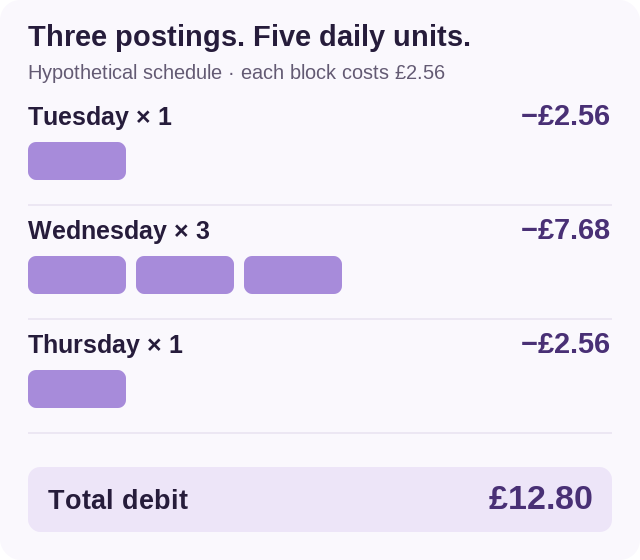
Counting three ordinary daily units would give £7.68, understating the debit by £5.12. Adding a second weekend charge would also be wrong: the model already defines exactly what each crossed event charges.
A different closing time can change the event count. Closing after Friday's modeled posting would add one unit, making the total debit £15.36. A zero multiplier adds nothing at that event; it does not cancel an earlier three-unit charge.
If rates, size or conversion change during a real hold, calculate each posting with its applicable inputs and then add the results. Multiplying today's rate by the whole holding period is only an estimate under a constant-rate assumption. Round according to the account's actual posting convention; the main example's event amounts already resolve to pennies.
What changes when the rate is money or an annual percentage?
Do not apply the points formula to a different unit. MT5 supports these other treatments; the specification decides which one applies. MQL5 swap modes.
| Mode | Calculation to establish |
|---|---|
| Money in the symbol's base, margin or profit currency | Apply the quoted size basis and multiplier, then convert into account currency. |
| Money in deposit currency | The amount is already in account currency; apply size and multiplier without another currency conversion. |
| Annual interest using current price | Use the price at swap calculation and the stated annual rate with a 360-day year. |
| Annual interest using opening price | Use the position's opening price with the same annual-rate and 360-day treatment. |
| Reopening at the close or Bid price | The position is closed and reopened at a price adjusted by the specified points. Reconcile that mechanism separately from a cash posting. |
| Swaps disabled | No swap under that mode; check account terms for any separate holding charge. |
For a separate money-mode example, suppose the quote is −4 EUR per lot per daily unit. At 0.50 lot, a three-unit posting is −6 EUR. With an assumed conversion of 0.85 GBP per EUR, the account amount is −5.10 GBP. There is no multiplication by Point because the quoted rate is already money.
For an annual-interest illustration, assume the 0.50-lot EUR/USD position uses a signed annual swap rate of −3.6% and an opening price of 1.10000 USD per EUR. Neither MetaQuotes page writes out the full formula. This example assumes the annual rate applies to the position's price-based notional, contract size × lots × price, which is 55,000 USD here:
100,000 × 0.50 × 1.10000 = 55,000 USD
Under the opening-price mode, one daily unit is:
55,000 USD × (−3.6 ÷ 100) ÷ 360 = −5.50 USD
At the earlier hypothetical conversion of 0.80 GBP per USD, that is a £4.40 debit. Under the current-price mode, a calculation price of 1.12000 instead gives 56,000 USD of notional and a £4.48 debit for the same annual rate and one daily unit.
Before relying on this reading for a real symbol, compare one calculated posting with the amount the account actually records.
These are alternative specifications, not charges added to the points example. The annual rate is not a daily percentage, and the modeled base is the position's notional value, not its margin deposit. A multi-unit posting still needs the applicable multiplier.
How does the calculated amount enter the account?
The calculation tells you the financing amount. Next, reconcile it with what the account actually records: an accrued swap, a posted debit or credit, or a close/reopen adjustment. The charge-accounting section explains how to include the amount once when reconstructing balance and equity.
The swap-booking time is a separate question from the daily-loss reset. Use the daily-reset clock explanation to place both events in order. A correct financing total alone does not establish the account's loss buffer at either event.
For the rest of the trade's cost, the spread and execution example follows quotes through fills and commissions. For crypto/perps, use the perpetual funding calculation, which has its own rate and settlement mechanics.
Before planning a hold, calculate its expected postings with the current specification. Afterward, compare those event amounts with the statement in the same currency. If they differ, identify whether the rate, multiplier, position size, conversion or posting treatment changed. Keep the difference attached to the particular event instead of adjusting the total until it happens to match.
Sources and method
Official sources checked on 19 November 2026:
- MetaTrader 5: Market Watch and symbol specifications, for displayed fields, swap directions and weekday multipliers.
- MQL5: Symbol properties and swap modes, for Point, currencies, rollover settings, annual-interest price bases, the 360-day year and reopening modes.
- FTMO: Points, pips and ticks, for the technical Point, pip distinction and contract-based monetary conversion (the page also uses a practical index point, which is not MT5's Point field).
- FTMO: What is a swap and for whom is it important?, for swaps as financing debits or credits. Historical rates and firm-specific schedules in that article are not adopted here.
All position settings, rates, conversion rates and event schedules used in the calculations are original hypothetical inputs. Each posting is calculated separately; the changed-size check rounds only its final account-currency result. The examples calculate financing, not total trade profitability or compliance with a named prop account's loss rules.