LearnFees and costs
Perpetual Funding Rates: How Holding a Position Changes Your P&L
Funding is a recurring payment between the long and short sides of a perpetual market. Depending on the rate and your position, you pay it or receive it. In a prop account that includes funding in equity, a debit reduces the room left above a loss limit even if the market price has not moved.
On this page
To estimate that effect, you need the position's value, the rate for the actual payment interval, and the program's accounting rules. The advertised account size and the margin needed to open the trade are not substitutes for position value.
This guide covers linear perpetuals and their treatment in prop accounts, with current examples from Hyperliquid, E8 Markets and Propr. Bybit and OKX illustrate differences between venues. All numerical trading scenarios are hypothetical, not current rates or named-firm account models. Their rates are chosen for simple arithmetic, not as typical levels. Official sources were checked on 18 October 2026.
Who pays perpetual funding, and why?
Funding encourages perpetual prices to stay close to their reference market. The published rate determines which side pays:
| Rate for the payment interval | Long position | Short position |
|---|---|---|
| Positive | Pays funding | Receives funding |
| Negative | Receives funding | Pays funding |
| Zero | No funding transfer | No funding transfer |
This sign convention is documented by Hyperliquid and OKX. It describes the market rate, not necessarily the sign used for a debit in your account statement. Hyperliquid funding · OKX funding mechanism
Do not decide which side pays just by comparing the latest trade with a spot quote. A venue's calculation can combine an interest component, an averaged price premium and limits on the result. OKX documents those ingredients in its rate formula. Use the applicable rate for the settlement event. OKX funding calculation
Receiving funding also does not settle whether the trade makes money. A short position can receive a funding credit while losing more from a price rise. Your record needs both entries.
For the contract and account relationship behind these payments, start with perpetual prop firms explained.
How do you calculate one funding payment?
For the linear model used here:
Payment amount = position value at the funding event × the absolute funding rate for that interval.
Determine whether that amount is paid or received from the position side and the rate's sign. If quantity is already measured in units of the underlying asset, position value is quantity multiplied by the specified reference price. A quantity expressed as contracts also needs the contract size and multiplier.
Which price belongs in that calculation? Hyperliquid specifies the oracle price for its funding-payment notional. Bybit's linear USDT and USDC contract examples use mark price. These are venue-specific instructions. Hyperliquid payment formula · Bybit funding fee calculation
Hyperliquid separately uses its mark price for unrealized P&L and risk functions. A single chart price therefore cannot automatically stand in for both funding valuation and the account's equity valuation. Hyperliquid price indices
For a hypothetical position worth $50,000 at a positive rate of 0.01% for one payment:
$50,000 × 0.0001 = $5.00.
The long pays $5; an equally sized short receives $5. The decimal conversion matters: 0.01% is 0.0001, not 0.01.
Changing the margin requirement while keeping that same position value and rate does not change this $5 calculation. Using the extra leverage to double the position value would double the payment. See leverage, margin and loss limits for the distinction between exposure and the margin supporting it.
Keep the settlement unit explicit. A result calculated in USDC remains a USDC amount; it is not automatically a USD bank receipt. The examples below use an invented USD ledger, so they require no stablecoin conversion. Inverse contracts need their own specification and valuation formula rather than this linear example.
If a later payout is settled in a stablecoin, the token-to-bank receipt example shows how the transfer charge, conversion quote and withdrawal fees affect the cash received.
Is the quoted rate hourly or for eight hours?
Match the rate's period to the payment interval before multiplying. Hyperliquid documents hourly payments at one eighth of its computed eight-hour rate. OKX documents a default eight-hour schedule, with other intervals and possible schedule changes. These are venue mechanics, not proof of a prop platform's posting time. Hyperliquid payment interval · OKX payment intervals
Suppose a hypothetical screen explicitly labels a rate 0.08% per eight hours, and the specification says to apply one eighth at each hourly payment. The one-hour rate is 0.01%, so a constant $50,000 position pays $5 per hour on the paying side. Eight identical payments total $40.
If the screen already gives 0.01% for the next hourly payment, use that figure directly. Dividing it by eight again would understate the payment. Multiplying an eight-hour rate by 24 would overstate a one-day estimate. Record the unit beside every rate you save.
Count the events that actually apply to the position. Bybit states that positions held at its funding time are included; it also warns that processing around that time creates uncertainty for openings or closures within five seconds. This is a Bybit rule, not a universal five-second window. Bybit timing rules
Do not assume a short hold owes a prorated fraction of a full-interval payment. Confirm the actual event rule, and distinguish an estimated next rate from the rate eventually posted. Closing and reopening also introduces execution costs; it is not automatically the cheaper choice.
What happens when the rate and position value change?
Consider a hypothetical USD-denominated linear account with a $10,000 starting balance and a long position of 0.5 BTC opened at $100,000 per BTC. The position stays open across three hourly funding events. The reference prices are $100,000, $102,000 and $101,000; the model uses those same prices to value floating P&L at each event.
Each rate below is already the rate for that hour. Fees, separate account credit, deposits and withdrawals are zero, and no loss limit is reached. Positive cash flow means a credit to the account; negative cash flow means a debit.
| Event, UTC | Position value | Hourly rate | Funding cash flow | Cumulative funding |
|---|---|---|---|---|
| 10:00 | $50,000 | +0.01% | −$5.00 | −$5.00 |
| 11:00 | $51,000 | +0.02% | −$10.20 | −$15.20 |
| 12:00 | $50,500 | −0.01% | +$5.05 | −$10.15 |
The second debit is $51,000 × 0.0002 = $10.20. The third event reverses direction: the negative rate credits the long $50,500 × 0.0001 = $5.05.
After all three events, the balance is $9,989.85. Floating price profit is 0.5 × ($101,000 − $100,000) = $500, giving equity of $10,489.85. Funding has reduced the $500 price gain to a $489.85 account gain before any exit costs.
An actual statement may already include funding in its net P&L field. Reconcile the field definition before subtracting the entries again. Likewise, use actual fills for price P&L rather than subtracting spread or slippage twice. The execution-cost guide explains that accounting boundary.
Can funding alone breach a prop loss limit?
Yes, when funding reduces the monitored account value to the program's breach boundary. Propr's rulebook explicitly includes funding debits and credits in equity, and its loss limits act when equity reaches or falls below the applicable level. That combination means a funding debit can trigger a breach without another price move. Propr rulebook, equity limits and funding
Here is a separate hypothetical account close to a fixed overall max-loss limit. It started at $10,000 and has a $500 overall allowance, so its equity threshold is $9,500. Touching that threshold is a hard breach. There is no trailing, reset or other binding rule during this example.
At 09:00 UTC, balance is $9,608 and floating P&L is −$100, giving equity of $9,508. Separate account credit is zero. The long position stays worth $50,000, price and floating P&L remain unchanged, and each hourly funding event debits $5. There are no other charges or cash flows before the breach test.
| Event, UTC | Balance | Equity | Distance above $9,500 | Account state |
|---|---|---|---|---|
| 09:00, starting snapshot | $9,608 | $9,508 | $8 | Active |
| 10:00, after −$5 funding | $9,603 | $9,503 | $3 | Active |
| 11:00, after −$5 funding | $9,598 | $9,498 | −$2 | Hard breach |
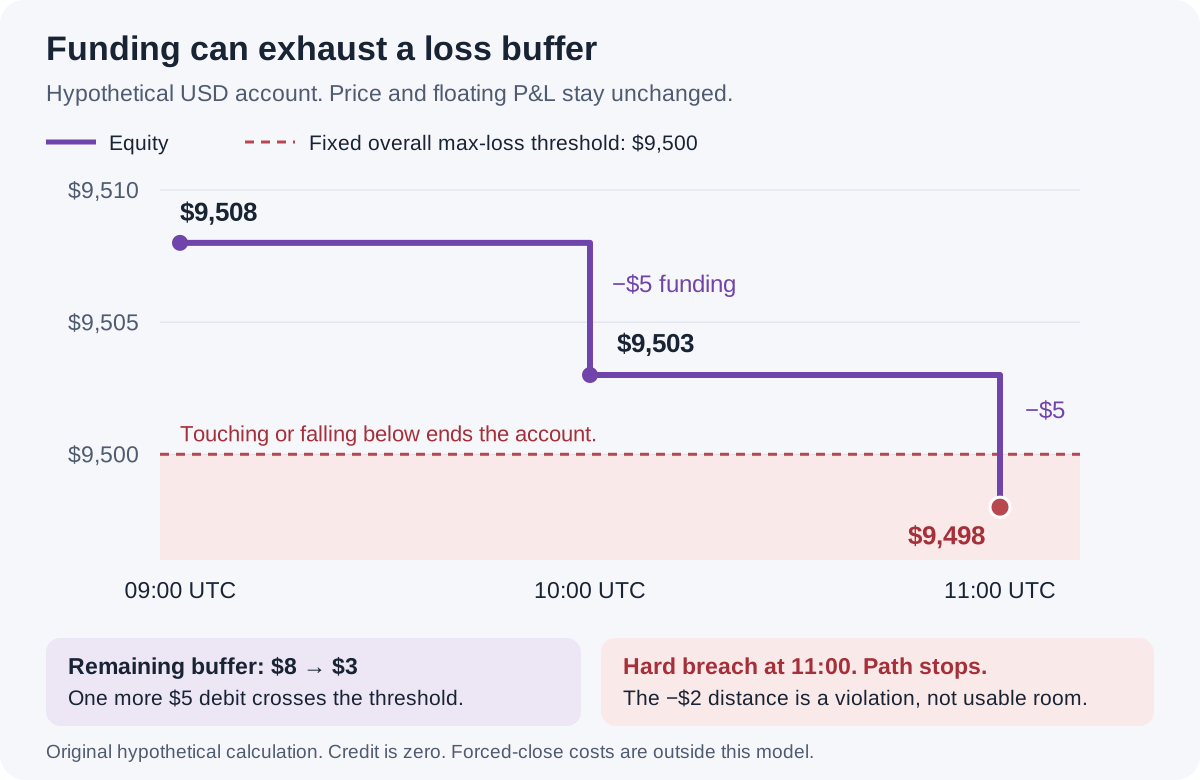
At each event, the model posts funding to balance, recomputes equity, then checks the unchanged threshold. A $3 debit at the second event would also breach by touching $9,500 exactly. A later funding credit cannot revive the terminated account.
A credit increases equity in the opposite direction, but the usable buffer also depends on the threshold. A trailing rule may raise that threshold, or a daily reset may establish a new reference. Read overall max-loss models and daily-loss resets for those separate calculations. Funding posting and a daily reset need an explicit event order when their timestamps coincide.
Funding also counts toward a profit target measured on equity. Propr's evaluation target is based on equity, and a step is passed once equity reaches it, so a funding credit moves the account toward the target and a debit moves it away. Propr rulebook, profit target
How do E8 and Propr apply funding to their accounts?
The relevant question is what the prop account records, including when its trading is simulated. The pages checked for this guide establish the following:
| Program and scope | Documented treatment |
|---|---|
| E8 One and E8 Pro perpetuals on E8 Terminal | E8 says the simulated environment uses Hyperliquid data and reproduces funding behavior, and links Hyperliquid's funding page for the full explanation. Its terminal guide identifies a separate funding-history view. Perpetuals guide · Terminal guide |
| Propr Classic 1-Step, Classic 2-Step, Pro 1-Step and Turbo 1-Step, evaluation and funded stages | The rulebook says funding is automatically debited or credited and included in equity. Its equity limits apply in both stages, and the evaluation's profit target is measured on equity. Rulebook, sections 5, 9 and 20 |
E8's cited pages establish that funding applies; they do not specify the posting order against a daily reset or every balance/equity field treatment. Propr settles the inclusion-in-equity question, but its cited funding paragraph does not specify the ordering of simultaneous funding and reset events.
Propr recalculates its daily limit from a balance snapshot at 00:00 UTC, so the order matters there: a debit posted to balance just before the snapshot also lowers the balance the day's limit is measured from, while one posted just after counts in full against that day's allowance. If that ordering affects your remaining buffer, ask for the sequence for your exact account. Propr rulebook, daily loss
Do not treat missing implementation detail as a zero funding cost. Nor should you add the venue payment to a simulated-account entry as though they were automatically two charges to you. Reconcile the participant's own ledger and agreement. The perpetuals guide explains the separate question of simulated accounts and firm-owned replication.
The E8 One, E8 Pro and Propr Classic 1-Step comparison puts these firms' funding treatments beside the selected accounts' trading fees and loss rules. Use it when the question is which account fits your holding plan, while keeping any unresolved posting sequence in your own funding record.
What should you check before keeping a position open?
Save a short funding record for the exact symbol, program, platform and stage:
- Exposure: position side, quantity, contract multiplier if needed, and the price used for funding notional.
- Clock: rate period, next event time, timezone and inclusion rule. Label a forecast as an estimate.
- Accounting: settlement asset, debit or credit, posting field, and whether the P&L total already includes it.
- Limits and targets: equity before the event, daily and overall thresholds, profit-target measurement if applicable, equality rule, and any reset or trailing update at the same time.
- Reconciliation: actual posted rate and amount, plus a source or written answer for unresolved implementation details.
Project each expected payment separately when rates or position values differ. After the event, replace the estimate with the actual entry. Historical or annualized rates can describe a past period; they do not lock in the next payment or the net return of the trade.
Use that record alongside the overnight and weekend holding checklist. Holding permission answers whether the position may remain open. Funding and the loss rules determine what carrying it does to the account.
Related reading
- Balance versus equity: follow open P&L, separate account credit and charges through the account.
- The full cost of a prop firm challenge: keep purchase costs and account-level trading costs in their proper places.
- When official rules conflict: resolve an implementation question against the applicable account terms.
Sources and method
Official pages were checked on 18 October 2026. Venue documentation supports the venue mechanics identified above; it does not establish every prop-platform implementation. Named program passages are limited to the stated products and account stages.
The payment ledger and breach example are original hypothetical USD models. They use invented rates, specified posting order and no stablecoin conversion. Calculations retain cents without intermediate rounding. The breach path stops when the monitored equity first reaches or falls below its threshold; forced-close execution is outside the model.
- Hyperliquid funding, for direction, payment notional and hourly settlement of the computed rate.
- Hyperliquid price indices, for the distinct roles of oracle and mark prices.
- Bybit funding fee calculation, for linear-contract valuation and its event-inclusion rules.
- OKX funding mechanism, for rate ingredients and differing settlement intervals.
- E8 perpetual futures guide, for the named perpetual products and simulated funding behavior.
- E8 Terminal guide, for the funding-history view.
- Propr rulebook, for funding inclusion in equity, loss-limit enforcement in evaluation and funded accounts, and equity-based evaluation targets.