LearnRisk essentials
Balance vs. Equity: How Open Trades Affect Your Limits
Balance records booked account transactions. Equity also includes the current profit or loss on open positions, account credit, and applicable adjustments. If a prop firm's loss rule monitors equity, an open loss can breach the limit before you close the trade. That can happen even while balance remains above the account's starting value.
On this page
The distinction is easy to define and easy to misread on a dashboard. A profitable trading history does not show the whole account while positions remain open. Account credit can also make equity differ from balance when no trades are open. Closing a losing position does not make its loss disappear: it moves the result into balance.
This guide explains credit first, follows a hypothetical trading ledger, then shows how to read the values used by a loss rule. Daily reset calculations and the different ways an overall threshold can move are separate questions.
What is the difference between balance and equity?
Think of balance as the account's booked record and equity as its current value after including open positions, credit, and relevant adjustments. MetaTrader 5's account-state definitions treat Balance and Credit as separate fields and include both in equity.
| Value | What it tells you | What it does not establish |
|---|---|---|
| Balance | The recorded amount after booked profits, losses, charges, and other account transactions | The current effect of positions still open |
| Credit (MT5) | A separately recorded credit amount included in equity | Trading profit, a balance deposit, or unconditional permission to withdraw it |
| Floating P&L | The current unrealized profit or loss on open positions | The eventual exit result; also check whether the displayed figure is gross or net of charges |
| Equity | The account value including credit, open P&L, and applicable adjustments | How much can be withdrawn, or how far away a particular loss limit is |
| Remaining loss buffer | The distance between the rule's monitored value and its current threshold | A recommended amount to risk on the next trade |
MT5 documents the following account-field calculation, with floating P&L treated as a signed amount:
Equity = Balance + Credit − Commission + floating P&L − Blocked
Commission and Blocked here refer to the platform's separate account fields. A commission already deducted from balance should not be deducted a second time. Swaps and other adjustments also need to be reconciled according to the fields in your account.
For the simplified examples below, with no blocked funds or other adjustments, the practical reconciliation is:
Equity = balance + account credit + floating P&L − charges not already included
The last term covers only applicable charges missing from the preceding figures. If a cost is already booked in balance or included in net floating P&L, do not deduct it again. Positive swap adds value rather than deducting it, but it is not necessarily recorded in MT5's separate Credit field.
The word net matters. cTrader's position information distinguishes unrealized gross P&L, which excludes swaps and commissions, from unrealized net P&L, which includes them. Follow the definition of the field you actually use.
Futures rules may use different labels. Topstep's Maximum Loss Limit monitors Net P&L, including realized and unrealized results. Tradeify's trailing-drawdown rule tests net liquidation value, defined there as balance plus unrealized P&L. Apex's intraday trail uses a peak balance that includes unrealized gains. These labels are not interchangeable: net P&L measures a result, net liquidation value measures account value, and peak balance records a high used to move a threshold. Check the starting value, measurement period, charges, and open-position treatment before mapping any field to equity. These futures definitions were checked on 1 October 2026.
These values can describe a simulated account. A displayed balance or equity figure is not, by itself, cash you own or can withdraw. For that distinction, see account size, opening loss allowance, and remaining buffer.
How does account credit affect equity?
A positive amount in MT5's Credit field increases equity without being added to Balance. It therefore belongs in an equity reconciliation even when no positions are open. The reason for the credit and the conditions for withdrawing or removing it come from the firm's terms.
Consider a fresh hypothetical USD account, separate from the trading ledger below. It has no commissions, swaps, blocked funds, or other adjustments. The credit in this example is withdrawable, and the final event removes it from the trading account without changing balance or the open position.
| Event | Balance | Credit | Floating P&L | Equity |
|---|---|---|---|---|
| Before credit is added | $100,000 | $0 | $0 | $100,000 |
| A $500 credit is added | $100,000 | $500 | $0 | $100,500 |
| An open position shows a $2,000 loss | $100,000 | $500 | −$2,000 | $98,500 |
| The $500 credit is withdrawn and removed; the open loss is unchanged | $100,000 | $0 | −$2,000 | $98,000 |
The withdrawal reduces equity by $500 even though neither balance nor floating P&L changes. Reclassifying credit into balance would be a different transaction: an equal increase in balance and reduction in credit would leave equity unchanged, before any other costs or adjustments.
A real example: The5ers' refundable evaluation fee
The5ers' High Stakes payout policy says that the refundable portion of the evaluation fee is added to funded-account equity. Its stated 70% refund applies to the portion paid with external funds and can be withdrawn with the first payout, subject to the program's eligibility conditions. This is a fee refund, not trading profit.
The policy separately describes Hub Credits, a form of purchase credit for new challenges. Those credits are nonwithdrawable and should not be added to a trading-account equity calculation. The page confirms the refundable fee's equity effect; the account record identifies whether the amount is posted as MT5 Credit or a balance transaction. These distinctions were checked on 27 September 2026.
For any program, check whether its loss calculation includes the credit and what happens to the relevant thresholds when the credit leaves the account. A higher displayed equity figure alone does not show how much additional loss the rules permit.
Worked example: a profitable balance with little loss room left
Consider a hypothetical USD account starting at $100,000 with a static overall max-loss threshold of $90,000. It therefore begins with $10,000 of overall loss allowance.
For this example, equity is monitored continuously and touching $90,000 is a hard breach. The threshold never moves. There is no daily limit, trailing rule, payout, credit, or other account adjustment. Overnight holding is allowed. The stated trade path has no deeper unshown equity dip, and the modeled exit occurs at exactly the price used to value the open position. These assumptions isolate the accounting; they do not reproduce a complete firm's program.
All commissions and the overnight charge are posted directly to balance when shown. Floating P&L in this ledger excludes those charges, and no additional accrued charge remains outside balance. Consequently:
Equity = balance + floating P&L
Remaining max-loss buffer = equity − $90,000
Follow balance and equity through the same ledger
- Balance
- $101,840
- Floating P&L
- −$11,400
- Equity
- $90,440
- Overall threshold
- $90,000
- Remaining buffer
- $440
- New charge, already in balance
- $0
Above the modeled overall threshold
Balance is still $1,840 above the starting value, but equity is only $440 above the loss threshold.
Account credit is $0 throughout. A charge shown here is already in balance and is not subtracted again.
| Event | New charge booked | Balance | Floating P&L | Equity | Max-loss buffer |
|---|---|---|---|---|---|
| A. Start with no open position | $0 | $100,000 | $0 | $100,000 | $10,000 |
| B. Close earlier trades for $2,000 gross profit | −$100 commissions on those trades | $101,900 | $0 | $101,900 | $11,900 |
| C. A new position is open and losing | −$40 entry commission | $101,860 | −$3,000 | $98,860 | $8,860 |
| D. An overnight charge is booked; market P&L is unchanged | −$20 | $101,840 | −$3,000 | $98,840 | $8,840 |
| E. The open loss grows | $0 | $101,840 | −$11,400 | $90,440 | $440 |
| F. Close the whole position at the same marked loss | −$40 exit commission | $90,400 | $0 | $90,400 | $400 |
The charge column explains a change already included in balance. It is not an instruction to subtract that charge again. Every row remains above the modeled threshold.
At event E, balance is still $1,840 above the starting value, but equity is only $440 above the loss threshold. Looking at balance alone would suggest $11,840 of distance to $90,000. The open loss accounts for the $11,400 difference.
The overnight debit at D also reduces equity and remaining room even though the market P&L does not change. Price movement is not the only event that can affect a monitored account value.
What if the position stays open instead?
Take a separate branch from event E, replacing the exit at F. If the floating loss grows by another $440, to −$11,840, equity becomes:
$101,840 − $11,840 = $90,000
That is the first breach in this alternative path. Balance is still $101,840 immediately before liquidation, but the modeled rule tests equity. The valid trading path ends there; a later recovery cannot turn it into a compliant continuation. Actual rules may specify touching or falling below a threshold, so check the precise boundary wording.
Does closing a losing trade restore equity?
No. At the same valuation and execution price, realizing a loss transfers it from floating P&L into balance. It does not create account value. Closing ends that position's future exposure; additional execution costs or a different fill can change the final result.
At event E, the account has $101,840 in balance and an $11,400 open loss, giving $90,440 equity. The modeled exit books the loss and charges another $40:
New balance = $101,840 − $11,400 − $40 = $90,400
Floating P&L becomes zero, so equity is also $90,400. The $40 reduction from the pre-exit equity is the exit commission. With no additional charge and the same fill, equity would remain $90,440.
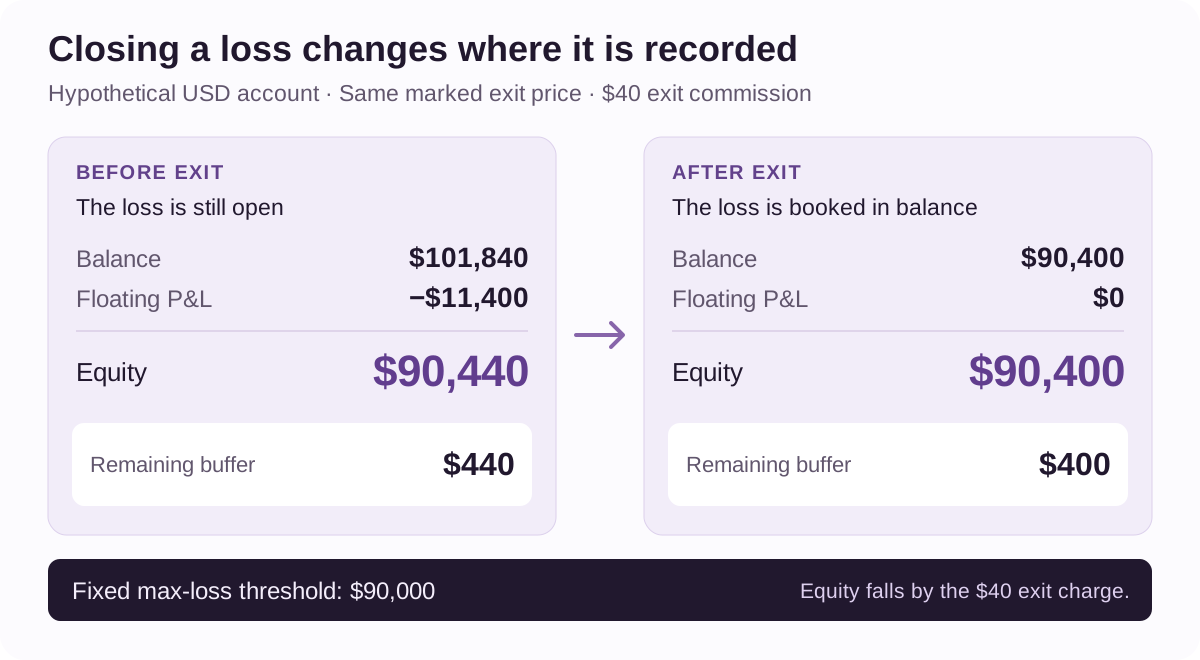
This transfer is also how cTrader describes closing a position: unrealized P&L becomes realized and the net result is applied to balance.
The same accounting principle applies to a partial close: only the closed portion becomes realized, while the remaining position still contributes floating P&L. The fill and any closing charges determine the amount booked.
A margin display answers a different question. In the MetaTrader account definition, free margin is equity minus required margin. Releasing margin when a position closes does not erase its trading loss or establish distance to a prop firm's loss threshold.
See the same-position leverage comparison for an example in which required margin changes while the trade's loss and remaining overall buffer stay the same.
How do you include charges without counting them twice?
Find where each charge is recorded before reconstructing equity. The same cost may already be included in balance, appear inside net floating P&L, or remain a separate adjustment under the platform's accounting.
The event-C entry commission illustrates the problem. Here are two hypothetical bookkeeping presentations of that same economic state, with no credit or other adjustments:
| Presentation | What you add | Resulting equity |
|---|---|---|
| Commission already booked in balance | $101,860 balance + (−$3,000 floating P&L) | $98,860 |
| Commission included in net floating P&L instead | $101,900 balance + (−$3,040 net floating P&L) | $98,860 |
Both reconcile to the same equity. In the first row, deducting another $40 would incorrectly produce $98,820. In the second row, adding net P&L and then subtracting its included commission would make the same mistake. These rows are accounting alternatives, not claims that every platform supports both presentations.
Check the treatment of three common cost types:
- Commission: check when it is charged and whether the displayed P&L already includes it. Entry and exit charges need not be booked together.
- Swaps or financing: identify whether an amount is accrued, already posted, a debit, or a credit. Check the specific instrument and account terms.
- Spread: where a position is valued against its applicable closing quote, the bid/ask difference is already reflected in that valuation. Do not deduct a second estimated spread from a P&L figure that already captures it. A later quote or execution price can still change the exit result.
MetaTrader documents both immediate and accumulated commission treatment in its account-state explanation. cTrader separately exposes realized and unrealized swaps and commissions in its position details. Those distinctions are useful when reconciling a dashboard with an account statement.
The spread, slippage and execution example follows quoted prices through actual fills and separate commissions, showing why spread and slippage already reflected in P&L should not be deducted again. For perpetual positions, the funding-payment ledger shows how separate debits and credits change balance while the position remains open.
An evaluation purchase fee paid separately from your bank card affects your personal cost. It is not a trading-account debit unless the account records include it. If the firm later returns a refundable portion as account credit, that is a separate event that increases equity, as in the credit section above. For payments made outside the trading account, see the inventory of challenge fees and related costs.
Does a balance-based limit ignore open losses?
Only if the rule explicitly excludes them from its breach test. “Balance-based” may describe the value used to set a threshold while a different value, including open P&L, is checked against it.
Read the rule as two separate questions:
| Question | What to identify |
|---|---|
| What sets or moves the threshold? | Initial balance, a day-opening snapshot, an end-of-day balance high, an equity high, or another defined reference |
| What is tested for a breach? | Balance, equity, net P&L, or another defined monitored value. Confirm how open results, credit, and charges are treated. |
For a current futures example, Topstep's Trading Combine Maximum Loss Limit uses end-of-day balance to update its trailing threshold, while monitoring realized and unrealized P&L during the session. Its use of balance language does not mean an open loss is ignored. The same page explains that liquidation can finish above the threshold after a violation has already occurred.
For a CFD/FX example, FTMO's 2-Step loss definitions include open-position P&L, swaps, and commissions in the equity tested against the limits. These examples were checked on 27 September 2026 and describe the specified programs, not every offering from either firm.
Once you know the reference and monitored value, the next question is when the threshold changes. The static, EOD, and intraday overall max-loss guide compares those mechanisms on one trade path.
Do floating profits increase the room available for losses?
They can increase current equity, but the effect on remaining room depends on the threshold. Consider a fresh hypothetical account with $100,000 balance, no charges, and a fixed $90,000 threshold. An open gain of $2,000 produces $102,000 equity and a $12,000 buffer. If that gain disappears without closing the position, equity returns to $100,000 and the buffer to $10,000.
An equity-trailing rule can behave differently: the open gain may raise the reference high and therefore the threshold. A later reversal can reduce equity without lowering that threshold. The worked overall max-loss comparison follows that effect in detail.
Equity also does not settle every performance requirement. For example, FTMO's 2-Step evaluation profit-target rule requires the specified profit in balance with all positions closed. An open gain that matters to a loss calculation does not automatically complete that target.
Nor does a gain automatically become an available payout. Eligibility, review, and payment have their own conditions, explained in the prop firm payout guide.
How can you check your own account's numbers?
Start with one timestamp and one account currency. Comparing a current equity figure with an older balance or a differently denominated P&L figure can create an apparent discrepancy before any rule is involved.
- Record balance and all open-position P&L. Check whether the P&L figure is gross or net; include the full account rather than a selected winning or losing position.
- Locate credit and other adjustments. Record any separate account Credit amount, charges already in balance, charges included in floating P&L, and other adjustments. Keep purchase credits outside the trading account separate. Check whether an account credit can be withdrawn, expires, or is removed after a specified event.
- Reconcile equity once. Make the components add up to the value used by the rule, without deducting the same cost twice. If they do not reconcile, keep the discrepancy open and ask for the field definitions.
- Write down each current threshold and its monitored value. Overall max loss and daily constraints are separate checks. Record the reference, update time, equality condition, and consequence for each.
- Calculate the relevant remaining buffer. For a rule testing equity against a minimum equity threshold, subtract that threshold from equity. An order-entry margin figure is not a substitute.
Keep the result attached to the exact program, account stage, platform, and applicable terms. If a dashboard and statement disagree, retain the timestamps and transaction details needed to explain the difference. When comparing offers, carry these field definitions into the program comparison worksheet so similar labels do not conceal different loss calculations.
Next step: reconcile one account snapshot using this checklist. Then see how daily loss limits use those values at reset, including a position that breaches the new threshold without a price change.
Sources and method
Official sources checked on 27 September 2026:
- MetaTrader 5: Executing Trades: account fields including Credit, commission treatment, margin, and position execution.
- The5ers: High Stakes Payout Policy and Hub Credit: refundable fee added to equity, with Hub Credits treated separately.
- cTrader Web: Trade Watch: gross/net P&L and realized/unrealized charge fields.
- cTrader Web: Positions: realizing results when a position closes.
- FTMO: Trading Objectives: the CFD/FX 2-Step loss and evaluation target definitions cited here.
- Topstep: Maximum Loss Limit: Trading Combine reference updates, intraday monitoring, and liquidation explanation.
Additional futures terminology checked on 1 October 2026 against the Topstep page above and:
- Tradeify: Rules: Trailing Max Drawdowns: its definition of net liquidation value and distinction between threshold updates and enforcement.
- Apex: Intraday Trailing Drawdown Explained: peak balance including unrealized gains.
The credit example, trading ledger, alternative bookkeeping presentations, and floating-profit example are original hypothetical calculations. They illustrate accounting under declared assumptions, not a trading strategy, a complete program simulation, or observed trader results. Platform documentation explains fields; the applicable program terms determine which values govern a particular rule. The source-check date records access and verification, not a contractual effective date.