LearnRisk essentials
Daily Loss Limits: Calculations, Reset Times, and Overnight Trades
A prop firm's daily loss limit depends on the amount allowed, the account value it is measured from, and the firm's definition of a trading day. When the rule includes open positions, an overnight loss can breach the new day's limit immediately after a reset, even without another trade or a price change. Reaching a limit can mean a temporary trading pause or a hard breach, depending on the program.
On this page
This guide explains those mechanics through hypothetical USD examples and selected official CFD/FX and futures rules. Research dates and unresolved source differences are recorded below. The examples isolate particular rules; they are not complete models of the named programs.
What does a daily loss limit actually measure?
Start by separating three numbers: the loss allowance, the threshold it creates, and the room remaining above that threshold.
A hypothetical $5,000 allowance measured from a $100,000 reference creates a $95,000 equity threshold. If current equity is $97,000, the remaining daily buffer is $2,000. The original $5,000 allowance is not the amount still available to lose.
Daily threshold = the rule's reference value − its loss allowance
Remaining daily buffer = current monitored equity − daily threshold
These formulas assume equity is the monitored value. A rule expressed as a limit on net daily P&L may be translated into an equity threshold only after checking what its P&L calculation includes.
| Part of the rule | What you need to identify |
|---|---|
| Allowance | Fixed dollars or a percentage, including the percentage's basis |
| Reference | Initial balance, opening balance, opening equity, or a specified high |
| Update schedule | Fixed during the session, recalculated at reset, or adjusted during trading |
| Monitored value | The balance, equity, or net P&L checked against the limit |
| Boundary and consequence | Whether touching counts, and whether the result is a pause or hard breach |
A balance reference does not mean floating losses are excluded. Balance can set the threshold while equity, including open positions, determines whether it has been crossed. The balance-versus-equity guide explains that distinction.
Account credit also needs explicit treatment. MetaTrader 5 (MT5)'s separate Credit field can increase displayed equity, but the program's rules determine how that credit is treated for loss monitoring. Do not assume a credit or fee refund creates extra permitted daily loss. See how account credit affects equity.
Why can two “5% daily loss” rules produce different limits?
The percentage alone does not identify the calculation. Consider two hypothetical rules for an account whose initial balance was $100,000. At today's reset, balance is $102,000 and equity is $104,000 because an open position has a $2,000 profit. There is no account credit or separate charge adjustment in this comparison.
Both rules below hold their threshold fixed until the next daily reset and monitor equity throughout the session.
| Calculation | 5% of initial balance, deducted from opening balance | 5% of the higher opening balance or equity |
|---|---|---|
| Percentage basis | $100,000 initial balance | $104,000 opening equity |
| Daily allowance | $5,000 | $5,200 |
| Threshold reference | $102,000 opening balance | $104,000 opening equity |
| Daily equity threshold | $97,000 | $98,800 |
| Buffer at $104,000 equity | $7,000 | $5,200 |
The second rule allows a larger percentage-derived dollar amount, yet sets a higher threshold. It leaves less room from the same current equity. Comparing only $5,000 against $5,200 misses the reference used in each calculation.
A fixed initial-balance allowance
Under the first model, multiply the initial balance by the daily percentage, then deduct that fixed amount from today's opening balance:
Allowance = 5% × $100,000 = $5,000
Today's threshold = $102,000 − $5,000 = $97,000
The allowance stays $5,000 even if the opening balance changes. The threshold can therefore move from one day to the next while remaining fixed during each day.
This is the structure described for FTMO's CFD 2-Step Challenge, Verification, and subsequent 2-Step FTMO Account: a 5% initial-capital amount deducted from balance at 00:00 CE(S)T. Its published rule monitors equity, including open P&L, swaps, and commissions. FTMO Trading Objectives
A percentage of the day's opening reference
Under the second model, use the higher opening value as the reference and deduct the stated percentage of that reference:
Reference = max($102,000 balance, $104,000 equity) = $104,000
Today's threshold = $104,000 × 95% = $98,800
Both the allowance and the threshold depend on the opening snapshot. FundingPips' 2-Step Standard rules describe this higher-of-opening-balance-or-equity approach at 3% or 5%, depending on the configuration purchased. The 5% version matches the hypothetical formula above. Its examples treat reaching the threshold as a breach. 2-Step Standard rules
A threshold that trails during the session
A daily rule can instead follow a specified intraday high. That is different from taking one opening snapshot.
For a separate hypothetical comparison, suppose the tracked equity high has reached $106,000:
| Intraday trailing formula | Threshold at that high |
|---|---|
| Always $5,000 below the high | $106,000 − $5,000 = $101,000 |
| Always 5% below the high | $106,000 × 95% = $100,700 |
These are different rules. Confirm whether the tracked high includes open profit, when tracking starts, and whether the threshold ever stops rising.
For a documented optional control, Topstep's manually configured Trailing Personal Daily Loss Limit (PDLL) offers realized or unrealized gain tracking. It is separate from the daily limit selected at checkout and from overall max loss. Its configured action and reactivation behavior also matter. Topstep daily controls
Descriptions such as “static,” “dynamic,” or “end-of-day (EOD)” are incomplete without the formula. An allowance adjusted after a completed day does not necessarily trail every intraday high. Likewise, a trailing overall max-loss rule does not establish that the daily rule trails. See the overall max-loss comparison for that separate calculation.
Can a daily reset cause a breach without a new trade?
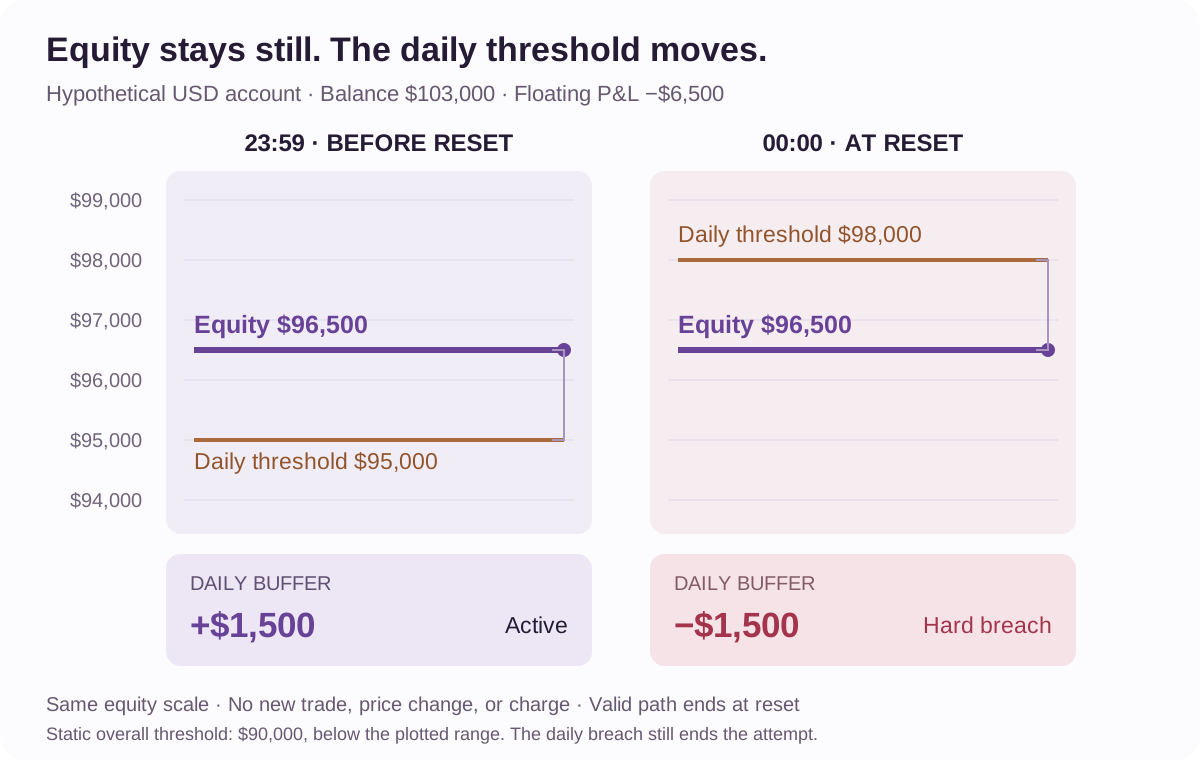
Yes. A new threshold can apply to an open position whose loss has not changed. The following hypothetical example uses the fixed initial-balance allowance described above.
Assume an initial $100,000 balance, a $5,000 daily allowance, and a static $90,000 overall max-loss threshold. Each day starts at 00:00 in the program's stated timezone. The daily threshold is that moment's balance minus $5,000, and equity is monitored continuously. Touching either threshold is a hard breach in this model.
Overnight holding is permitted. There are no commissions, swaps, account credit, withdrawals, or other adjustments. No earlier breach occurs. At midnight, the new daily threshold takes effect and is tested against unchanged equity before any further trading.
| Event | Balance | Floating P&L | Equity | Daily threshold | Daily buffer / status |
|---|---|---|---|---|---|
| Day 1 opens | $100,000 | $0 | $100,000 | $95,000 | $5,000; active |
| A $3,000 profit is closed | $103,000 | $0 | $103,000 | $95,000 | $8,000; active |
| 23:59: another trade has a $6,500 open loss | $103,000 | −$6,500 | $96,500 | $95,000 | $1,500; active |
| 00:00: the daily reference resets | $103,000 | −$6,500 | $96,500 | $98,000 | −$1,500; hard breach |
Before midnight, the day's closed profit offsets part of the open loss:
+$3,000 − $6,500 = −$3,500
Equity remains $1,500 above that day's $95,000 threshold. At midnight, the $3,000 is already part of the new opening balance. There is no new closed profit for Day 2, while the existing $6,500 floating loss remains:
New daily threshold = $103,000 − $5,000 = $98,000
Buffer at reset = $96,500 − $98,000 = −$1,500
Move through the midnight reset
- Balance
- $103,000
- Floating P&L
- −$6,500
- Equity
- $96,500
- Daily reference (opening balance)
- $100,000
- Fixed daily allowance
- $5,000
- Daily threshold
- $95,000
- Daily buffer
- $1,500
- Overall buffer above $90,000
- $6,500
Above both modeled thresholds
The day's $3,000 closed profit offsets part of the open loss, leaving equity $1,500 above the $95,000 threshold.
The prior profit has not vanished from the account. It has changed roles: yesterday's booked profit is now part of today's opening reference. A reset changes the daily calculation; it does not close an open trade or erase its loss.
FundedNext's Stellar 2-Step Challenge documentation also illustrates this overnight interaction, with a position that fits the old day's calculation but breaches after midnight. Its example uses different amounts from the PFW model above. FundedNext daily-loss calculation
Can an overnight floating profit also affect the next day's limit?
Yes, when opening equity helps set the new reference. An unrealized profit can raise the threshold even though it has not been booked into balance.
In a separate hypothetical account, opening balance is $100,000 and an open profit of $4,000 makes opening equity $104,000. The rule takes 5% of the higher opening value and fixes the resulting threshold for the session. No charges, account credit, or other account changes apply.
Daily threshold = $104,000 × 95% = $98,800
If the open profit later disappears, equity returns to $100,000. The threshold stays $98,800, leaving $1,200 of daily buffer. The account is back at its opening balance, but much of the distance from the opening equity reference has been used.
Contrast that with the first model, which would use the $100,000 opening balance minus its $5,000 initial-balance allowance. Its threshold would be $95,000. The difference comes from which value was captured at reset, not from whether the position was closed.
Which clock defines the trading day?
Use the program's stated timezone and session calendar. Your local midnight, the platform's daily candle, the swap booking time, and the daily-limit reset are not automatically the same event.
| Scoped example | Published daily clock | What to check |
|---|---|---|
| FTMO CFD 2-Step | 00:00 CE(S)T | Convert the Central European reset for the specific date. Objectives |
| FundingPips 2-Step Standard | 00:00 platform time, stated as UTC+3 | Confirm the dashboard countdown for the account. Rules |
| FundedNext challenge calculation page | 00:00 server time; GMT+2 or GMT+3 seasonally | Confirm the current server offset. Calculation and server-time note |
| Topstep Trading Combine / Express Funded Account with checkout Daily Loss Limit (DLL) | Next session begins at 5 PM CT under the ordinary schedule | A session crosses calendar dates; check holidays separately. Daily limit |
Do not save a permanent conversion such as “reset is always at my 1 AM” without checking daylight-saving changes in both locations. Record the rule's timezone first, then the corresponding local date and time.
Holidays can also change what counts as one day. Topstep's holiday guidance distinguishes Live Funded Accounts on TopstepX, which follow the stated CME blended-trade-date protocol, from Trading Combines and Express Funded Accounts, which do not. Under the blended protocol, a daily limit can span more than one calendar date. Do not apply that treatment to every Topstep account. Holiday trading hours
Before carrying a position across any reset, use the overnight and weekend holding checklist to confirm that the exact account permits the complete holding period. Then calculate the upcoming threshold using the expected snapshot and check the existing open P&L against it. Include applicable financing and transaction costs once, in the fields where they are recorded. The balance-and-equity worked ledger shows why an already-booked charge must not be subtracted again.
The examples above exclude these adjustments to isolate the reset. In an actual account, a charge, account-credit removal, or price movement near the boundary can change the outcome as well.
Does hitting the daily limit end the account?
Read the consequence in the specific rule. A daily pause restricts further trading until the next defined session; position closure and order cancellation depend on the program. A hard breach makes the current attempt or account noncompliant; waiting for the next daily reset does not repair it. Platform access, the availability of a paid reset, and funding eligibility are separate questions.
FTMO's CFD 2-Step objectives describe equity below the daily threshold as a violation. That wording differs from the touch-as-breach assumption in our midnight example. A comparison must preserve the equality boundary instead of treating “reaches” and “falls below” as interchangeable. FTMO objectives
Topstep's checkout Daily Loss Limit for the Trading Combine and Express Funded Account is a temporary stop: it flattens positions, cancels pending orders, and blocks new trading until the next session. Triggering that daily limit is not itself a rule violation. Other account rules still apply. Topstep DLL
Some firms call their daily restriction a soft breach. That phrase is not a universal synonym for a pause: FundingPips also uses it for certain Master-account news-rule violations that remove affected profits without closing the account. FundingPips 2-Step Standard Record the actual consequence, not just the label; the news-rule guide distinguishes an execution restriction, a required flat window, and a profit adjustment.
A new session does not restore losses already incurred. If the remaining overall max-loss buffer is smaller than the next daily allowance, overall max loss can trigger first. Account C in the opening-loss-allowance guide demonstrates a pause, next-day resumption, and then a hard max-loss breach. Its assumed position closure is explicit; it is not a universal pause rule.
A liquidation threshold is also not a guaranteed fill price. Real closure costs and execution differences can leave less room than an exact-fill example suggests. Tradeify makes this distinction in its Daily Loss Limit explanation. A pause should never be assumed to prevent a separate max-loss breach.
How do daily-loss rules compare across prop firms?
These examples cover eight firms and specific published rule configurations, originally checked on 25 September 2026, with the scope clarifications below rechecked on 1 October 2026. Match the program, stage, purchase options, and applicable agreement to your account before using a figure. “Hard breach” below means that ordinary next-session reopening does not restore the breached attempt.
CFD/FX examples
| Firm and scoped example | Published daily calculation and example | Update and consequence |
|---|---|---|
| FTMO: 2-Step, including Verification and subsequent 2-Step account | 5% of initial simulated capital, deducted from the current day's opening balance. Initial $100K and opening balance $102K give a $97K threshold. | Fixed intraday; resets 00:00 CE(S)T. Equity below the threshold violates the rule. Objectives |
| The5ers: High Stakes drawdown FAQ; check plan applicability | The FAQ describes 5% of the higher balance/equity at rollover. Its $110K reference gives $5,500 allowance and a $104,500 threshold. | Daily snapshot at 00:00 server time; termination on breach. Percentage applicability is unresolved across the pages noted below. Drawdown FAQ |
| FundedNext: Stellar 2-Step Challenge | 5% of initial balance: $5,000 on initial $100K. Today's booked results and floating P&L count; intraday profits increase remaining room above the unchanged boundary. | Resets 00:00 server time, seasonally GMT+2/+3. Hard breach; the challenge requires an account reset, not merely waiting overnight. Calculation · Consequence |
| FundingPips: 2-Step Standard | 3% or 5% of the higher opening balance/equity, depending on the purchased configuration. With 5%, opening balance $105K and equity $107K give $5,350 allowance and a $101,650 threshold. | Fixed intraday; resets 00:00 platform time, stated as UTC+3. Touching the threshold is a hard breach; floating losses count. Program rules |
| E8 Markets: E8 One / E8 Pro daily-drawdown mechanism, using the help page's 4% illustration | A fixed amount based on initial balance, deducted from the day-opening balance. At initial $100K and opening balance $102,500, the illustrated $4K amount gives a $98,500 threshold. 4% is an example, not a universal E8 setting. | Resets 00:00 server time. Balance or equity reaching the threshold causes permanent violation. The percentage can be customized at checkout. Daily Drawdown |
The5ers percentage remains unresolved: its High Stakes product page presents a 2-Step program with Classic and NEW options and displays 5% daily loss. The High Stakes drawdown FAQ, marked updated 15 September 2026, also says 5%. However, the 2-Step Plan Rules & Specifications, marked updated 7 September, says 3% for the New and Classic evaluation options. The FAQs describe a daily opening reference rather than continuous intraday highs. The reviewed pages do not establish which percentage governs every purchase cohort. At a $110,000 reference, 3% would give a $3,300 allowance and a $106,700 threshold; 5% gives $5,500 and $104,500. Verify the applicable plan before selecting either figure.
Futures examples: daily limits can be temporary stops
The rows below use DLL to mean Daily Loss Limit. A daily restriction can leave the account active, but its separate overall max-loss rule still applies.
| Firm and scoped example | Published daily rule | Update and consequence |
|---|---|---|
| Lucid Trading: LucidPro with DLL ON | The $100K evaluation lists a fixed $1,800 daily limit. One DLL ON/OFF choice covers both evaluation and funded stages and cannot be changed on an active account; a different setting requires a new purchase. | The daily-rule page says additional trades are blocked until the next session, provided the account has not been liquidated. It does not specify automatic position closure. Daily rule · Purchase options |
| Tradeify: $100K Growth, under the documented non-legacy rule | Initially $2,500 per day. Reaching the $106K balance milestone raises the allowance to $3,500, effective the next session. | Session reset at 6 PM ET. A temporary stop, provided overall max loss was not breached. This milestone adjustment is not continuous intraday trailing. Daily Loss Limit |
| Topstep: $100K Trading Combine / Express Funded Account (XFA) with checkout DLL selected | Optional $2,000 daily limit. Its manually configured trailing personal control is separate. | Checkout DLL flattens positions, cancels orders, and blocks trading until 5 PM CT next session; not a rule violation. Daily Loss Limit |
Lucid also illustrates a different kind of changing daily allowance: its LucidPro daily-rule page describes LucidScale as 60% of highest end-of-day profit after the specified activation threshold. A $4,000 peak end-of-day profit gives $2,400. That is EOD scaling of an allowance, not a threshold following every intraday equity high. Its funded overview instead labels the basis “Peak EOD Balance”; that wording discrepancy needs resolution for an exact funded-account calculation. Do not apply 60% to the full advertised account size from that shorthand.
When comparing daily rules, identify the initial-balance amount, day-opening percentage, EOD-scaled allowance, or intraday trailing threshold, then check what happens when it is reached. The word “dynamic” alone does not identify the formula. A trailing max loss rule is also not evidence of a trailing daily loss rule.
Write the daily rule before calculating your remaining room
Complete this worksheet from the exact program, stage, platform, and selected options. Keep the official source and checked date beside it. Leave an unresolved answer marked unknown.
| Field | What to record |
|---|---|
| Does a daily rule apply? | Mandatory limit, selected option, personal control, or explicitly no daily rule |
| Amount and reference | Dollar allowance or percentage basis; the balance, equity, or high used to set the threshold |
| Update timing | Opening snapshot, intraday tracking, or another specified recalculation |
| Monitored value | Open and closed P&L, charges, and treatment of account credit and adjustments |
| Reset clock | Timezone, current offset, relevant local date/time, holiday calendar, and session definition |
| Overnight treatment | Holding permission and whether the whole existing floating result counts after reset |
| Trigger and consequence | Touch or below; pause or hard breach; position/order handling and resumption conditions |
| Other active limits | Overall max-loss threshold and any separate restrictions that can trigger earlier |
Next step: calculate the current daily threshold and, if you plan to hold a trade across reset, the threshold that would apply to that position at the next snapshot. Compare equity with both, then check overall max loss separately. The difference between those two daily calculations is often the detail a headline percentage leaves out. Add the resulting rule to the broader program-comparison worksheet before deciding which offer fits your requirements.
To check a past trading period, use the worked account-history replay. Its separate hypothetical example combines a midnight daily reset with consistency and qualifying-day checks, showing why favorable closed results cannot erase an earlier breach.
Sources and method
The original mechanics sources were checked on 27 September 2026; the firm-comparison sources were first checked on 25 September 2026. FundingPips, The5ers, Lucid, and Topstep scope clarifications were rechecked on 1 October 2026. Named examples are scoped in the text. The calculations and figures are hypothetical, independently recomputed, and stop at the first modeled hard breach. They do not establish permissions or outcomes for another program.
- FTMO: CFD Trading Objectives
- FundingPips: 2-Step Standard
- FundedNext: daily-loss calculation and reset, plus Daily Loss Limit vs. Maximum Loss Limit
- The5ers: High Stakes product page, High Stakes drawdown FAQ, and 2-Step Plan Rules & Specifications. Their percentage discrepancy remains unresolved.
- E8 Markets: Daily Drawdown
- Lucid Trading: LucidPro Daily Loss Limit, Customization, and Funded Account. Their scaling-basis wording discrepancy remains unresolved.
- Topstep: daily limits and personal controls, plus holiday trading hours
- Tradeify: Daily Loss Limit and execution
Recheck the terms attached to the account before relying on a formula, reset time, or consequence. A source-check date records this article's research; it does not establish which agreement governs an individual account.