LearnChoosing a program
Overnight and Weekend Holding: A Checklist for Swing Traders
A prop firm's overnight and weekend holding rules determine whether a position may remain open across specified time boundaries on a particular account. Permission depends on the product, account type, stage, and instrument. It does not suspend financing charges, news restrictions, daily loss, or overall max loss.
On this page
For a strategy that needs several days in a trade, begin with the required holding period. Establish whether the position can stay open for that entire period, then check what can change while it does. A permitted hold can still become a loss-limit breach after a reset, charge, or reopening gap.
This guide separates CFD/FX and futures examples, then follows one hypothetical position from Thursday to Sunday. Official examples were checked on 4 October 2026. The worked schedule and account rules are invented for explanation and do not describe a named program.
What does “overnight holding allowed” actually cover?
Ask which boundary the rule describes. Crossing midnight on your own clock is different from carrying a position through the program's required closing time.
| Boundary | What to establish before holding |
|---|---|
| Calendar midnight | Which timezone defines the account day? Does anything change at that instant? |
| Session close or maintenance break | Must positions be closed and pending orders canceled, even if trading resumes shortly afterward? |
| Daily-loss reset | Which balance or equity snapshot sets the next threshold? What happens to the existing floating loss? |
| Financing cutoff | Which charge or credit applies, when is it posted, and is there a multi-day multiplier? |
| News window | May the position remain open, and may an entry or exit order execute during the window? |
| Weekend or holiday closure | Is carrying through the entire closure permitted? Is there an earlier deadline for this instrument or date? |
Record the rule's timezone and the local date and time for the intended hold. Recheck daylight-saving changes and holiday notices. Do not assume the chart clock, financing cutoff, loss reset, and required exit all coincide.
Holding permission also needs a stage check. A strategy that fits the evaluation may not fit the account issued afterward. Use the evaluation-to-funded transition checklist to compare the outgoing and incoming account terms.
Which CFD/FX accounts allow overnight and weekend positions?
There is no single CFD/FX holding rule. These official examples show the scope that a useful answer needs.
| Offering and stage | Published holding condition, checked 4 October 2026 |
|---|---|
| FTMO CFD evaluation, Standard and Swing | Its FAQ permits overnight and weekend holding during evaluation. |
| FTMO CFD Account, Standard | Close before the weekend market close and before a market break longer than two hours. This is not a blanket ban on every overnight position. |
| FTMO CFD Account, Swing | The same FAQ exempts Swing from those holding restrictions. |
| FundedNext CFD Stellar 2-Step, Challenge and FundedNext Account | Its holding guide permits overnight and weekend positions in both stages. Swap-bearing accounts remain subject to applicable swaps. |
Sources: FTMO CFD holding policy and FundedNext holding policy.
These are scoped examples, not a ranking or a complete list. They do not establish permission for every symbol, configuration, or other product sold under the same brand. Check the account's actual instruments and current notices before using a general policy to plan a hold.
How do futures programs handle session-to-session holding?
A futures market's available hours and a prop program's holding permission are separate constraints. An evening trade can cross calendar midnight while remaining within one permitted session. That does not establish permission to carry it through the next required flattening time.
Two current examples make the distinction concrete:
- Topstep Trading Combine and funded accounts: positions must be closed by 3:10 p.m. U.S. Central Time on weekdays, or before an earlier product close. Its guide does not allow carrying positions from one session to the next. It also warns against opening new positions after 3:08 p.m. CT as risk managers begin flattening. Topstep hours and products
- FTMO Futures: close positions and cancel all resting orders before 4:10 p.m. U.S. Eastern Time or the relevant market close, whichever comes first. Its FAQ says not to rely on automatic liquidation or cancellation at the close. This is a separate policy from FTMO's CFD holding rules. FTMO Futures closing policy
Use the applicable product and date in the CME trading-hours and holiday calendar, then apply any earlier program deadline. Do not copy one instrument's hours to all futures contracts or assume every product has the same weekend closure.
Also distinguish a daily trading break from contract expiry or rollover. Permission to hold through a session would not by itself establish permission to hold an expiring contract. The CFD-versus-futures guide explains expiry and rollover.
Turn the applicable cutoff into a dated plan with the worked futures operating week. It shows how a shortened session, the next reopening, and a contract change fit on one calendar.
What can change while a permitted position stays open?
First, check the economics of the hold. For a swap-bearing CFD/FX symbol, record the long or short rate, calculation method, position size, currency conversion where needed, posting time, and daily multipliers. A displayed rate in points cannot be treated as an account-currency amount without the relevant conversion. MetaTrader 5's symbol specification distinguishes swap calculation types, long and short values, weekday multipliers, and trading sessions. MetaTrader 5 symbol specifications
Do not assume that every multi-day charge occurs on Wednesday. FundedNext's holding guide gives different schedules by asset class and, for some instruments, platform; it also says applicable swaps affect daily-loss calculations. Check the actual symbol and account option. FundedNext swap guidance
Second, recalculate the loss buffer after the next reset. Under a rule based on the new day's opening balance, yesterday's realized profit can raise the daily equity threshold while the losing position remains open. The daily-loss reset guide explains that mechanism in detail.
Establish whether financing is included in floating P&L or already posted to balance, and whether posting happens before or after the reset snapshot. Count each charge once. The balance-and-equity guide shows why subtracting an already-recorded cost again produces the wrong account state.
For perpetual positions, record the rate's payment interval and the applicable settlement events separately from the daily reset. The perpetual funding guide explains that clock and follows the payments into equity and the loss buffer.
Finally, recheck intervening news restrictions. A policy may allow an existing position to remain open while restricting executions, including protective exits. The news-rule order and action checklist helps separate those questions. Removing protection does not resolve whether a strategy fits the rule.
Worked example: one position from Thursday to Sunday
Consider a hypothetical simulated CFD-style funded-stage account in USD. The program permits holding through the modeled short break and weekend. The position is already open on Thursday evening and stays open throughout this example. Its size is fixed; the stated floating P&L includes the price and spread effects being modeled.
The initial account value is $100,000. Thursday began with that balance, and $2,000 of earlier net realized profit raised the current balance to $102,000. The open position now has a $4,000 floating loss, leaving equity of $98,000.
Rules and assumptions for this example
| Item | Hypothetical setting |
|---|---|
| Holding schedule | A short break runs Thursday 23:00–23:30 UTC. The weekend closure runs Friday 21:00 to Sunday 22:00 UTC. Holding is permitted through both. |
| Daily loss | A fixed $5,000 allowance. At 00:00 UTC every calendar day, including Saturday and Sunday, the threshold becomes the balance snapshot minus $5,000. It stays fixed until the next reset. |
| Overall max loss | A fixed $10,000 allowance from the initial $100,000, so the equity threshold remains $90,000. There is no trail or lock adjustment. |
| Enforcement | Equity at or below either threshold is an immediate hard breach. Check every price update, reset, and charge. The modeled path does not touch either threshold between checkpoints. |
| Financing | A $100 debit posts Friday at 00:01, after the reset. A further $200 debit posts Friday at 20:59, before the weekend close. No other financing posts before the Sunday endpoint. These assumed amounts and times are not a real symbol's fee schedule. |
| Other account changes | Account credit is zero. No withdrawals, new trades, or unrecorded charges occur. Earlier transaction costs are already included in the stated balance and P&L. |
| News | A hypothetical Friday 12:30 release has an execution restriction from 12:28 through 12:32 UTC, including both endpoints. Holding is permitted; opening and closing executions, including protective exits, are prohibited. No order executes in that window. This assumes no trigger, not removal of protection. |
For this model, equity equals balance plus floating P&L, because credit and other unbooked adjustments are zero. The remaining daily buffer is equity minus the current daily equity threshold. It is a distance to the breach boundary, not an amount the trader can lose while remaining compliant at equality.
The event ledger
| Checkpoint, UTC | Balance | Floating P&L | Equity | Daily threshold | Remaining daily buffer |
|---|---|---|---|---|---|
| Thursday short break and 23:59 | $102,000 | −$4,000 | $98,000 | $95,000 | $3,000 |
| Friday 00:00, reset before financing | $102,000 | −$4,000 | $98,000 | $97,000 | $1,000 |
| Friday 00:01, after $100 debit | $101,900 | −$4,000 | $97,900 | $97,000 | $900 |
| Friday 12:30, held through news | $101,900 | −$2,500 | $99,400 | $97,000 | $2,400 |
| Friday 21:00, last quote after $200 debit | $101,700 | −$1,500 | $100,200 | $97,000 | $3,200 |
| Saturday and Sunday 00:00 resets, using the last quote | $101,700 | −$1,500 | $100,200* | $96,700 | $3,500* |
| Sunday 22:00, first reopening quote | $101,700 | −$4,500 | $97,200 | $96,700 | $500 |
* During the closure, these are last-quote values, not executable prices. The balance snapshots set the weekend thresholds in this model; they do not reveal the next tradable price.
Two rows need a word of explanation. Floating P&L is unchanged when trading resumes after Thursday's short break. Immediately before the Friday $200 debit, floating P&L is already −$1,500; that debit reduces equity from $100,400 to $100,200 without moving Friday's threshold.
At Friday's reset, the reference changes even though the position's price has not moved:
New daily threshold = $102,000 - $5,000 = $97,000
The subsequent financing debit reduces equity:
Equity after charge = $102,000 - $100 - $4,000 = $97,900
Remaining daily buffer = $97,900 - $97,000 = $900
The initial $3,000 buffer has fallen to $900 through the reset and charge alone. If the $100 charge had posted before the snapshot, the balance reference would have been different. Posting order is therefore part of the calculation, not an administrative detail.
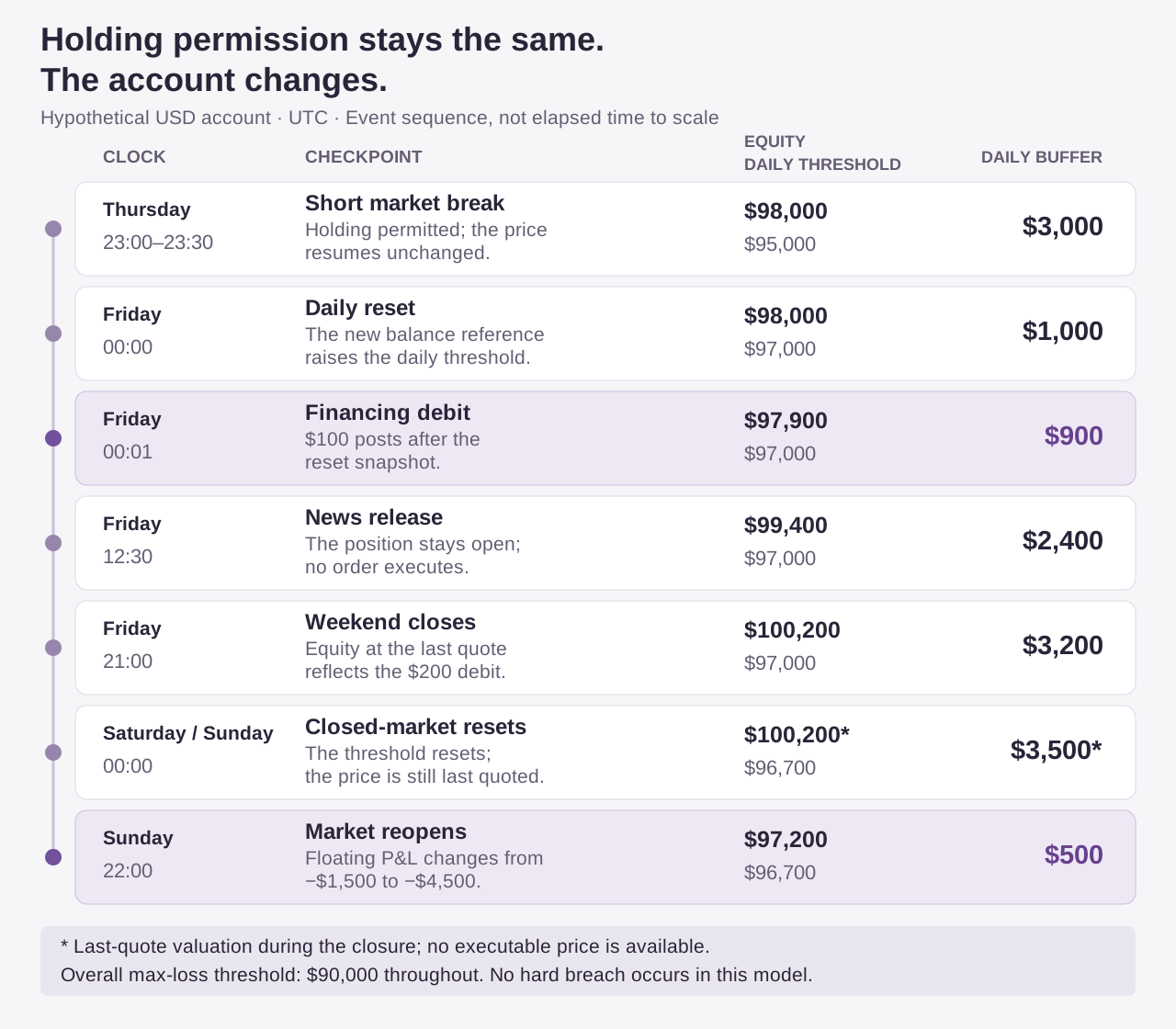
On Saturday and Sunday, the balance-based daily threshold becomes $101,700 − $5,000 = $96,700. At Sunday's reopening quote, the floating loss increases from $1,500 to $4,500. That $3,000 adverse change leaves equity at $97,200, only $500 above the daily threshold. Overall max-loss room is still $97,200 − $90,000 = $7,200, so daily loss is the closer boundary.
The position remains open at the endpoint. There is no modeled payout or realized closing result. An additional $500 adverse equity change before the next reset would reach the daily threshold and end the valid path. The example ends at Sunday's reopening quote, before any such breach.
If a different program required Friday closure, this holding path would be unavailable. The position would need to be closed and any required orders canceled by that program's deadline. Likewise, replace this example's fixed overall threshold if the actual account uses EOD or intraday trailing max loss.
Does a stop loss make weekend holding predictable?
A stop does not make the reopening price predictable or guarantee execution at its trigger. FTMO's execution explanation describes weekend gaps triggering exits at different prices and notes the effect of spread widening on execution. Holding permission leaves that execution risk in place. FTMO slippage and execution
Order behavior also depends on the market and order type. CME distinguishes stop-limit orders from stops with protection: the former becomes a limit order when triggered, while the latter can execute within a defined protection range. A stop-limit can therefore remain unfilled when the reopening price gaps through its limit, leaving the position open. That distinction does not establish an exact fill at the trigger. CME futures order types
For a permitted weekend position, examine what an adverse reopening quote, wider spread, charge, and actual exit would do to account equity. Include the loss threshold that will apply at reopening. A favorable Friday buffer or a nominal stop distance is not enough to determine that result.
For an account that must be flat, plan the exit while execution is still available and verify completion. A submitted closing order is not the same as a confirmed fill. Check remaining positions, pending entries, and any other orders the policy requires you to cancel.
What should a swing trader verify before choosing a program?
Write the intended holding period first, then complete this record for the exact account under consideration.
| Check | Record an actionable answer |
|---|---|
| Account scope | Market, program, stage, account type, platform, and relevant options. |
| Required duration | Whether the strategy needs a short overnight hold, several sessions, a weekend, or a holiday closure. |
| Permission and deadlines | Allowed holding periods; required exit and cancellation times; instrument exceptions; consequences of missing them. |
| Clock and schedule | Source timezone, date-specific local conversion, symbol sessions, and holiday updates. |
| Holding costs | Long/short rate, calculation units, size, multipliers, booking time, and treatment in balance or floating P&L. |
| Loss boundaries | Expected next daily threshold, overall max-loss threshold, and remaining buffer after known costs and the modeled adverse move. |
| Intervening events | News restrictions, allowed order actions, expiry or rollover, and any stage transition. |
| Execution and evidence | Exit plan, acknowledgment checks, current official links, verification date, and any unresolved condition requiring clarification. |
Treat an essential holding permission as a requirement before comparing price or profit share. Add it to the program comparison worksheet, alongside its scope and source. A simple spreadsheet or note with the fields above is enough to make the comparison explicit. If the rule remains unclear, record it as unresolved rather than treating silence as permission.
Sources and method
Official pages checked on 4 October 2026:
- FTMO CFD: overnight and weekend holding, for the evaluation permission, the Standard FTMO Account closing rule, and the Swing exception.
- FundedNext: overnight and weekend holding, for Stellar holding permission by stage, swap treatment, and multiplied-swap days by asset class and platform.
- Topstep: trading hours and permitted products, for the 3:10 p.m. CT close, earlier product closes, and the 3:08 p.m. CT warning.
- FTMO Futures: closing positions and canceling orders, for the 4:10 p.m. ET deadline and resting-order cancellation.
- MetaTrader 5: Market Watch and symbol specifications, for swap types, long and short values, weekday multipliers, and sessions.
- CME Group: trading hours and holiday schedules, for product hours and holiday calendars.
- FTMO: slippage and order execution, for weekend gaps and spread widening at stop execution.
- CME Group: futures order types, for stop-limit orders, unfilled limits, and stops with protection.
The named examples illustrate particular published policies. The worked account and event sequence are original hypothetical illustrations, independently recalculated from their stated assumptions. The UTC schedule, news release, financing debits, and P&L path are invented model inputs. Use the applicable account agreement, symbol specifications, and dated notices for an actual holding decision.