LearnFees and costs
Spreads, Slippage and Order Execution in Prop Firm Accounts
The prices at which a position actually opens and closes determine its price-based profit or loss; separately charged trading costs then affect the net account result. A chart move or stop setting alone does not establish either amount, and a planned exit does not guarantee that a prop account stays within its loss rules.
On this page
The practical task is to connect the quote, order, fill and account statement. This guide uses a hypothetical instrument to separate spread, slippage and commission, then explains what changes for order types, chart prices and simulated accounts. Official sources were checked on 12 October 2026.
Which price are you looking at?
A displayed price is useful only when you know what it represents. For a straightforward marketable buy, the relevant quote is the ask; for a sell, it is the bid. That quote is still distinct from the eventual fill. MetaTrader 5 distinguishes an order instruction, the deals that execute it and the resulting position; one order can produce several deals. MetaTrader 5: Basic Principles.
| Term | What to identify |
|---|---|
| Bid and ask | The quoted selling and buying sides at a stated time; spread is ask minus bid |
| Last price | The price of a previous transaction, where supplied; it need not equal the current bid or ask |
| Midpoint | The average of bid and ask; a useful comparison benchmark, not a promised executable price |
| Fill price | The price recorded for an executed quantity; use each fill or a correctly weighted average |
| Slippage | The difference between a fill and a clearly identified reference price for that order |
| Commission or fee | A separately specified charge; identify its unit, timing and whether the displayed result already includes it |
Label the reference before measuring slippage. A buy filled above its reference is adverse; a sell filled below its reference is adverse. Reversing those differences is favorable. Comparing a buy fill with a bid-only candle can combine spread and execution movement, rather than isolate slippage.
Spread and slippage can affect the prices inside profit and loss (P&L). They need not appear as separate statement debits. The full challenge-cost guide separates these account effects from purchase fees and payout deductions.
Worked example: from quoted prices to the net result
Consider a hypothetical USD account starting with $100,000 balance and equity. It buys 1,000 units of an invented linear instrument and later sells all 1,000. One dollar of price movement changes the position's value by $1,000. These units, quotes and charges are not taken from a named firm's symbol specification.
The complete order fills once on each side. Commission is $10 at entry and $10 at exit, posted directly to balance. There is no financing, credit, currency conversion, other fee, other position or cash flow. Assume both orders are accepted; margin and stop-out are outside this example.
The following quotes are recorded when each order is submitted. Each reference uses the side needed for that order.
| Event | Bid | Ask | Order's quote reference | Actual fill |
|---|---|---|---|---|
| Buy 1,000 units | $99.90 | $100.10 | Ask: $100.10 | $100.12 |
| Sell all 1,000 units | $100.90 | $101.10 | Bid: $100.90 | $100.87 |
The entry midpoint is $100.00 and the exit midpoint is $101.00. A calculation using those two midpoints gives a $1,000 gain: 1,000 × ($101.00 − $100.00). It is a benchmark result, not the outcome of the recorded trade.
At the quoted sides, the result would be 1,000 × ($100.90 − $100.10) = $800. The $200 difference from the midpoint benchmark comprises $100 from buying above the entry midpoint and $100 from selling below the exit midpoint. This attribution uses the two specified quote snapshots. Because both snapshots have a $0.20 spread, the two halves add up to one full spread on 1,000 units, not a full spread at each end.
The buy fills $0.02 above its ask reference, costing another $20 relative to that reference. The sell fills $0.03 below its bid reference, costing $30. Actual fill-based P&L is therefore:
1,000 × ($100.87 − $100.12) = $750.
The two $10 commissions then give a $730 net result. With the position closed and no other account activity, balance and equity are both $100,730.
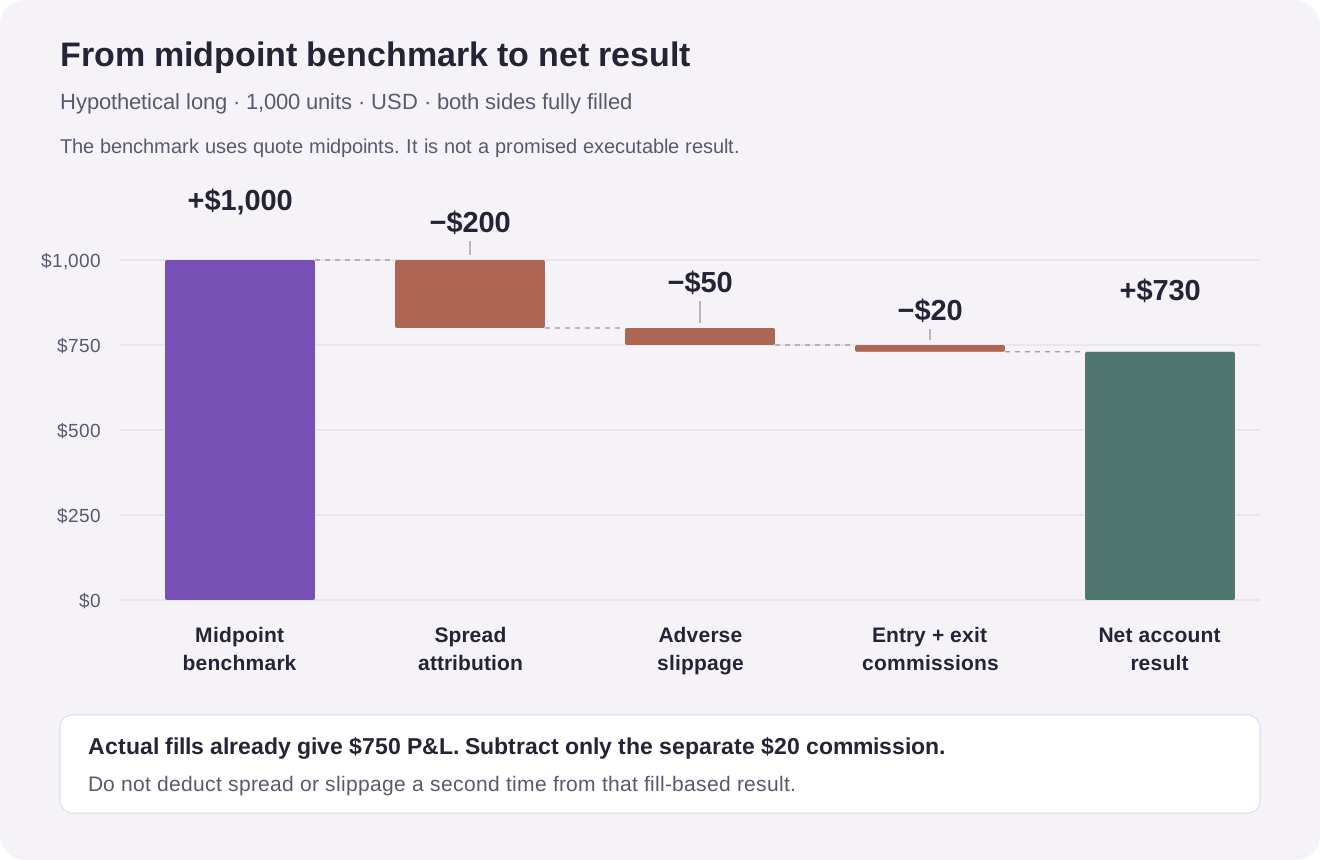
Two calculation routes agree: $1,000 − $200 − $50 − $20 = $730, or $750 − $20 = $730. Starting with $750 and subtracting the spread and slippage again would count their effect twice. If the platform already reports $730 net of commission, deducting another $20 would also be wrong.
The snapshot comparison measures a difference, not its cause. It cannot establish whether a gap came from market movement while the request traveled, available volume, the execution model or an error. That requires the execution record.
What does an order type control?
An order can control the acceptable price, the condition that activates it or the handling of quantity. These are different choices.
| Order | What it controls | What remains uncertain |
|---|---|---|
| Market | Requests execution at available prices under the applicable execution mode | The eventual price, quantity filled and whether platform or market restrictions prevent execution |
| Limit | Sets a maximum buy price or minimum sell price | Whether any or all of the quantity fills |
| Stop-market | Activates a market order when its trigger condition is met | The fill can differ from the stop price |
| Stop-limit | Activates a limit order when its trigger condition is met | The activated order can remain unfilled while the market moves away |
For futures, CME also documents market and stop orders with protection ranges. Those protections are specific order mechanics, not a promise to close exactly at the trigger price. Check which order your platform actually sends and which types the product supports. CME Group: Futures Order Types.
Volume instructions matter too. MetaTrader 5's fill policies can require the full requested quantity, allow a partial fill and cancel the remainder, or leave eligible remaining quantity working. Available policies depend on execution settings. Verify the completed quantity and remaining order state rather than treating “submitted” as “fully filled.” MetaTrader 5: Basic Principles.
No order label, by itself, proves compliance with a program's trading restrictions. The news-rule guide explains why the time and type of an execution can matter separately from when the order was placed.
Why can a stop trigger outside the visible candle?
First check which prices build the chart. MetaTrader 5 documents Bid-based bars and, where applicable, Last-based bars. Its Ask line is a separate display setting. A candle therefore need not show the quote that matters to a particular order. MetaTrader 5: Chart Settings.
For the CFD-style bid/ask convention, a short position is bought back at the ask. If its stop condition uses the ask, an ask-price rise can activate it while the bid remains below the stop. E8 Markets illustrates this distinction in its help article on stops and take profits. That page's bid-chart examples should not be treated as a universal description of every futures chart or trigger. E8 Markets: Why are my SLs and TPs not working?.
CME's exchange futures stops use market trades as the trigger basis. A stop-limit becomes a limit order when triggered; a stop with protection becomes a market order that can execute only within its protection range. CME specifies that a stop with protection activates when the market trades at or through its stop level. A platform or simulated account that holds the stop itself may apply its own trigger rule, so check which price its documentation names. CME Group: Futures Order Types.
As a hypothetical quote checkpoint, take a short with a $100.05 stop that explicitly triggers when Ask reaches or exceeds that level. Bid is $100.00 and Ask is $100.08. Its trigger condition has been met even though a Bid-only chart has not reached $100.05. Neither quote tells you the eventual fill price. Trigger evidence and fill evidence answer separate questions.
A current Ask line cannot reconstruct every historical Ask quote. Preserve the relevant timestamped prices when investigating an execution; a screenshot of a candle alone may leave the decisive quote missing.
How can execution affect the remaining loss buffer?
A position can begin with a loss even before the reference market price moves. Immediately after the worked example's buy, assume the bid is still $99.90 and the position is marked to that closing-side quote. Its floating P&L is 1,000 × ($99.90 − $100.12) = −$220. With the $10 entry commission already in balance, equity is $99,990 − $220 = $99,770.
If this hypothetical account has a fixed $90,000 overall equity threshold, its remaining buffer is $9,770. Spread, the entry fill and commission have affected equity; the margin reserved to open the trade is a different quantity. See leverage, margin and loss limits.
Now take a separate near-threshold checkpoint, not a continuation of the profitable trade. Earlier activity has left balance at $90,010, including all entry charges. The only position is 1,000 units long from $100.12, currently marked at Bid $100.16. There is no credit, financing, daily rule or other adjustment. The fixed overall rule monitors equity continuously, and touching $90,000 breaches.
The exit fills at $100.12, which is $0.04 below the recorded bid reference, and incurs a $10 exit commission. Assume no earlier breach. Separate the bookkeeping effects of this one exit:
| Checkpoint | Balance | Floating P&L | Equity | Overall buffer |
|---|---|---|---|---|
| Before exit, marked at $100.16 | $90,010 | $40 | $90,050 | $50 |
| Fill at $100.12 booked, before exit commission | $90,010 | $0 | $90,010 | $10 |
| $10 exit commission booked | $90,000 | $0 | $90,000 | $0: breached |
The middle row isolates an accounting effect, not a guaranteed opportunity to take another action between fill and fee. The $40 execution difference and $10 charge consume the entire $50 buffer. The path ends at the breach. A planned exit or a positive pre-exit buffer did not guarantee compliance; these figures are not suggested stop distances or trade sizes.
Real rules may monitor another value or include a separate daily condition. Use the balance-and-equity guide and daily-loss guide to establish the actual account calculation. MetaTrader's documentation also distinguishes immediate commissions from charges accumulated and booked later, so this example's posting sequence is an assumption, not a platform-wide rule. MetaTrader 5: Executing Trades.
What changes in simulation and futures accounts?
A simulated account can use market data and still apply its own fill model. E8 Markets explicitly says it includes slippage in its simulated environment. That supports the possibility of simulated slippage; it does not establish that an individual order went to a live exchange, or that the model reproduces every live fill. The same page says E8 does not reimburse, rebalance or adjust positions affected by slippage in its simulated (SimFi) accounts. E8 Markets: What is slippage?.
In its TopstepX order guidance, Topstep distinguishes stop activation from execution and notes that unrealized losses can cross an account threshold before a stop executes. Its personal daily risk controls are also described as monitoring tools that generate an exit after a threshold event, rather than pre-existing resting orders. Keep these tool mechanics separate from the contractual loss rule for the account. Topstep: Order Types, Fills, and Slippage.
For futures, translate a price difference through the contract's tick size, tick value and filled quantity. For CFD/FX, establish contract size, the meaning of a point or pip, and any account-currency conversion. The invented units in this guide supply neither specification. Check commissions on a consistent basis: one side versus entry plus exit, per contract or lot, and any additional applicable fees.
A familiar interface does not establish identical data, queue treatment, partial fills or charges across account stages. The platform and market-data guide provides the setup checks. For exposure across a market closure, use the overnight and weekend guide; permission to hold does not fix the reopening price.
What belongs in an execution record?
To compare trading conditions or investigate one fill, preserve enough information to connect the instruction to the result.
| Record | Include |
|---|---|
| Account and symbol | Firm, program, stage, simulated/live status, platform, exact symbol or contract and account currency |
| Instruction | Order ID, side, quantity, order type, limit/stop levels, time-in-force, modifications and cancellation acknowledgments |
| Time and price basis | Timestamp with timezone and available precision; Bid, Ask, Last or other specified trigger/reference; data source |
| Executions | Deal/fill IDs, prices and quantities, partial fills, weighted averages and unfilled remainder |
| Charges | Entry/exit commission, separate fees and financing; where each is posted and what the displayed P&L already includes |
| Account consequence | Monitored account value and applicable threshold before and after the event; any recorded rule or liquidation event |
| Supporting evidence | Trade-history export, platform logs, relevant quote records, screenshots and the applicable dated terms |
Compare like with like. A spread advertised “from” a value is not a record of the spread at your order time. A midpoint comparison needs bid and ask snapshots at both endpoints. A commission comparison needs the same unit and completed-trade basis. If the data is absent, leave that component unmeasured rather than assign it zero.
Do not infer execution quality from one isolated favorable or unfavorable fill. A useful assessment needs comparable instruments, order types, sizes, sessions and reference definitions. A discrepancy is a reason to inspect the record; it does not, on its own, prove an error or rule out one.
Start with one completed trade and reconcile its fills and posted charges to the statement. Then bring any unresolved difference to the provider with the exact identifiers and timing. Keep the broader program comparison checklist alongside this execution-specific record.
Related reading
- The full cost of a prop firm challenge, for external payments versus trading-account costs.
- Balance versus equity, for charges already included in account fields.
- Leverage, margin and loss limits, for opening capacity versus remaining loss buffer.
- News-trading rules, for the actions and timestamps a restriction can cover.
Sources and method
Official sources were checked on 12 October 2026. Platform and exchange documentation support the stated mechanics; E8 Markets and Topstep are scoped examples of provider explanations. No live trading, execution-quality test or private account inspection was performed.
The worked instrument, account, quotes, fills and charges are hypothetical. The midpoint comparison is an original reconciliation of two recorded quote snapshots, not a claim that those midpoints were tradable. Spread attribution and quote-relative slippage are already reflected in fill-based P&L. The separate near-threshold example assumes continuous equity monitoring, a fixed threshold and breach on equality, and ends at its first breach. No result estimates a pass rate, ranks a firm or recommends a position size.
- MetaTrader 5: Basic Principles, for orders, deals, positions and fill policies.
- MetaTrader 5: Executing Trades, for trade records, weighted fill prices and commission posting.
- MetaTrader 5: Chart Settings, for Bid/Last bars and the separately displayed Ask line.
- CME Group: Futures Order Types, for price and fill trade-offs, protected order types and stops triggered by trades.
- E8 Markets: Why are my SLs and TPs not working?, for bid/ask examples affecting triggers and visible chart prices.
- E8 Markets: What is slippage?, for its explicit inclusion of slippage in simulation.
- Topstep: Order Types, Fills, and Slippage, for its stop-execution and personal risk-tool explanations.