LearnPayout conditions
Minimum Trading Days and Profitable Days: What Counts?
A minimum-day requirement counts only the days that meet the program's definition. Opening a trade may be enough for one rule. Another may require a specified net profit, measured at the end of the session. Neither is the same as waiting a number of calendar days before requesting a payout.
On this page
That distinction matters when a trader reaches the profit target but still cannot pass, or has several profitable sessions but remains ineligible to withdraw. The missing condition may be the type of day, the amount earned, the measurement time, or a new counting window after a payout.
This guide explains those day counts for retail CFD/FX and futures prop programs. Named examples were checked on 3 October 2026. The worked calendar is hypothetical and illustrates counting mechanics, not a trading plan or a promised payout date.
What counts as a minimum trading day?
A minimum trading-day rule requires a certain number of distinct days with qualifying activity. Read the definition before interpreting the number. A program may count a day when a position is opened, when a trade is closed, or only when additional conditions are met.
Under a rule requiring at least one new position per day, opening ten positions on one day still adds only one day. Holding one position across several days does not automatically add a day for each date it remains open. The qualifying event, rather than time spent in the market, determines the count.
Also check where the requirement applies. A minimum for each evaluation phase is different from a minimum before the first payout or before every subsequent payout. Reaching a profit target does not replace an unmet activity condition. See the profit-target and loss-limit guide for the other conditions a target comparison leaves out.
These terms describe different things:
| Term | What is counted? | What does not establish it? |
|---|---|---|
| Calendar days | Dates or elapsed calendar intervals, using the stated start event and counting convention | A count of executed trades |
| Trading days | Distinct sessions meeting the program's activity definition | Logging in, or holding a position, unless the rule expressly counts it |
| Profitable or winning days | Sessions meeting the specified profit test | Any positive trade, or a positive account total |
| Business days | Working days under the calendar used for the relevant process | Every day on which an instrument trades |
| Waiting period | Time that must pass after a stated event | Completing activity requirements early |
The label alone is not decisive. Even a rule named “minimum trading days” can include a minimum-profit condition.
What counts as a profitable day?
For a qualifying profitable-day rule, being above zero may be insufficient. A session must reach the amount specified by the program, using its measurement basis.
Suppose a hypothetical rule requires at least $150 in daily net trading profit. A $149.99 day does not qualify. A $150.00 day does, because “at least” includes equality. If the rule instead requires more than $150, the boundary changes.
Costs can decide the result. Under a definition that deducts commissions and trading fees:
Daily qualifying result = trading P&L before those charges − applicable charges.
A $180 trading result with $35 of charges becomes $145. The day is profitable, but it does not satisfy the hypothetical $150 test. If the platform already shows net P&L after those charges, do not subtract them again.
The amount may instead be a percentage of a specified balance. On a hypothetical $100,000 initial balance, a 0.5% requirement is $500 per qualifying day. Record the percentage base: initial balance, current balance, and day-opening balance are different inputs.
A threshold applies separately to each day. A single $600 result cannot become four $150 days. Nor does a positive average establish that every session passed the daily test.
How do actual programs define the day?
These examples demonstrate different rule designs. They are not a ranking or a complete list of passing and payout conditions.
| Program and stage | Day-count condition | Distinction to retain |
|---|---|---|
| FTMO, CFD/FX, 2-Step Challenge and Verification | At least four trading days in each phase; a day counts when a position is opened during that CE(S)T calendar day. Trading Objectives | Opening activity is the test. FTMO's Academy explanation says the days need not be consecutive. |
| The5ers, CFD/FX, High Stakes evaluation | Three profitable days in each step. The published threshold is at least 0.5% of initial balance, with a midnight balance/equity calculation. High Stakes rules | A green closed-trade result alone does not establish qualification; inspect the formula below. |
| Topstep, futures, Express Funded Account Standard | Five winning days with at least $150 net P&L each; they need not be consecutive. A day locks at 4 p.m. CT. Payout Policy | The count is a payout condition for this particular path. |
| Topstep, futures, Express Funded Account Consistency | Three days with a trade each day, alongside a 40% best-day consistency condition. Payout Policy | Do not import the Standard path's five winning days into this path. |
When open losses change whether a day qualifies
The5ers publishes this High Stakes profitable-day calculation:
Qualifying result = lower of midnight balance and midnight equity − previous-day balance. Official formula
Apply that formula to a hypothetical account with $100,000 initial balance and a $500 qualifying threshold. Assume the previous-day balance is $100,000. At midnight, balance is $100,600 but equity is $100,400 because of a $200 floating loss. All relevant charges are already included, with no credits or cash adjustments.
The qualifying result is $100,400 − $100,000 = $400. The day falls short despite the $600 balance increase. This is an illustration of the published formula, not a replay of every High Stakes rule. Confirm the account's midnight timezone before assigning actual trades to the day. The balance-versus-equity guide explains the accounting behind the difference.
Worked calendar: seven traded days, four qualifying days
Consider one hypothetical first-payout window. It has three requirements that run at the same time:
- At least four distinct trading days with a new position opened.
- At least four qualifying days, each with $150 or more in net trading profit. They need not be consecutive.
- A wait of seven full 24-hour periods after the first trade.
For this example, permitted sessions run Monday through Friday, 9 a.m. to 5 p.m. UTC, with no holidays. Day counts are confirmed at 5 p.m. Every traded session includes an opening and all positions are closed before that cutoff. There are no overnight positions, account credits, refunds, deposits, payouts, or other adjustments. The charges below are deducted once to obtain net P&L. The account remains compliant with all other rules throughout, and all other request requirements are satisfied when these three conditions finish.
The first trade is at 9 a.m. UTC on Monday, 14 September 2026. The invented session schedule and waiting rule do not belong to any of the named programs above.
| Date in 2026 | Trading P&L before charges | Charges | Net P&L | Trading days so far | Qualifying days so far |
|---|---|---|---|---|---|
| Mon 14 Sep | +$190 | $40 | +$150 | 1 | 1 |
| Tue 15 Sep | +$180 | $35 | +$145 | 2 | 1 |
| Wed 16 Sep | −$60 | $40 | −$100 | 3 | 1 |
| Thu 17 Sep | +$245 | $45 | +$200 | 4 | 2 |
| Fri 18 Sep | +$30 | $30 | $0 | 5 | 2 |
| Sat 19 Sep | No session | $0 | $0 | 5 | 2 |
| Sun 20 Sep | No session | $0 | $0 | 5 | 2 |
| Mon 21 Sep | +$320 | $20 | +$300 | 6 | 3 |
| Tue 22 Sep | No trades | $0 | $0 | 6 | 3 |
| Wed 23 Sep | +$270 | $20 | +$250 | 7 | 4 |
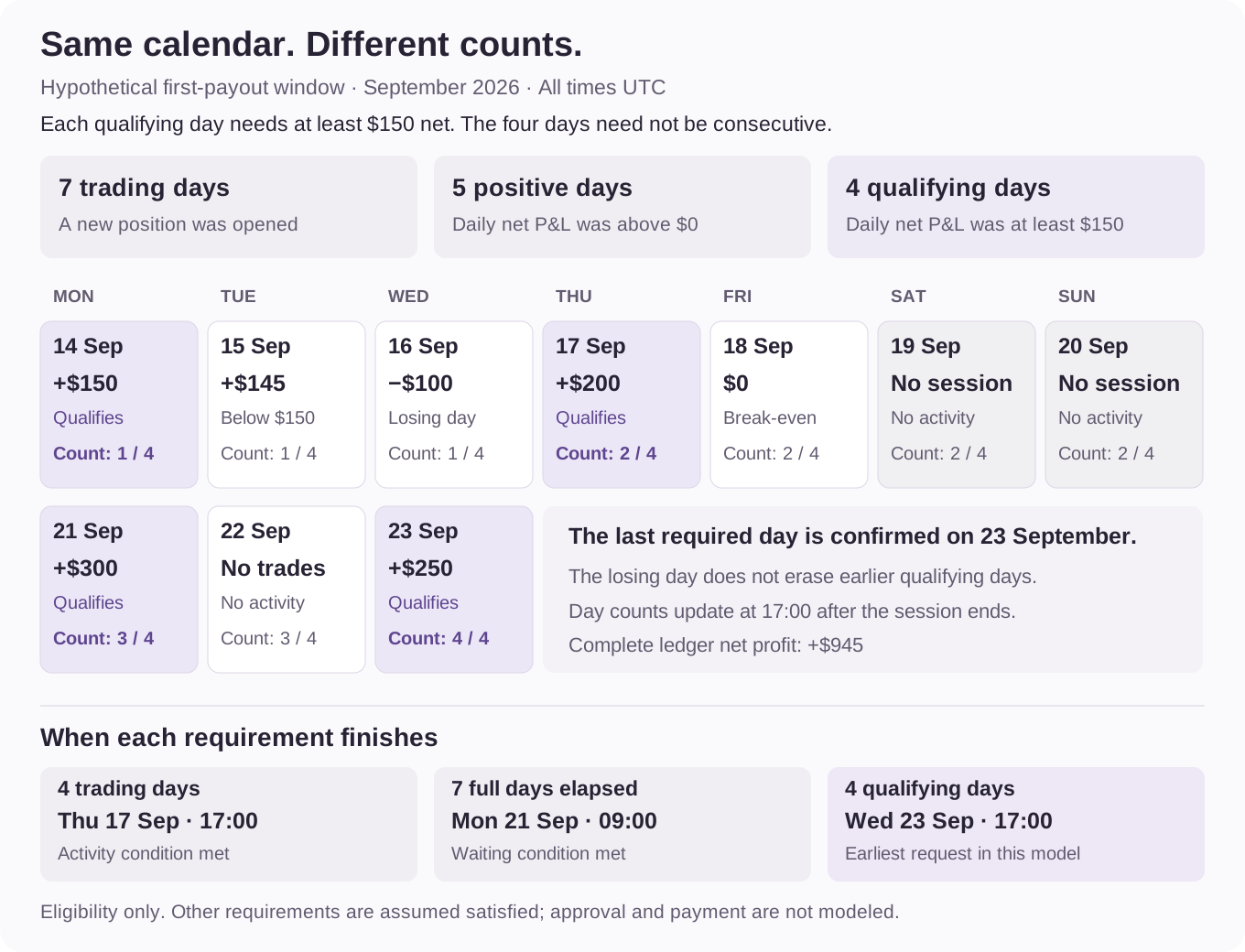
Monday the 14th qualifies exactly at the boundary. Tuesday the 15th is positive but below it. Wednesday's loss and Friday's break-even result add trading days, without adding qualifying days. The weekend advances the elapsed wait, while Tuesday the 22nd adds no activity because no trade is opened.
The losing session does not erase the earlier qualifying day under this explicitly nonconsecutive rule. It does reduce total net profit: the complete ledger ends at +$945. A different rule requiring a streak, a rolling window, or an unbroken sequence would need a different count.
Which timezone and session boundary control the count?
Use the program's day, even if your laptop, chart, or bank uses another timezone. Keep three events separate: when a session begins, when trading must stop, and when the firm confirms the result. Those times need not coincide.
FTMO's 2-Step activity definition uses the calendar day from midnight through 23:59:59 in CE(S)T. One position held into the next date does not satisfy the requirement for a new opening on that date. FTMO Trading Objectives
Futures sessions can span two civil dates. Topstep's Trading Combine Parameters describes a trading day from 5 p.m. CT through 3:10 p.m. CT the following calendar day, with evening activity assigned to the next day's session. This is distinct from the XFA day-confirmation time in the payout policy.
Record the named timezone and its daylight-saving convention, rather than relying on a permanently fixed UTC offset. Check holiday schedules separately. A market closure can reduce the sessions available for activity without pausing a calendar wait.
The day boundary used for an activity count also should not be assumed to define a loss rule. Consult the daily-loss guide's trading-day clock for the boundary used by that separate rule.
How do day counts interact with a payout waiting period?
If a program allows requirements to run concurrently, eligibility begins only after the last outstanding condition is satisfied. Do not add a calendar wait to an activity count when the two are already progressing together.
In the hypothetical calendar:
| Requirement | Completion |
|---|---|
| Four confirmed trading days | Thu 17 Sep, 5 p.m. UTC |
| Seven full 24-hour periods after the first trade | Mon 21 Sep, 9 a.m. UTC |
| Four confirmed qualifying days | Wed 23 Sep, 5 p.m. UTC |
The earliest request time under the declared assumptions is therefore Wednesday, 23 September 2026 at 5 p.m. UTC. This is an eligibility timestamp, not an approval, dispatch, or receipt estimate. The payout-process guide follows those later stages.
Once eligible, use the profit-split, payout-cap, and buffer calculation to distinguish the approved request from cash received.
For an actual program, identify both the start event and the counting convention. “On day seven,” “seven calendar days after activation,” and “168 hours after the first trade” need not describe the same timestamp. Check whether the request window is open when the final condition is met. If one requirement starts only after another ends, model that dependency explicitly.
What resets after a phase change or payout?
Keep the counter attached to a specific account, stage, and measurement window. Do not carry evaluation days into a funded account, or one payout cycle into the next, without an explicit rule allowing it.
FTMO's four-day requirement applies separately to the two evaluation phases; its published 2-Step objectives do not apply that requirement to the subsequent FTMO Account. FTMO Trading Objectives
For Topstep XFA, the payout policy restarts the relevant day count after a payout and excludes the payout-request trading day from the next cycle. It also requires positive net profit since the previous payout for subsequent Standard requests. The request's session label matters: an evening request can belong to the next calendar day's trading session. Topstep Payout Policy
An evaluation reset can restart the activity record too. Topstep states that a Trading Combine reset returns its trading-day count to day one, alongside balance, Maximum Loss Limit, and Consistency Target. Confirm which counters restart before carrying earlier sessions into a new attempt. Topstep reset rules
Do not treat surplus days as stored credits for a later cycle unless the terms allow that treatment. Record whether the reset occurs at submission, approval, deduction, payment, or new-account activation. If the source only says “after payout,” confirm the operational event before forecasting a specific next eligible day.
Are profitable-day rules the same as consistency rules?
A profitable-day requirement asks how many sessions meet a test. A best-day consistency rule asks how concentrated profit is within a defined period. Passing one does not establish the other.
For example, four hypothetical daily results of $150, $150, $150, and $1,550 all meet a $150 minimum. However, the largest day is $1,550 ÷ $2,000 = 77.5% of total net profit. The account would not satisfy a separate hypothetical rule limiting the best day to 40% of that total.
Conversely, balanced profits can satisfy a concentration test without meeting the required number of active sessions. The consistency-rule calculation guide explains denominators, losing days, and measurement windows.
“No minimum trading days” therefore needs context. It can mean that one particular activity counter is absent while profit targets, consistency conditions, waiting periods, and review requirements still apply. Read the complete set of conditions for the named stage.
For example, Topstep says its Trading Combine cannot be passed in one day and can be passed in as few as two. Its guidance is to keep the best day below 55% of the profit target to avoid increasing the Consistency Target. That guidance concerns the profit needed to satisfy consistency; it is not a separate hard-breach limit. Trading Combine Parameters
What should you record before counting days?
Complete these fields from the rules for the account you are considering. Leave unclear items unresolved rather than filling them with another firm's definition.
| Field | What to record |
|---|---|
| Account and window | Firm, market, program, phase, account size, selected payout path, applicable cohort, and first or later payout |
| Required count | Number of activity days and number of qualifying profitable days, separately |
| Qualifying activity | Opening, closing, or another event; any size, duration, instrument, or conduct conditions |
| Daily result | Closed or marked-to-market result, included charges, floating P&L treatment, and adjustments |
| Threshold | Amount or percentage, percentage base, rounding, and whether equality qualifies |
| Day boundary | Session start/end, timezone, daylight-saving treatment, holidays, and confirmation time |
| Sequence | Consecutive or cumulative days, rolling-window length, and whether a losing day changes the count |
| Waiting period | Start event, units, inclusive/exclusive counting, and overlap with activity requirements |
| Reset and exclusions | Exact reset event, treatment of prior or surplus days, and excluded sessions |
| Next gate | Remaining profit, consistency, account-status, request-window, and verification conditions |
Then use a session ledger to reconcile your count with the account dashboard. For a discrepancy, retain the trade timestamps, session label, charges, end-of-session values, and applicable rule text. These are more useful than a screenshot showing only a green daily total.
Add the completed fields to the before-you-pay comparison worksheet. The useful comparison is the exact qualifying-day definition for each stage, alongside the remaining conditions for passing or requesting a payout.
Sources and method
Official sources checked on 3 October 2026:
- FTMO Trading Objectives, scoped here to the CFD/FX 2-Step day definition and phase applicability.
- FTMO Academy: Minimum Trading Days, supporting the nonconsecutive-day and new-opening explanations for that evaluation requirement.
- The5ers High Stakes, for evaluation profitable days and the published midnight balance/equity formula.
- Topstep Payout Policy, for the two Express Funded Account paths, day confirmation, cycle resets, and request-day exclusion.
- Topstep Trading Combine Parameters, for that program's trading-session convention and the interaction between consistency and completion time.
- Topstep reset rules, for restarting the Trading Combine's day count after an evaluation reset.
The calendar, boundary calculations, and concentration example are original hypothetical illustrations, independently recalculated from their stated assumptions. They are not observed trader results. The named examples explain selected day-count mechanics, not every applicable account condition. The checked date records research, not a contractual effective date.