LearnPayout conditions
Prop Firm Consistency Rules: Best Day, Total Profit, and Payouts
A prop firm best-day consistency rule limits how much of a defined profit total can come from one trading day. To calculate it, divide the best day's qualifying profit by the denominator specified in the program's rules. Total net profit and the sum of profitable days are different denominators. A losing day reduces the first but does not enter the second.
On this page
The consequence also depends on the program. An unmet consistency condition can keep an evaluation incomplete or prevent a payout request without automatically ending the account. Identify the applicable formula, measurement window, and consequence before treating a percentage as a pass or breach.
This guide covers best-day profit concentration. A rule about individual trades, position sizes, or trading behavior needs its own definition and cannot be tested with this daily formula.
What does the consistency percentage measure?
For a rule based on total net profit:
Consistency percentage = best single-day net profit ÷ total net profit in the window × 100
Both figures must belong to the same account and stage. Use the documented measurement window for each input; use one shared window only when the rule defines it that way. The account's advertised size is not the denominator in this formula. Neither is the amount you want to withdraw.
Before calculating, resolve these details:
| Detail | What to establish |
|---|---|
| Unit measured | One trading day, one trade, or another defined unit? |
| Profit basis | Closed results or another measure? Before or after commissions, swaps, and other charges? |
| Denominator | All-day net profit, the sum of positive days, or a specified target? |
| Window | Entire evaluation phase, current payout period, or a rolling interval? What starts and ends it? |
| Day boundary | Which timezone and session cutoff determine the day? When is its result finalized? |
| Threshold | Is equality allowed? Does the system compare exact values or rounded displays? |
| Stage and consequence | Evaluation or funded stage? Incomplete objective, payout restriction, or a stated breach? |
Use the firm's qualifying result, not a convenient figure from another report. For example, Topstep states that commissions and fees appear in Net P&L. A gross trading result is therefore not interchangeable with that net figure. Topstep pricing and payment questions
Open-position gains also should not be inserted into a closed-profit calculation. The balance-versus-equity guide explains how realized results, floating P&L, and charges differ.
Worked example: a losing day changes the percentage
The following hypothetical payout condition requires the best day's net profit to be 40% or less of total net profit. Equality qualifies for this condition. All figures are USD, and each daily result includes that day's closed trades and trading charges. All positions are closed at each daily checkpoint.
The example uses five consecutive UTC calendar days, assessed at each day's close, within one measurement window beginning at Day 1. There are no payouts, deposits, credits, or adjustments during the window. These are invented assumptions, not a simulation of a named firm's full program. Daily loss, max loss, required activity, and payout approval are not modeled.
| Day | Daily net P&L | Total net profit | Best day so far | Best-day share |
|---|---|---|---|---|
| 1 | +$1,200 | $1,200 | $1,200 | 100% |
| 2 | +$600 | $1,800 | $1,200 | 66.67% |
| 3 | +$600 | $2,400 | $1,200 | 50% |
| 4 | −$400 | $2,000 | $1,200 | 60% |
| 5 | +$1,000 | $3,000 | $1,200 | 40% |
Percentages are rounded for display where needed; the condition is assessed using the unrounded calculation.
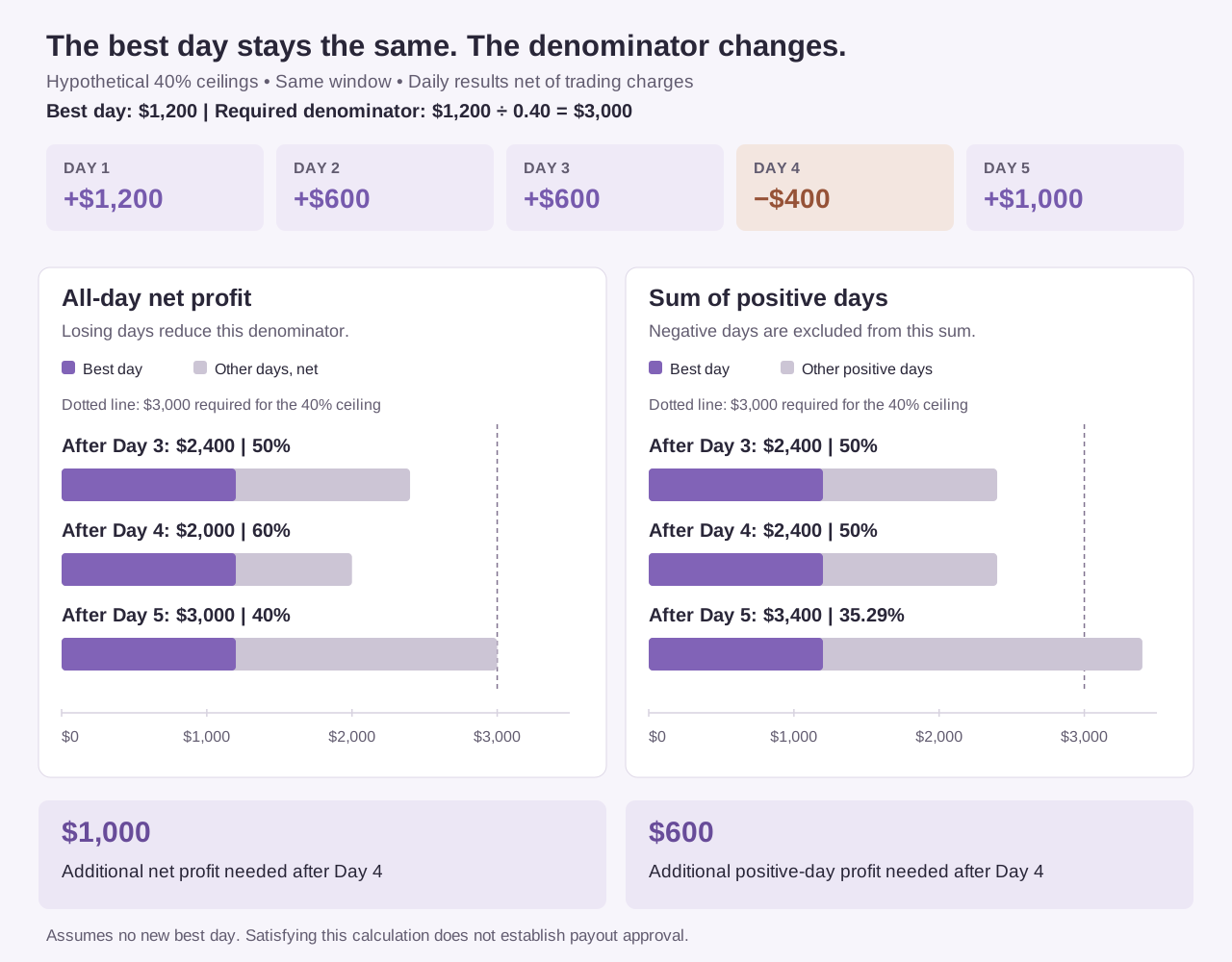
After Day 3, the best day accounts for half the total: 1,200 ÷ 2,400 = 50%. Day 4's loss reduces total net profit to $2,000. The historical best day stays at $1,200, so its share rises to 60%. The losing day has not erased or reset that best day.
Day 5 adds $1,000 without setting a new best day. Total net profit reaches $3,000, making the share exactly 40%. The modeled consistency condition is now met. That result does not establish that other account rules were respected or that a payout is available or approved.
If total net profit is zero, the division is undefined. If it is negative, a negative quotient is not evidence of eligibility. This model requires positive total net profit before interpreting the percentage.
What changes if only profitable days count?
Now change only the denominator in a separate hypothetical variant. Keep the same ledger, 40% ceiling, day boundaries, and best-day definition, but add only daily net results above zero. This is the sum of positive days, not the sum of every winning trade. A day's losing trades and charges still affect whether that day finishes positive and by how much.
| Checkpoint | All-day net profit | Sum of positive days | Best day ÷ net profit | Best day ÷ positive days |
|---|---|---|---|---|
| After Day 3 | $2,400 | $2,400 | 50% | 50% |
| After Day 4's loss | $2,000 | $2,400 | 60% | 50% |
| After Day 5 | $3,000 | $3,400 | 40% | 35.29% |
The negative Day 4 is excluded from the positive-days sum. That percentage stays at 50%, even though account profit has fallen. After Day 5, the positive-days sum is $3,400: $1,200 + $600 + $600 + $1,000.
Compare the same ledger under two definitions
- Day 1+$1,200
- Day 2+$600
- Day 3+$600
- Best day
- $1,200
- Total net profit
- $2,400
- Sum of positive days
- $2,400
- Selected denominator: total net profit
- $2,400
- Best-day share
- 50%
- Additional amount needed, if the best day stays unchanged
- $600
This consistency condition is not met
The same completed daily results feed both definitions; only the denominator changes.
This checks one consistency condition. It does not establish account validity, other objectives or payout approval.
Both variants still need a denominator of $3,000 to accommodate a $1,200 best day at 40%. After Day 4, that means another $1,000 of net profit in the first model, versus another $600 added to the positive-days sum in the second, assuming the best day does not increase. Further losing days would increase the first shortfall but would not enter the second sum.
Excluding a losing day from this denominator does not excuse it from the account's other calculations. Check the daily-loss rule and its consequence separately.
How much additional profit would satisfy the condition?
For a positive denominator and an equality-allowed ceiling, rearrange the formula:
Minimum qualifying denominator = best-day profit ÷ allowed fraction
Additional amount needed = max(0, minimum denominator − current denominator)
Use 0.40 for a 40% ceiling. In the main example after Day 4:
$1,200 ÷ 0.40 = $3,000 required total net profit
$3,000 − $2,000 = $1,000 additional net profit
This is a conditional calculation. It assumes the existing best day remains the largest, the added profit belongs to the same window, and no intervening result changes the denominator. It is not a trading target or a reason to increase risk.
A new best day changes both inputs
Consider an alternative Day 5, replacing the original $1,000 result with $2,400. Total net profit would reach $4,400, but the new best day would also become $2,400:
$2,400 ÷ $4,400 × 100 = 54.55%
The required denominator would rise to $6,000, leaving another $1,600 of net profit needed if that new best day remains unchanged. More profit has not necessarily brought the share below the ceiling.
Also distinguish a completed historical day from a session still in progress. Additional profit earned during the current best day can increase the numerator as well as the denominator. You cannot assume every new dollar dilutes the existing share.
Equality and charges matter near the boundary
The original Day 5 result of $1,000 is already net of charges. If a gross $1,000 result instead became $980 after charges, total net profit would be $2,980 and the share would be about 40.27%, so this condition would remain unmet.
Even a total of $2,999.99 leaves the exact share above 40%, despite a display rounded to 40.00%. If a rule requires strictly less than 40%, exactly $3,000 would not satisfy it either. Use the documented inequality and the underlying precision.
How selected official rules differ
These examples were checked on 3 October 2026, and FTMO's again on 16 October 2026, after its 1-Step rule changed. They cover the specified programs and stages, not every product sold by either firm. The shared 40% examples above isolate the arithmetic; they do not reproduce the full conditions below.
| Program and stage | Published consistency basis | What an excessive share means |
|---|---|---|
| FTMO, CFD 1-Step Challenge and FTMO Account (1-Step) | Consistency, for accounts from orders created on or after 12 October 2026 or merged on or after that date: best day at most 50% of total profit. Best Day Rule (Legacy), for accounts directly initiated from earlier orders: best day at most 50% of Positive Days' Profit | Under either rule, the condition remains unmet until more profit brings the best day's share to 50% or less; exceeding it is not treated as a breach. Trading Objectives · Our record of the change |
| Topstep, futures Trading Combine | Best day at most 55% of the Profit Target, with an increased target when needed | Required total profit is the higher of the base target and best day ÷ 0.55. Both the target and consistency condition must be met. Consistency at Topstep |
| Topstep, futures Express Funded Account, Consistency payout path | Largest single-day net profit must be at most 40% of total net profit | The payout condition remains unmet. This path also requires at least three trading days with a trade on each. XFA parameters |
Topstep also expresses consistency as best day divided by total profit. The base profit target is the starting requirement, and a larger best day can raise it. Combining the target and consistency conditions gives:
Required total profit = max(base profit target, best-day profit ÷ 0.55)
For its $50K Combine, the base target is $3,000. A best day above $1,650 raises the requirement; a $2,200 best day requires $4,000 total profit. The original $3,000 target is therefore not a permanently fixed denominator. This calculation assumes no later increase in the best day; profit added during the same best-day session can raise the requirement again. Topstep's target and consistency explanation
Which FTMO denominator applies depends on when the account was ordered, or merged, not on its size. Consistency's total profit is the cumulative sum of closed profits and losses across all trading days, so a losing day lowers it, like the all-day net profit denominator. The Legacy Best Day Rule's Positive Days' Profit adds only the closed results of profitable trading days, like the positive-days sum. Under both, each new trading day begins at 00:00 CE(S)T. For an account merged on or after 12 October 2026, FTMO's pages do not say whether days before the merge count under Consistency. Confirm which rule applies to your account before choosing a denominator, and do not apply either 1-Step rule to a different program without checking its terms. FTMO objectives · Our record of the change
Topstep's 40% condition belongs to its XFA Consistency option; Standard is a separate payout path. Its payout policy states that XFA days lock at 4:00 PM CT, while its consistency page gives 3:10 PM CT for locking a Trading Combine best day. These are different stages and timestamps. Payout policy · Evaluation consistency details
An evaluation's headline target may therefore be only one completion condition. The profit-target and loss-limit guide explains why a target-to-loss comparison leaves out these additional obligations.
Does consistency reset after a payout?
Use the rule's exact reset event. A request, approval, account debit, and payment receipt can occur at different times. A window defined by one of those events should not be reconstructed using another.
For Topstep's XFA Consistency path, the consistency page specifies a reset after a payout is requested. The next window starts on the following trading day; trades on the request day do not contribute to that next window. Remaining account balance is not carried forward as new-window profit. Topstep consistency reset
Keep a ledger for each payout cycle and retain any historical result the program carries forward. Do not substitute lifetime profit or the whole account balance for current-cycle profit. Check the reset event for each input: a new cycle may leave a lifetime best-day reference intact. Do not assume a payout reset has erased a separate loss-limit restriction.
Keep the activity counter separate from the profit-concentration calculation. The trading-day and profitable-day guide explains which sessions count and what can reset after a payout.
Meeting consistency also does not determine the withdrawal amount. Other conditions can govern eligible days, request size, profit splits, retained buffers, and review. The payout-process guide separates eligibility, request, approval, dispatch, and money received.
Work through your own ledger
Write down the exact program, stage, payout option, official rule URL, and date checked. Then:
- Set the window and day boundary. Assign each qualifying result to the correct session and period.
- Record every day's qualifying P&L. Retain losing days and charges even if a particular denominator excludes negative days.
- Find the best day and the correct denominator. Do not substitute account size, account balance, or requested payout amount.
- Calculate without premature rounding. Apply the stated inequality and flag zero or negative denominators.
- Recalculate after changes. A loss, new best day, charge, or window reset can alter the result.
- Check the remaining requirements. Consistency is one condition; account validity, other objectives, and payout review require separate evidence.
Next step: reproduce the Day 4 calculation under both definitions, then add your program's formula and window to the program-comparison worksheet. If the official terms do not establish a field, record it as unknown before relying on the result.
Then check whether the account could reach that result without an earlier loss-rule breach. The combined trading-history replay separates the consistency calculation from the equity path and shows what remains unresolved when only closed-trade records are available.
Sources and method
Official examples were checked on 3 October 2026, and FTMO's Trading Objectives again on 16 October 2026. The daily ledger, denominator comparison, alternative Day 5, and boundary calculations are hypothetical. They demonstrate rule arithmetic without estimating trading success or certifying payout eligibility.
- FTMO, CFD: Trading Objectives, for the 1-Step Consistency rule and the Legacy Best Day Rule: the accounts each applies to, their denominators, the day boundary, and the consequence.
- Topstep, futures: Consistency at Topstep, for evaluation consistency, stage-specific timing, and the XFA request-window reset.
- Topstep, futures: Express Funded Account parameters and Payout Policy, for the selected Consistency payout path and its activity and timing requirements.
- Topstep: Pricing and payment questions, for commissions and fees in Net P&L.