LearnChoosing a program
Prop Firm News Trading Rules: Orders, Windows, and Account Stages
A prop firm's news-trading rule depends on the account, event, instrument, time window, and action being restricted. “News allowed” does not tell you whether a pending order may execute, a stop loss may close a position, or the resulting profit will count in full.
On this page
Read the rule as an operating instruction. Establish what can remain open, which actions count, when the restriction starts and ends, and what happens if it applies. Repeat that check when moving from evaluation to the next account.
This guide covers CFD/FX and futures programs. Official examples were checked on 4 October 2026. The worked event clock is hypothetical and has its own declared boundaries, so it can be reproduced without treating one firm's wording as a universal rule.
What does a news-trading restriction actually restrict?
A rule can prohibit particular executions, require an account to be flat, adjust the profit recognized from affected trades, or restrict a specific trading behavior. Those conditions have different consequences. Record each one explicitly instead of reducing the policy to a yes/no field.
Start by separating an order instruction, an execution, and a position. In MetaTrader 5, for example, an order is an instruction, a deal records execution, and a position describes the resulting exposure. One order can produce several deals. This distinction helps explain why the time you submitted an order may differ from the time that matters to a rule. MetaTrader 5 trading principles
| Action or state | What to establish in the applicable rule |
|---|---|
| Submit a market order | Does the rule refer to submission, execution, or both? A click outside the window does not establish a fill outside it. |
| Place a pending entry order | Is placing or leaving the order permitted? Separately, may it execute during the window? |
| Hold an existing position | Is existing exposure permitted, or must the account have no open positions? Does the original entry time matter? |
| Close or partially close | Are manual exits and reductions covered? Can a partial closure affect treatment of the entire trade? |
| Execute a stop loss or take profit | Does an automatic exit count as a restricted closing action or an affected trade? |
| Modify or cancel an order | Are these actions covered explicitly? Has the change been accepted, and did any fill occur first? |
“I did not place a new order during the release” answers only one question. A previously submitted order may still fill, and an existing position may still close automatically. Likewise, “holding is allowed” does not establish that every possible exit from that position is permitted during the same interval.
Platform behavior is evidence of what happened. Permission comes from the applicable program terms. A technically accepted order can still be outside those terms. Use the evaluation-to-funded rule check to keep the two stages separate.
Which events, instruments, and times count?
Use the event list or calendar specified by the provider. A color or impact rating on another calendar is useful context, but it does not establish the provider's restricted-event list. Also check current account notices for temporary changes or more specific instructions.
For example, FTMO's CFD news policy identifies restricted releases in its calendar and maps them to affected instruments. That mapping includes instruments beyond currency pairs. A currency label alone is therefore insufficient to decide whether a particular index or commodity symbol is covered. FTMO news policy and event mapping
Build one record for the event you are checking:
| Field | Record explicitly |
|---|---|
| Account | Market, program, stage, account type, platform/options, and any applicable cohort |
| Event | Exact release or speech, date, provider-designated impact or restriction, and latest schedule |
| Instruments | Exact symbols or products covered, including whether the restriction applies to all products |
| Clock | Calendar timezone, platform/server timezone, and the date-specific conversion between them |
| Window | How long before and after the event; whether the boundary instants are included |
| Actions | Placement, execution, holding, closing, partial closing, modification, and cancellation |
| Consequence | Account breach, profit adjustment, temporary trading block, or another stated result |
Distinguish a scheduled data release from a statement, press conference, or speech listed separately. If applicable windows overlap, check the combined period for the same account, instrument, and action. The end of one window does not cancel another active restriction.
Do not reuse a remembered UTC offset without checking the date. The relevant locations or server clock may change with daylight saving time on different schedules. If the event is delayed, rescheduled, or has no fixed end time, establish how the firm's rule defines the operative window. Silence does not establish a shorter one.
The event clock is also separate from a daily-loss reset. The daily-loss guide explains that account-level clock. A release taking place after a daily reset does not gain permission from the reset itself. If the position will stay open beyond the release, the worked overnight and weekend timeline follows the next market break, reset, financing debit, and reopening quote as separate checks.
Worked example: an order placed earlier can still breach the window
Consider a hypothetical CFD-style funded account and one affected instrument. An invented scheduled release occurs at 12:30:00 UTC. All timestamps below use UTC on the same hypothetical day; this is not a real event schedule.
This model defines the following rule:
- From 12:28:00 through 12:32:00, including both boundary instants, no order may execute to open, add to, reduce, or close a position on the affected instrument. New entry-order placement is also prohibited during that window.
- A position opened before the window may remain open. A pending order placed earlier may remain working, but its execution during the window is prohibited. A stop-loss or take-profit execution is covered too.
- Canceling an unfilled pending entry order is permitted. Cancellation must be confirmed before any execution. Other order modifications are outside this example.
- The first prohibited action is a hard breach that ends the account's valid path. Other account requirements are assumed satisfied up to that point.
The window is calculated directly:
Start = 12:30:00 - 00:02:00 = 12:28:00 UTC
End = 12:30:00 + 00:02:00 = 12:32:00 UTC
The following are four independent scenarios, not four trades continuing on one account. Times are completed execution or acknowledged-cancellation times where indicated. No price, P&L, costs, withdrawal, or loss-threshold calculation is modeled.
| Scenario | Before the window | Later event | Result under this hypothetical news rule |
|---|---|---|---|
| A: cancel a pending entry | Entry order placed at 12:26:00 | Cancellation acknowledged at 12:27:30; no fill occurs | No news-rule breach. The unfilled order is gone before the window. |
| B: pending entry fills | Entry order placed at 12:26:00 | Order executes at 12:29:00 | Hard breach at 12:29:00. Earlier placement does not permit the later fill. |
| C: protective exit executes | Position opened at 12:25:00 | Stop loss executes at 12:30:20 | Hard breach at 12:30:20. This is a closing execution inside the window. |
| D: hold without an execution | Position opened at 12:25:00 | No fill or other prohibited action during the window; position closes at 12:33:00 | No news-rule breach in this path. Holding is explicitly permitted by the model. |
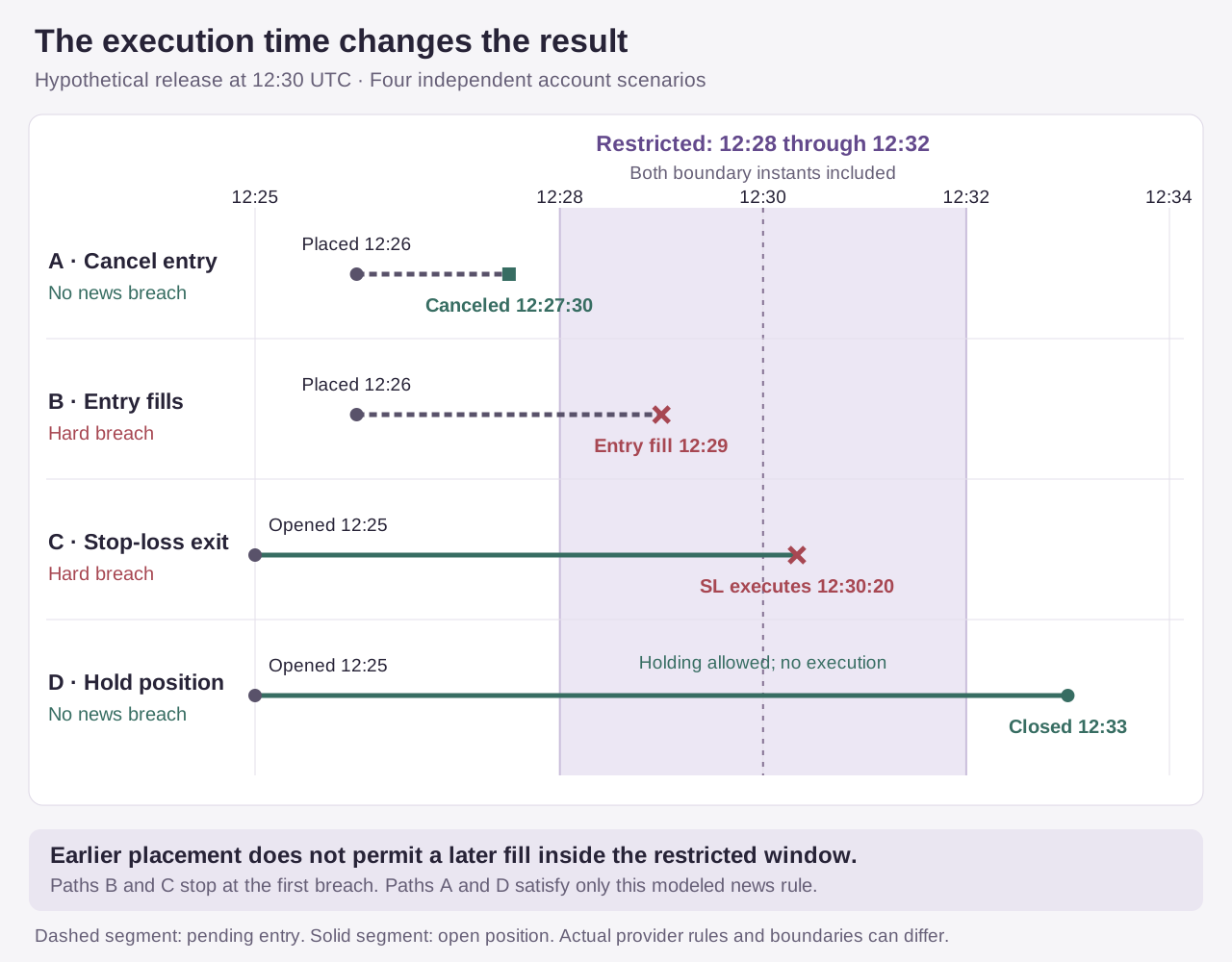
In this model, an execution at exactly 12:28:00 or 12:32:00 is inside the window. That is a declared assumption, not an interpretation of every provider's boundary wording. If the actual policy leaves equality unclear, obtain clarification and allow operational time for the intended action to complete.
Scenario D assumes that no protective exit triggers. It does not assume that protection is removed. Whether that holding plan is workable depends on both the permission to hold and the consequences of any exit that could occur. A different rule requiring all positions and orders to be cleared would make D incompatible from the start of that rule's window.
How do actual CFD/FX and futures rules differ?
These selected examples illustrate different mechanisms. They are not a ranking, a complete event list, or a substitute for the account's current agreement.
| Exact scope | Published news treatment | What the comparison must preserve |
|---|---|---|
| FTMO CFD Standard, FTMO Account stage, following either evaluation route | Opening or closing affected trades is restricted from two minutes before to two minutes after selected releases. Pending executions, including SL/TP, count; earlier positions can be held under the stated conditions. | The restriction does not apply during evaluation; Swing is excepted. A breach may lead to account termination. Official policy |
| FundedNext CFD Stellar 2-Step, Challenge versus FundedNext Account | The Challenge permits news activity without the funded-stage profit adjustment. The FundedNext Account applies separate treatment to affected news profits. | Permission and the amount recognized are separate questions. See the calculation below. Stellar 2-Step policy |
| FTMO Futures, its news FAQ's stated phase scope | News trading is allowed during any phase without a special news restriction, subject to its Forbidden Trading Practices. | The CFD Standard window cannot be transferred to this separate futures product. Futures policy |
| Take Profit Trader futures PRO accounts | All open positions and open orders must be cleared for the interval one minute before, during, and one minute after a prohibited event. The listed event restrictions cover all products. | This requires a flat account with no working orders. Permission to hold an older position cannot be assumed. Check its designated calendar. PRO rules |
Also inspect conduct rules outside the news FAQ. Topstep, for example, does not require positions to be flattened for economic releases in its simulated or funded accounts. Topstep economic releases It separately prohibits purposefully trading the full Maximum Position Size directly into a scheduled major news event. That condition should not be converted into a universal minute window or an invented numerical allowance for smaller positions. Topstep prohibited strategies
The CFD/FX versus futures guide separates market mechanics from program choices. News treatment belongs to the exact product and stage. Neither the market label nor a shared firm name settles it.
Can news trading be allowed while less profit counts?
Yes. For Stellar 2-Step FundedNext Accounts, the cited policy counts 40% of profit from affected trades opened or closed within five minutes before or after a listed high-impact event, while losses count fully. It includes market and pending executions, including SL/TP. Stellar 2-Step news policy
The fuller guidance limits the treatment to directly related instruments, says a partial closure can affect the entire order, and calculates the adjustment after the cycle ends. Those details matter when inspecting the trade record. FundedNext news guidelines
To isolate the arithmetic, take two hypothetical, fully closed, affected trades: one gains $500 and one loses $300. Assume the provider has already classified both as covered by the published 40% treatment. For this illustration there are no charges, credits, other trades, or withdrawals.
| Component | Before the adjustment | Amount counted in this illustration |
|---|---|---|
| Winning affected trade | +$500 | 40% × $500 = +$200 |
| Losing affected trade | −$300 | Full −$300 |
| Combined result | +$200 | −$100 |
Counted result = 0.40 × $500 - $300 = -$100
Multiplying the combined +$200 by 40% would produce +$80, which is a different calculation. It would incorrectly reduce the losing trade as well. The example shows why the profitable and losing components must be separated before applying the adjustment.
This is a profit-recognition calculation. It does not calculate cash received, model an entire payout cycle, or establish that the account satisfies its other rules. Apply the relevant payout conditions and use the profit-split and payout-cap guide for the later amount calculation. Do not interpret “40% counted toward balance” as a promise of a 40% cash payout.
FundingPips 2 Step Standard's news rule shows how a position's opening time can change the treatment of a profitable close during a restricted announcement.
Does permission to trade remove the execution or loss risk?
Permission and execution quality are separate. Topstep's economic-release guidance describes rapid price movement, lower liquidity, and slippage, including fills at worse prices than expected. It also says economic-release losses are not grounds for account adjustments or Reset credits. Topstep economic releases
For a time-based restriction, record the actual execution or cancellation acknowledgment required by the rule. Do not assume that sending a request just before the boundary completes it before the boundary. Check partial fills, remaining quantity, attached orders, and each connected account separately.
Use the execution-record checklist to connect each instruction and fill to its timestamp, quote reference, completed quantity and account effect. A visible candle or submitted request alone may not establish what executed.
Plan any required closure and cancellation while those actions are still permitted. If holding would leave a possible protective exit in conflict with the news rule, resolve that conflict before entering the restricted interval. Removing a required or planned protective stop merely to keep the position open changes the risk of the trade and may conflict with other account conditions.
Daily loss and overall max loss also continue to apply according to their own definitions. An allowed news trade can still reach a loss threshold. The overall max-loss guide explains the separate mechanics; a news permission does not add loss allowance or excuse a breach.
If an execution is disputed, preserve order and deal identifiers, timestamps with timezone, relevant account notices, the applicable event record, and the provider's response. An active dashboard immediately after the event does not establish that every later review has been completed. The payout-process guide explains why eligibility and review are separate stages.
What should you check before the next release?
Complete this record for the actual account and repeat it when its stage or terms change. Keep unanswered conditions visible rather than filling them from another product's rules.
| Check | Evidence or decision to retain |
|---|---|
| Correct configuration | Firm, market, program, stage, account type, platform/options, and applicable terms |
| Event and instrument match | Current designated calendar entry, exact symbol, and any account-specific notice |
| Complete window | Date, timezone, conversion, boundaries, and overlapping applicable events |
| Existing exposure | Whether holding is allowed or the account must be flat |
| Working orders | Pending entries, attached exits, partial fills, and acknowledged cancellations |
| Automatic activity | What an EA, copier, bracket, or server-side instruction could execute on each account |
| Profit treatment | Which trades are affected, positive and negative treatment, partial-closure scope, and adjustment timing |
| Consequence and evidence | Stated breach or adjustment outcome, source, checked date, and any precise question still unresolved |
If an EA or copier can act during the news window, check both its automation and copying permissions and the order actions permitted on each receiving account.
For an unclear policy, ask a concrete question: “On this program and account stage, may a stop loss close an existing position on this symbol during this event window?” Include the event, timezone, and relevant order behavior. A general answer that news is allowed may leave that question open.
Add the result to the before-you-pay comparison worksheet. If your method depends on holding through releases or executing near them, compare that requirement with the funded-stage terms before committing to the route.
Sources and method
Official sources checked on 4 October 2026:
- MetaTrader 5: Basic Principles, for order, deal, and position distinctions.
- FTMO CFD: Can I Trade News?, for account-stage scope, affected instruments, event mapping, and execution restrictions.
- FTMO Futures: Can I Trade News?, for the separate futures-product policy.
- FundedNext: Stellar 2-Step News Policy, for Stellar 2-Step permission and funded-stage profit treatment.
- FundedNext: Full News Guidelines, for affected instruments, partial closures, and adjustment timing.
- Take Profit Trader: PRO Account Rules, for the PRO requirement to clear positions and orders around prohibited events.
- Topstep: Prohibited Trading Strategies, for the conduct restriction on full Maximum Position Size into major news.
- Topstep: Economic Releases, for holding permission during releases, execution risk, and loss treatment.
The worked examples are original hypothetical illustrations, independently recalculated from their stated assumptions. The event times and hard-breach convention are invented assumptions, not a claim about a named provider. The profit example applies the cited percentage to hypothetical trade results, without modeling payout eligibility, loss thresholds, or cash receipt. No trading-performance forecast, universal permission, or firm ranking is calculated.