LearnRisk essentials
Prop Firm Account Size vs. Drawdown: Your Opening Risk Budget
A prop firm's advertised account size does not tell you how much the account can lose. A hypothetical $100,000 account with a $10,000 max loss starts with $10,000 of opening loss allowance and a $90,000 max-loss threshold. A daily loss limit or daily pause can stop trading before that max loss is reached.
On this page
This guide covers retail CFD/FX and futures programs. The worked account paths are hypothetical, with all amounts in USD. Named examples are scoped to the stated account and rule. Detailed daily formulas and the eight-firm comparison are in the daily-loss guide.
Start with three distinctions:
- Account size is the advertised label; check the actual starting account value.
- Opening total loss allowance is the starting distance to the max-loss threshold.
- Remaining buffer is the current distance to a particular boundary, which can change.
Calculate the distance to each limit, then identify which rule can stop trading first.
What does a prop firm's advertised account size mean?
An account-size label identifies the advertised tier or reference amount. Its practical meaning depends on the actual starting balance and the loss rules attached to that account.
The label does not mean the trader receives that amount as cash or trades it live. For example, FTMO describes its CFD/FX FTMO Account as a simulated account. That statement concerns the account described by FTMO, not every product marketed as “funded.”
For the wider process, see how prop firm challenges progress from purchase to payout, including the transition from evaluation to a funded-stage account.
The displayed tier and the actual opening balance can also differ. Topstep's Maximum Loss Limit documentation distinguishes the Trading Combine from the Express Funded Account, where the tier describes buying power rather than the starting balance. Check the account stage before putting a number into a formula.
The following terms describe different parts of the account:
| Term | Meaning |
|---|---|
| Balance | The account's recorded amount after booked transactions |
| Equity | The account value including open-position profit or loss, account credit where applicable, and charges under the program's definition |
| Max loss | The overall loss limit, calculated from the reference value specified by the program |
| Daily loss | The loss limit for a defined trading day, where one applies; check its calculation and consequence |
| Daily pause | A loss-triggered restriction until the next defined session; check whether it also closes positions and cancels orders |
| Opening total loss allowance | The starting monitored account value minus the opening max-loss threshold |
| Remaining buffer | The current distance to the relevant loss threshold |
| Threshold | The account-value boundary monitored for a loss rule, sometimes described as an equity level or floor |
| Drawdown | A label firms may use for max loss, a trailing max-loss rule, or daily loss; identify the formula and time period behind it |
Keep the loss amount and threshold separate. A $5,000 daily loss measured from $100,000 corresponds to a $95,000 daily-loss threshold. A $10,000 max loss measured from the same starting value corresponds to $90,000. The loss amounts are $5,000 and $10,000.
Here, opening risk budget means only the opening total loss allowance. It does not specify how much to risk on a trade.
How do you calculate the opening loss allowance?
When equity is the monitored value and the opening max-loss threshold is known:
Opening total loss allowance = starting equity − opening max-loss threshold.
For a hypothetical account starting at $100,000 with a fixed $90,000 max-loss threshold:
$100,000 − $90,000 = $10,000
If the rule instead states a max loss of 10% of the initial $100,000, the same calculation is:
Max loss = 10% × $100,000 = $10,000
Max-loss threshold = $100,000 − $10,000 = $90,000
Always check the percentage basis. A limit measured from the initial balance behaves differently from one measured from a later peak. For a dollar allowance, check whether its threshold moves and what triggers a breach.
The loss limit is not a suggested risk budget for a trade. If touching the corresponding threshold is a breach, losing exactly that amount reaches the breach point. Costs, execution differences, and separate constraints must also be considered.
For a named-account comparison, see FTMO, FundedNext, and The5ers at the same advertised account size, where each account's total and daily loss rules sit side by side, so the account-size label does not stand in for the rules.
Worked example: two hypothetical $100,000 accounts
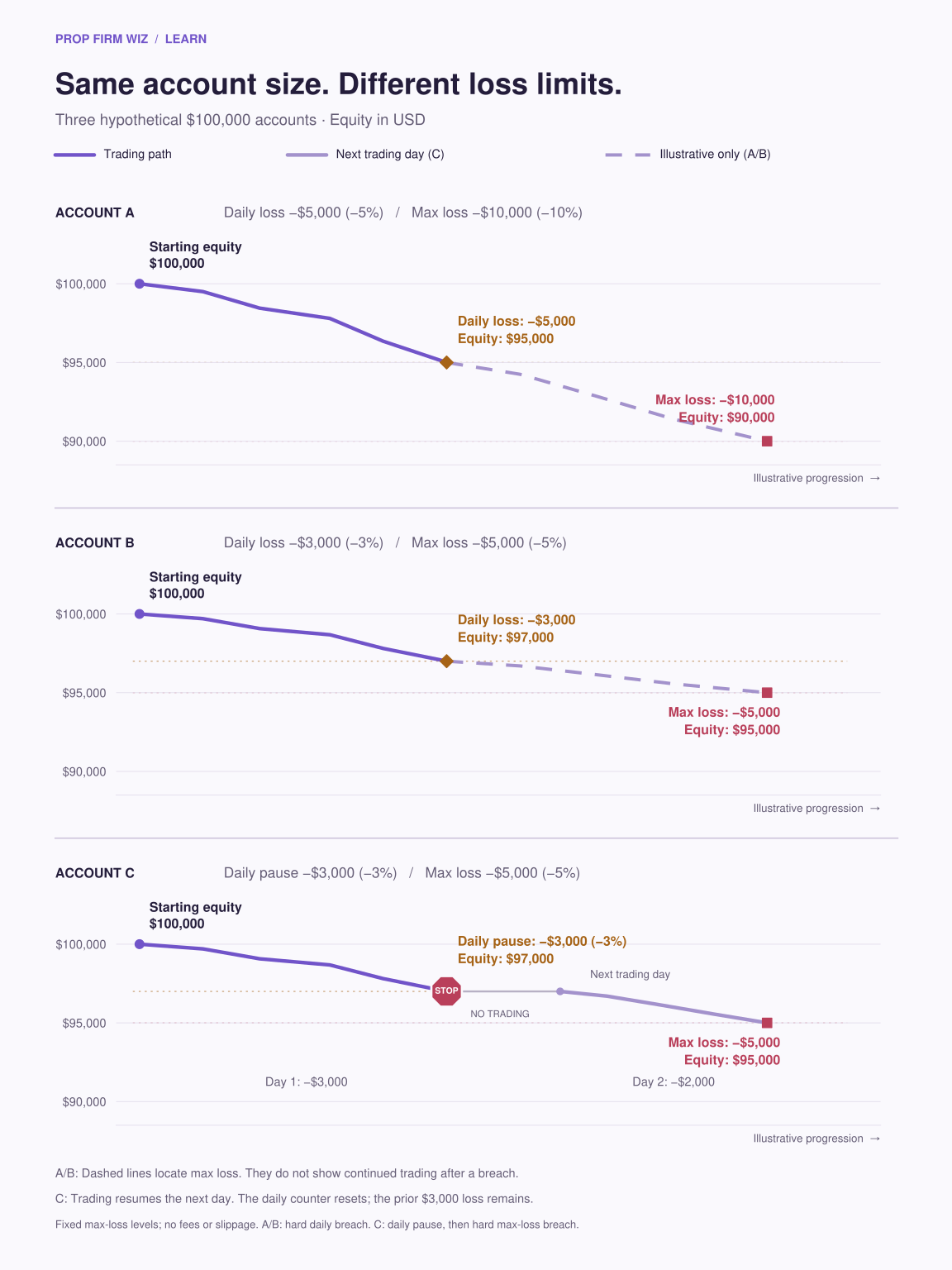
Accounts A and B have the same advertised size and actual starting value. Their rules differ.
Assumptions for this example: Both start with $100,000 balance and equity, with no open positions, prior profits, fees, or withdrawals. All amounts are USD. The daily-loss and max-loss thresholds remain fixed throughout this session. Equity is monitored continuously. Reaching either loss limit is a hard breach in these two hypothetical accounts; no daily pause applies. The illustrated loss path excludes trading costs.
| Opening value or boundary | Hypothetical account A | Hypothetical account B |
|---|---|---|
| Starting balance/equity | $100,000 | $100,000 |
| Max loss / opening total loss allowance | $10,000 | $5,000 |
| Max-loss threshold | $90,000 | $95,000 |
| Daily loss | $5,000 | $3,000 |
| Daily-loss threshold | $95,000 | $97,000 |
| First limit reached on a continuous decline | Daily loss | Daily loss |
Account A has a $10,000 max loss. Account B has a $5,000 max loss. The identical $100,000 label therefore hides a two-to-one difference in opening total allowance.
The daily limits add another constraint: neither account can use its entire opening total allowance during this session without breaching the daily rule first.
Can daily loss trigger before max loss?
Yes. A daily loss limit can be reached while equity is still above the max-loss threshold. In the opening A/B example, daily loss is the first rule to trigger.
For these two accounts, with fixed loss thresholds at the opening snapshot:
Distance to the first loss limit = the smaller of the remaining max-loss allowance and remaining daily-loss allowance.
- A:
min($10,000, $5,000) = $5,000. - B:
min($5,000, $3,000) = $3,000.
This calculation describes the opening snapshot. Recalculate it when the monitored value or either threshold changes.
Now consider the same attempted continuous decline from $100,000 toward $96,500:
| Hypothetical check at $96,500 equity | Account A | Account B |
|---|---|---|
| Remaining allowance before max loss | $6,500 | $1,500 |
| Position relative to daily loss | $1,500 remaining | Limit exceeded by $500 |
| Outcome under the stated rules | Neither loss limit reached | Daily loss already breached |
Account A remains above both modeled boundaries. Account B breaches when equity first touches $97,000. The $96,500 checkpoint shows where the attempted path leads; B cannot continue along it as a compliant account after that breach. A negative buffer describes a crossed boundary, not additional allowance.
Check whether a real program treats touching a threshold or falling below it as a breach. For example, FTMO's CFD/FX 2-Step objectives use below-limit wording. Accounts A and B use the explicitly stated touch-as-breach assumption.
How is daily pause different from daily loss?
A daily pause restricts trading for the rest of the defined trading day; some programs also close open positions. Trading can resume at the stated session or reset if no account-ending rule was breached. Check position and order handling separately.
For example, The5ers' dedicated daily-pause FAQ explicitly requires open trades to close and disables the account until the next trading day for Hyper Growth in all stages and Bootcamp at the funded stage. That consequence belongs to those programs, not every daily pause.
Some firms call a temporary restriction a “soft breach,” but that label can describe other consequences too. Classify the rule by what happens to the account, positions, orders, and profits. The daily-loss guide compares pause and hard-breach outcomes.
Account C: pause today, resume tomorrow
Account C starts at $100,000 with a fixed $5,000 max loss, so its max-loss threshold is $95,000. Its daily pause is 3% of the initial balance: $3,000, measured from each day's opening balance. There is no separate hard daily-loss rule in this hypothetical example. Assume exact closure at the trigger, no costs or slippage, and no other account adjustments.
| Event | Equity | Trading status | Remaining max-loss buffer |
|---|---|---|---|
| Day 1 opens | $100,000 | Trading enabled | $5,000 |
| Day 1 loses $3,000 | $97,000 | Open trades close; trading paused for the rest of the day | $2,000 |
| Day 2 opens | $97,000 | Trading enabled again; daily counter resets | $2,000 |
| Day 2 loses a further $2,000 | $95,000 | Max loss reached; account breaches | $0 |
A daily pause does not refund losses or replenish the max-loss allowance. On day two, C reaches max loss before losing another $3,000. That is why the chart's lighter solid line can reach max loss without a second daily pause. Account C uses the hypothetical rules stated above; its path is not a complete The5ers configuration.
At Day 2's $97,000 opening balance, the $3,000 pause allowance sets C's new pause threshold at $94,000. The unchanged $95,000 max-loss threshold is nearer: $2,000 away.
See which loss rule stops each account
- Equity
- $97,000
- Daily-pause threshold
- $97,000
- Overall threshold
- $95,000
- Distance to the daily-pause threshold
- $0
- Remaining overall buffer
- $2,000
- Opening total loss allowance
- $5,000
Session paused: trading stops until the next session
Positions close exactly at $97,000 and trading stops for this session. The $3,000 loss still uses up part of the overall allowance.
Stepping backward reviews earlier states. It does not revive a breached account. The next-session step exists only for C's pause path.
Where terms specify both a daily pause and a separate hard daily-loss limit, record each amount and consequence. The next trading session follows the program's timezone, which may differ from your local calendar day.
For a detailed rollover example, see how daily loss limits reset around open positions. It follows one account from 23:59 to the midnight reset, when an unchanged open loss breaches the new threshold.
How do companies calculate daily loss differently?
A daily-loss percentage needs a basis, a reference value, and an update schedule. A fixed dollar allowance based on initial balance can create a different threshold each day. A percentage of opening balance or equity can change both the allowance and the threshold. An intraday trailing rule can raise the threshold during the session.
The daily-loss formula comparison shows how those mechanisms produce different thresholds from the same account state. Use the formula, not “static” or “dynamic” alone, to calculate the current daily buffer.
A new daily threshold can also breach an unchanged overnight position. The midnight-reset example shows the account immediately before and after that change.
How do daily-loss rules compare across prop firms?
See the eight-firm daily-rule comparison for scoped CFD/FX and futures examples, their reset clocks, and their consequences. Match the program, stage, and purchase options before using a published amount. Those details determine which daily boundary to compare with the account's overall max-loss threshold.
Why can your remaining buffer change?
The opening allowance describes one moment. Later, the monitored account value, the max-loss threshold, or both may change.
Open trades and charges can affect the monitored value
A balance that looks comfortably above a loss threshold may coexist with equity close to it. For example, FTMO's CFD/FX 2-Step loss definitions include open-position P&L, swaps, and commissions in the equity calculation.
Use the program's accounting definition. If a charge is already reflected in the displayed balance or equity, do not subtract it again. Check both the value that moves a threshold and the value monitored for a breach; they need not be the same.
For a transaction-by-transaction example, see how balance, floating P&L, and charges combine into equity.
A trailing max-loss threshold can move after profits
A static max-loss threshold stays fixed unless an applicable event changes it. A trailing threshold can rise with a specified account high. The rule must identify that reference value, when the threshold updates, and whether it eventually locks.
End-of-day (EOD) recalculation does not necessarily mean end-of-day enforcement. Topstep's Maximum Loss Limit documentation describes an end-of-day update alongside intraday monitoring that includes unrealized P&L. A later recovery does not erase an earlier breach under that rule.
This is why two accounts with equal opening allowances may behave differently after the same trading results.
The static, EOD, and intraday overall max-loss comparison demonstrates those differences using the same trade path.
A withdrawal can reduce the remaining buffer
Consider a fresh hypothetical account D, separate from the earlier paths. It starts at $100,000 with a fixed $90,000 max-loss threshold. There are no open positions or fees. Assume no other constraint intervenes and that threshold stays unchanged throughout.
| Event in hypothetical account D | Equity | Max-loss threshold | Remaining max-loss buffer |
|---|---|---|---|
| Opening state | $100,000 | $90,000 | $10,000 |
| $4,000 net closed profit added | $104,000 | $90,000 | $14,000 |
| $2,000 authorized withdrawal debited from the account | $102,000 | $90,000 | $12,000 |
The final calculation is:
($104,000 − $2,000) − $90,000 = $12,000
The account debit reduces the buffer by $2,000. The amount paid to the trader can differ because of profit splits and payment charges; this example measures the amount removed from the account.
For an actual program, check whether a payout also resets, raises, or locks the max-loss threshold before calculating the remaining buffer.
For the conditions and steps leading to payment, see how prop firm payouts move from eligibility to money received.
Five values to record before comparing programs
Start with the exact program, market, stage, size, platform, and applicable purchase terms. Then complete these five rows from the official rules:
| Record | Questions to resolve | Your program |
|---|---|---|
| 1. Starting account value | What are the actual opening balance and equity? Does the advertised tier match them? | __________ |
| 2. Max-loss formula and threshold | Is the amount fixed or percentage-based? Percentage of what? At what equity would it trigger? | __________ |
| 3. Daily loss and daily pause | Which apply? Record the percentage basis, opening reference or high-water mark, amount, threshold, reset time, and consequence. | __________ |
| 4. Monitored value and breach condition | Is balance, equity, or another measure tested? Are open P&L and charges included? Does touching the boundary trigger it? | __________ |
| 5. Movement, locks, and account events | Does each threshold move intraday, at rollover, or after a milestone? What happens after a payout or stage transition? | __________ |
Keep the source URL, relevant wording, and date beside your answers. If a rule is missing, record it as unknown and identify which calculation it prevents. An absent daily-limit statement is not enough to conclude that no daily limit exists.
Once those inputs are clear, calculate the opening allowance and each current buffer separately. Compare the full cost of a challenge, profit targets, permissions, and payout conditions as additional questions. A larger loss allowance alone does not establish that an account is easier to pass or more suitable for you.
Apply the calculation to your program
Use the five-value worksheet with the official terms for the account you are considering. Calculate its opening max-loss allowance, then check daily loss, daily pause, and how the thresholds change. That gives you a defined basis for comparing the account's loss limits. Then use the full program-comparison checklist to examine eligibility, trading permissions, costs, and payouts alongside those limits.
For measured differences between size tiers, see the study of fees and opening loss allowances across 18 configurations. It keeps each program's selected options fixed and shows where a larger tier changes the fee per unit of allowance and the required profit target.
Sources and method
The original official-source research was checked on 25 September 2026. The daily-pause clarification was rechecked on 1 October 2026. Named claims apply only to the program and configuration identified beside them.
- FTMO: Account technical status and Trading Objectives.
- The5ers: How Does the Daily Pause Work?.
- Topstep: Maximum Loss Limit.
The article combines desk research with hypothetical calculations. The worked paths assume exact fills and exclude costs and slippage where stated; they are not execution tests or evidence of trader results. A source-check date does not determine which agreement governs an individual account.