LearnChallenges explained
Prop Firm Challenges Explained: From Purchase to Payout
A retail prop firm challenge is usually a paid trading evaluation. You aim to meet a profit target while following the program's loss limits and other trading rules. Passing can make you eligible for a funded-stage account after review and onboarding. That account may still be simulated, and receiving a payout requires a separate set of conditions.
On this page
Passing an evaluation, receiving a funded-stage account, and receiving money are three different events. This guide follows the journey between them, using selected CFD/FX and futures programs and one hypothetical worked example.
What are you buying when you pay for a challenge?
You are paying for access to a program under its terms. A purchase advertised as a $100,000 challenge does not mean $100,000 is deposited into your bank account or becomes yours to withdraw.
The fee structure also varies. A program can charge once for an evaluation, renew a subscription while you remain in it, or require an additional activation payment after passing. Identify what the payment covers and what could trigger another charge. The full challenge-cost guide brings renewals, resets, activation, and conditional refunds into one cost record.
| Payment or entry option | What you pay for | What may follow if the conditions are met |
|---|---|---|
| One-time evaluation fee | Access to the specified evaluation and included phases | Progression to the next phase or funded stage |
| Evaluation subscription | Access under a recurring billing arrangement | Progression after passing; cancellation and renewal follow the subscription terms |
| Funded-stage activation fee, where applicable | Activation of the account after qualification | Funded-stage trading and potential payout eligibility |
| Direct-entry fee | Access to a program that skips the evaluation | Trading under its funded-stage rules and working toward a payout |
For example, FTMO's CFD 2-Step fee is a one-time payment covering the Challenge and Verification. Its reimbursement comes with the first reward withdrawal under that product's terms; simply passing is not the reimbursement event.
Topstep's futures Trading Combine uses a subscription that rebills every 30 days until that Combine is passed or canceled. An Express Funded Account activation fee may also apply, depending on the subscription path selected.
Read the displayed account size alongside the actual starting balance, trading limits, and maximum permitted loss. Those figures describe different parts of the product. The fees you pay remain a real expense even when the trading environment is simulated.
For a worked comparison, see how advertised prop account size differs from its loss allowance.
What is the difference between one-step, two-step, and direct entry?
The label mainly describes how you enter the funded stage. It does not tell you the complete cost, difficulty, account type, or payout terms.
A one-step challenge has one evaluation phase. A two-step challenge has two phases, each with its own requirements. Completing the first phase of a two-step route advances you within the evaluation; it does not complete the whole process. FTMO's CFD evaluation explanation distinguishes these routes explicitly.
A direct-entry or instant-funding program skips the evaluation. You still need to follow its account rules and satisfy its payout conditions. For example, Tradeify's futures Lightning Funded program provides direct access to a simulated funded account, but payout requests still depend on its profit and consistency requirements.
The practical comparison is therefore more than “How many phases?” Ask what happens after those phases, what account you receive, and what must happen before you can request money.
For a worked comparison, follow one-step, two-step, three-step, and instant-funding offers through the first payout, including fees, account transitions, and the requirements that remain after entry.
How does the journey from purchase to payout work?
The following diagram shows the main transitions. A real program may perform some identity or eligibility checks earlier, combine steps, or use different names. Direct entry bypasses evaluation; a later live-account transition is available only where the program offers it.
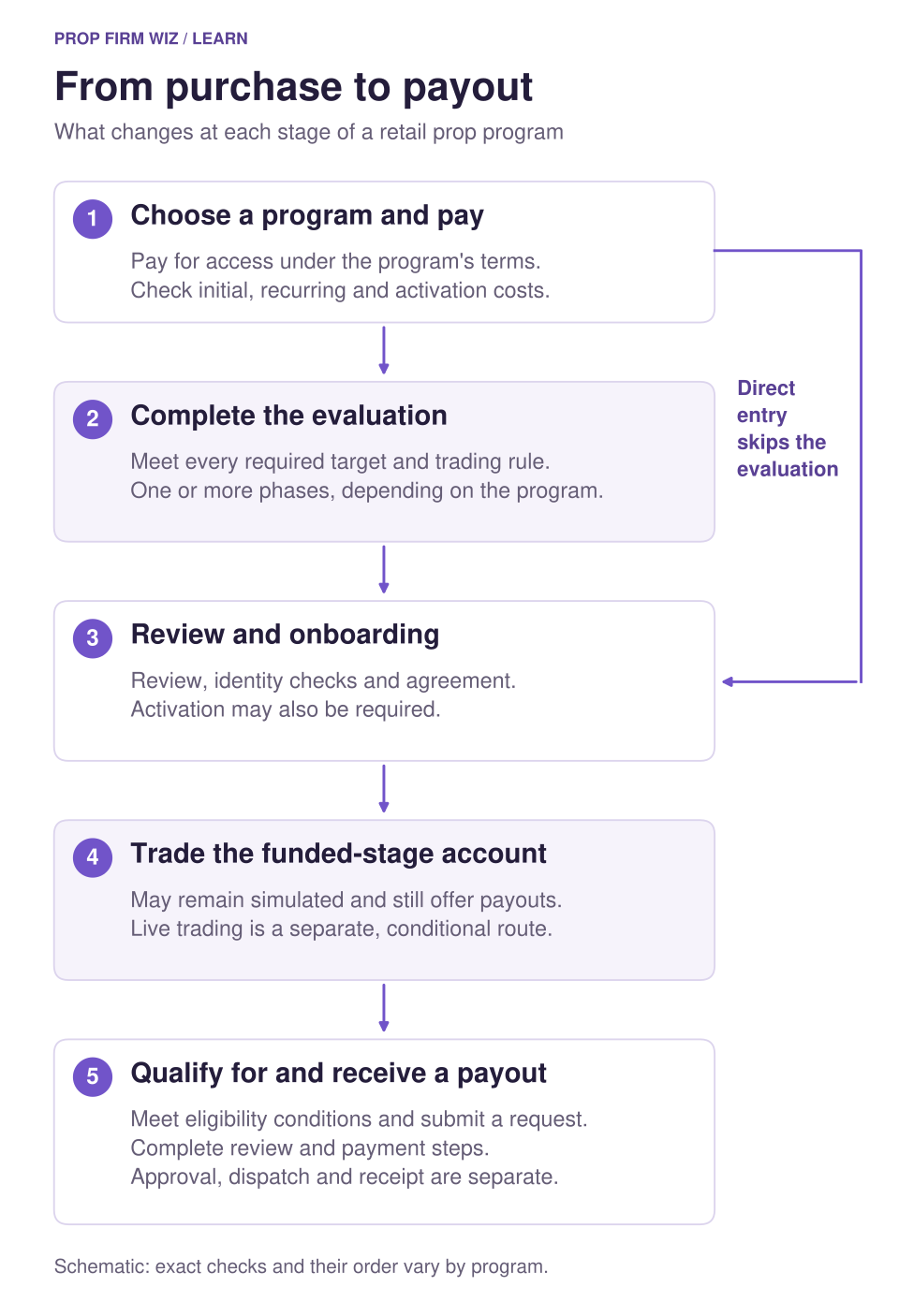
1. Choose the exact program and understand its costs
Before purchasing, identify the market, program, account size, platform, and any optional rule or payout path. Check that you are eligible to use it and that your intended instruments and trading methods are allowed.
If you are choosing between markets, compare CFD/FX and futures program mechanics before assuming that similar account labels describe the same trading setup.
Keep the applicable rules and checkout terms with your purchase record. A firm's general homepage may describe several products, while your account follows one specific configuration. Record recurring charges, cancellation instructions, possible activation or reset costs, and the condition for any fee reimbursement.
This is also the point to read the funded-stage rules. They determine what you are working toward, even though the immediate purchase may be an evaluation.
2. Complete every required evaluation phase
Reaching the profit target is one condition for passing. The account must also satisfy the other requirements that apply to that phase.
Depending on the program, those can include:
- Loss rules: overall max loss and, where present, daily loss or a daily pause. A temporary pause and a hard breach have different consequences.
- Activity rules: minimum trading days, qualifying days, or a deadline.
- Performance rules: requirements governing how profits are distributed, such as a limit on the contribution of the largest day.
- Trading restrictions: permitted instruments, position sizes, news or overnight activity, and prohibited practices.
Check whether each rule measures balance, equity including open positions, or closed trading results. Ending above a target does not prove that the account remained compliant along the way.
For the overall account limit, see how static, EOD, and intraday max-loss rules work. The daily-loss guide explains reset times, overnight positions, and the difference between a pause and a hard breach.
For a concrete two-phase structure, FTMO's CFD 2-Step lists a 10% profit target for the Challenge and 5% for Verification. Those are evaluation targets, not a payout schedule. The other objectives still apply.
3. Pass review and complete onboarding
A target shown on the trading platform is not the same as confirmation that the next account is ready. The firm may need to review the results and complete identity checks, an agreement, or activation steps.
In FTMO's CFD 2-Step process, reviewed Challenge results lead to Verification. After Verification is passed and reviewed, identity verification and the FTMO Account Agreement are required before an FTMO Account may be provided.
Follow the instructions for the exact transition rather than assuming that another trade is needed or that access is automatic. Check whether new credentials are issued, whether the balance starts afresh, and whether the rules change.
4. Trade the funded-stage account under its own rules
A funded-stage account may be simulated or live. The account label alone does not tell you whether your orders are being executed with live capital.
FTMO explains that traders on its CFD FTMO Accounts trade simulated capital and can receive real-money rewards when the applicable conditions are fulfilled. Real payment and simulated trading can therefore coexist.
Topstep's futures route makes a different distinction: the Trading Combine and Express Funded Account are simulated, while a later Live Funded Account is a separate stage reached through a call-up. An Express Funded Account can work toward payouts before that transition. Passing the Combine does not itself put the trader on a live account.
Use the evaluation-to-funded rule check to compare the new account's starting values, loss mechanics, and permissions. For example, FTMO's CFD Standard accounts have selected-news restrictions at the FTMO Account stage that do not apply during evaluation; Swing accounts are an exception. A method allowed during an evaluation can therefore face different conditions afterward.
5. Satisfy the payout conditions and follow the payment process
Funded-stage profit is the starting point for a payout assessment, not proof that every displayed dollar can be withdrawn immediately. Read the conditions for your first request and the amount you can request.
The program may require a waiting period, qualifying trading activity, a profit or consistency condition, completed verification, and compliance with request limits. Your share of eligible profit, any amount that must remain in the account, and payment charges affect the result.
After a request, separate review, approval, payment dispatch, and receipt. For example, FTMO's CFD reward process describes account review followed by approval, withdrawal information, and invoice-related payment steps. The fact that a request is allowed does not mean money has already reached your destination.
Also check whether you may keep trading while the request is pending and what would happen if the account's status changed. After payment, read the requirements for the next cycle and the effect of the withdrawal on the account before assuming the same conditions still apply.
The prop firm payout guide follows eligibility, requests, review, dispatch, and receipt through a worked timeline.
Worked example: which profits can become a payout?
Consider a hypothetical two-phase CFD-style program, with all amounts in US dollars. Each phase starts with a fresh $100,000 simulated balance. Phase 1 requires 10% net profit; Phase 2 requires 5%. The funded stage then also starts afresh at $100,000.
These target percentages are recognizable from the FTMO 2-Step example above, but this is a simplified model, not a statement of all FTMO terms. Assume all trading and activity requirements are satisfied, all shown profits are net of trading charges, positions are closed at each checkpoint, and no rule was breached between checkpoints. The model does not carry evaluation profits forward or pay a reward on them.
| Stage | Opening balance | Net trading profit | Closing balance | What that result establishes in this model |
|---|---|---|---|---|
| Phase 1 evaluation | $100,000 | +$10,000 | $110,000 | The 10% target is met; progression follows the required review |
| Phase 2 evaluation | $100,000 | +$5,000 | $105,000 | The 5% target is met; funded-stage access follows review and onboarding |
| Funded-stage trading | $100,000 | +$2,000 | $102,000 | There is funded-stage profit to assess against the payout rules |
The evaluation arithmetic is:
Phase 1 target = $100,000 × 10% = $10,000
Phase 2 target = $100,000 × 5% = $5,000
The trader has produced $15,000 across the two evaluations, but that is neither a cash payment nor a balance carried into the funded stage in this model. Each new stage starts again at $100,000.
Now assume the entire $2,000 funded-stage profit is eligible, the trader's share is 80%, all payout conditions and review are complete, and no cap or minimum limits this request. There are no separate payment or currency-conversion charges and no fee reimbursement in this example.
Payment to the trader = $2,000 × 80% = $1,600
Once dispatched and received, the trader has $1,600 in cash from this payout. That is distinct from both the account's advertised $100,000 size and the $15,000 of evaluation results. This illustration stops at receipt; it does not model the account balance or remaining loss allowance after withdrawal.
The 80% share answers only the split calculation under these assumptions. For the conditions and steps before money arrives, see payout eligibility, requests, and payment stages.
Do not assume every program resets to a displayed $100,000. Topstep's Express Funded Account starts at a zero balance, with the account tier representing buying power; Trading Combine profits do not transfer. Check the actual opening value and carryover terms of the account you will receive.
What happens if you fail a challenge?
Check both the account's funding eligibility and its billing status. They can change independently. A failed evaluation may require a reset or a new attempt before it can qualify, and continued platform access does not necessarily mean the attempt remains valid.
Topstep provides a concrete example. Under its Trading Combine subscription rules, breaking the maximum loss limit makes the account ineligible for funding until reset. Practice trading can continue, and the subscription continues to rebill unless it is canceled. Passing cancels that specific Combine subscription; it does not automatically cancel other active Combines.
Before paying for another attempt, identify the rule involved, whether the current account can be reset, the cost and effect of that reset, and whether a new billing period will start. A reset, a new purchase, and cancellation are separate actions.
The same care applies after reaching a funded stage: its agreement determines what a breach means for account access and any pending reward. Passing an evaluation does not remove the obligation to follow later rules.
What should you check before paying?
Start with four questions about the exact program's official rules and checkout terms. If an important answer is missing or contradictory, ask the firm a question that names the program, account stage, and option you intend to buy.
| Question | Essential details |
|---|---|
| What am I buying, and what can it cost? | Exact program and options, eligibility, evaluation or direct-entry route, fees, renewals, activation, resets, cancellation, and refund conditions |
| What completes or stops each stage? | Targets, loss limits, activity requirements, trading permissions, and the consequence of a breach |
| What account follows qualification? | Review and onboarding, simulated or live status, actual opening balance, treatment of evaluation profits, and rules that change at the funded stage |
| What must happen before and after a payout? | First-request conditions, eligible amount, trader's share, payment steps, and the effect on continued trading and later payouts |
Use the before-you-pay comparison worksheet to bring these answers together for two exact offers. Save the answers with their source links and the date you checked them. You should be able to explain each transition in one sentence: what you must complete, what happens next, and what remains conditional. That gives you a clearer basis for evaluating a program than its account-size headline alone.
Sources and method
Official sources were checked on 26 September 2026. Named examples describe the markets and programs identified in the text; they are not rankings or a complete account of every condition. The numerical journey is hypothetical, and its assumptions are stated before the calculation. Account-specific terms can differ or change.
- FTMO, CFD programs: 2-Step structure, fees, after passing, news restrictions, and rewards.
- Topstep, futures programs: program stages, Trading Combine subscriptions, and Express Funded Account activation.
- Tradeify, futures Lightning Funded: direct-entry account overview.