ResearchRule history
Did These Changes Apply to Existing Accounts? Ten PFW Records From October 2026
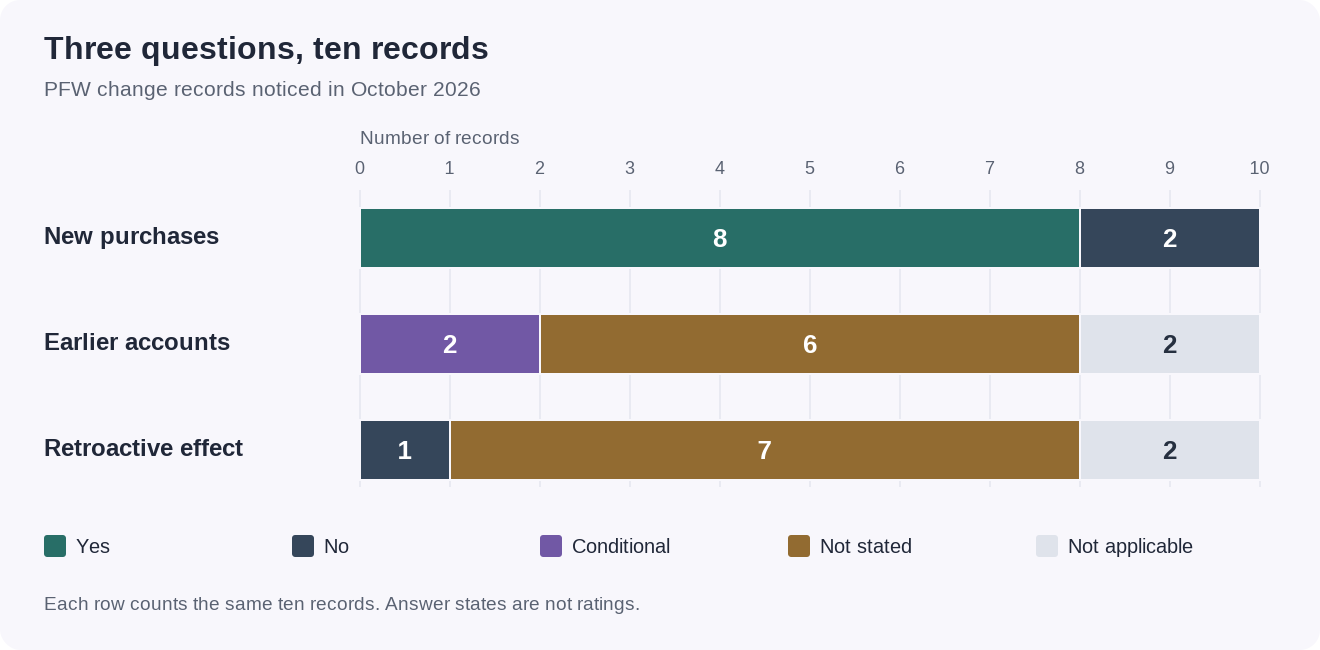
In PFW's ten-record October snapshot, the treatment of earlier accounts was conditional in two records and not stated in six. The other two records concerned new programs, so earlier-account treatment was not applicable. A clear change to the offer for a new buyer often left a separate question for someone who had already paid.
- Data
- PFW’s change records of firm changes noticed 1–31 October 2026.
The figures describe those records as they stood at site revision 7d55eb8 and stay as published; a later edit to a record, shown in its history, does not change them.
- Supporting data
- Applicability of the ten October change records (CSV, 19 KB)
On this page
These findings describe the changes PFW recorded, not every change made by prop firms during October. They count what the archived records establish about applicability, not what happened to individual traders. Every record is linked below, and the accompanying CSV preserves all 30 answers across the three questions.
What are the three separate questions?
The same change can have different answers for a new purchase, an account already in use, and activity that happened before the change. PFW records those questions separately:
- New purchases: does the newly observed offer or rule apply when buying now? For a withdrawal, "No" means that the product can no longer be bought.
- Accounts bought earlier: what does the evidence say about accounts purchased before the change? The answer may depend on a later event, such as activation or merging.
- Retroactive effect: does the evidence say that the change reaches earlier activity or transactions? That is a separate question from which rule governs an older account's next action.
Not stated is short for the records' label "Not stated in the sources we reviewed." It is neither permission nor a finding that the change applies. Conditional means the explanation matters: the word alone does not identify which account receives which treatment. Not applicable describes the two new-program records, not missing research about existing accounts. The records' sixth state, Sources conflict, does not occur in this set.
Keeping these answers separate prevents two opposite mistakes: assuming every older account keeps its original terms, or assuming that a new page rewrites every older account's history.
What did the ten records say?
The set contains six rule or price changes, two program launches, and two programs withdrawn from sale. Each record contributes once to each question, regardless of how many sizes or rule rows it covers.
| Recorded question | Yes | No | Conditional | Not stated | Not applicable |
|---|---|---|---|---|---|
| New purchases | 8 | 2 | 0 | 0 | 0 |
| Accounts bought earlier | 0 | 0 | 2 | 6 | 2 |
| Retroactive effect | 0 | 1 | 0 | 7 | 2 |
All ten records give a definite answer about availability or applicability for new purchases. That does not carry across to earlier buyers. Among the eight records concerning existing products, two give conditional earlier-account treatment and six leave it unstated. The two withdrawals belong in that eight: a product leaving the shop does not settle what happens to accounts already sold.
For retroactive effect, Propr is the one recorded "No." Seven records leave that question unstated; the two launches are not applicable. There is no recorded "Yes," but those seven unstated answers cannot be converted into seven additional "No" answers.
The complete record register makes the conditional and unstated results traceable. Dates in the first column are when PFW noticed the change, not necessarily when it took effect.
| Record and PFW observation date | New purchases | Earlier accounts | Retroactive effect |
|---|---|---|---|
| 7 Oct: FundedNext Legacy withdrawn from sale | No | Not stated | Not stated |
| 7 Oct: FundedNext Direct added | Yes | Not applicable | Not applicable |
| 12 Oct: FTMO Instant added | Yes | Not applicable | Not applicable |
| 13 Oct: FTMO 1-Step Consistency replaces the Best Day Rule | Yes | Conditional | Not stated |
| 15 Oct: FundedNext Flex prices and reset fees raised | Yes | Not stated | Not stated |
| 20 Oct: FundingPips smaller 2 Step accounts repriced | Yes | Not stated | Not stated |
| 20 Oct: The5ers futures payout cap changed | Yes | Not stated | Not stated |
| 23 Oct: Propr rulebook adds restrictions and an evaluation cap | Yes | Conditional | No |
| 31 Oct: E8 Signature Classic Markets withdrawn from sale | No | Not stated | Not stated |
| 31 Oct: FundingPips On Demand replaces Monthly | Yes | Not stated | Not stated |
Why were FTMO and Propr conditional?
The two conditional records identify different events and leave different questions open. Combining them into a general "older accounts are protected" category would discard the information a trader needs.
FTMO: order creation and a later merger. In the 1-Step record, accounts directly initiated from orders created before 12 October 2026 keep the Legacy Best Day Rule. Orders created on or after that date use Consistency. An account merged on or after that date also follows Consistency, so an earlier order date alone does not settle the rule after a merger.
The earlier-account answer is therefore conditional. The retroactivity answer remains "Not stated" because the reviewed pages do not say whether trading days before that merger count under Consistency. Knowing the rule after the merge is not the same as knowing how the earlier history is assessed.
Propr: activation and account stage. The Propr record quotes Propr's rule tying active funded accounts to the rules in force at activation, with the qualification "unless otherwise stated." It also records that the rulebook says nothing about evaluations bought earlier. The funded-account statement cannot simply be extended to those evaluations.
Separately, the record gives retroactive effect as "No," based on the changelog's general statement that rules are never changed retroactively. The changelog has no entry for this change itself, and Propr gives no effective date. That explicit answer coexists with conditional earlier-account treatment. The missing evaluation treatment and the stated position on retroactivity remain separate findings.
What remained unstated for earlier buyers?
The six unstated earlier-account answers are not all the same kind of gap. They concern a later reset, a price already paid, future payouts, an existing reward cycle, or a product withdrawn from new sales.
A later reset on a previously bought account. The FundedNext Flex record documents both higher purchase prices and higher reset fees. It leaves unstated which reset fee applies when an account bought before the change is reset afterward. That is the earlier-account question. Whether the new fee reaches a reset already paid for is the separate retroactivity question, also unstated.
A lower one-time purchase price. The FundingPips price record covers lower list prices for the $5,000, $10,000 and $25,000 Standard, Flex and Pro 2 Step accounts. It records a fee paid once at purchase and no stated earlier-buyer policy. It does not establish a reset-price change or a refund of the difference for earlier purchases. Treating both price records as the same reset-fee question would add a claim that the FundingPips record does not contain.
Future payouts on an older account. The The5ers record leaves unstated whether previously bought $25,000 futures accounts keep their earlier payout cap. The retroactivity entry asks a different question: whether the new cap applies to payouts made before the change. The FAQ's single cap "across all accounts" answers neither question in this record.
An existing reward-cycle choice. The FundingPips On Demand record concerns 2 Step Standard, 2 Step Pro and 1 Step Flex. It records that the reward cycle is chosen at Master Account setup and cannot be changed later, while leaving treatment of accounts already on Monthly unstated. The replacement in the published choices does not itself establish a migration for those existing Monthly accounts. The record separately leaves the treatment of earlier reward requests unstated.
A program leaving the shop. The FundedNext Legacy and E8 Signature Classic Markets records establish that those products were no longer offered to new buyers. Neither establishes closure or changed rules for accounts already bought. Help pages still describing those products are part of the recorded evidence, not a complete earlier-account policy.
The two launches were treated differently for a reason. FundedNext Direct and FTMO Instant were new programs in their records, with no earlier activity of those new products to reassess. Neither launch record establishes migration from another program. In particular, observing Direct and the withdrawal of Legacy on the same day does not establish that one replaced the other for existing customers.
What do the dates and observation coverage leave out?
Only one of the ten records supplies an established effective date: FTMO's 1-Step change, dated 12 October 2026 and noticed by PFW on 13 October. That one-day difference shows why the observation date cannot stand in for the effective date. The separate FTMO Instant record has an announcement dated 12 October but leaves its effective date unestablished.
The Flex record illustrates a second distinction. PFW last read the old purchase prices on 12 October and first read the new ones on 15 October. Its last reading of the old reset fees was earlier, on 9 October. The 12 October order-page readings had captured prices, not reset fees. A record covering several fields can therefore contain different evidence windows. Neither interval establishes the firm's effective date.
Page-update labels also remain page-update labels. The The5ers FAQ carried a 16 October update date, while PFW first found the new payout-cap wording on 20 October. The record leaves the effective date unestablished. It does not turn either date into the day earlier accounts changed treatment.
Coverage limits the meaning of the count. On 1 October, PFW reviewed three firms: FTMO, The5ers and FundedNext. Eleven more were added during the month: FundingPips on 12 October, Topstep on 13 October, Alpha Capital Group on 15 October, Lucid Trading, Propr and E8 Markets' crypto/perps programs on 16 October, E8 Markets' CFD/FX and futures programs and Tradeify on 18 October, My Funded Futures and Apex Trader Funding on 21 October, and Vest Markets and Breakout on 31 October. Three of the six firms in these records, FundingPips, Propr and E8 Markets, were among those added, so PFW observed them for only part of the month.
The way changes were noticed also changed. PFW's page watcher, which reads the official pages its releases cite, began daily runs on 15 October. The four records noticed before then came from PFW's own readings, and so did the later Propr, E8 Markets and FundingPips On Demand records; the watcher cannot open E8 Markets' site or FundingPips' help center.
The ten-record set therefore cannot measure every firm's change frequency, the industry-wide share of changes affecting earlier buyers, or whether one firm honored its stated policy in practice. It measures the recorded evidence available for these selected changes.
How should you use these findings?
Start with the record for the exact product and market, then read the answer to the question your next action raises. A reset on an old evaluation, a payout on an existing funded account, and a merger can each turn on different conditions. Read the explanatory text behind "Conditional" or "Not stated" before deciding that a date or account label settles it.
For the practical task of keeping an order confirmation and asking about a particular purchase, use The Purchase Record You'll Want If the Rules Later Change. For the difference between a page date and the event that assigns your rule, see Does the newest page apply to an older account?.
Use the Changes archive for later records and each linked record's history for subsequent edits. The counts here describe this study's snapshot; a later clarification can improve an individual record without silently changing this edition's results.
Sources and method
This study counts PFW's October change records as they stood on 4 November 2026, at the site revision named under the lead. Selection includes every final record classified as a firm change and noticed by PFW from 1 through 31 October 2026, inclusive. The ten selected records are PFW-CH-0001 through PFW-CH-0010, with actual observation dates from 7 through 31 October. They cover six firms across CFD/FX, futures and crypto/perps.
PFW-CH-0011 is excluded because it is a PFW correction, not a firm change. PFW-CH-0012 was first noticed on 2 November and falls outside the observation window. Publication dates do not determine inclusion.
For each selected record, we counted its stored answer to each of the three applicability questions without reclassifying the answer. Each question therefore has ten observations. The eight-record existing-product subtotal excludes only the two launches and keeps the two withdrawals. Effective and announcement dates are counted once per record, not once per answer. No percentages, account-weighted totals or firm scores are calculated.
The accompanying 30-row applicability CSV preserves the answer states, explanatory text, linked source identifiers, source URLs and reading dates. Its rows give the records' own wording, unchanged. Each of the ten record pages linked in the register lists its sources and readings, which span 3 through 31 October 2026.
The findings concern what those archived records state. They do not establish legal rights, observed account enforcement, or the contents of pages that PFW did not review. Later source wording and later record edits are not substituted into this frozen dataset.