LearnRisk essentials
Prop Firm Leverage and Margin: What Limits Your Position?
For the same position, higher leverage can reduce the required margin without changing the loss from a given price move or the account's loss limits. The distinction matters because an order that the platform accepts can still expose a prop account to more loss than its rules allow.
On this page
Check three questions separately: can the position open, how much does its value change when the market moves, and how close would that leave the account to a loss-rule breach?
This guide focuses on CFD/FX margin mechanics, with a separate futures section. The worked accounts are hypothetical. Official sources were checked on 10 October 2026.
What does leverage change?
Leverage expresses a relationship between exposure and the margin needed to support it. In a simple model where required margin equals account-currency notional divided by leverage, a 1:50 setting requires one unit of margin for every 50 units of exposure. At 1:100, the same exposure requires half as much margin.
That formula applies only when the instrument uses that calculation method. MetaTrader 5 supports several methods, including ones that use contract-specific margin amounts, as well as currency conversion and additional margin rates. An account's headline leverage does not supply every symbol's calculation. MetaTrader 5: margin calculation.
Position size answers a different question. If you keep the instrument, quantity, entry price and subsequent price move unchanged, changing the margin requirement does not make the position's profit or loss larger. Increasing the quantity does.
For example, the hypothetical position below starts with $50,000 of notional exposure on a $100,000 account. Its initial exposure-to-equity ratio is 0.5 times, under either leverage setting. Selecting 1:100 does not mean the trader has automatically opened exposure equal to 100 times the account's equity.
The advertised account size also does not tell you how much the account may lose. For that distinction, see account size and opening loss allowance.
Required margin, free margin and loss buffer
These quantities can all appear in dollars while measuring different things.
| Quantity | What it measures | What it does not establish |
|---|---|---|
| Required or used margin | The amount reserved to support positions and, where applicable, pending orders | The position's maximum possible loss |
| Free margin | Under the applicable platform calculation, equity available after margin requirements | The loss the prop firm permits |
| Remaining loss buffer | Distance from the rule's monitored account value to its current breach threshold | Money reserved for opening another position |
MetaTrader 5 describes free margin as equity minus margin and margin level as equity divided by margin, multiplied by 100. Its documentation also notes that trading conditions can affect how floating results enter the free-margin calculation. Use the values and settings for the actual account. MetaTrader 5: account state.
Reserving margin is not, by itself, a trading loss or a fee deducted from equity. Opening a real position may nevertheless change equity through the spread and charges. Separate those effects from the margin reservation.
For the simplified account used here:
- Free margin = equity − used margin.
- Remaining overall buffer = equity − current max-loss equity threshold.
The second formula assumes that the rule monitors equity. A balance-based rule, daily limit or moving threshold needs its own calculation. See overall max-loss models and daily-loss limits.
If the platform includes a separate trading-account credit, reconcile it when calculating equity and confirm whether the firm recognizes it for its loss rules. Credit is not automatically balance, realized profit or withdrawable cash. Balance versus equity explains the accounting in more detail. The example below has no credit.
The same position under two leverage settings
Consider a hypothetical USD account with a $100,000 balance and equity. Its static overall max-loss threshold is $90,000, monitored continuously using equity. Touching or falling below that threshold breaches the account. There is no separate daily rule in this example.
The invented linear instrument is priced at $100 per unit. Buying 500 units creates $50,000 of initial notional exposure. Each $1 price change produces a $500 change in the position's value. This specification is not taken from a named firm or symbol.
Compare the same position at 1:50 and 1:100. There are no other positions, pending orders, spread, commissions, financing, slippage, credit, withdrawals or adjustments. The comparison shows margin at entry; it does not model a margin stop-out.
| Quantity | Leverage 1:50 | Leverage 1:100 |
|---|---|---|
| Initial notional exposure | $50,000 | $50,000 |
| Initial required margin | $1,000 | $500 |
| Equity immediately after opening | $100,000 | $100,000 |
| Initial free margin | $99,000 | $99,500 |
| Floating P&L after a 1% adverse move | −$500 | −$500 |
| Equity after that move | $99,500 | $99,500 |
| Remaining overall loss buffer | $9,500 | $9,500 |
The margin calculations are $50,000 ÷ 50 = $1,000 and $50,000 ÷ 100 = $500. The market then falls from $100 to $99. In both accounts, the position loses 500 units × $1 = $500. Equity becomes $99,500, leaving $99,500 − $90,000 = $9,500 above the max-loss threshold.
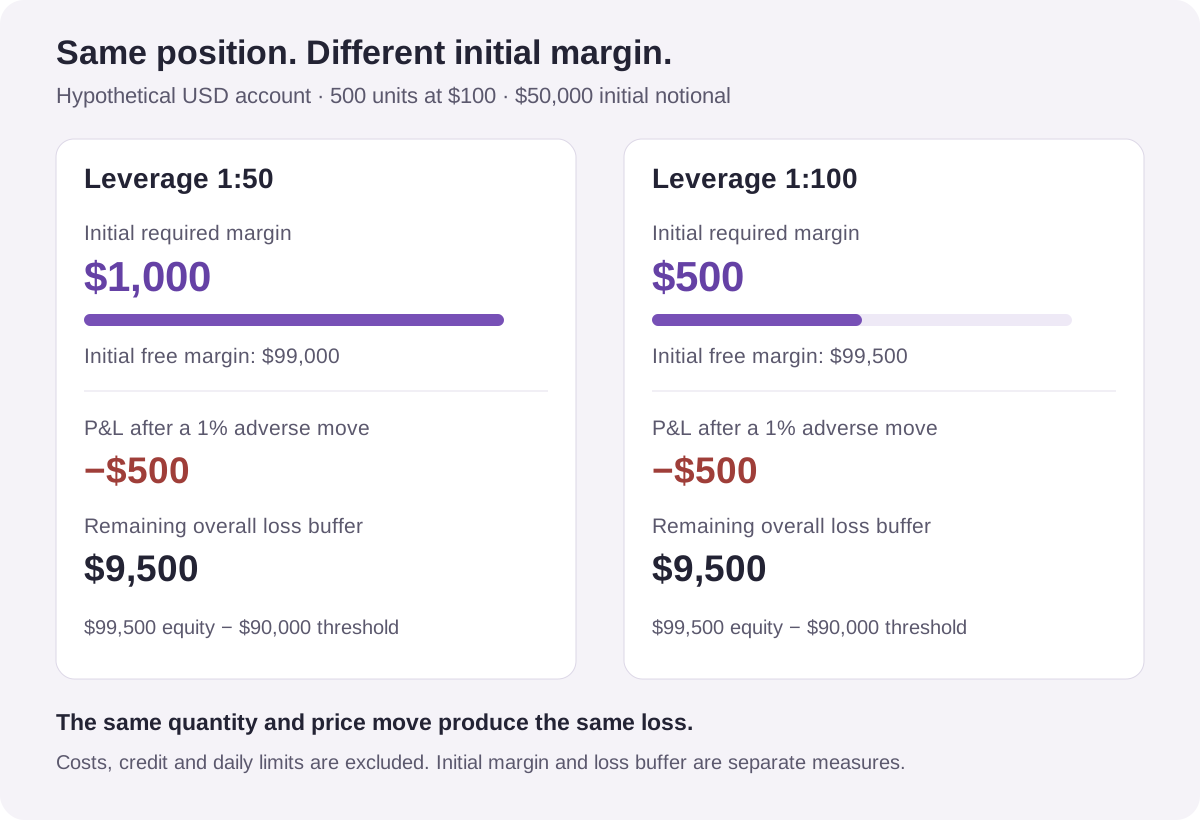
Only initial margin and free margin are shown in the first table. After a price move, current margin can depend on the instrument's calculation method, conversion rates and settings. That table does not assume that margin stays fixed throughout a trade.
Closing the position at $99 realizes the $500 loss. With the assumed absence of costs, balance and equity would both be $99,500. Releasing the position's margin does not return the lost $500 or rebuild the loss buffer.
Spread, slippage and commission would change these figures. The separate spread, slippage and commission example follows a trade from its quotes to the net account result and explains how execution can change the remaining loss buffer.
What if you keep margin constant instead?
That is a different comparison because the position size changes. Under the same simple entry-margin formula, using $1,000 of margin supports $50,000 of initial notional at 1:50 or $100,000 at 1:100.
| Same $1,000 of entry margin | Leverage 1:50 | Leverage 1:100 |
|---|---|---|
| Initial notional exposure | $50,000 | $100,000 |
| Units at the hypothetical $100 entry price | 500 | 1,000 |
| P&L after the same 1% adverse move | −$500 | −$1,000 |
| Equity after that move | $99,500 | $99,000 |
| Remaining overall loss buffer | $9,500 | $9,000 |
Here the larger loss comes from doubling the position. The account's $90,000 threshold has not changed. More available exposure is not an increase in permitted loss, and neither table is a suggested trade size.
How far can the price fall before the threshold?
Follow each hypothetical position from its $100 entry price to the first touch of the $90,000 equity threshold.
This table holds margin at its entry amount; on a real platform, current margin can change with price, conversion and settings.
| Position | Breach price | Price move to breach | Margin reserved at entry | Free margin at breach, with margin held at its entry amount |
|---|---|---|---|---|
| 500 units at 1:50 | $80 | 20% | $1,000 | $89,000 |
| 500 units at 1:100 | $80 | 20% | $500 | $89,500 |
| 1,000 units at 1:100 (the same $1,000 of entry margin) | $90 | 10% | $1,000 | $89,000 |
Follow each position down to the loss threshold
Same $50,000 position: 500 units at 1:50, with $1,000 of margin reserved at entry.
- Price
- $100
- Floating P&L
- $0
- Equity
- $100,000
- Remaining overall buffer
- $10,000
- Margin reserved at entry
- $1,000
- Free margin, with margin held at entry
- $99,000
Above the threshold
Each price is a checkpoint on a hypothetical path, not a trade or a stop-loss suggestion. Moving the price back up selects an earlier checkpoint; it does not revive a breached account. On a real platform, current margin can change with price, conversion and settings.
Leverage alone does not move the breach price: both 500-unit positions reach the threshold at $80 because each $1 fall costs $500 against a $10,000 opening buffer. Doubling the position to 1,000 units reaches it at $90, after half the price move. Equity is $90,000 in every row, and at least $89,000 of free margin remains even though the loss rule is already breached. Each path ends at that breach; the account does not continue past it. These prices are not stop-loss suggestions.
Why the symbol specification matters
A lot is a platform quantity whose underlying size depends on the instrument. Before comparing two accounts, identify the exact symbol and how its quantity translates into exposure and price sensitivity.
On MetaTrader 5, the symbol specification includes contract size, margin and profit currencies, calculation method, tick size and value, and volume restrictions. In Market Watch, open the symbol's context menu and select Specification. MetaTrader 5: symbol specifications.
Check four details in particular:
- Contract size and quantity: how many underlying units does the selected volume represent?
- Price sensitivity: what does a point, tick or pip change mean in account currency?
- Margin method: does the symbol use leverage, a specified margin amount or another calculation?
- Conversion and adjustments: do currency conversion, tiered margin rates or existing orders change the result?
Program names matter too. Funded Trading Plus publishes leverage by both program and instrument group. Its leverage page distinguishes 2-Step Classic from 1-Step Express and Instant, with separate entries for FX, metals, indices, energy and cryptocurrency. That is a reason to check the applicable combination, rather than apply a headline maximum to every market. The page alone does not establish a complete stage, platform or purchase-cohort matrix for a particular account. Funded Trading Plus: leverage.
If two official pages give incompatible settings for your exact account, preserve that uncertainty and seek a scoped answer. Do not resolve it by choosing the higher leverage. See how to handle conflicting prop-firm rules.
Order rejection, margin stop-out and prop-rule breach
These events have different tests and consequences.
| Event | What is being checked? | What the result means |
|---|---|---|
| Order rejected for insufficient margin | Available capacity for the proposed order under the platform's settings | The requested order cannot open as submitted |
| Platform margin stop-out | The account's configured liquidation condition | The server closes positions according to its rules |
| Prop-rule breach | The firm's applicable daily or overall loss condition | The consequence specified by that program, potentially account termination |
| Firm risk review | The firm's stated review conditions and trading behavior | An assessment, whose trigger is not itself the final decision |
MetaTrader 5 documents server checks before execution, including rejection when funds are insufficient. Its trading documentation separately describes server-side stop-out closures. Neither behavior establishes a prop firm's contractual loss allowance. Order checks and stop-out processing.
Where a platform uses a percentage margin level, its denominator is used margin. A prop firm's equity threshold has a different basis. A positive free-margin figure therefore does not prove that the account remains above its loss threshold. If the hypothetical account reaches $90,000 equity, its stated max-loss rule is breached even if margin remains available. In the price path, each position still shows at least $89,000 of free margin at that point, with margin held at its entry amount.
An accepted order also does not certify compliance with every strategy or risk policy. Funded Trading Plus's Risk Review Policy describes automated margin-utilization triggers for a manual review at three milestones: evaluation passes, scaling requests and withdrawal requests from simulated-live accounts. The policy says high utilization is not necessarily an issue, and that red-flag factors, even combined, do not automatically fail the review. A review trigger is neither a universal prohibition nor a guaranteed safe boundary below it. Funded Trading Plus: Risk Review Policy.
Unlike a loss threshold, a margin-utilization trigger depends on the margin calculation, so the leverage applied matters here. The policy's manual forex example calculates margin at 1:30, while the firm's leverage page lists 1:50 for forex on its 2-Step Classic program. Applying those two figures to the same position, with the same utilization denominator, would give different utilization. The pages do not resolve which calculation applies to that exact account. Raise the difference with the firm, as described under symbol specifications. Risk Review Policy and FT+ Leverage were rechecked on 11 October 2026.
What changes for futures accounts?
Futures margin has an exchange and clearing context. CME describes performance bonds as deposits supporting obligations, with requirements varying by product and volatility. Initial margin concerns opening a position; maintenance margin concerns the amount maintained afterward. CME Group: performance bonds and margins.
That explanation does not tell you how a simulated prop account sets its buying power, or whether the participant posts any margin of their own. Check the program's contract cap, micro/mini counting, position-size progression, loss rules and any separate platform restrictions. For the broader distinction, see CFD/FX versus futures prop accounts.
Contract count and price sensitivity remain separate. For a linear futures position, a specified move's gross P&L is the number of contracts × the number of ticks moved × the value per tick, with the sign determined by the position's direction. Use the actual contract specification and include charges when estimating the account effect. The margin supporting a contract is not the most that contract can lose.
Use the futures contract-limits guide for counting rules and progression. Increasing the permitted contract count does not, by itself, increase the account's remaining loss buffer.
A margin-and-exposure record for the exact account
Before relying on a familiar lot or contract size, complete this short record. Use the platform specification for mechanics and the applicable program rules for account conditions.
| Record | Include |
|---|---|
| Account | Firm, market, program, stage, size, platform and relevant purchase cohort |
| Position | Exact symbol, direction, quantity, contract size and account currency |
| Entry requirement | Applicable margin method, conversion, existing positions/orders and resulting free margin |
| Market effect | Account-currency P&L for a stated adverse move, plus material trading costs |
| Loss conditions | Current daily and overall thresholds, monitored values and equality treatment |
| Other controls | Volume caps, stop-out settings, firm risk-review conditions and unresolved restrictions |
| Evidence | Source links, applicable dates and the date checked |
Calculate the proposed trade's effect alongside existing positions. A margin check can accept several positions that lose together; margin availability alone does not assess their combined downside.
For a worked quantity calculation, position sizing from stop distance and remaining loss room combines the proposed trade's costs with further losses on existing positions, then checks the account after the modeled exits.
If the resulting account state is unclear, resolve the missing specification or rule before treating the size as usable. The program comparison checklist gives the wider before-you-pay checks.
Related reading
- Account size and opening loss allowance, for the difference between the advertised tier and permitted losses.
- Balance versus equity, for floating results, account credit and charges.
- Static, EOD and intraday max-loss rules, for the threshold behind the remaining buffer.
- Futures contract limits, for position caps and micro/mini counting.
Sources and method
Official documentation was checked on 10 October 2026, with the two Funded Trading Plus pages rechecked on 11 October 2026 for the margin-utilization discussion. Platform documentation supports mechanics; firm help pages support only the policy scope described beside each link. No named firm is assigned the hypothetical account, instrument or loss rule.
The numerical comparisons are original calculations. The first holds quantity and the market move constant; the second holds entry margin constant while quantity changes. The third follows the 500-unit and 1,000-unit positions down to the $90,000 threshold, holds margin at its entry amount and stops each path at the breach. All start with $100,000 equity and a fixed $90,000 overall threshold. They exclude costs and other account activity to isolate these relationships. Current firm leverage values are not used as inputs, and no result estimates pass probability or recommends a position size.
- MetaTrader 5: Margin Calculation for Retail Forex, Futures, for calculation modes, conversion and margin adjustments.
- MetaTrader 5: Executing Trades, for account-state fields and stop-out processing.
- MetaTrader 5: Market Watch, for symbol specifications and volume settings.
- MetaTrader 5: Basic Principles, for order processing and checks.
- Funded Trading Plus: FT+ Leverage, for program and instrument-group distinctions and the forex figure that differs from the Risk Review Policy's calculation.
- Funded Trading Plus: Risk Review Policy, for the distinction between a review trigger and its outcome.
- CME Group: Performance Bonds/Margins FAQ, for exchange and clearing margin context.