LearnFees and costs
Why Can a Limit Order Pay a Taker Fee?
A limit order can pay a taker fee when it executes against an order already available at its limit price or better. The limit controls the price you will accept. Under a maker/taker model, the execution's role determines the rate: taking existing liquidity or supplying an order that another trader later matches. One order can do both through different fills.
On this page
This distinction matters when reading perpetual prop-account fees. E8 describes its crypto rates using market and limit orders as shorthand for taker and maker. Propr says it replicates Hyperliquid's rates. Neither description makes an order button a complete fee calculation. You still need the applicable platform rules, filled quantity, execution price and eventual exit. E8's fee explanation and Propr's terminal FAQ provide the starting schedules.
What does the Trading fees row measure?
Trading fees are execution charges: the cost of opening, increasing, reducing or closing a position. PFW's Trading fees row describes the charged unit, the rate and the amount to which that rate applies. These charges are separate from the price paid to obtain the prop account.
For a fill charged on its notional value, calculate:
Fill notional = filled quantity × execution price
Trading fee = fill notional × fee percentage ÷ 100
For example, 0.1 BTC filled at $100,000 has $10,000 of notional. A 0.045% charge on that fill is $4.50. Applying the percentage to the margin used would give the wrong base. Holding the quantity and fill price fixed, changing leverage alone does not change this notional-based fee. My Funded Perps' commission guide explicitly makes that distinction.
The word maker describes a resting order that supplies liquidity when it is matched. Taker describes the incoming execution that consumes available liquidity. A lower maker rate is common, but the account's fee schedule decides whether the distinction changes the charge.
| Firm | Charged unit and rate basis | What the distinction changes |
|---|---|---|
| E8 One and E8 Pro on E8 Terminal | E8 describes a percentage of position notional. For crypto, it lists 0.015% maker and 0.045% taker. | Its market/limit shorthand does not separately explain a limit order that is immediately marketable. Ask E8 how that execution is classified. E8 source. |
| Propr | Its rulebook passes through Hyperliquid's maker/taker fees without markup; the terminal FAQ lists 0.015% maker and 0.045% taker for crypto. Check the asset-specific schedule for other markets. | Its terminal FAQ says a limit order in the simulation triggers when the market reaches its price, then fills "using the same walk the book mechanism as market orders". It does not say whether that fill pays the maker or the taker rate. Rulebook and terminal FAQ. |
| Vest Markets | Fees are calculated per fill. The maker/taker schedule depends on the market. | Count each execution, including a partial fill, rather than treating the submitted order as one indivisible event. Order Types and Markets. |
| Breakout | Its evaluation and funded-account FAQs apply a fee to each buy or sell order, with different crypto and non-crypto rates and no separate maker/taker rates. This applies to 1-Step Classic, Turbo and Pro. | That schedule does not offer a lower crypto rate for a limit order. It does not specify partial-fill accounting; do not silently replace "order" with "fill." Evaluation fees and funded-account fees. |
| My Funded Perps | Commission is charged on each fill's notional. Within the applicable asset class and account configuration, maker and taker use the same rate. | Choosing a limit order does not reduce the commission rate. Check the configuration, including any Reduced Fees add-on, separately. Commissions and Fees. |
| HyroTrader | The rate depends on the platform. Its Bybit demo route uses Bybit's VIP 0 USDT maker/taker schedule. On BloFin, the fees are whatever the trader's own BloFin demo account applies. The Hyro platform uses simulated fees, but its execution FAQ does not publish their numerical rates. | Do not apply the Bybit schedule to the Hyro platform merely because it uses Bybit market data. Bybit fees, execution environments and relaunch explanation. |
Check the applicable account row and linked official schedule for current rates. Read the unit as carefully as the percentage. A rate per side requires another calculation when you close; a position closed in several executions may need several fee entries. If the firm describes an order-level charge without explaining partial fills or rounding, its own fill history or support needs to settle that implementation detail.
How can one limit order have two fee rates?
Suppose you submit a buy limit at a price already offered by a seller. Your instruction permits an immediate match at that price. It does not require the order to wait. If only part can match, an eligible remainder can stay on the book and fill later against a new incoming order.
Coinbase Exchange explicitly documents this split for its own venue: the immediately matched portion incurs the taker fee; the remainder incurs the maker fee if it later fills from the book. That is evidence for the convention, not a claim that Coinbase sets the fees on a prop account. Coinbase Exchange fees.
My Funded Perps' commission guide uses the same definition for its own fills: a limit order that crosses the spread is a taker fill. It then charges maker and taker fills the same rate, so there the classification does not change the fee.
Hyperliquid's documentation supplies the related mechanics in separate places. Its order-types page describes resting GTC orders and post-only ALO orders. Its Chase FAQ identifies resting post-only fills as maker fills, while its self-trade page distinguishes an incoming aggressor from the resting maker. Order types, Chase FAQ and self-trade prevention.
Applying the immediate/resting split to a mixed Hyperliquid fill is our interpretation of those mechanics and its maker/taker schedule. Those pages do not state the mixed-fee example as explicitly as Coinbase does. E8's wording does not settle the marketable-limit case. Propr's simulation fills a triggered limit order by walking the book, as it does a market order, and does not say which rate that fill pays. The example below is therefore a calculation under that interpretation, not a verified fee trace from either prop terminal.
For the broader account differences behind the schedules, see the E8 Markets and Propr comparison.
What does a $25,000 entry cost to open and close?
For this hypothetical BTC trade, express notionals in US dollars and apply Hyperliquid's published Tier 0 base perpetual rates: 0.045% taker and 0.015% maker. These are the base columns, with no tier, staking, referral or other discount and no additional charge. Other markets and account arrangements need their own schedule. Hyperliquid Fees.
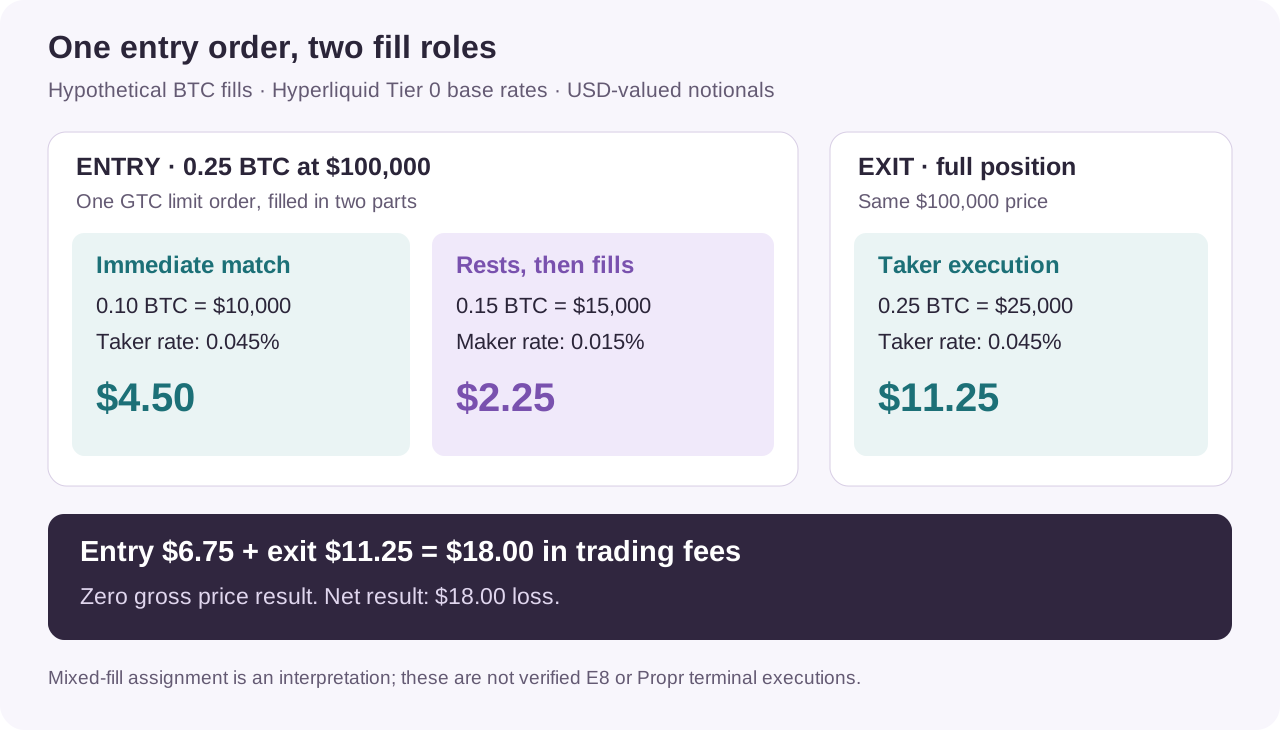
You submit a GTC limit buy for 0.25 BTC at $100,000. Assume 0.10 BTC matches immediately, then the remaining 0.15 BTC rests and later fills at the same price. You subsequently close all 0.25 BTC as a taker at $100,000. Each stated fill has sufficient opposing liquidity. There is no price movement, slippage, financing posting or other account activity, and sufficient loss room to complete the trade.
| Execution | Filled notional | Rate applied | Calculation | Fee |
|---|---|---|---|---|
| Immediate part of the entry | $10,000 | 0.045% taker | $10,000 × 0.00045 | $4.50 |
| Resting part, filled later | $15,000 | 0.015% maker | $15,000 × 0.00015 | $2.25 |
| Exit of the full position | $25,000 | 0.045% taker | $25,000 × 0.00045 | $11.25 |
| Total | $50,000 traded across entry and exit | Mixed | $4.50 + $2.25 + $11.25 | $18.00 |
The entry costs $6.75. The later taker exit adds $11.25. Although the gross price result is zero, the completed trade has an $18 loss after trading fees. The $50,000 total in the table is cumulative turnover, not a $50,000 position held at once. If the exit price or quantity changes, use that exit's actual notional.
Can post-only prevent a taker fill?
On Hyperliquid, post-only ALO allows execution only as a resting order. It prevents the immediate-taking part of the example, but it cannot make someone trade against the order. The order may remain unfilled. GTC by itself does not provide that post-only condition. Hyperliquid order options.
Vest gives a useful second illustration. Its documentation says a marketable limit can execute immediately, a partially filled GTC order can leave the remainder resting, and fees are calculated per fill. It also offers ALO as the post-only choice. In that setting, "limit" and "post-only limit" are different instructions. Vest Order Types.
| Outcome | What exists afterward? | Execution-fee consequence |
|---|---|---|
| GTC limit partly matches immediately; the remainder later fills | The completed position includes both immediate and resting executions. | Apply the applicable role and rate to each fill. |
| IOC takes the available quantity and cancels the rest | Only the filled quantity becomes a position. | Calculate fees and any later exit on that quantity, not the original requested size. |
| Post-only order rests, never fills, then you cancel it | No position was opened by that order. | No execution fee arises from a fill that never occurred. There is no resulting position to close. |
The last row is a separate hypothetical outcome. It is not a cheaper version of the completed trade: you did not get the intended exposure. If you later replace the order with an immediately executable instruction, calculate the fee on the new fills. Treat other account or service charges separately from execution fees.
A passive order can make sense when you can wait for a fill. When completing an exit is the priority, the risk of remaining in the position also matters. The order-execution guide explains the difference between a price instruction and completed execution.
Why do fees matter when the price returns to entry?
A flat gross price result does not restore the fees already paid. In the worked example, the account has absorbed an $18 loss. If its loss test uses equity after those fees and the threshold stays fixed, that debit also uses $18 of remaining loss room.
Propr explicitly states that trading fees reduce balance, count toward P&L and affect its equity limits. My Funded Perps likewise says its commissions reduce balance and the headroom under loss rules. The consequence is relevant before a trade closes as well as afterward: an entry charge is already part of the account state. Propr's fee rules and My Funded Perps commissions.
For a concrete first-breach comparison, Vest Markets vs Breakout follows an entry debit and adverse price move through two different loss rules. The daily constraint decides that example; the fee moves Breakout's touch earlier.
Keep other costs in their own calculations. Funding and financing can change equity while a position stays open. Spreads and slippage affect the execution prices used to calculate the price result. If you already use actual entry and exit fills, do not subtract an estimated spread again. Liquidation and prop loss limits address a separate set of triggers and consequences.
PFW's Fee per $1,000 of opening risk is an acquisition-cost comparison for a 30-day attempt. Trading fees are excluded. A low value in that row does not mean frequent entries and exits will be cheap; read Trading fees separately.
What should you check before submitting the order?
Use the applicable schedule and the execution record together:
- Match the account and market. Confirm the firm, platform, instrument, stage and any fee option. A crypto rate or a Bybit-demo rate does not automatically apply elsewhere.
- Identify the base. Is the percentage applied to position notional, each fill's notional or a charge described per order? Record any minimum fee and rounding rule the provider states.
- Read the actual instruction. Check the limit price and time in force, including whether post-only is enabled. Decide what you will do if only part fills or nothing fills.
- Include the exit. Use an explicit exit assumption, then update it with actual exit fills. Fee rates may differ between entry and exit.
- Reconcile the account. Compare fill timestamps, quantities, prices, maker/taker labels where supplied, charged fees and the resulting balance or equity. Keep funding entries separate.
For the gaps identified here, ask E8 support how an immediately marketable limit and a mixed-fill order are charged in the exact terminal you will use, and ask Propr whether a triggered limit order pays the maker rate. Ask Breakout how a partially filled order is accounted for. A useful answer specifies the execution and fee base, rather than only repeating "limit order."
Choose an instruction that fits the trade's required execution as well as its fee. The meaningful comparison is the cost and account state after the fills you actually obtain.
Related reading
- Perpetual prop firms explained, for the contract, account structure and separate kinds of limits.
- E8 Markets vs Propr, for the named accounts' fees and funding treatment.
- Vest Markets vs Breakout, for entry costs within a first-breach sequence.
- Perpetual funding rates, for holding costs that are separate from execution charges.
Sources and method
Official pages were checked on 9 November 2026. This guide explains execution fees using named schedules and an original hypothetical BTC fill sequence. It does not use a live trade, a backtest or a customer statement. The public account rows were checked separately against PFW's current catalogue; that check does not change their original evidence dates.
The worked amounts use Hyperliquid's Tier 0 base perpetual rates, with no discounts or added charges. The mixed-fill assignment is an explicitly labeled interpretation of Hyperliquid's documentation, supported by Coinbase's direct explanation of the convention on its own venue. The example does not establish E8 or Propr's terminal implementation. Calculations use exact decimal arithmetic; the changed-input check applies the same assumptions.
- Hyperliquid Fees, for the base perpetual rates and separate tier/discount schedules.
- Hyperliquid Order types, Chase FAQ and Self-trade prevention, for resting instructions and maker/aggressor terminology.
- Coinbase Exchange fees, for the explicit immediate/resting fee split on that venue.
- E8's perpetual-futures explanation, for supported programs, crypto rates and position-notional calculation.
- Propr Official Rulebook and Trading Terminal FAQ, for pass-through rates, account deductions and the separately described simulation.
- Vest Order Types and Markets, for marketable limits, partial fills, post-only and the fee schedule.
- Breakout evaluation fees and funded-account fees, for the per-order rates in both stages.
- My Funded Perps Commissions and Fees, for fill-notional charging, the maker/taker definition, equal rates and configuration differences.
- HyroTrader Bybit fees, execution environments and relaunch explanation, for platform-specific fee treatment, including the trader's own BloFin demo account.