ResearchPerpetual accounts
Vest Markets vs Breakout: Two $50K Crypto/Perps Accounts Compared
Matching overall loss allowances do not make Vest Markets 1-Step and Breakout 1-Step Classic interchangeable. In the selected builds, Breakout has the lower entry price, while Vest leaves more room for the particular adverse BTC move modeled below because that build has no daily loss limit. Breakout's entry fee comes out of that daily room too, but the modeled move reaches Breakout's daily threshold with or without it. After passing, the claim process, withdrawal effect and consequences of a breach still need separate comparisons.
- Compares
Only these two accounts. Other programs, options and sizes can have different rules and costs.
- Values
- Quoted from the account pages, with sources checked 30 October – 3 November 2026. Each value’s information button opens its conditions and sources.
- Side by side
- Compare these accounts
On this page
Which exact accounts are being compared?
This comparison uses Vest Markets 1-Step $50K, in the purchase selector's standard build, and Breakout 1-Step Classic $50K, in the purchase portal's standard build. The account sizes name the products. They are not deposits you own or cash you can withdraw.
| Measure | Vest Markets 1-Step | Breakout 1-Step Classic |
|---|---|---|
| Selected route and configuration | 1-Step $50,000, Vest Capital (Vest Markets' perpetual futures): the purchase selector's standard build, a 10% profit target, a 6% maximum drawdown, no daily loss limit and an 80% profit split, in one Evaluation Phase, then a Live Funded Account. | 1-Step Classic $50,000, Breakout (crypto and other markets, simulated): the purchase portal's standard build with an 80/20 profit split, a 10% profit target, a 6% static maximum drawdown and a 3% daily loss limit, in one evaluation phase, then a funded account with Payward Oceanic, Ltd. |
| Evaluation profit target | 10% | 10% |
| Opening loss allowance | $3,000 | $3,000 |
| Initial trader share | 80% | 80% |
| List price and billing | $745 one-time | $400 one-time |
The target, opening allowance and base share match; the purchase prices do not. That makes the pair useful for isolating a question the headline account size cannot answer: which rule would stop your intended trading sequence first? Opening loss allowance measures room under the overall loss rule at the start. It is not the amount you can necessarily lose in a day or put at risk in a trade.
Keep the configuration intact when comparing prices. Vest's selectable builds and Breakout's checkout upgrades can change the purchase you are evaluating. A different option needs its own account record and rule check.
Why can the same BTC trade end at different points?
The overall loss allowance is only part of the account's usable room. A daily rule may bind earlier, and a fee already charged to the account leaves less room for the next price move.
| Rule used in the example | Vest Markets 1-Step | Breakout 1-Step Classic |
|---|---|---|
| Loss limits and breach boundary | Maximum drawdown $3,000 (6% of starting capital): a fixed floor at $47,000, set when the account is created, the same in the evaluation and once Live. Profits do not raise it. Account equity, including unrealized P&L, is checked against it at all times, intraday or otherwise, and the account closes immediately and permanently below it. Sources differ on a touch: Vest's Loss Limits page says equality alone does not breach a limit; its FAQ says touching the floor closes the account. No daily loss limit in this build. | Maximum drawdown $3,000, 6% of the initial balance, static: the floor does not move as the balance grows. Maximum daily loss: 3% of the balance at 00:30 UTC, open positions left out, recalculated every day at that time. Equity that reaches or exceeds either limit is a breach: in the evaluation the account fails; once funded, terminal access ends 7 calendar days later. The same limits apply once funded, and requesting a payout widens that day's daily limit by the payout amount. |
| Trading fees | Vest's market fees, charged per fill: maker 0%; taker 0.0025% on index and commodity markets, 0.0015% on FX and 0.01% on all other markets. In the Evaluation Phase they are simulated but count toward the loss limits like a realized loss. | 0.04% of each buy or sell order on crypto markets and 0.02% on the eight non-crypto markets (since 29 October 2026), in the evaluation and once funded. They reduce the account's balance rather than being charged to you. |
| Funding and financing | Funding is paid between longs and shorts and settled hourly, on position notional at the index price, from each market's base interest rate and the perpetual's premium over its index: crypto 10.95% a year over a 24-hour interval, CME index futures 0% over 48 hours, other CME futures 0% over 120 hours, all other markets 5% over 120 hours. Vest's terms list funding charges among the account's modelled trading costs. | No funding payments: Breakout charges a fixed financing ("swap") fee of 0.033% of notional a day for each open position, taken in six parts every four hours on the Breakout Terminal. |
Consider a hypothetical evaluation sequence. Both accounts are new and flat when Breakout samples the balance for its daily reset. Immediately afterward, each opens the same BTC long at the same entry price and position size. Vest's entry fills as a maker order; Breakout's quoted crypto rate applies to any buy order. A taker entry at Vest would add its quoted taker fee, which also counts toward the loss limits, without changing the order of events here. Assume the same subsequent price path, no transfer and no intervening liquidation, and that the sequence ends before either account's next funding settlement or financing charge in the quoted rows. The matched fills are a modeling choice, not evidence that the platforms would produce identical execution.
Breakout's entry fee is debited from balance. Its equity therefore begins the price move with less remaining daily room. The adverse move then grows the open loss in both accounts. We choose a move that reaches Breakout's daily threshold before either account reaches its overall threshold.
| Event in the chosen sequence | Vest Markets 1-Step | Breakout 1-Step Classic |
|---|---|---|
| Entry fills | The maker-fee treatment in the quoted row applies. | The crypto entry fee reduces balance and remaining daily room. |
| Price moves against the position | Equity falls while remaining above the overall threshold. | The fee and open loss together consume the remaining daily room. |
| Breakout first touches its daily threshold | Vest is still above its own overall threshold. | The evaluation is breached and ends here. |
| The modeled price move continues | The position remains open and stays above the overall threshold through the endpoint. | The valid evaluation path has already stopped. There is no later trading outcome to compare. |
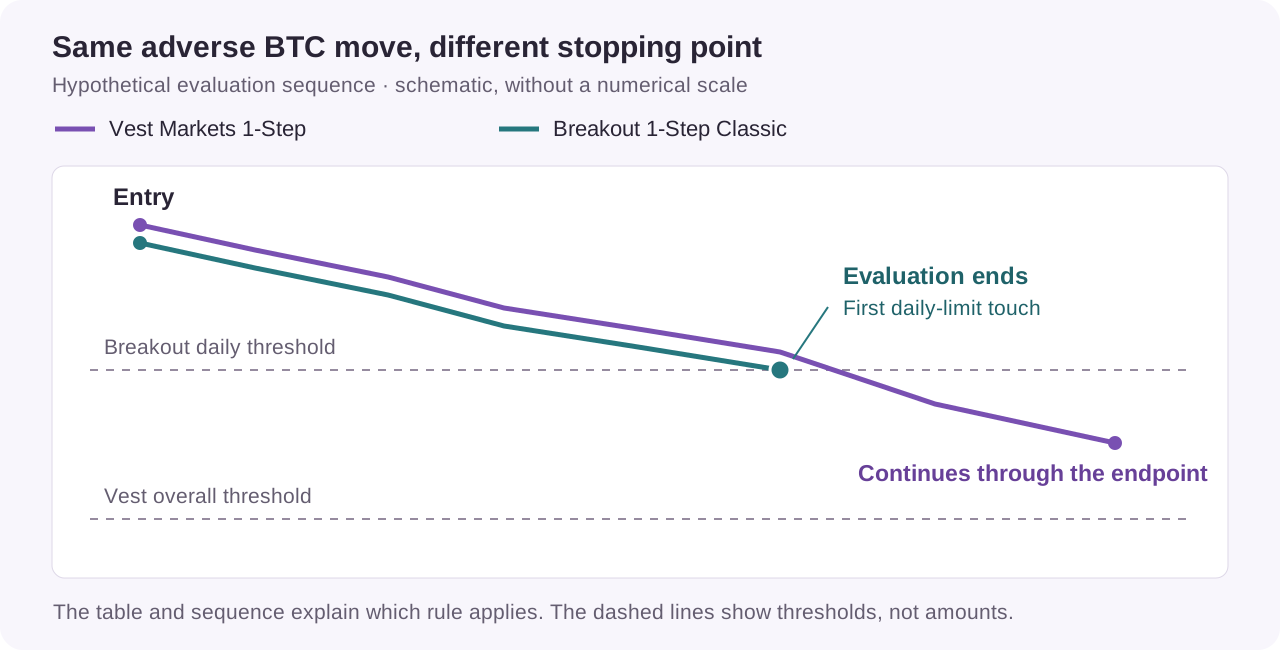
The difference comes from Breakout's daily constraint, not from the account-size label. The fee already booked moves the touch earlier; the modeled move would reach the daily threshold without it. This does not establish how either account would perform on a different trading history. Starting with prior profits, carrying a position across the reset, using a different entry type or incurring a financing charge changes the state that must be tested.
Vest's sources disagree about whether merely touching its overall threshold closes the account. The example remains strictly above that threshold throughout, so its result does not depend on choosing one interpretation. If your proposed trade could touch it, resolve that point with Vest before relying on the remaining room.
The example isolates BTC. Both firms also describe non-crypto markets, whose costs and schedules need their own checks. For the distinction between a trading fee and a later funding payment, see fees and funding in the E8 Markets and Propr comparison. Its account-specific rates belong to those accounts.
What does funded mean for these accounts?
| Trading environment | Vest Markets 1-Step | Breakout 1-Step Classic |
|---|---|---|
| Evaluation and funded stages | Simulated at both stages: Vest's Prop Trading Terms of Service say "All Accounts, including Instant Funded Accounts, are simulated" and users "do not execute live trades". Vest may trade or hedge for its own account with its own capital, which does not make the account live. Vest's FAQ and documentation describe the funded account as live, with real capital. | Simulated at both stages: in the evaluation, "All trading on the Breakout Terminal happens on a demo account funded with simulated capital"; once funded, "Your funded account trades on simulated capital, not real capital". Payward Oceanic may record a trade idea as a book entry or route it to a market maker or exchange for its own book, which does not make the account live. Breakout's homepage says "Once funded you trade with Breakout's capital". |
Vest's Prop Trading Terms of Service describe simulated accounts, while its FAQ and operational documentation describe the funded stage as live with real capital. That disagreement should stay visible. The stage label alone is not a basis for treating the account as a brokerage balance you own.
Breakout's stage-specific help also describes simulated trading, despite its homepage's capital wording. As the quoted row says, routing a trade idea to the provider's own book does not make the account live. For this comparison, passing opens a route to compensation under the program's rules; it does not make the displayed account size withdrawable.
What happens between a profit claim and the next trade?
Compare the request conditions, cash-transfer process and account left behind. A permissive request clock does not answer all of them.
| Payout question | Vest Markets 1-Step | Breakout 1-Step Classic |
|---|---|---|
| When can a claim or request be made? | On demand: a profit claim can be submitted at any time, as often as you like, with no threshold before the first; open positions or orders may need closing first. | On demand: once funded, a payout can be requested at any time, on weekdays or weekends, with no open positions and no breach. |
| What processing happens before receipt? | A profit claim is credited to the Primary Account in USDC within 24 hours; a withdrawal to an external wallet then has a 24-hour processing period. Vest's homepage says "Withdrawals hit your wallet immediately". | A payout request is deducted from the balance at once; Payward Oceanic's approval "can take 12-24 hours, but is usually much quicker", and USDC is then sent to the trader's ERC-20 wallet. Breakout's homepage says "No cycles, no approval queue. Most requests processed within hours." |
| Which minimums and caps apply? | No minimum and no cap on a profit claim. A withdrawal from the Primary Account to a wallet has a 1 USDC minimum, and withdrawals over $50,000 in a rolling 24 hours wait 24 hours. | $50 minimum, after the profit split. No payout cap is stated; combined funded capital is capped at $200,000. |
| What changes in the account? | The maximum drawdown floor stays fixed: a claim lowers the balance, not the floor. | The requested amount is deducted from the balance at once, and that day's daily loss limit widens by the payout amount until it is recalculated at 00:30 UTC. The static maximum drawdown floor is not said to change. |
At Vest, Claim Profit and withdrawal are separate actions. The claim moves the trader's share to the Primary Account; the withdrawal then moves funds from that account to an external wallet. A condition on the wallet transfer is not a minimum profit claim. Vest's Claiming Profit and Withdrawals pages describe processing at those separate stages, as the processing-time row records. Their timing differs from the homepage's immediate-wallet wording. Plan receipt around the documented steps, rather than treating on-demand request eligibility as instant cash arrival.
At Breakout, assess the payout minimum after applying the trader's share. Breakout states no payout cap; the combined funded-capital ceiling in the quoted row limits allocation. The request also needs an eligible account with positions closed. Being able to submit a request is a different milestone from its approval and receipt.
For the next trade, Vest's unchanged overall threshold means a claim reduces the buffer above it. Keeping some profit in the account leaves more room than claiming it all, under the same account state.
Breakout adjusts the day's daily limit when a payout is requested, then recalculates it at the next reset. That adjustment is not a new grant of overall loss allowance: the static overall threshold still matters. Check both thresholds against the reduced balance before sizing the next position. How payouts change the drawdown buffer explains why cash received and room left to trade are separate outcomes.
What ends the account, and can your method continue?
| Question | Vest Markets 1-Step | Breakout 1-Step Classic |
|---|---|---|
| Consequences of a breach or prohibited conduct | A breached loss limit closes the account immediately and permanently, without warning or grace period. For a prohibited use, Vest may suspend access or payouts while it investigates, invalidate affected trades or results, deny or recover compensation, and end access. | A breach (a loss limit reached, prohibited trading or a breach of the agreement) ends the evaluation, closes open positions and disables the account, with no refund and no reset; a breached funded account receives no payout. A confirmed cross-account hedging violation ends every associated account, forfeits accrued profits and suspends the trader permanently. |
| Automation and copying your own trades | API trading is not available on Vest Capital accounts, in the Evaluation Phase or Live. Copying trades between your own accounts is not addressed; the terms bar misusing multiple accounts, and the FAQ restricts coordinating across funded accounts, such as opposite sides of one market on different accounts. | Bots and expert advisors are not addressed; a third-party or off-the-shelf approach marketed to pass evaluations, or to grow a funded account, is prohibited. Copying trades between your own accounts is not addressed; hedging across accounts (your own included), copy trading across users and trade ideas copied from third parties are prohibited. |
The evaluation example stops at Breakout's first breach. Its funded-stage interval between breach and termination of terminal access, quoted in the loss-limits row, is a separate event. Continued access during that interval does not turn the breach into a recoverable trading allowance or restore payout eligibility.
For Vest, the quoted sanctions distinguish a loss-limit closure from measures available during a prohibited-use investigation. Plan around the applicable consequence, not simply whether the dashboard can still be opened.
Neither account's evidence establishes permission to copy trades between your own accounts. That unknown remains relevant in both stages. Breakout's explicit restrictions on cross-account hedging and copying other people's ideas, and Vest's restrictions on misusing multiple accounts and coordinating across funded accounts, do not settle every same-owner copying arrangement. Vest's restriction on API access is a separate automation rule, not an answer on copying a manually placed trade. If copying or automation is essential, describe the exact tool, accounts and directions to the relevant firm's support and obtain an account-specific answer before purchase.
Does the entry fee come back?
The reward-linked refund and the unused-purchase cancellation are different questions. Keep both in the cost comparison.
| Refund question | Vest Markets 1-Step | Breakout 1-Step Classic |
|---|---|---|
| Does a reward return the entry fee? | None stated: no page offers the fee back with a profit claim. | None stated: no page offers the fee back with a payout, and evaluation fees are non-refundable. |
| Can an unused purchase be canceled for a refund? | Within 3 days of purchase, if the account has not been used: no trades placed. Failing the Evaluation Phase does not qualify. Refunds go back to the original payment method in 5 to 10 business days. | None: evaluation fees are non-refundable, and the terms of use allow no refunds except under a separate agreement. If identity verification (KYC) cannot be approved after a manual review, active evaluations are refunded. |
Do not reduce either purchase price by an assumed refund with the first reward. Vest's unused-account refund depends on the cancellation conditions; placing a trade ends that option. Breakout's identity-verification exception is a specific outcome, not a general option to try the evaluation and cancel afterward.
The lower listed entry price therefore answers a real upfront-cost question. It does not remove the need to test whether the rules fit the intended trade sequence or whether the resulting payout leaves enough room for the next one.
Which differences matter to your plan?
| Your requirement | What this comparison establishes |
|---|---|
| Lower initial purchase cost in these standard builds | Breakout has the lower listed entry price. Retain the quoted configuration when comparing checkout totals. |
| Room for the modeled adverse intraday BTC move | Vest remains active through this sequence; Breakout ends at its daily-limit touch. A different history requires a new test. |
| Frequent access to earned profit | Both have on-demand request routes, but compare the minimum, position-closing conditions and transfer stages before treating them as equivalent. |
| Continuing after taking profit out | Recalculate the remaining buffer and applicable daily threshold. A payout changes the starting state for the next trade. |
| Copying between your own accounts | The evidence does not establish permission for either selected account. Resolve the exact arrangement before relying on it. |
| A live trading account under your control | The simulated-account descriptions and Vest's conflicting terminology do not support that expectation. |
Choose on the conditions your method actually needs. An approach that stays comfortably within Breakout's daily constraint may place greater weight on the lower entry price. A method that needs the room demonstrated by this specific path has a reason to examine the selected Vest build, while still accounting for its cost and unresolved boundary wording. Neither conclusion establishes a higher pass rate, better execution or more reliable payment.
Before purchase, open the Vest account record and Breakout account record, match the checkout settings, and test your entry, adverse move and intended withdrawal against those exact rules.
Related reading
- Daily loss limits, for the balance reference, monitored equity and reset clock.
- Perpetual prop firms explained, for the account structure, trading costs and separate liquidation constraint.
- Perpetual funding rates, for how holding a position through a funding or financing charge changes equity and loss room.
- When official prop firm rules conflict, for documenting a disagreement without silently choosing the more favorable wording.
Sources and method
This is a comparison of the named standard configurations, with an original hypothetical evaluation sequence. The account facts carry their own evidence and check dates. Supplemental official pages supporting the interpretation and document differences were checked on 6 November 2026.
The model holds entry price, BTC quantity, direction and subsequent price movement constant. It applies the quoted entry-fee treatment, tests equity as the loss grows and stops each account at its first breach. It excludes financing postings, transfers, slippage and intervening liquidation. These choices isolate the rule difference; they are not a backtest, an execution comparison or a recommendation to use that exposure. The figure is structural and supplies no numerical scale.
- Vest account evidence and Breakout account evidence, for the selected routes, prices, limits, payouts, permissions and refund conditions.
- Vest Loss Limits, for the fixed overall threshold, account-type scope and exact-touch wording.
- Vest Markets and Order Types, for maker/taker treatment and charging fees per fill.
- Breakout's evaluation daily-loss rule, trading fees and breach consequences, for the reset reference, entry debit and first-stop sequence.
- Breakout's funded-limit explanation and payout adjustment, for separating the breach from later access termination and the request from the next daily reset.
- Vest Funding and Breakout Terminal swap fees, for the settlement and financing events the chosen sequence ends before.
- Vest Claiming Profit and Withdrawals, for the separate account-credit and wallet-transfer stages, including the processing notices.
Vest's exact-touch disagreement and the absence of a settled own-account copying answer remain unresolved. They are not treated as permission or as favorable assumptions. The selected path avoids the former; a method that depends on the latter needs an answer before it can be assessed.