LearnRisk essentials
Perpetual Prices and Liquidation: Which Account Limit Is Reached First?
The first limit reached depends on the price used for each test, the collateral supporting the position and the prop account's current loss boundary. A stop setting or a displayed liquidation price cannot answer that question alone. Follow the price update into open P&L, test the applicable conditions, then account for any fill and charge.
On this page
This guide works through that sequence. It uses one hypothetical perpetual position under two isolated-margin allocations, followed by a changed stop order. The broader perpetual-account guide explains why venue liquidation and prop-account breach are separate events. Here, the task is to calculate which happens first.
Which price does each job?
Start with the actual contract and platform settings. A chart can display a different series from the one used to value a position or activate an order.
| Job | Price or record to identify |
|---|---|
| Display the market | The chart's selected series, such as last-traded, mark or index price. |
| Supply a reference | The index or oracle for this contract, including its construction and update schedule. |
| Value an open position | The price required by the account's unrealized-P&L calculation. |
| Trigger a stop | The order's chosen or required trigger series and crossing condition. |
| Execute an exit | The actual fills and quantities. A reference price is not a fill. |
| Test a loss boundary | The monitored account value, its valuation inputs and the current threshold. |
The perpetuals guide defines last-traded, index and mark prices, and Hyperliquid's split between them: an oracle for funding, a mark for margin, liquidation, TP/SL triggers and unrealized P&L. That mark is a median of several inputs, including other venues' prices, rather than the latest trade, and it updates when validators publish new oracle prices, about every three seconds. Those are Hyperliquid mechanics, not proof that a prop platform implements every field identically. Hyperliquid price indices
Order settings also differ between venues. Bybit documents last, mark and index trigger choices for conditional orders. Its isolated-margin liquidation test uses mark price, so a last-price stop can remain untriggered while liquidation begins. Bybit execution and liquidation FAQ
For a prop account, establish the firm's own valuation and enforcement rules. In a simulated environment, identify which liquidation model is actually implemented. A venue formula cannot fill an undocumented gap in the participant's agreement.
Define the account before following the prices
The following is an invented USD-denominated linear BTC perpetual model, not a Hyperliquid, Bybit or named prop-firm account. Prices are dollars per BTC; account amounts are dollars in the hypothetical ledger. These inputs illustrate the interaction, not current prices, representative margin rates or a suggested trade size.
| Input | Hypothetical rule or starting value |
|---|---|
| Account and position | Starting balance $10,000; long 0.5 BTC at an actual entry fill of $60,000 per BTC. |
| Opening fee | $5 already booked, leaving balance $9,995. Do not subtract it again. |
| Open-position valuation | Floating P&L = 0.5 × (mark price − $60,000). Account equity = balance + floating P&L. Separate account credit is zero. |
| Prop loss rules | Fixed daily equity threshold $9,500 and fixed overall threshold $9,000. Touching either is a hard breach. No reset, trail or lock change occurs during the sequence. |
| Margin allocation | Case A assigns $3,000 of the existing balance to this isolated position. The rest remains outside its margin pool. Allocation does not reduce total account equity. |
| Venue margin test | Isolated equity = allocated margin + floating P&L. Maintenance requirement = 0.5% × current mark-price notional. Liquidation starts only when isolated equity is below that requirement. |
| Initial eligibility | The invented venue requires at least 2% of entry notional to open. Both allocations used below meet that requirement. Quantity and maintenance tier stay fixed. |
| Stop | A full-position sell stop-market order, triggered when last price is at or below $58,900. No earlier trigger has occurred. |
| Other activity | No other positions, funding, deposits, withdrawals, margin transfers or additional charges before a stated exit. |
The daily and overall thresholds have already been established for this session. They are not recalculated from the $9,995 balance. The margin pool is part of that balance, not another $3,000 added to it.
Each row below is a complete, ordered price update. Between rows, the model's prices remain unchanged; there are no hidden valuations or fills. At an update, value the position and test the prop rules, liquidation condition and stop trigger. If an exit occurs, book its actual fill and stated fee, then test the prop rules again. These are explicit simulation assumptions, not a universal processing order.
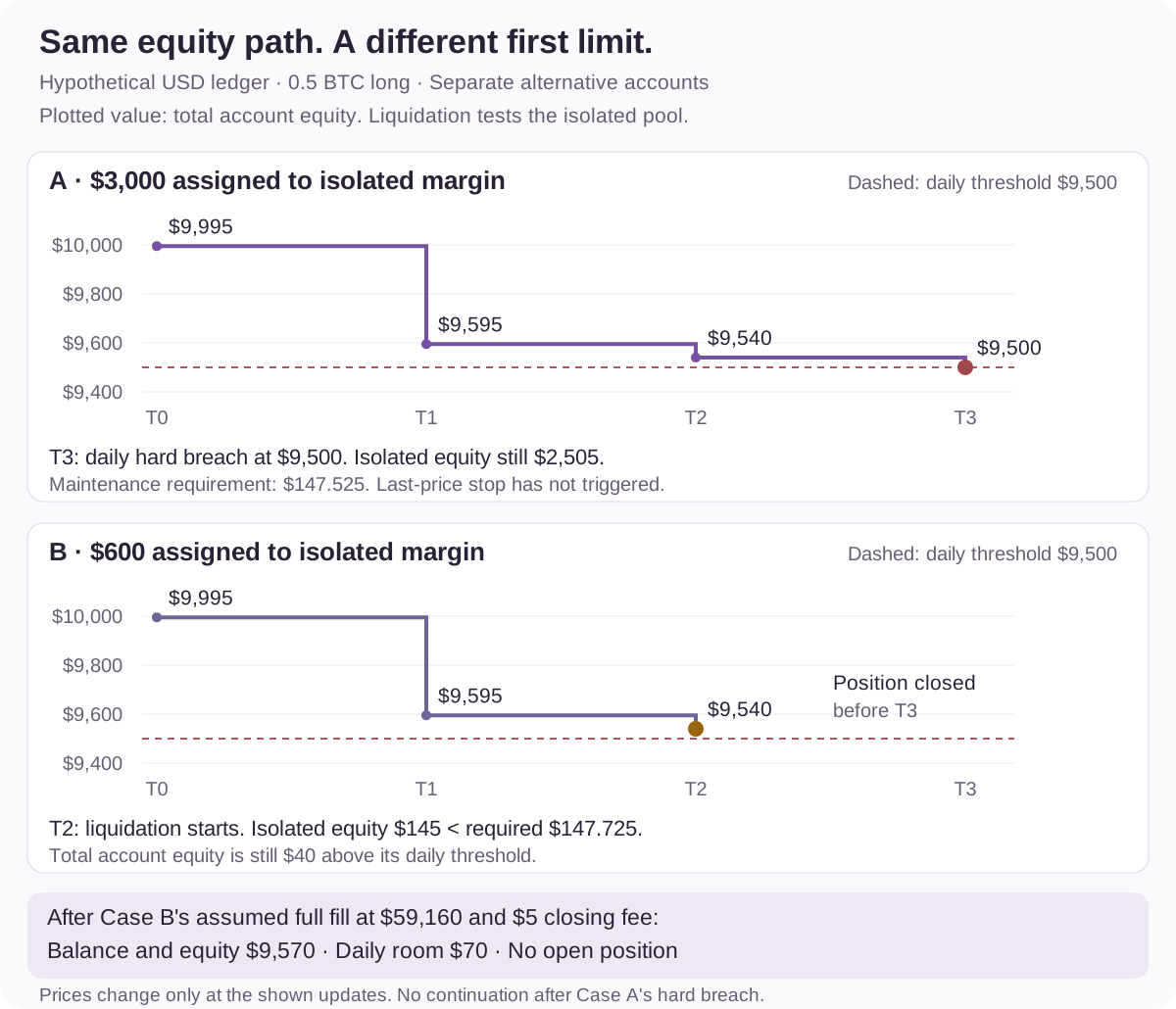
Case A: the prop loss limit acts first
The same last, oracle and mark observations feed both cases. The oracle is recorded for comparison but does not enter this model's P&L, stop or margin formulas.
| Update | Last price | Oracle price | Mark price | Account equity | Room above daily threshold |
|---|---|---|---|---|---|
| T0: position open, fee booked | $60,000 | $60,000 | $60,000 | $9,995 | $495 |
| T1 | $59,400 | $59,230 | $59,200 | $9,595 | $95 |
| T2 | $59,200 | $59,110 | $59,090 | $9,540 | $40 |
| T3: first hard breach | $59,180 | $59,040 | $59,010 | $9,500 | $0 |
At T3, floating P&L is 0.5 × ($59,010 − $60,000) = −$495. Adding it to the $9,995 balance gives $9,500 equity. The account touches its daily threshold, so the valid account path ends here. The overall threshold still has $500 of room; that does not offset the daily breach.
The last-price stop has not triggered: $59,180 is still above $58,900. Nor has this position reached the invented venue's liquidation condition:
- Isolated equity: $3,000 − $495 = $2,505.
- Mark-price notional: 0.5 × $59,010 = $29,505.
- Maintenance requirement: 0.005 × $29,505 = $147.525, displayed as $147.53.
The position has ample margin under this model when the prop account breaches. We stop the account replay at the breach; an eventual forced-close fill is not assumed. A later recovery in price could not erase this already-recorded hard breach.
Valuing the position at last price instead would have produced $9,585 equity and an apparent $85 of daily room. That is the wrong calculation for these rules. The relevant issue is which price the account must use, not which chart looks less adverse.
Case B: less isolated collateral reverses the order
Now start a separate alternative account with the same balance, quantity, prices, prop thresholds and stop. Change only the opening isolated allocation from $3,000 to $600. That is 2% of the $30,000 entry notional, so this case meets the invented initial-margin requirement.
The account still starts with $9,995 equity. Its price P&L is unchanged. What changes is how much of the balance supports this isolated position.
| Update | Floating P&L | Isolated equity | Maintenance requirement | Result |
|---|---|---|---|---|
| T1 | −$400 | $200 | $148.00 | Position remains open. |
| T2 | −$455 | $145 | $147.725, displayed as $147.73 | Liquidation starts. |
At T2, $145 is below $147.725. Liquidation starts while account equity is still $9,540, or $40 above the prop daily threshold. The last-price stop remains untriggered. The rest of this hypothetical balance does not automatically replenish isolated collateral.
To finish the account calculation, assume the liquidation order then closes the full position at an average $59,160, with a $5 closing fee and no additional liquidation charge. This is a stipulated fill, not a price promised by the margin model:
Closing balance = $9,995 + 0.5 × ($59,160 − $60,000) − $5 = $9,570.
With no open position, equity also equals $9,570. The account retains $70 of daily room and $570 above overall max loss. The isolated pool returns its remaining $175 to the account; that amount is already included in the $9,570 total, not extra profit.
This hypothetical program imposes no separate account-ending penalty for liquidation, so the account remains valid after this closure. Its position is gone before T3. An actual program's liquidation penalty, closure costs and fill record need separate confirmation.
That survival depends on the fill. With the same $5 fee, an average fill at or below $59,020 would leave equity at or below $9,500, so the closing transaction would breach the daily threshold. A fill at T2's mark of $59,090 would leave $9,535 equity and only $35 of daily room. If a liquidation instead consumes the entire $600 pool, with no additional charge outside it, equity falls to $9,395, already below the daily threshold. Less isolated collateral changed which test acted first; it does not by itself keep the account above its threshold.
Real venues close liquidated positions in different ways. Bybit says its liquidation engine attempts to close the position at the bankruptcy price, where the position's margin is fully depleted. Hyperliquid first sends market orders to the book, and any collateral left once the maintenance requirement is met stays with the trader; if that fails and equity falls below two-thirds of the maintenance margin, a backstop liquidation transfers an isolated position and its margin to the liquidator. Hyperliquid's displayed liquidation price can also change with funding and, for cross-margin positions, with other positions. Do not interpret a trigger price as the final exit price. Bybit execution and liquidation FAQ · Hyperliquid liquidations
Would changing the stop trigger change the outcome?
It can change when the order activates. It does not determine the fill or replace either risk test.
In Case A, changing the stop to a mark-price trigger of $59,150 would activate it at T2, when mark jumps from $59,200 to $59,090. The account has $40 of daily room immediately before execution. Its final result then depends on the actual exit prices and charges.
A higher stop trigger does not settle Case B's ordering. Its invented maintenance test reaches equality at approximately $59,095.48, and liquidation requires a mark below the exact boundary. The $59,150 stop sits higher, but T2 jumps from $59,200 straight to $59,090. Both conditions are met at that update. Their price levels do not establish which action executes first; that requires the implemented processing order. This variant therefore leaves priority unresolved rather than assuming that the stop beats liquidation.
A stop-limit order adds another condition: the resulting limit order needs a fill at its limit or better. Hyperliquid's TP/SL documentation explicitly distinguishes market and limit orders and illustrates a triggered limit order resting unfilled after a price jump. Even its TP/SL market orders carry a 10% slippage tolerance. Use the actual order settings, including its quantity, when checking whether the position has closed. Hyperliquid TP/SL orders
A partial fill leaves exposure to test at subsequent valuations. For the accounting distinction between a quoted price and a completed exit, see the worked fill record. Use fills to compute realized price P&L, then add separately booked costs once.
What can move the boundary while the trade is open?
The examples held every other input fixed. An actual replay needs each change that affects a calculation.
Margin mode and collateral scope matter. Hyperliquid distinguishes isolated collateral from shared cross margin. Its current documentation also qualifies how sharing works across DEXs and account modes. Record the actual pool and positions; do not assume every balance visible in a wallet supports every position. Hyperliquid margining
Costs and account adjustments can reduce equity without a price move. Record where funding and fees are posted, and which loss test includes them. The funding and loss-limit example shows the account effect; the prop-account treatment section identifies the separate posting-order question around resets.
A prop threshold can change independently of liquidation. Use the actual daily reset and overall drawdown model. Recompute after the applicable event rather than carrying forward the earlier distance.
Quantity, margin tiers and fills can change the next test. A new order or partial exit changes exposure. A simple percentage move inferred from the leverage label is not a substitute for the implemented maintenance calculation. Recheck the account after each event, including closure costs.
Build one record for the account you will trade
Before relying on a stop or liquidation display, complete this record for the exact program, stage, symbol and platform. Keep the official source or written clarification beside each answer.
| Record | What you need to establish |
|---|---|
| Price series | Chart series, valuation series, stop-trigger series and the required source for each. |
| Order | Side, quantity, trigger condition, market or limit execution, limit price if applicable, and any unfilled remainder. |
| Margin | Isolated or cross mode, eligible collateral pool, other supported positions, maintenance tier and liquidation condition. |
| Prop rules | Current daily and overall thresholds, monitored value, equality boundary and consequence. |
| Other events | Funding, fees, credit, transfers, resets and threshold updates, with their accounting and processing order. |
| Evidence after an incident | Timestamped valuations, margin states, trigger and order-status records, fills, charges and the firm's breach record. |
A candle that never touches the displayed liquidation level does not settle the account history. Establish its series and sampling interval, then reconstruct the relevant risk updates. If two events share a timestamp and their order changes the result, retain both possible outcomes until the sequence is established. The history-replay framework explains that evidence step.
Use the completed record to trace the proposed trade through the first applicable action and the account state it leaves. If a material field is missing, identify that specific gap for the firm or platform before treating the displayed buffer as usable room.
Related reading
- Perpetual prop firms explained: contract structure, simulation and the account relationship.
- Prop firm position sizing: translating stop distance and remaining loss room into a proposed CFD or futures quantity.
- Balance versus equity: account credit and why its treatment belongs in the equity record.
Sources and method
Official sources were checked on 27 October 2026. Named venue statements apply to those documents, not to an unverified prop-platform implementation. The two accounts and the knowledge check are original hypothetical calculations. Their fees, price updates, margin requirements, enforcement rules and closing fills are invented; none describes a reviewed firm's account. Calculations retain full precision for the tests and round displayed money to cents where needed.
- Hyperliquid: robust price indices, for the documented price roles.
- Bybit: order execution and liquidation FAQ, for conditional trigger choices, mark-price liquidation and the close at the bankruptcy price.
- Hyperliquid: liquidations, for order-book and backstop liquidation and changing estimates.
- Hyperliquid: take-profit and stop-loss orders, for trigger and execution behavior.
- Hyperliquid: margining, for collateral scope and margin modes.