LearnChoosing a program
Perpetual Prop Firms Explained: What You Trade and How the Account Works
A perpetual prop program gives you access to an account for trading perpetual derivatives, contracts that have no scheduled expiry date. The contract tells you what price exposure you take. The prop agreement tells you whether the account is simulated or live, what can close it, and when its performance may qualify for a payment. Those are separate questions.
On this page
That distinction matters when a program mentions crypto, Hyperliquid, USDC or on-chain execution. None of those labels, on its own, proves that you own cryptocurrency or control a live trading account.
This guide covers retail prop programs offering perpetual contracts, with scoped examples from E8 Markets and Propr. It does not rank the firms or cover prediction-market contracts. Official sources were checked on 17 October 2026; program terms can change.
What do you trade in a perpetual prop account?
A perpetual, often shortened to perp, is a derivative whose value follows a reference asset or market. It lets you take a long or short position without buying that underlying asset. Unlike a dated futures contract, it has no scheduled expiry requiring you to settle or move to another contract month. Hyperliquid's contract specifications describe its crypto perpetuals this way. Hyperliquid contract specifications
The underlying market need not be a cryptocurrency. E8's perpetual offering includes contracts referencing crypto, stocks, indices and metals. Buying an equity perpetual therefore does not mean buying shares, just as a Bitcoin perpetual is not a Bitcoin spot purchase. The instrument specification, rather than the asset's familiar name, tells you what you are trading. E8 perpetual futures guide
Start with the exact symbol and its contract specification. Record the reference asset, position unit, settlement denomination and permitted size. A BTC price chart is useful context, but it does not identify which BTC-linked contract your account offers.
How do perpetuals differ from CFDs and dated futures?
Perpetuals are a type of futures derivative. The useful comparison here is with dated exchange-listed futures, rather than treating every product called futures as identical.
| Instrument | What identifies it | What to check in the prop program |
|---|---|---|
| CFD | A contract with a provider based on the underlying asset's price change; you do not own the underlying asset. | The provider's specification, pricing, financing and account terms. |
| Dated exchange-listed futures | A specified contract with an expiry and settlement process. Continuing exposure can require closing one contract and opening a later month. | Which contract months you may trade, rollover restrictions and the program's session cutoff. |
| Perpetual futures | A derivative with no scheduled expiry. Funding can apply while a position remains open. | The exact contract, funding treatment, relevant prices and the program's holding and loss rules. |
The instrument distinctions above follow ASIC's Moneysmart CFD explanation, CME's expiry guide and Hyperliquid's perpetual specifications. They do not establish the execution status of any particular prop account. Moneysmart · CME · Hyperliquid
For the first two categories in more depth, see CFD/FX versus futures prop firms. A program's market label is the beginning of the comparison, not its full rulebook.
Does a perpetual prop account trade live money?
The account agreement determines whether your activity is simulated or live. Real-time market data and a connection to a live venue do not answer that question.
E8 states that its perpetual accounts use Hyperliquid market data inside a simulated environment and that real funds are not deployed on the participant's behalf. Its guide places this offering on E8 Terminal. Those statements describe E8's offering, not every firm using the same market feed. E8 perpetual futures guide
Propr's evaluation terms and funded terms both describe the participant's activity as paper trading. The firm can separately choose to use a signal in live markets, called A-Booking in its terms; the participant has no right to require that execution. The evaluation terms add that the evaluation's simulated profit and loss is identical whichever way Propr handles a trade, and the rulebook disclosure states that any resulting live position belongs to Propr. A firm-owned position and the participant's simulated record can therefore coexist. Propr evaluation terms, clauses 7.3 and 7.4 · Propr funded terms, definitions and clause 3.4 · Propr rulebook disclosure
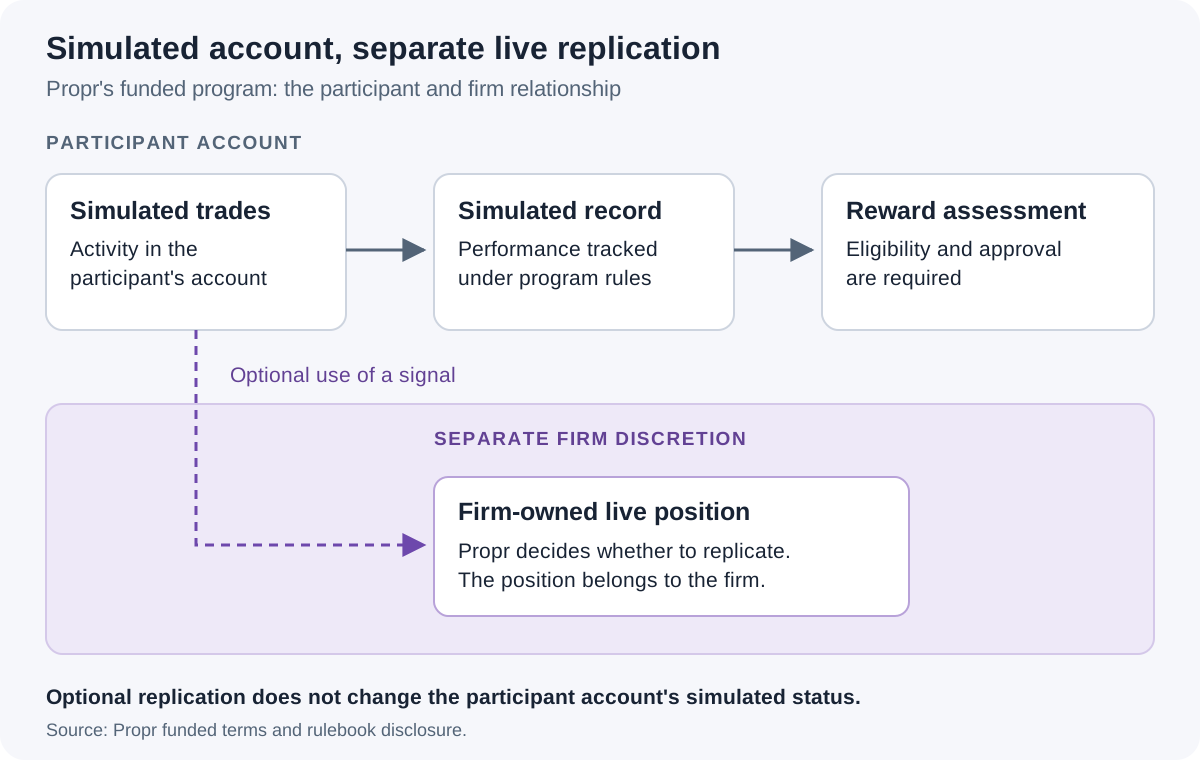
When reviewing another program, look for the same answers in its own agreement: Who holds the capital? Who owns any position? Is your dashboard a simulated performance record? What event, if any, changes that status? The platform guide helps separate account access, market data and execution.
What do funding rates and price references change?
Funding is a periodic payment associated with holding a perpetual position. It helps keep the contract price aligned with its reference market. On Hyperliquid, positive funding means longs pay shorts; negative funding reverses that direction. Its documentation specifies hourly payments. Another venue or a prop program's implementation must be checked separately. Hyperliquid funding
For a prop account, establish whether the program reproduces funding, when it posts the entry and how that entry affects the account's monitored balance or equity. Propr's rulebook, for example, says funding debits and credits affect equity. A position can consequently change your distance from a loss boundary through costs as well as price movement. Propr rulebook, funding section
Do not assume one number on the chart drives every account calculation:
- Last-traded price describes a completed trade in that contract.
- Index or oracle price supplies a reference derived from underlying-market information; the construction depends on the venue and contract.
- Mark price is a calculated valuation used for specified risk and accounting purposes.
Hyperliquid, for example, uses an oracle in funding calculations and a mark price for margin, liquidation, take-profit and stop-loss triggers and unrealized P&L. That does not prove a prop dashboard uses every venue field in exactly the same way. Ask which price the firm uses to value open positions, trigger stops and test its loss limits. Hyperliquid price indices
Funding also needs its own line in your cost record. Check transaction fees, spread and execution effects separately; a quoted trading fee is not a complete holding-cost estimate. E8 Terminal's guide documents separate funding and trading history views, which can help reconcile the entries shown in that environment. E8 Terminal guide
For a practical holding check, see E8 One perpetuals' overnight permission and funding information.
For payment formulas, rate periods and the effect on a loss buffer, see perpetual funding rates.
Can the prop account breach before a position is liquidated?
Yes. A venue's liquidation condition and a prop firm's loss rule measure different things. At venue level, liquidation concerns whether account equity supports the required maintenance margin. Hyperliquid documents liquidation when equity falls below that requirement and uses mark prices in this process. Hyperliquid liquidations
A prop program can also impose a daily loss boundary or an overall loss boundary. These restrictions belong to the program agreement. Propr's rulebook, for example, specifies equity-based loss enforcement, including open-position P&L. Propr rulebook
Propr Classic 1-Step's fee and funding treatment shows how account entries affect room above equity limits.
If a program's loss boundary is reached first, a displayed venue liquidation price offers no protection from that breach. In a simulated account, you also need to establish which margin and liquidation mechanics the firm implements rather than importing a live exchange formula yourself.
The reverse needs its own check. Liquidation does not, by itself, establish that a prop loss limit has been breached. Closing a position realizes its profit or loss; whether that closure ends the account depends on the program's rules and the equity it leaves. The Propr rulebook cited above specifies equity limits but does not provide a margin requirement or liquidation-price formula.
Keep three questions separate: How much position size is permitted? How much margin does that position require? How much further can account equity fall before the program acts? A large size allowance does not expand a separately defined loss allowance. The leverage, margin and loss-limits guide develops that distinction with CFD/FX and futures examples. The drawdown guide covers how different overall boundaries move.
Does no expiry mean you can hold indefinitely?
No scheduled contract expiry removes one reason to close or roll a position. It says nothing by itself about the prop account's lifetime, permitted holding periods, trading access or continued compliance.
For each symbol and account phase, check:
- When new orders and position closures are available.
- Whether overnight and weekend holding are permitted.
- Whether a daily reset changes the loss reference while the position is open.
- Whether funding, maintenance or a forced-close rule creates an event to monitor.
- Whether an inactivity or other account rule can end access.
Propr permits weekend holding in its rulebook, while its evaluation terms allow temporary service interruptions for maintenance and upgrades. Permission to carry a position and continuous access to manage it are different questions. Do not use a general crypto-market hours claim as the complete schedule for every symbol in a multi-asset program. Propr rulebook · Propr evaluation terms, clause 6.7
Use the overnight and weekend holding guide to record the applicable events before deciding how long to keep a position open.
What does a USDC balance or payout tell you?
Keep four fields separate: the asset underlying your contract, the unit shown in the trading account, the asset used to pay the purchase fee, and the asset used for an approved payout. Knowing one does not fill in the other three.
Propr's evaluation terms say the capital shown in a paper account is not a deposit of funds and has no monetary value. Its funded terms specify USDC settlement for approved rewards, subject to eligibility and identity checks. A simulated balance denominated in a stablecoin is therefore not the same as that stablecoin already sitting in your wallet. Propr evaluation terms, clause 7.3 · Propr funded terms, clauses 2 and 5
The same separation applies when you classify a program: the payment asset does not identify the traded contract.
Before paying, confirm the payout conditions and supported transfer details for your chosen program. The payout rules guide covers eligibility and processing, while the country and KYC guide explains why access to registration does not settle every eligibility question.
The USD, USDT and USDC guide follows the purchase asset, the account's unit and the payout asset from checkout to the cash you finally receive.
What should you record before buying a perpetual program?
Build one record for the exact program, size, platform and account phase. Use its current agreement and rule pages; preserve the source date and any written clarification.
| Check | Record the answer |
|---|---|
| Instrument | Exact symbol, reference asset, position unit and contract specification. |
| Account relationship | Simulated or live status, ownership of capital and positions, and any transition conditions. |
| Platform and prices | Required terminal, data source, valuation price and order-trigger price. |
| Trading costs | Transaction fees, spread or execution effects, funding schedule and posting treatment. |
| Margin and loss limits | Permitted exposure, implemented margin rules, daily and overall loss tests, and enforcement action. |
| Hours and holding | Symbol access, permitted carry periods, maintenance, reset events and forced closures. |
| Money and eligibility | Purchase currency, account denomination, payout asset and network, country eligibility, KYC and reward conditions. |
The decisive test is whether you can explain what would change the account's equity, close a position, end the account or prevent a payout. If a label leaves one of those unanswered, return to the relevant terms. If sources conflict, use the process in resolving conflicting prop firm rules before buying.
For a comparison of named accounts, see E8 One, E8 Pro and Propr Classic 1-Step. It follows three selected perpetual configurations through their loss rules, trading permissions and payouts, with the account denomination and unresolved source differences kept visible.
Related reading
- How to compare prop firm programs: build a broader purchase record.
- Account size versus usable risk budget: separate the advertised balance from the loss allowance.
- Spreads, slippage and execution: understand costs and fills beyond a headline fee.
Sources and method
Official documentation was checked on 17 October 2026. Venue documentation establishes the mechanics described for that venue; it does not verify a prop firm's implementation. Named program examples are scoped to their cited pages and are not a ranking, audit of execution or assessment of payout reliability. The classification exercise is hypothetical.
- Hyperliquid contract specifications, for crypto perpetual contract structure.
- CME: futures expiration and contract roll, for dated futures expiry and rollover.
- ASIC Moneysmart: contracts for difference, for the CFD definition and underlying-asset distinction.
- E8: perpetual futures, for its market offering, platform and simulation disclosure.
- E8: using E8 Terminal, for account-history views.
- Hyperliquid funding, for funding direction and payment timing.
- Hyperliquid price indices, for oracle and mark-price roles.
- Hyperliquid liquidations, for maintenance-margin liquidation.
- Propr evaluation terms, for paper trading in the evaluation, simulated balances and availability.
- Propr funded terms, for the signal relationship and conditional rewards.
- Propr rulebook, for its loss rules, funding treatment, holding permissions and ownership disclosure.