LearnChoosing a program
Futures Contract Limits: Minis, Micros, and Scaling Rules
A futures prop firm's contract limit sets the position size your account may hold under that firm's counting rules and your current account stage. To use the number correctly, establish which instruments it covers, how minis and micros combine, and when a scaling change becomes effective.
On this page
Keep three questions separate: How much does this contract gain or lose when its price moves? How much of the firm's position limit does it use? How much risk does the proposed trade create for the account? The answers need not move together.
This guide explains those checks with a mixed-position calculation and dated examples from official sources. Named policies were checked on 6 October 2026. They illustrate different mechanisms, not a ranking or a complete account comparison.
What changes between a mini and a micro contract?
A contract specification describes the instrument itself. Two useful values are the dollar value of one index point and the minimum price increment, called a tick. Multiplying the point value by the tick size gives the dollar value of one tick, per contract.
For these CME equity-index futures, the Micro E-mini has one-tenth of its corresponding E-mini's point value:
| Contract | Symbol | Value per index point | Outright tick size | Value per tick |
|---|---|---|---|---|
| E-mini S&P 500 | ES | $50 | 0.25 points | $12.50 |
| Micro E-mini S&P 500 | MES | $5 | 0.25 points | $1.25 |
| E-mini Nasdaq-100 | NQ | $20 | 0.25 points | $5.00 |
| Micro E-mini Nasdaq-100 | MNQ | $2 | 0.25 points | $0.50 |
Source: CME's Micro E-mini specification FAQ. The table concerns these four contracts and outright trades; it is not a universal specification for every product with “mini” or “micro” in its name.
For the same price movement in the same index, ten MES contracts have the same gross price sensitivity as one ES, and ten MNQ have the same as one NQ. That calculation does not establish identical commissions, fills, or treatment under a prop firm's rules.
For the wider distinction between exchange-traded contracts and CFD sizing, see the CFD/FX-versus-futures guide.
How does the firm count contracts toward the limit?
Start with the applicable rule, not the contract multiplier. A firm's limit might apply to the combined open position, to each instrument, or to both. It may also contain product exceptions or depend on the account's current progression tier.
Where a policy explicitly treats ten permitted micros as one mini and permits mixed positions, a fractional counting model can be written as:
Counted position = number of minis + number of micros ÷ 10.
This is a conditional formula. Confirm whether the actual policy uses fractional equivalents, rounds groups of micros, treats each product separately, or prohibits particular combinations. Earn2Trade's progression rule, for example, says up to ten micro contracts count as one standard contract; wording like that should prompt a check of how a partly filled group is counted when it matters to the order.
Also establish what the limit measures. An open-position cap concerns simultaneous holdings. A per-order cap concerns one submitted order. A daily-volume cap, if present, concerns trading activity over a period. A label such as “maximum contracts” does not explain all three.
Product exceptions can change the answer
My Funded Futures' instrument list says Micro Bitcoin, MBT, uses the allowance for a mini: its example permits three MBT when the mini maximum is three. The product name therefore does not establish a ten-for-one allowance. Check the current instrument-specific notices as well as the account's headline limit. The same page sets separate caps for micro metals contracts by account size, five on a $50,000 account, for example. My Funded Futures instrument list.
Mixing sizes and offsetting positions are separate permissions
Tradeify's published rule permits minis and micros together within a combined ten-micros-to-one-mini limit. Its hedging restrictions still apply, including opposing positions within its defined product groups, in one account or across your accounts. Permission to mix contract sizes therefore does not grant permission to offset positions. Tradeify mini/micro and hedging policy.
For copying or coordinating positions across accounts, use the separate automation and multiple-account permission record. Do not treat an unused allowance in another account as capacity available to this one.
How does a mixed position use the available capacity?
Consider a hypothetical account, not a named firm's configuration. Its rules are defined as follows:
- The current cap is 3.0 mini equivalents across all open positions in this account, with equality allowed.
- ES counts as 1.0 per contract; MES and MNQ each count as exactly 0.1. There is no rounding or separate product cap in this model.
- These instruments and same-direction mixed positions are permitted. All positions in the example are long; no offsetting or netting is used.
- Only filled open positions consume the modeled cap. Before submitting an entry, calculate the resulting count if it fills completely.
- This is solely a position-count check. Prices, P&L, costs, and other account conditions do not change in the calculation.
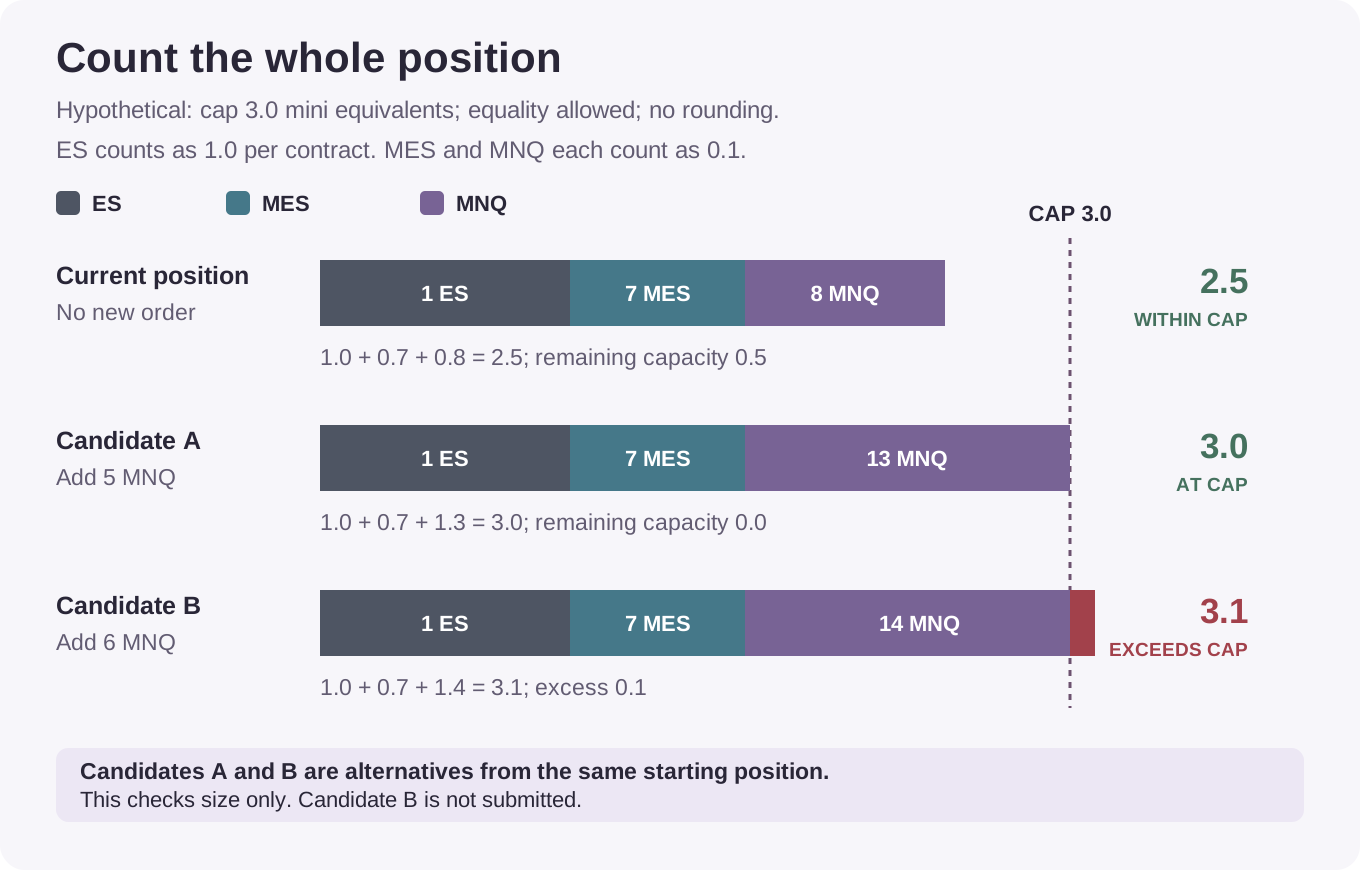
The account currently holds 1 ES, 7 MES, and 8 MNQ:
Counted position = 1 + 7 ÷ 10 + 8 ÷ 10 = 2.5 mini equivalents.
The remaining capacity is 3.0 − 2.5 = 0.5 mini equivalents, or five of the permitted micros under this model.
| Position being checked | Resulting holdings | Count | Size check |
|---|---|---|---|
| Current position | 1 ES + 7 MES + 8 MNQ | 2.5 | Within the 3.0 cap |
| Candidate A: add 5 MNQ | 1 ES + 7 MES + 13 MNQ | 3.0 | Exactly at the cap |
| Candidate B: add 6 MNQ | 1 ES + 7 MES + 14 MNQ | 3.1 | Exceeds the cap; do not submit |
Candidates A and B are alternatives calculated from the same starting position. Candidate B is never executed in this example. Candidate A passes only the modeled size check; that result does not establish permission under every other rule or suitability for the account.
Check a proposed entry against the combined cap
- Existing holdings, unchanged
- 1 ES + 7 MES + 8 MNQ = 2.5
- If this entry filled
- 1 ES + 7 MES + 13 MNQ = 3.0
- Proposed count
- 3.0
- Current cap
- 3.0
- Remaining capacity
- 0.0: at the cap
At the cap: equality is allowed
A result within the cap passes only this hypothetical count rule. It does not establish the dollar risk, another rule's permission, or a future scaling allowance.
The calculation combines ES-family and Nasdaq-family holdings only because the hypothetical firm counts them in one pool. It does not claim that they have the same dollar exposure or that losses in one market cancel losses in the other.
When does scaling change the permitted position?
Contract scaling changes the account's permitted position size when specified conditions are met. The advertised maximum may be a later tier. Record the starting allowance, each threshold, the value measured, and the time when the new allowance becomes usable.
The following official examples show why those details matter:
| Scoped example | Published mechanism | What to establish before an order |
|---|---|---|
| Take Profit Trader, $50,000 Test | Its Test position-size rule describes a static cap and lists 6 contracts or 60 permitted micros. | Use the current cap for the chosen Test; verify other stages separately. |
| Earn2Trade, Trader Career Path evaluation | The progression rule uses current balance and profit levels in real time. Exceeding the permitted count ends the evaluation. | Check the applicable ladder and present allowance before increasing size. |
| Tradeify, $50,000 Select funded account | Starts at 2 minis or 20 micros. An EOD balance of $51,500 enables 3/30 the next trading day; $52,000 enables 4/40. | An intraday balance touch does not establish a next-day tier. |
Sources: Take Profit Trader Test position-size rule, Earn2Trade Trader Career Path progression rule, and Tradeify Select scaling plan. These rows compare mechanisms, not otherwise equivalent programs.
Tradeify also distinguishes stages: its Select evaluation has the full allowance for the selected size, while the funded account starts lower. Its published funded scaling plan says earned tiers remain available when the balance fluctuates. That retention condition should not be transferred to another firm's ladder.
The FTMO Growth, FundedNext Flex and The5ers Day Trade comparison puts three accounts' contract limits beside their loss rules. FTMO's funded account starts below its evaluation cap, while FundedNext and The5ers each state one cap for both stages.
For any scaling plan, resolve four points:
- Measurement: Is the threshold based on balance, equity, realized profit, or another defined value? Are charges included?
- Timing: Does permission change immediately, at a session boundary, or after an update or approval?
- Reversal: Can losses or withdrawals lower the allowance, and what happens to an existing position if they do?
- Transition: Does passing, resetting, receiving a payout, or moving to a live account replace the schedule?
If a rule is described as real-time but does not make the monitored value or reduction procedure clear, obtain those details before relying on it. Record the published condition and the currently confirmed allowance together. The evaluation-to-funded checklist provides the broader account-stage check. For a change to the account's capital, or a merger of accounts, use the capital-scaling and merging guide.
Does the platform prevent an oversized position?
Do not use order acceptance as proof of compliance. My Funded Futures' cross-instrument policy distinguishes single-instrument rejection from combinations that can execute across instruments while exceeding the overall allowance. It expressly prohibits those combinations. My Funded Futures cross-instrument policy.
Before adding size, count the position that would exist after the relevant entries fill. Two separately acceptable entries can be too large together. Include other working entries in that check according to their actual behavior and the firm's treatment of pending orders. Do not assume one order cancels another unless the setup establishes that relationship.
Recheck order quantities after a partial close, a size change, or a move between mini and micro symbols. Whether a leftover protective order can open or reverse a position depends on the order and platform configuration. Confirm that behavior in the supported environment, using the platform workflow checklist.
Keep the consequence separate from the arithmetic. A rejected order, a forced position reduction, and an account failure are different outcomes. The applicable rule determines which applies; a software safeguard does not replace that rule.
Why is the contract limit a separate check from risk?
The cap tells you whether a position fits the size rule. It does not tell you how far the price can move before a daily-loss or overall max-loss condition is reached.
For a stated adverse price movement, the gross loss calculation is:
Gross loss = contracts × adverse index-point movement × dollar value per point.
As a separate hypothetical pre-trade comparison, suppose the same 3.0-equivalent cap applies, all other positions are closed, and you examine a 60-point adverse move in Nasdaq-100 futures:
| Proposed position | Count under the hypothetical cap | Gross loss over the stated move |
|---|---|---|
| 1 NQ | 1.0 | 1 × 60 × $20 = $1,200 |
| 5 MNQ | 0.5 | 5 × 60 × $2 = $600 |
Both positions fit the size cap, but their dollar exposure differs. These are calculations, not trade recommendations or a predicted market move. The figures exclude commissions and slippage and assume the full stated price movement. They are not guaranteed stop-loss outcomes or an account path that continues after a breach.
Compare the proposed exposure with the account's current loss conditions, including other open positions and costs. Use the overall max-loss guide and daily-loss guide for those mechanics. A larger scaling allowance does not itself increase the distance to either loss boundary.
The futures margin distinction explains why exchange margin, a simulated program's buying capacity, its contract cap and the account's remaining loss buffer answer different questions.
The futures position-sizing example works backward from a chosen trade allowance, includes fees and slippage, and then applies a separate assumed contract cap.
What belongs in your position-size record?
Complete this record for the exact account before trading, and update it at a stage change or when the relevant scaling condition changes:
| Field | Record |
|---|---|
| Account scope | Firm, plan, advertised size, stage, simulated/live status, and applicable purchase cohort |
| Permitted instruments | Symbols and any temporary restrictions or product-specific caps |
| Counting method | Mini/micro weights, rounding, aggregation across instruments, and treatment of pending orders |
| Current allowance | Confirmed present limit, separately from the eventual maximum |
| Scaling | Thresholds, monitored value, effective time, tier-reduction rules, and payout/reset treatment |
| Order behavior | Controls provided by the platform and the firm's consequence for exceeding the rule |
| Evidence | Applicable rule page, check date, and written clarification for unresolved conditions |
Then perform two calculations: the combined count after the proposed entries, and the dollar exposure against the account's loss constraints. If either depends on an unresolved rule, resolve that point before placing the order.
Keep the full contract expiration and its permitted trading window in the session and rollover record. Recheck the size allowance if you change product or contract size at the roll.
Keep the record alongside the before-you-pay comparison worksheet. A usable maximum-contract figure identifies the permitted instruments, counting policy, current tier, and effective time.
Related reading
- CFD/FX versus futures prop firms, for instrument and account-structure differences.
- Evaluation-to-funded account changes, for checking the size schedule again after passing.
- Prop firm platforms and market data, for verifying the connection and order workflow.
- Payouts and the remaining loss buffer, for the account state after a withdrawal.
Sources and method
Official pages checked on 6 October 2026. Contract specifications establish the named instruments' price sensitivity. Firm documents establish only the scoped policies cited above. The mixed-position and adverse-move examples are original hypothetical calculations, with the counting assumptions stated explicitly; neither is a provider's risk model or a recommended position size.
- CME Micro E-mini FAQ, for ES/MES and NQ/MNQ multipliers and outright tick specifications.
- Take Profit Trader Test position-size rule, for the static Test cap and permitted-micro allowance.
- Earn2Trade Trader Career Path progression rule, for real-time progression and the evaluation consequence.
- Tradeify Select payout and scaling policies, for the funded scaling schedule, update timing, tier retention, and evaluation distinction.
- Tradeify hedging and correlated-product rule, for mixed-size counting and separate direction restrictions.
- My Funded Futures instrument list, for MBT counting and micro-metals caps.
- My Funded Futures cross-instrument policy, for the distinction between platform rejection and the overall position rule.