LearnChoosing a program
Prohibited Trading Practices: How to Read Prop Firm Rules
A prop firm's strategy restriction applies to the behavior described in the applicable policy, not simply to the name you give your strategy. To establish what it means for an account, identify the activity, account scope, test and consequence. A prohibition, a condition for requesting a payout and a trigger for review can lead to different results.
On this page
“Scalping allowed” is a starting point for that check. It does not answer every question about holding times, order activity, exposure or simulated fills. This guide explains how to read those conditions, using scoped CFD/FX and futures examples checked on 12 October 2026.
Why doesn't a strategy name establish permission?
Two traders can describe their methods as scalping while placing very different orders. One may close a discretionary trade after a market move. Another may repeatedly target a simulator's unusually favorable fills. The holding time alone does not describe the source of the result.
FundedNext's CFD help page, for example, permits scalping in Challenge Accounts and FundedNext Accounts while prohibiting tick scalping, and makes that permission conditional on the activity complying with its policies. It points to a separate prohibited-strategy policy for those conditions, and FundedNext's CFD challenge terms list tick scalping among prohibited trading patterns. This is a description of those pages' distinction, not a universal definition or permission for every automated implementation. FundedNext: scalping; CFD challenge terms, section 8.15.
Describe what the strategy does before searching the rules: the instruments, entry and exit logic, normal and shortest holding periods, order modifications, position sizes, overlapping exposure and any links between accounts. Include unusual conditions such as news events or a disrupted price feed.
A platform accepting an order establishes a technical result. It does not establish that the account's agreement permits the activity. Likewise, passing a loss-limit check answers that check; it does not answer a separate conduct restriction.
For software ownership, copying direction and the source of trading decisions, use the EA and copying permission record. The question here is what the resulting trading behavior is allowed to do.
Is it a prohibition, a condition or a review trigger?
Read the operative wording and the consequence together. The following are reading categories, not a shared classification used by every firm.
| Policy wording describes | What it establishes | What it does not establish by itself |
|---|---|---|
| A prohibited practice | The defined behavior is not permitted in the stated scope | Whether the consequence is automatic termination, an adjustment, a contractual penalty or a discretionary response |
| A progression or payout condition | A requirement for a specified next step | That failing the requirement immediately closes the account |
| A review trigger | A condition that starts or flags an assessment | That the review has already found a violation |
| General examples or a broad standard | Conduct the firm may assess under the applicable policy | A complete list of everything that can be reviewed |
| Silence or conflicting wording | The available evidence does not settle the question | Permission to carry out the activity |
A consequence can also reach beyond the account. FundedNext's CFD challenge terms set a contractual penalty of USD 25,000 for each prohibited-practice breach, which may be counted, for example, per trade, strategy pattern or account and set off against money FundedNext owes. Whether such a clause is enforceable is a legal question this guide does not assess; record that it is there. FundedNext: CFD challenge terms.
Also separate when the behavior occurs from when it is assessed. A policy may be checked during trading, at an evaluation pass or when a payout is requested. A review at a payout request can assess trades placed weeks earlier; the condition it applies is not new just because the check came later.
Read words such as “may,” “must,” “more than,” “at least” and “for example” carefully. They affect discretion, equality boundaries and whether a list is exhaustive. Do not convert a qualitative phrase such as excessive exposure into a numerical limit unless the applicable source supplies one.
Which parts of the behavior should you inspect?
Organize the search around the mechanism. These are questions to investigate in the applicable documents, not a list of strategies prohibited everywhere.
| Area | Questions that make the policy check concrete |
|---|---|
| Prices, data and simulation | Does the method depend on stale quotes, errors, queue treatment or fills the policy describes as unrealistic? Does the clause require intent? |
| Order activity | Does it address frequency, rapid cancellations, server requests, pending orders or manipulative order placement? What is measured, over which period? |
| Position and risk pattern | Does it address concentrated exposure, position-size changes, repeated high-risk attempts or correlated instruments? Is there a fixed cap or a broader assessment? |
| Multiple accounts | Does it cover opposing exposure, coordinated decisions or spreading a strategy across accounts? Which accounts and people are included? |
| Timing and contract selection | Does it depend on a news window, session boundary, product, contract month or stage? Is opening, holding, modifying or closing the relevant action? |
For each question, capture the source's actual definition. Terms such as arbitrage, hedging, high-frequency trading and gambling can describe different restrictions in different policies.
The news-order guide explains why placing an order and its later execution are separate events. The execution guide explains why simulated fills do not establish live-market repeatability. Neither guide grants strategy permission.
What do actual policies show?
These examples illustrate how to read a policy. They are not complete assessments of a firm or confirmation that a particular account can use a strategy.
Funded Trading Plus: a flag is not a failed review
For its simulated CFD/FX-style programs, Funded Trading Plus's Risk Review Policy uses automated margin-utilization triggers to start a manual review at three milestones: evaluation passes, scaling requests and withdrawals from simulated-live accounts. It says one or more red-flag factors do not automatically fail that review, and its assessment considers more than margin use. The leverage and margin guide explains why such a trigger is neither a prohibition nor a safe boundary. FT+ Risk Review Policy.
The policy also says accounts outside those milestones do not trigger a risk review. The program terms, under Trading styles and risk management, say FT+ may perform a risk review at any stage, and reserve termination of the account or agreement and denial of a withdrawal. Neither page says which applies where they differ, so record both and treat a review outside the milestones as unresolved rather than ruled out. Staying below a published review trigger is not a general approval of the strategy either. FT+ program terms, Trading styles and risk management.
Tradeify: a payout condition, and which text prevails
Tradeify's futures trading guidelines place their microscalping condition at the funded stage, excluding evaluation. To request a payout, more than half of trades must last longer than 10 seconds, and more than half of profit must come from trades held longer than 10 seconds. The page says missing those criteria prevents a payout request without failing the account. That specific consequence does not excuse another prohibited practice. Tradeify: Guidelines for Traders.
Tradeify's public agreement words the condition differently. The page at its Funded Trader Agreement address is headed Evaluation Services Agreement. Its section 6.8, under Prohibited Trading Activities, requires 50% or more of account profit to come from trades held longer than 10 seconds, and states no trade-count test, stage or payout consequence. Section 4.1 incorporates the Help Center rules, and section 11 says which text prevails: where the agreement and a Help Center rule conflict, the Help Center rule prevails for trading rules and the definition of prohibited trading conduct. Read together, these public pages give the guidelines' two-part payout condition. That is this agreement's own order, not a rule that help pages always override agreements. The pages cannot show which versions your account accepted, and section 16 lets Tradeify change both, so record the date you read them. Tradeify Funded Trader Agreement.
This is why “short trades are banned” can be an inaccurate summary, while “short trades are unrestricted” can also be unsupported.
Topstep: read the explanation alongside the terms
Topstep's futures strategy page describes simulator exploitation through examples such as algorithms targeting unrealistic fills and repeated use of simulation-specific execution advantages. It distinguishes intentional, systematic exploitation from a few favorable fills. That helps explain the behavior under discussion. Topstep: Prohibited Trading Strategies.
However, section 27 of its Terms of Use also addresses Trading Combine activity that knowingly or unknowingly circumvents rules or produces profits unavailable in live trading. Read the help explanation with that broader wording; absence of intent alone is not established as an exemption. Topstep Terms of Use.
Topstep's conduct page applies across its program and lists possible responses: a warning, deletion of the affected trading day, an account reset, permanent account closure, and delay or denial of a payout request. It says violations are reviewed case by case, based on severity and history. A list of possible responses is not a promise that a warning will come first. Topstep: Prohibited Conduct.
Tradeify: examples do not close the list
Tradeify's Risk & Compliance FAQ says its examples are non-exhaustive, that a review does not itself establish a violation, and that prior approval does not prevent further review. Read that as the firm's stated framework, not as an invented set of numerical safe limits. Its statement that a more specific applicable policy controls is discussed in the source-roles guide. Tradeify: Risk & Compliance Guidelines.
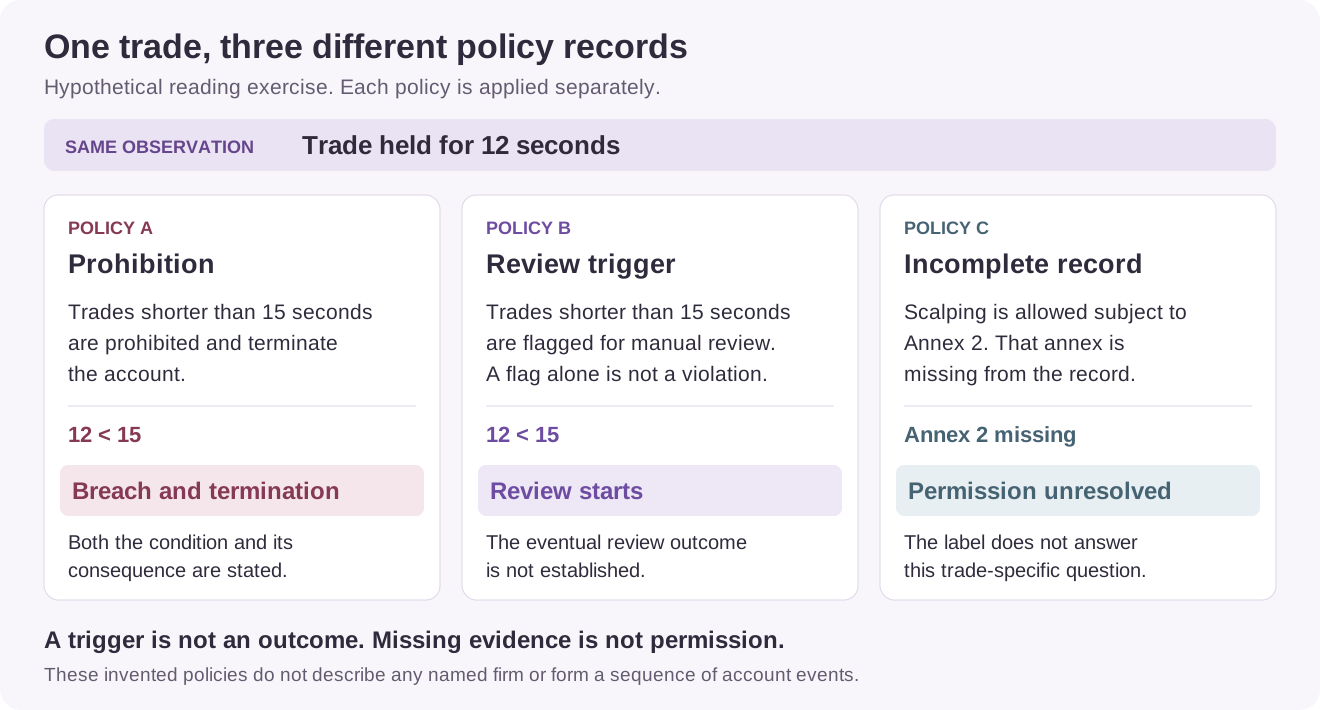
Exercise: the same trade, three different policy records
Consider a hypothetical trade held for 12 seconds, tested separately against three invented policy records. The account, stage and recorded duration are known and match each record's scope. The excerpts below are invented for reading practice and are not a firm's rules. No profit, loss or account-value path is being modeled.
- Policy A: “Closing a trade less than 15 seconds after entry is prohibited and terminates the account.” Twelve is less than 15, so this stated rule establishes a breach and its termination consequence.
- Policy B: “A trade lasting less than 15 seconds is flagged for manual review. A flag alone does not establish a violation.” The duration meets the trigger. The review outcome remains unknown.
- Policy C: “Scalping is allowed subject to Annex 2.” Annex 2 is missing from the available record. The sentence alone does not establish whether this particular trade is permitted.
Now test a different kind of condition. The following question uses another invented rule and a complete count of closed trades. It assesses only the stated payout condition.
Build a strategy-permission record
Make one record for the setup you intend to use. A useful record connects a concrete behavior to its evidence and unresolved questions; it does not produce an approval score.
| Field | What to record |
|---|---|
| Account scope | Firm, market, program, stage, size, platform, options and applicable purchase or agreement cohort |
| Proposed behavior | Instruments and contract months; entries, exits, cancellations, holding periods, sizing, overlapping positions and account connections |
| Applicable documents | Accepted agreement, incorporated rules, detailed policy, any stated order of precedence between them, version or effective date, URL and actual date checked |
| Test | Quantity, unit, period, denominator, equality boundary and aggregation, where the policy defines them; otherwise its qualitative standard |
| Assessment | When review can occur, what information may be requested and any stated discretion |
| Consequence | Breach, profit adjustment, blocked progression or payout, contractual penalty, action on other accounts, warning, review or another stated action; distinguish mandatory from possible |
| Finding | Permitted with documented conditions, prohibited under the matched clause, or unresolved; separately record any pending review or unmet eligibility condition |
For a duration rule, ask how a trade is identified when an order has partial fills or a position is scaled in and out. For an exposure rule, ask whether simultaneous positions, correlated products and other accounts are combined. A percentage is not reproducible until its numerator, denominator and measurement period are known.
Retain the order and fill records needed to describe what actually happened, plus the applicable documents and written clarifications. If a review starts, respond through the firm's stated process with the requested evidence. Keeping a record helps explain the activity; it does not guarantee a particular decision.
Repeat the check when the account changes stage. The evaluation-to-funded comparison keeps permission changes separate from changes to balances, loss rules and payout access.
What if the wording is unclear or conflicts?
First check whether the documents themselves say which one prevails. Tradeify's agreement does; Funded Trading Plus's two pages do not. Where no stated order covers the difference, ask about the specific activity and consequence. “Do you allow scalping?” invites a broad answer. A more useful question is:
For this program, stage, platform and purchase date, my method opens and closes these instruments using these holding periods, position sizes and order actions. Which clause applies? Is the described activity prohibited, subject to review, or relevant only to a progression or payout condition? How is the condition measured, and which document governs the difference between these two passages?
Attach the actual passages and fill in the behavior accurately. If the response leaves a decisive condition open, keep that item unresolved before relying on it. A reply about another program or a changed setup does not answer the original question, and a support reply should not be assumed to amend an agreement.
Use the conflicting-rules guide for a complete discrepancy record. In the program-comparison worksheet, keep essential strategy permissions visible: an attractive fee or payout split cannot resolve an unanswered restriction.
Related reading
- EAs, copy trading and multiple accounts for decision ownership, tool access and account connections.
- Spreads, slippage and order execution for the records needed to distinguish an order instruction from its fills.
- Conflicting prop firm rules for source scope, dates and unresolved differences.
Sources and method
Official sources were checked on 12 October 2026. The examples summarize the specified public pages, not every account agreement or a complete permission assessment. A check date is not an effective date or proof of applicability to an earlier purchase. Market and stage distinctions stay with each example.
- FundedNext: Is scalping allowed?, for its conditional scalping distinction.
- FundedNext: CFD challenge terms, for tick scalping as a prohibited pattern (8.15), the contractual penalty per breach (9.8) and set-off (9.9).
- Funded Trading Plus: Risk Review Policy, for its milestone review triggers, its statement that other accounts do not trigger a review, and the assessment.
- Funded Trading Plus: Program Terms & Conditions, for review at any stage, its stated consequences and trading restrictions.
- Tradeify: Guidelines for Traders, for its funded-stage duration and payout wording.
- Tradeify Funded Trader Agreement, for sections 4.1, 6.8 and 11: the incorporated Help Center rules, its microscalping wording and which text prevails; section 16 covers amendments.
- Topstep: Prohibited Trading Strategies, for simulator-exploitation examples.
- Topstep Terms of Use, for section 27's Trading Combine scope and broader wording.
- Topstep: Prohibited Conduct, for program-wide conduct review and possible responses.
- Tradeify: Risk & Compliance Guidelines FAQ, for non-exhaustive examples and the role of specific policies.
The behavior checklist and policy exercises are PFW's explanatory framework. Every exercise clause and input is hypothetical. The examples test what the supplied wording establishes; they do not predict enforcement, validate a real strategy or replace the account's applicable terms.