LearnChoosing a program
CFD vs. Futures Prop Firms: What Actually Differs?
CFD/FX and futures prop programs differ in the instruments they offer, how position sizes translate into profit and loss, and the market calendars traders must follow. Whether an account is simulated or live, what it costs, how much it can lose, and when it can pay out are separate questions determined by the specific program.
On this page
Compare both layers: the instrument you will trade and the agreement under which you will trade it. A familiar market name, a larger advertised account, or the word “futures” does not answer both.
This guide covers paid retail prop programs using CFD/FX-style instruments or exchange-listed futures. It does not cover employment at traditional proprietary trading desks or perpetual-futures programs, which have their own guide. The original official examples were checked on 1 October 2026; the additional FTMO dual-market example was checked on 3 October 2026.
What is the difference between CFD/FX and futures?
A contract for difference, or CFD, measures the change in a referenced asset's price without giving the trader ownership of that asset. In the provider-to-client model discussed here, the contract is arranged over the counter (OTC) rather than traded as an exchange-listed futures contract. ASIC's Moneysmart explains that a CFD's underlying reference can include currencies, shares, commodities, or indices. A simulated prop account can reproduce those price and profit-and-loss mechanics without creating a live CFD transaction for the participant. Sources: Moneysmart's CFD explanation and FTMO's CFD account description.
An exchange-listed futures contract has defined specifications, including its multiplier, minimum price movement, and expiry. For example, CME specifies the Micro E-mini S&P 500 contract's size and price increments. The underlying exchange market uses an order book, although a prop participant may be trading a simulation based on that market. Sources: CME contract specifications and CME's description of its central limit order book.
“Forex” describes currency exposure. “Futures” describes a contract structure. They are not mutually exclusive: currency futures exist. Likewise, a program marketed as forex or CFD can offer index and commodity symbols alongside currency pairs. FTMO's CFD instrument list and Topstep's futures product list illustrate this overlap. Always inspect the actual instruments available on the account. Sources: FTMO instruments and Topstep permitted products.
The useful comparison at a glance
| Question | CFD/FX programs | Exchange-listed futures programs |
|---|---|---|
| What identifies the instrument? | Its symbol and provider's specifications. Similar names need not mean identical contracts. | The exchange contract and expiry month, with published contract specifications. |
| How is size expressed? | Often lots, subject to the symbol's contract size, minimum volume, and permitted increments. | Whole contracts of a specified product. Micro and larger contracts have different multipliers. |
| What price data matters? | The account's actual symbol quotes and execution conditions. | The relevant futures contract's data and the account's execution or simulation conditions. |
| Which calendar applies? | The symbol's sessions, financing or adjustment schedule, and any expiry terms. | Exchange sessions and contract expiry, plus the program's earlier cutoffs where applicable. |
| Is a funded account necessarily live? | No. Read the account description and agreement. | No. A futures program can have a simulated funded stage and a separate live stage. |
| Can positions stay open across sessions? | Check the program, account type, stage, and instrument. | Check the program and stage, even if the exchange contract itself can be held longer. |
| Do fees, loss limits, and payouts follow from the market label? | No. Compare the purchased configuration. | No. Compare the purchased configuration. |
The sections below explain these distinctions and their sources. “CFD/FX” is a practical grouping here, not a claim that every retail foreign-exchange product has the same legal form.
Does a futures prop account trade real money?
Sometimes, but the market label alone does not tell you.
FTMO describes its CFD FTMO Account as a demo account with fictitious capital. Any separate trading FTMO conducts using clients' trading data does not turn the client's account into a live account. Topstep describes both its Trading Combine and Express Funded Account as simulated, followed by a separate Live Funded Account stage. These are examples of named offerings, not descriptions of every CFD or futures firm. Sources: FTMO account mechanics and Topstep's program stages.
Keep three questions separate:
- What market is being represented? An index CFD, currency pair, or particular futures contract.
- Where do your orders go? Into a simulation or into live-market execution.
- What creates your right to receive money? The program's agreement and payout conditions.
Real market data does not prove that your own orders reach an exchange. A cash payout also does not prove that the profits were generated in your own live brokerage account.
The challenge-lifecycle guide explains the stages from purchase through funded trading and payout. Establish the account's status at each stage before comparing offers.
How do lots and futures contracts compare?
Compare money gained or lost per price movement, then check whether the permitted position increments let you reach the exposure you intend.
For a CFD/FX symbol, “one lot” is incomplete information. You need its contract size, tick size and value, profit currency, and volume increments. MetaTrader's symbol specification contains these fields; FTMO directs traders to the instrument specification in their actual platform. A fractional lot is usable only if that symbol permits it. Sources: MetaTrader 5 specifications and FTMO account specifications.
For CME's Micro E-mini S&P 500 futures, commonly identified by the root symbol MES, one contract changes by $5 for each full index point. Its regular outright tick is 0.25 points, worth $1.25 per contract. An E-mini S&P 500 contract, ES, has ten times that point value. A micro contract is a separate standardized product, not a decimal quantity of the larger contract. Source: CME Micro E-mini specifications.
Worked example: the same point movement, different quantities
Hypothetical comparison. Assume a USD-denominated S&P 500-referencing CFD pays $1 per full index point per lot, and permits the quantities below. This specification is invented for the arithmetic; it is not taken from FTMO's or any other firm's symbol specification. Use the real CME multiplier for MES.
Model separate long positions that each experience a 20-point adverse movement in their own instrument. Here, one point means a full 1.00 index-price unit, not the platform's smallest quote increment. Ignore spreads, commissions, financing, currency conversion, and slippage. The table compares gross price sensitivity, not identical fills or total trading costs.
Gross P&L = signed price movement × value per point per unit × quantity.
| Position | Value per point per unit | Quantity | Total exposure per point | Gross P&L after a −20-point move |
|---|---|---|---|---|
| Hypothetical CFD | $1 per lot | 1 lot | $1 | −$20 |
| Same hypothetical CFD | $1 per lot | 5 lots | $5 | −$100 |
| Micro E-mini S&P 500 futures | $5 per contract | 1 MES contract | $5 | −$100 |
For the five-lot CFD position: −20 × $1 × 5 = −$100.
For one MES contract: −20 × $5 × 1 = −$100. As a cross-check, 20 points equals 80 regular MES ticks, and −80 × $1.25 = −$100.
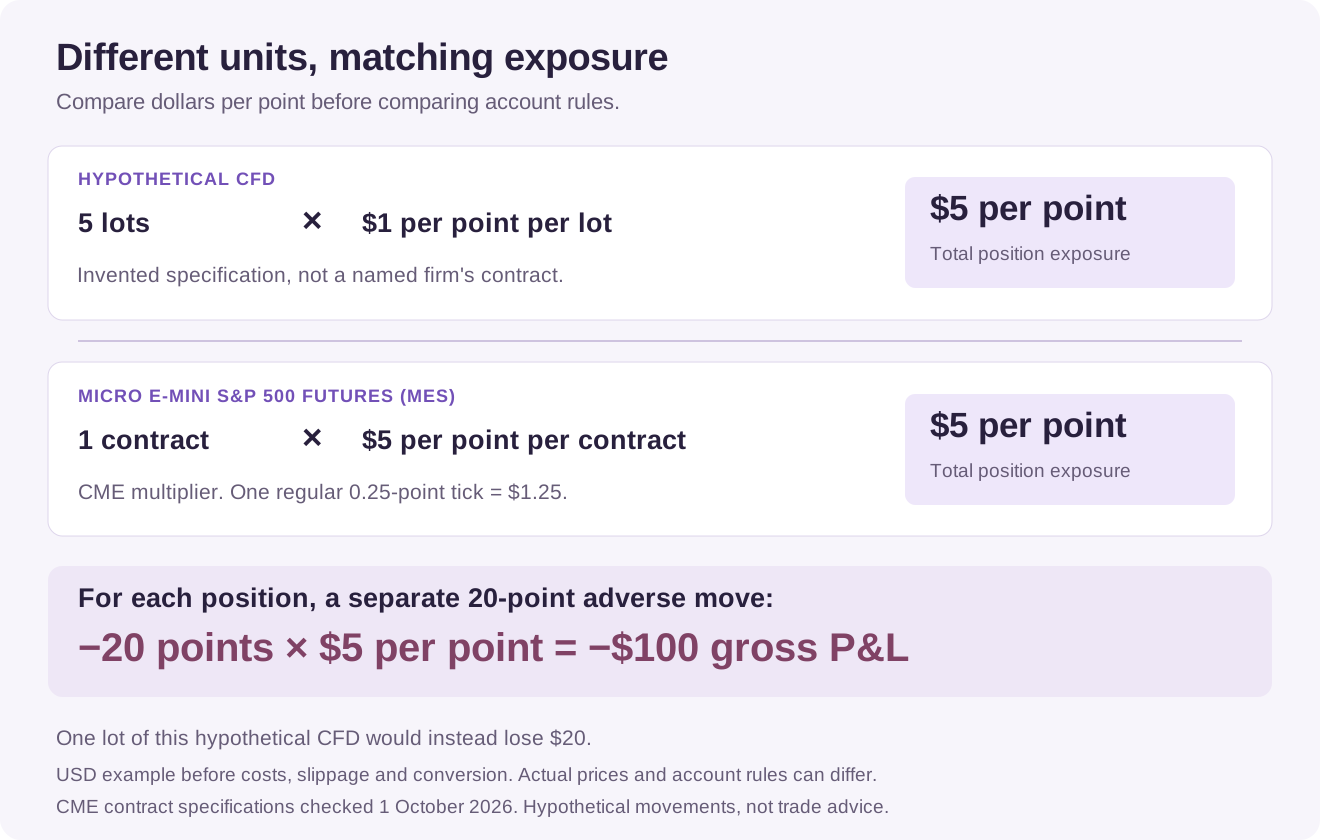
This is why changing a trading ticket from “1 lot” to “1 contract” can change exposure substantially. First calculate the actual point or tick value. Then check the smallest permitted quantity and any position cap. For a futures account, also compare the mini/micro counting policy and current scaling allowance, including how positions across instruments combine.
Do not assume an index CFD and its corresponding futures contract quote the same price. CME's equity-index fair-value explanation includes interest rates, expected dividends, and time to expiry among the inputs that can separate futures and cash-index levels. A provider's CFD pricing convention adds another specification to inspect. Source: CME fair value.
Finally, compare that exposure with the account's remaining loss buffer, not its advertised size. The account-size and loss-allowance guide explains the difference. The example above is not a recommended trade size.
Can you trade the same hours and hold the same positions?
Check both the instrument's trading session and the program's holding rules. A market being open does not necessarily mean your program allows you to maintain a position.
Two firms' published rules show why the account stage matters:
| Offering | Published holding condition |
|---|---|
| FTMO CFD evaluation | The overnight/weekend holding restriction described in its FAQ does not apply during the evaluation. |
| FTMO CFD Account, Standard type | Positions must be closed before the weekend market close or a market break longer than two hours. The same FAQ identifies an exception for Swing accounts. |
| Topstep Trading Combine and funded accounts | Positions must be closed by 3:10 p.m. U.S. Central Time on weekdays, or before an earlier product close. The program does not permit holding from one session into the next. |
Sources: FTMO overnight and weekend rules and Topstep trading hours. These examples were checked on 1 October 2026; they are not universal market rules.
For someone whose method needs a position to remain open for several days, the overnight and weekend holding checklist can identify an incompatible cutoff before fees or profit splits enter the comparison. Someone who closes every session may weigh that condition differently.
Record the timezone and holiday exceptions as well as the clock time. The platform's displayed time, a program's daily-loss reset, and an exchange session boundary can be different. Use the daily-loss checklist to verify the reset separately.
What changes at futures expiry?
An exchange-listed futures position identifies a particular contract month. As expiry approaches, a trader who wants to maintain exposure may close that contract and open a later one, subject to the account's permissions. CME calls this rollover: offsetting the expiring contract and opening the same position in a later contract month. Closing a trade each day does not remove the need to select the correct contract for the next session. Source: CME futures expiration and contract roll.
For a futures prop account, check which months are tradable, when the program requires a switch or closure, and how your chart identifies the contract. A continuous chart can combine a series of contracts; the order ticket still needs the instrument the program actually permits. Source: CME continuous price series.
For the day-to-day futures routine, use the session, flat-time, and rollover calendar. It separates the account's deadline from contract expiration and the symbol shown on a continuous chart.
For a CFD/FX symbol, inspect its own terms rather than importing a futures calendar. Establish whether it is a rolling cash-style symbol or a dated contract, how any rollover is handled, and whether financing or other adjustments apply. The word “rollover” can refer to different events, so ask what changes in the position, price, or account.
How do platforms, data, and costs differ?
The platform is part of the configuration you buy. FTMO's CFD FAQ lists MetaTrader 4, MetaTrader 5, cTrader, and TradingView, with selection through its configurator. Topstep presents TopstepX as its program platform. Availability for a particular purchase, region, or stage still needs to be confirmed. Sources: FTMO platforms and Topstep program overview.
If you rely on depth-of-market information, a particular order type, a trade copier, or an automated strategy, verify the feature and the permission to use it. A platform supporting a feature does not establish that every prop program permits it. Before choosing an account, confirm the specific application, connection, and data package with the platform compatibility guide.
Separate money paid to access the program from costs charged to trading results:
| Cost layer | What to compare |
|---|---|
| Program access | Entry fee, recurring billing, reset or retry purchases, and any funded-stage activation charge. |
| Trading results | Spread, slippage, commissions, and any financing or adjustments applicable to the instrument and holding period. |
| Tools and data | Whether the required platform, exchange data, market depth, and connections are included or separately charged. |
A CFD symbol can involve a spread, commissions, and overnight financing. A futures trade also has a bid-ask spread and can incur slippage; published commissions may be only part of its transaction cost. For example, TopstepX lists commission, exchange, and regulatory components and distinguishes per-side from round-turn charges. Read the actual account's schedule before treating a displayed commission as the full cost. Sources: Moneysmart on CFD costs and TopstepX fees.
Billing is a program choice. FTMO's CFD challenges use a one-time entry fee. Topstep's Trading Combine uses a subscription that rebills every 30 days until the relevant account passes or is canceled. These examples do not establish a universal “CFD equals one-time, futures equals monthly” rule. Sources: FTMO challenge fees and Topstep subscriptions.
Compare total cost under a stated completion timeline. For the complete inventory, including refunds and payout charges, use the challenge-cost guide.
Which differences come from the program rather than the market?
The exchange defines MES's multiplier. It does not define your prop program's profit target, drawdown calculation, evaluation fee, or eligibility for a reward.
Compare these conditions separately for evaluation and funded trading:
- Loss rules: opening allowance, static or trailing max loss, daily loss or daily pause, and what counts toward each calculation.
- Position permissions: maximum quantity, product availability, news restrictions, holding periods, and permitted trading methods.
- Progression: evaluation phases, targets, qualifying days, and any conditions attached to a later live-account transition.
- Payouts: qualifying activity, consistency requirements, withdrawal limits, retained buffer, split, and request process.
- Access: residency and identity requirements, permitted platform access, and an available payout destination.
These conditions can change the outcome even when two accounts provide the same exposure to the same market. A standardized futures contract does not standardize the prop firm's agreement.
For three named futures accounts, compare FTMO Growth, FundedNext Flex and The5ers Day Trade. The comparison follows their loss rules, contract limits, permissions and payouts through both stages, so a shared market and account size do not stand in for the account rules.
The country and KYC eligibility guide shows why the market, account stage, trading location, and payout provider need separate access checks, even within one brand.
The same firm can offer both markets. FTMO has CFD Challenges and separate FTMO Futures programs; read the rules for the selected product rather than treating FTMO as a single-market label. FTMO CFD objectives · FTMO Futures objectives and rules
Use the overall max-loss comparison to inspect loss mechanics and the payout-process guide to separate eligibility from payment. Keep detailed rule calculations attached to the exact program.
The same distinction matters when assessing trust. Exchange trading rules describe the underlying market; they do not by themselves verify a program operator's payment record or the protections attached to your particular agreement. Identify the contracting entity and account status instead of treating “exchange-listed” as a complete assessment of the offer.
The guide to reviews and payout evidence separates testimonials, published claims, documented events, and cohort evidence. Use those distinctions when assessing either a CFD/FX or futures provider.
How should you choose between the two?
Start with the trading process you need to preserve, then test specific programs against it.
| Your requirement | What needs to be verified |
|---|---|
| A particular currency pair, index, or commodity | The exact available symbol or futures contract, its specifications, and the account stage where it is available. |
| Fine control over position size | The smallest usable quantity and its monetary effect at the price distance you intend to trade. |
| Positions held for several days | Holding permission, closures, financing or adjustments, and any expiry or rollover obligations. |
| An intraday routine | Session access, daily cutoff, news restrictions, and the relevant local-time conversion. |
| A specific platform or automated workflow | Supported connection, data, order functions, and written program permission. |
| A limited purchase budget | Total spending under a defined timeline, including renewals and possible additional purchases. |
For example, an existing CFD trader considering MES would need to translate lot sizing into contract exposure, confirm the futures calendar, and check platform compatibility. A futures trader considering a cash-index CFD would need to inspect that symbol's point value, quotes, spread, financing, and permitted volume increments. Familiarity with the underlying index is only one part of either transition.
A useful shortlist records the instrument, account stage, usable exposure, permitted schedule, total cost, and payout conditions. If an essential answer is missing, leave it unresolved until the applicable terms or support clarify it.
Next step: use the before-you-pay comparison worksheet to compare the exact configurations that meet your market and trading requirements.
Sources and method
The original official sources were checked on 1 October 2026. The additional FTMO CFD/Futures offering example and its two objectives pages were checked on 3 October 2026. CME sources establish exchange-contract mechanics; platform documentation explains specification fields; firm sources support only the named offerings and stages. The numerical CFD specification and price movements are hypothetical. The example compares gross sensitivity before costs and does not estimate profitability, passing probability, or a suitable trade size.
- CFD definition and costs: ASIC Moneysmart. Used for the instrument explanation, not to apply Australian retail-account protections to prop programs.
- Futures specifications and pricing: CME Micro E-mini FAQ, CME's description of its central limit order book, fair value, expiry and contract roll, and continuous price series.
- Instrument fields: MetaTrader 5 Market Watch and FTMO account specifications.
- Scoped CFD-program examples: FTMO's instruments, account mechanics, holding rules, platforms, and challenge fees.
- Scoped futures-program examples: Topstep's program stages, permitted products and hours, TopstepX transaction costs, and subscription terms.
- One firm, separate markets: FTMO CFD objectives and FTMO Futures objectives and rules, checked 3 October 2026 for the separate product offerings.