LearnPayout conditions
USD, USDT and USDC in Prop Trading: What You Actually Receive
The currency shown on a prop account, the asset used for a payout and the cash you receive describe different stages of the payment. A balance displayed in USD is an accounting figure. A transfer of 800 USDC delivers a token amount; the dollars it can become depend on your available conversion rate and the charges along your route.
On this page
Keep the unit attached to each amount from purchase through receipt. This guide explains how, with a hypothetical payout that starts after approval and ends at a USD bank account. It applies across prop markets when these currencies or tokens are used. Named examples are limited to the programs and documents identified below; official sources were checked on 19 October 2026.
Where do USD, USDT and USDC appear?
USD is the US dollar currency code. USDT, also styled USDt by Tether, and USDC are separate digital tokens designed to track one US dollar. Tether and Circle describe their respective dollar pegs. A peg is the target value; your actual cash-out price comes from the route you can use. Tether overview · Circle USDC overview
The same program can use different units at different stages:
| Stage | Amount to identify | What it tells you |
|---|---|---|
| Purchase | Price quoted in USD, plus the asset and amount accepted at checkout | What you must pay for access |
| Trading account | Balance, P&L and loss limits in the program's accounting unit | How performance and rule compliance are measured |
| Approved payout | USD obligation or a specified number of tokens | What the firm has approved for settlement |
| Transfer and provider credit | Asset, network and amount credited to the receiving service or wallet | What has reached that destination |
| Cash receipt | Currency and amount credited to your bank | What the completed cash-out route delivered |
These fields answer different questions. Paying a challenge fee in USDT does not identify what you trade, and a USDC-denominated account does not establish whether your trades are live. The perpetual prop firm guide separates contract type, account accounting and the simulated or live trading arrangement.
What amount are you agreeing to pay at checkout?
First establish whether checkout fixes a price in USD or a quantity of tokens. For a USD-priced invoice settled in tokens, the required token quantity depends on the checkout conversion quote. For a fixed-token price, your cost in USD depends on what those tokens cost you. The displayed dollar price alone does not settle both questions.
Read the final quote for the selected asset and network, including its expiry and how fees are charged. A fee can be added to what you pay or deducted from what the merchant receives. Keep the invoice, payment confirmation and any conversion receipt so the purchase can be reconciled.
If a refund is offered, check which amount and asset the refund terms promise. Returning the same number of tokens and returning the original USD value can produce different results after a price change. This is a question to resolve in the applicable terms, not an assumed refund policy. The challenge-cost guide covers the wider purchase and retry costs.
What does a USD or USDC account balance mean?
An account label identifies the unit used by the program's ledger. It does not, by itself, establish that the displayed capital is yours to withdraw. For example, Propr's evaluation terms describe its paper capital as having no monetary value and representing no deposit; evaluation results do not earn remuneration. Those statements concern the evaluation stage. Propr evaluation terms, clause 7.3
Read balance, equity, profit targets and loss limits in the units and valuation method specified for that account. If a hypothetical program records a funding debit of 5 USDC, record 5 USDC in that ledger. A USD estimate of the entry is a separate calculation. The funding-rate guide explains how the debit or credit affects performance and the remaining loss buffer.
Do not substitute a wallet's USD price into a prop loss-limit formula unless the program uses that conversion. Likewise, converting an account display to USD does not turn simulated capital into withdrawable money. Establish the accounting treatment first, then use the balance-versus-equity guide to follow the fields that the rules monitor.
Is the approved payout a dollar amount or a token amount?
Before estimating receipt, establish what was approved. A payout of 800 USDC fixes a token quantity. A payout of $800 settled in USDC needs a rule for converting that dollar obligation into tokens. The rule might specify a parity convention or a quoted rate at a particular time. Read it rather than assuming the token quantity must be 800.
For a stated USD obligation converted at a rate expressed as USD per token, token quantity equals the USD obligation divided by that rate, before the route's specified fees and rounding. In the other direction, token quantity multiplied by USD per token gives the USD proceeds before separate charges. Writing the rate's units prevents reversing the calculation.
Current official examples show why the route matters:
| Documented route | Consequence for the reader |
|---|---|
| Propr's funded-program terms specify approved rewards transferred on-chain in USDC, subject to the agreement's conditions and identity verification. Funded terms, clauses 5.1, 5.3 and 5.6 | Identify the supported receiving network and wallet details in the payout process. The USDC label alone is not a complete destination. |
| E8 Markets' payout guide says payouts go only through third-party processors, such as Rise (cash or cryptocurrency) and WorkMarket, with no direct crypto payouts. Its terms of service instead allow withdrawals in USD, USDC, USDT, Bitcoin or Ethereum. E8 payout guide · E8 terms of service, section 5.2 | E8's own documents differ, so confirm which route applies to your account. Under the terms, a crypto payout is converted at the Coinbase Exchange price, which is valid for a limited time, and a confirmed conversion cannot be reversed. Through a processor, its credit is an intermediate stage before your bank or wallet. |
Propr's rulebook states that it charges no withdrawal fee. E8 likewise states no E8 payout fee while allowing for processor charges. Those statements identify the firm's charge; later conversion and withdrawal costs still belong in your receipt calculation. Propr rulebook, section 20 · E8 payout guide
Determine eligibility, the applicable split and any cap before this calculation. The profit-split and payout-cap guide establishes that approved amount; the payout-rules guide separates request, approval, dispatch and receipt. A token label does not shorten those steps.
For the account rules that come before conversion, compare the payout conditions of E8 One, E8 Pro and Propr Classic 1-Step. Their eligibility tests, requestable amounts and withdrawal effects differ even before the payment reaches a provider or wallet.
Which token and network must the receiving account support?
For a blockchain payout, match the exact asset and network supported by both sender and receiver. Then use the receiving service's deposit instructions for the address and any required memo or tag. Coinbase's receiving guide explicitly requires the asset and network to match; an unsupported transfer can fail to credit or be lost. Treat that as a provider example, and check your own receiver's instructions. Coinbase receiving guide
The ticker alone is insufficient. A token can be issued on several networks, and a bridged representation can differ from the issuer's native token. Circle publishes network-specific USDC contract addresses and distinguishes native USDC from certain bridged versions. Verify the exact asset against the issuer's documentation and the receiver's supported deposit route. Circle USDC contract list
Identify who pays the network charge and where it appears. A provider may deduct a charge from the transfer or collect it separately. When you send from a self-custody wallet, the network may require a different asset for fees: Ethereum transactions, for example, pay gas in ETH. This concerns sending or making an on-chain transaction; receiving a payout does not by itself mean you must pay ETH. Ethereum gas documentation
Resolve an unsupported asset or network before requesting dispatch. A cheaper sending option is useful only when the receiving route accepts it. Do not rely on a recovery process to make an incompatible transfer work. Both named firms put that risk on you: Propr's funded terms say it is not responsible for wallet incompatibility on your designated network, and E8's terms of service treat a payment made to incorrect wallet information as forfeited. Propr funded terms, clause 5.3 · E8 terms of service, section 5.2
How can an approved 800 USDC become a different bank receipt?
This hypothetical example begins with 800 USDC already approved after all eligibility checks, profit sharing and payout caps. It is not a named firm's payout policy. The recipient uses a supported route, and every transfer and conversion succeeds.
The model deducts a 2 USDC transfer charge, covering all transfer charges included here, then converts the remaining tokens at an executable quote of $0.995 per USDC. That quote already incorporates its spread. A separate conversion fee is 0.5% of gross USD proceeds, rounded to the nearest cent with half cents rounded up. A final bank-withdrawal fee is $3. There are no other charges, additional gas payments, taxes or further currency conversions in the model. The invented rate and fees are chosen to demonstrate the arithmetic, not to represent typical pricing.
| Step | Calculation | Amount after the step |
|---|---|---|
| Approved token payout | Starting amount | 800 USDC |
| Transfer to the conversion provider | 800 − 2 USDC | 798 USDC |
| Convert to USD | 798 USDC × $0.995 per USDC | $794.01 |
| Deduct conversion fee | $794.01 × 0.5% = $3.97005, rounded to $3.97 | $790.04 |
| Withdraw to the USD bank account | $790.04 − $3 | $787.04 |
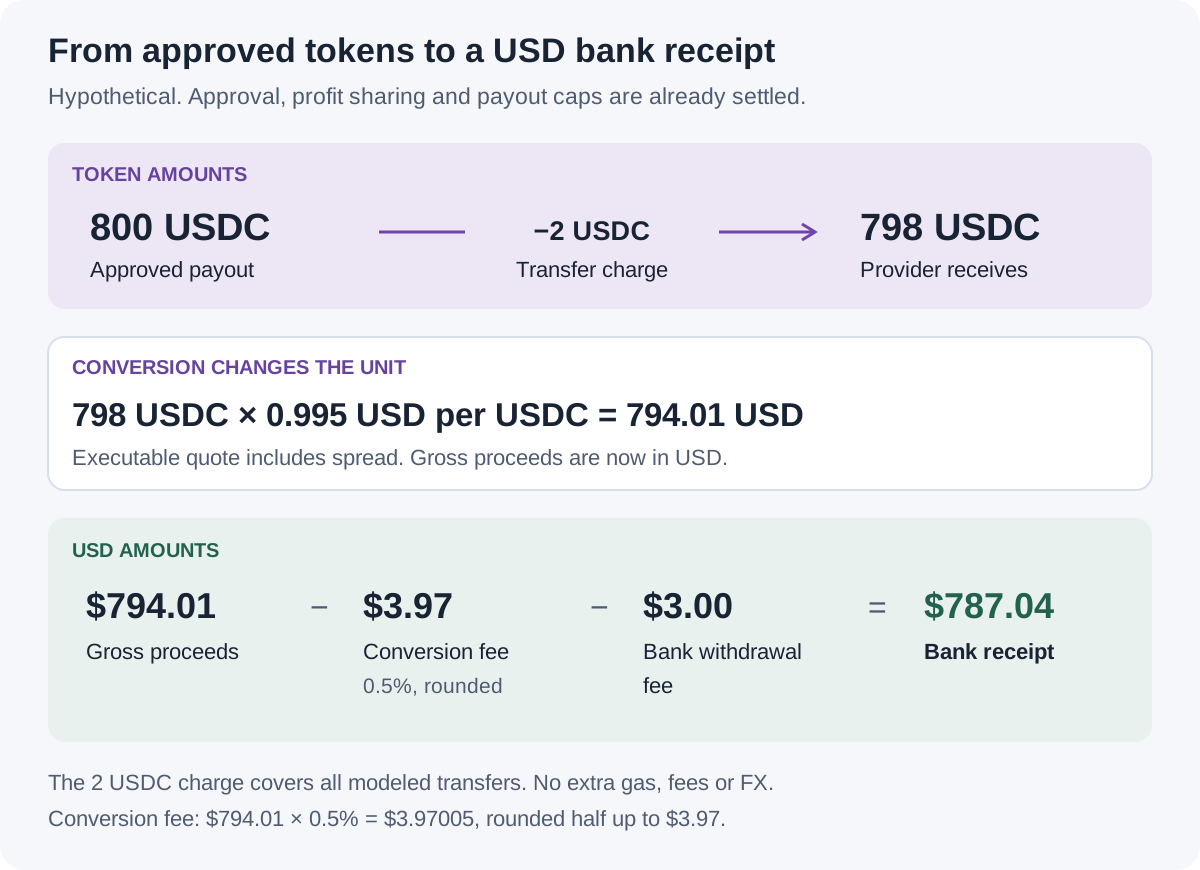
The change of unit happens at conversion. Before that step, the balance is a token quantity. After it, the proceeds are in USD. Do not deduct the spread again when it is already reflected in the executable quote, or add a separate network cost when the stated transfer charge already covers it.
At exactly $1 per USDC, the same 798 tokens would produce $798 gross. Keeping the model's 0.5% conversion fee and $3 bank fee would leave $791.01. Parity alone therefore would not make the bank receipt equal the approved 800-token amount.
If you keep the 798 USDC instead of converting it, your endpoint is a token holding. A wallet's estimated dollar valuation is not a completed USD sale or bank receipt. If your bank receives another currency, add that conversion and its charges as a separate step.
Does a dollar peg give you direct redemption with the issuer?
Issuer redemption and a retail cash-out route have different access conditions. Circle says Circle Mint serves institutions and is unavailable to individuals or small businesses; individuals can obtain USDC through third-party services. Tether's published schedule sets a $100,000 minimum for direct acquisition or redemption. A small prop payout does not, on its own, meet that Tether minimum. Circle USDC FAQ · Tether fees
Use the terms of a route available to you. Circle's USDC terms for holders outside the EEA explicitly state that third-party trading prices may be above or below $1. The peg therefore cannot replace a current executable quote when estimating a sale through a third party. Circle USDC terms, scope and section 13
PFW's account pages and comparisons keep the same distinction. Where they show a USDC amount in US dollars, they count 1 USDC as $1 while its checked market price is from $0.99 to $1.01 inclusive, use that market price otherwise, and say which they did. That is a convention for comparing accounts, not a price you can sell at.
Check that you can complete the receiving provider's onboarding and withdraw to your intended bank or wallet. A method available for purchasing a challenge may differ from the methods available for receiving its payout. The country and KYC guide follows that access question across the firm, processor and receiving account.
What should you record before requesting the payout?
Write down the complete route for your exact program and payout request:
- Approved amount: its unit, the applied split and caps, and whether it is a fixed token quantity or a USD amount settled in tokens.
- Conversion basis: who sets each rate, when it is fixed, its units, quote expiry and rounding rule.
- Destination: provider or wallet, exact asset and network, required address details, and completed access checks.
- Charges: each fee's payer, unit and deduction point, including whether a quoted rate already includes spread.
- Endpoint: tokens held, provider credit or bank currency received. Name the endpoint when comparing amounts or speed.
- Reconciliation: approval record, transfer reference, receiving credit, conversion receipt and final bank credit where applicable.
Use the worked table as a template, replacing its invented inputs with your own route's current quote and terms. Keep an unresolved charge or conversion rule marked as unknown until the responsible firm or provider supplies it. Once the payout completes, reconcile the actual entries against the estimate and check the separate effect of the payout on the prop account's drawdown buffer.
Related reading
- Perpetual prop firms explained: distinguish the traded contract from the account and payment arrangements.
- Prop firm payout rules: identify eligibility, request clocks and the meaning of payout speed.
- When official rules conflict: resolve an unclear conversion or settlement instruction against the applicable terms.
Sources and method
Official pages were checked on 19 October 2026. Issuer documents describe their own tokens and access terms. The named prop and provider examples establish only the routes stated above; they are not a ranking or a complete account comparison. No purchase, wallet transfer, payout or conversion was executed for this guide.
The receipt ledger and knowledge check are original hypothetical calculations. The model keeps token quantities separate from USD proceeds, applies the conversion fee to gross USD proceeds and rounds that fee once before the final deduction. Its rates and charges are invented. Local calculations do not verify an actual provider quote or change PFW's comparison-data methodology.
- Tether overview, for the USDt peg and issuer framework.
- Circle USDC overview and FAQ, for USDC and Circle Mint access.
- Propr evaluation terms, for the nature of evaluation capital and results.
- Propr funded terms, for approved reward settlement in USDC and its conditions.
- Propr rulebook, for the firm's stated withdrawal-fee policy.
- E8 Markets payout guide, for its processor routes and fee scope.
- E8 Markets terms of service, for withdrawal currencies, the crypto conversion price and incorrect wallet details (section 5.2).
- Coinbase receiving guide, for asset, network and destination matching.
- Circle USDC contract list, for network-specific token identity.
- Ethereum gas documentation, for ETH-denominated gas on Ethereum.
- Tether fee schedule, for the direct acquisition and redemption minimum.
- Circle USDC terms, for non-EEA scope and third-party price differences.