ResearchFutures accounts
My Funded Futures vs Apex Trader Funding vs Take Profit Trader: Three $50K Futures Routes
My Funded Futures (MFF) Rapid EOD, Apex Trader Funding EOD Standard and Take Profit Trader (TPT) Test share an end-of-day evaluation drawdown structure. After passing, the routes separate: TPT's PRO account trails intraday, including unrealized gains, while the selected MFF and Apex simulated funded accounts retain EOD treatment.
- Compares
- Apex Trader Funding · EOD Trail Standard · $50,000
- My Funded Futures · Rapid EOD · $50,000
- Take Profit Trader · Test · $50,000
Only these three accounts. Other programs, options and sizes can have different rules and costs.
- Values
- Quoted from the account pages, with sources checked 20 October – 20 November 2026. Each value’s information button opens its conditions and sources.
- Side by side
- Compare these accounts
On this page
That change matters before a payout is possible. An open trade can lift TPT's loss threshold and then give back profit without lowering it. On the selected EOD accounts, the same temporary intraday high does not itself move the overall-loss threshold. All three still enforce their applicable loss boundary during trading.
The purchase also buys different time: a nonrenewing MFF evaluation, a time-limited Apex evaluation, or a renewing TPT Test. Follow the exact route through passing or stopping before comparing what you pay and what you can withdraw.
Which three accounts are compared?
This comparison selects one reviewed $50K Tradovate route at each firm. Passing leads to a simulated funded account; a later move to live is a separate transition.
| Account | Selected route |
|---|---|
| Apex EOD Standard | EOD Trail $50,000, Standard, Apex Trader Funding: a 30-day evaluation, then a simulated funded Performance Account (PA) of the same size, opened with a one-time activation fee. Read on the Tradovate vendor; a live account is by invitation. |
| MFF Rapid EOD | Rapid EOD $50,000, My Funded Futures: one evaluation, then a simulated funded (Sim Funded) account. Read on the Tradovate platform at checkout, in the default version without the daily loss limit add-on. |
| TPT Test / PRO | Test $50,000, Take Profit Trader: the Test (the evaluation), then a simulated PRO account; Take Profit Trader may later invite a PRO trader to a live PRO+ account. Read on the size card, for the Tradovate platform on the CQG data feed. |
Why Rapid EOD? It keeps an EOD trail into the Sim Funded stage and offers a daily payout route once its requirements are met. MFF's Builder and Pro alternatives also use EOD treatment across those stages, but have different payout schedules and conditions. Regular Rapid changes to an intraday trail in Sim Funded. The Rapid EOD guide and MFF payout overview support this selection; it is not a claim that Rapid EOD is MFF's only EOD option or its cheapest plan.
MFF sells Rapid EOD in a default version without a daily loss limit and an add-on version that adds one at a lower purchase price. This comparison follows the default, which the quoted rows describe. The version is chosen at checkout and cannot be switched later.
At Apex, this is the EOD Trail Standard purchase route. Its No Activation Fee alternative changes the purchase structure, and its Intraday accounts change the loss rule. At TPT, the selected Test-to-PRO route changes from EOD to intraday drawdown, before any later PRO+ invitation. TPT's current menu labels this drawdown pattern Classic and also offers separate Intraday and EOD paths. Those other paths are outside this comparison. These choices define the comparison; they do not represent every account at the three firms.
What changes in the funded loss rules?
The quoted rules distinguish the amount of allowed drawdown, the reference that moves the threshold, and the point at which it stops trailing. Matching the opening allowance does not make the later thresholds interchangeable.
| Account | Evaluation and simulated funded max loss |
|---|---|
| Apex EOD Standard | An end-of-day drawdown of $2,000: the threshold is set at each market close from the end-of-day balance and enforced in real time in the next session; touching it fails the evaluation or closes the PA. The evaluation starts at $50,000 with a $48,000 threshold, which on Tradovate trails the peak end-of-day balance indefinitely. On the PA it stops at $50,100. |
| MFF Rapid EOD | An end-of-day trailing Max Loss Limit of $2,000. The evaluation starts at $50,000 with a $48,000 floor and locks at $50,100; open positions count, so a dip below the floor fails it. The Sim Funded account starts at $0 with its floor at -$2,000; the floor trails each end-of-day high and locks at $100. |
| TPT Test / PRO | A $2,000 trailing drawdown. In the Test it trails the end-of-day balance: the minimum balance starts at $48,000, follows the highest end-of-day balance and stops at $50,000. In the PRO account it trails intraday, on the peak balance with unrealized gains, from $48,000 until it reaches $50,000. Falling to the minimum balance at any time, open losses included, liquidates the account. |
Consider a hypothetical first funded session, before any trail has locked: an open position rises into profit, gives some of it back, and closes with a smaller net gain before the daily close. Assume the path remains above every loss threshold, includes all trading charges, respects position and session rules, and involves no withdrawal or earlier account history.
At TPT PRO, the open-profit peak has already raised the intraday threshold. The retreat does not undo that rise. At MFF Rapid EOD and Apex EOD, the temporary peak does not move the EOD reference. Their next threshold update uses the applicable closing reference instead. The difference is the room left after the reversal, even though the trade ends profitably. It is not evidence that any of these accounts failed this hypothetical session.
The drawdown guide separates updating a threshold from enforcing it. The Apex EOD and intraday answer applies that distinction to unrealized profit. EOD does not mean that an account can cross its existing threshold safely until the close.
There is another funded-stage difference: the daily control and position allowance.
| Account | Daily control and position limits |
|---|---|
| Apex EOD Standard | A daily loss limit of $1,000 in the evaluation, a pause: reaching it stops trading for the rest of the session without failing the account. Up to 6 contracts (60 micros) in the evaluation. The PA scales by tier, set before each session from the previous close and able to move down as well as up: 2 contracts and a $1,000 daily loss limit at $0 to $1,499 of profit; 3 contracts and a $1,000 daily loss limit at $1,500 to $2,999 of profit; 4 contracts and a $2,000 daily loss limit at $3,000 to $5,999 of profit; 4 contracts and a $3,000 daily loss limit at $6,000 and up of profit. Orders over the limit are rejected. |
| MFF Rapid EOD | No daily loss limit in either stage. Up to 3 minis or 30 micros in the evaluation and on the Sim Funded account. |
| TPT Test / PRO | No daily loss limit in the Test or the PRO account (the size card strikes out the $1,100 limit as removed). Up to 6 contracts or 60 micros at a time in the Test; Take Profit Trader's comparison table says contract limits do not change from the Test to the PRO account, and no scaling plan applies. |
Apex's daily limit is a session pause, separate from its overall-loss boundary. Its funded position tier can move down after a weaker close. The absence of a daily loss limit at the selected MFF and TPT stages leaves their overall max-loss rules in force; it does not create additional loss room.
Does the evaluation suit your profit pattern?
The common target does not establish the same route to passing. The distribution of profit across days and the time or activity conditions matter too.
| Account | Target and profit distribution | Minimum days, time and activity |
|---|---|---|
| Apex EOD Standard | 6% | No minimum: it can be passed in one trading day, within 30 calendar days of purchase, after which it expires. A PA must record 2 trading days with $50 of net profit in every rolling 30 days, or it closes. |
| MFF Rapid EOD | 6% | A minimum of 4 trading days and no time limit. An account with no trade for 7 consecutive calendar days can be closed, Sim Funded accounts included. |
| TPT Test / PRO | 6% | At least 3 trading days, each with at least one trade, and no time limit. |
Apex's evaluation does not impose a best-day consistency test, but its PA payout rules do. MFF Rapid EOD and TPT already test profit concentration during evaluation. A trader who can reach a target with one unusually strong day should inspect the applicable consistency condition before treating that day as a completed evaluation.
Keep the clocks separate. Apex's access period is a passing deadline, while its activation window starts later. MFF's lack of a passing deadline does not remove its inactivity provision. After passing, TPT's PRO rules, checked on 25 November, require trading in every calendar month to keep the PRO account active; a traded day requires a completed round trip. TPT's continuing evaluation access comes with subscription billing until passing or cancellation.
What do passing, continuing and stopping cost?
Use the listed purchase route and its activation charge together. A price requiring a coupon is a different purchase assumption; it should not silently replace the list price in a comparison.
| Account | Evaluation purchase | Activation | Data fee |
|---|---|---|---|
| Apex EOD Standard | $590 one-time | $129 | None |
| MFF Rapid EOD | $275 one-time | None | None |
| TPT Test / PRO | $170 per month | $130 | None |
The following calendar is hypothetical. Buy the selected evaluation on 5 January 2027. The successful branch reaches official passing status on 21 January and opens the simulated funded account on 22 January. The stopping branch has traded but stops without passing on 19 January, cancels any renewing subscription that day, and makes no further purchase. Assume the quoted charging rules still apply, activity requirements are met while an attempt continues, and there are no resets, optional services or additional accounts. These are billing examples, not simulated trading results or payout forecasts.
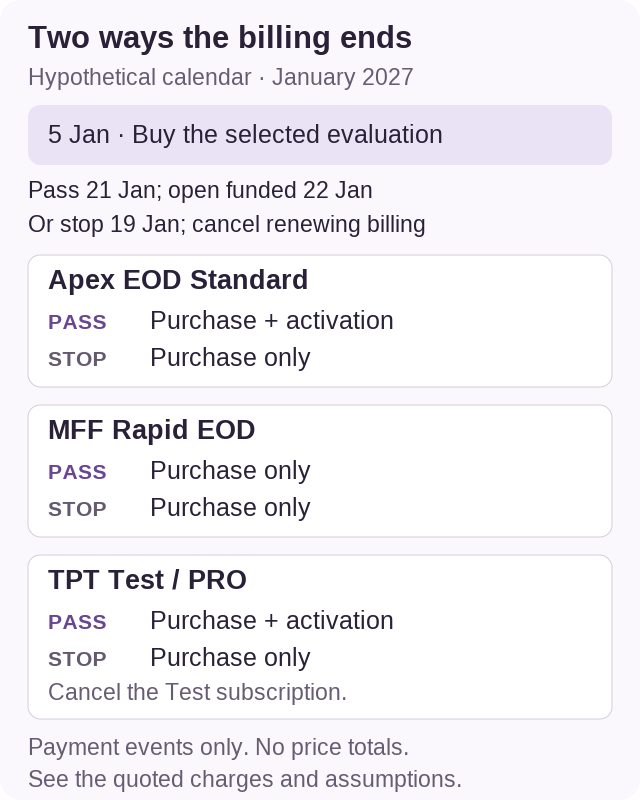
On the successful branch, MFF Rapid EOD has the evaluation purchase, while Apex Standard and TPT add their quoted activation payment. On the stopping branch, each route has the original evaluation purchase and no activation payment. TPT cancellation is a separate action: its subscription policy says a failed Test does not automatically cancel billing. Passing does cancel that Test's subscription.
Now extend the unfinished attempt to 9 February, with the account still valid wherever its terms permit. TPT would have renewed on 5 February if it had not passed and the subscription were still active. MFF Rapid EOD does not add a scheduled renewal. Apex's original access period cannot cover that full interval; continuing evaluation trading after it expires requires a new purchase, with a new attempt rather than carried-over progress. Its access policy does not provide an extension or automatic renewal.
This is why a low initial charge and a low completed-route cost answer different questions. Choose the same finishing or stopping outcome before adding prices. The subscription versus one-time guide explains the method, and the completion-time study applies it to a separate dated evidence set.
A failed attempt that you want to restart is another branch. Use the current firm-level reset terms for Apex, MFF and TPT; a reset should not be assumed to cancel an existing subscription or move its renewal date.
Canceling is not the same as receiving a refund
| Account | Cancellation refund | Fee returned with funding or a payout |
|---|---|---|
| Apex EOD Standard | None: Apex does not refund purchases, in whole or in part, including evaluations and PA activation fees; an evaluation fee cannot be moved to another size or type. | None stated: no page read offers the fee back with a payout, and purchases are not refunded. |
| MFF Rapid EOD | A full refund of the amount paid when it is requested within 14 days of purchase and the account has not traded, opened positions or accessed market data. Breached accounts and crypto purchases are not refunded. | None stated: no page read offers the fee back with a payout. |
| TPT Test / PRO | The subscription can be cancelled from the dashboard and stays active to the end of the billing period. An account that has not been used or traded can be refunded within 72 hours of purchase, less a $75 fee. | None stated: no page read offers the Test's fees back once the PRO account is reached, and the terms refund only an account that has not been used or traded, within 72 hours of purchase. |
The stopping branch above assumes trading has already begun, so it does not qualify as an unused purchase merely because it never passed. MFF refunds only an account that has not traded, so the stopping branch is outside its refund. A cancellation refund and a fee returned with a later payout are also different benefits. A possible later refund does not reduce the cash paid upfront. Record it as a separate event only when its applicable conditions and timing are established.
How does profit become requestable?
A profit split describes the trader's share of an eligible payout. It does not say how much account profit can be requested, when a request can be made, or how much must remain.
| Account | Request timing | Requestable profit and limits | Trader share |
|---|---|---|---|
| Apex EOD Standard | No calendar wait: each payout needs 5 trading days, not necessarily in a row, each with at least $250 of net profit, counted since the last payout. Apex calls this up to weekly payouts; there is no deadline. | Minimum request $500, from a balance of at least $52,600: the safety net of $52,100 (the drawdown limit plus $100) stays for the life of the PA, and only profit above it can be withdrawn. Caps per payout: $1,500 for the first, $1,500 for the second, $2,000 for the third, $2,500 for the fourth, $2,500 for the fifth, $3,000 for the sixth. The PA closes after its sixth payout. | 100% |
| MFF Rapid EOD | The first request can be made 24 hours after the first trade on the Sim Funded account, once the buffer is cleared, and then daily. | Minimum request $500, of which the trader keeps 90%, after clearing the $2,100 buffer. Each later payout needs $500 of net profit since the last one; there is no cap per request. | 90% |
| TPT Test / PRO | From day one in the PRO account and daily after that, once the balance is above the buffer ($52,000): no minimum days, no profitable days and no payout window. | No withdrawal restrictions on profit above the buffer and no maximum amount, at 80%. The buffer equals the drawdown, so the balance must first reach $52,000 ($50,000 plus $2,000). After the PRO account is closed, 50% of the buffer zone can be withdrawn. | 80% |
Apex's full share of an approved payout sits behind qualifying-day, consistency, safety-net and payout-cap conditions. The stated number of payouts also limits the life of this PA. MFF Rapid EOD and TPT PRO offer different daily-access structures, both with retained-buffer requirements. A daily request route does not make all profit immediately withdrawable.
For TPT, read the first-payout answer alongside the funded loss rule. Reaching a payout buffer and avoiding the intraday loss threshold are separate tests.
| Account | Funded consistency |
|---|---|
| Apex EOD Standard | A 50% consistency rule on the PA: no single profitable day may be 50% or more of the net profit since the last approved payout; until it is met, a payout cannot be requested, but the account stays open. The consistency article's example accepts exactly 50%. |
| MFF Rapid EOD | None on the Sim Funded account. |
| TPT Test / PRO | None in the PRO account or a PRO+ account. |
At Apex, the quoted wording rejects a best day at the consistency boundary while the example accepts it. This comparison leaves that conflict visible. It does not treat an exact-boundary result as confirmed payout eligibility. A funded account without a best-day consistency test still has to meet its other payout and trading conditions.
What changes after a withdrawal?
| Account | After a payout and later account changes |
|---|---|
| Apex EOD Standard | The safety net stays; the consistency count and the 5 qualifying days start again after each approved payout. While a request is pending, trade as if the amount were already deducted: a balance below the threshold cancels it. On Tradovate, a request needs the account flat. A live account is by invitation. |
| MFF Rapid EOD | Payouts can follow daily while the balance stays above the buffer and $500 of fresh profit is made. A $10,000 net profit in a single trading day moves the account to live automatically. |
| TPT Test / PRO | Only profit above the buffer can be withdrawn, so the balance stays at or above $52,000 after a withdrawal; the pages read do not say whether a withdrawal moves the minimum balance, which stops trailing at $50,000. A withdrawal needs no open positions or working orders when it is requested. |
Apex's next request needs a new set of qualifying activity and consistency results. MFF's later requests require fresh profit as well as the retained buffer. At TPT, the reviewed withdrawal pages do not say whether a withdrawal changes the minimum balance. The payout buffer and the trailing-loss lock are different boundaries; do not infer a post-withdrawal loss calculation from the buffer alone.
MFF's move to live is another account-state change. The simulated-to-live guide explains regular Rapid's reserve and live-ledger treatment; Rapid EOD's official guide expressly adopts those standard Rapid rules for the live stage. That inheritance does not turn Rapid EOD's Sim Funded drawdown into regular Rapid's intraday rule.
A request is not a bank receipt
| Account | Processing stages | Payout fees |
|---|---|---|
| Apex EOD Standard | Apex reviews a payout within 2 business days and sends approved funds within 3 to 4 business days; the bank or Plane usually takes 3 to 7 more, 5 to 11 business days in all. The same page still describes an older rule (eight trading days, five of them with $50 of profit, between requests) that the PA payout pages do not use. | Not stated: no page read names a payout fee. |
| MFF Rapid EOD | Most requests are approved instantly; one sent for manual review takes 6 to 12 business hours, the help centre says, while the Rapid plan pages allow up to 24 business hours. The money then goes to the trader's Riseworks account. | Not stated: no page read names a payout fee. |
| TPT Test / PRO | From a Tradovate PRO account to the wallet in 5 to 10 seconds (Rithmic PRO and PRO+ withdrawals are still handled by hand); the dashboard balance updates once a day, at about 8 to 9 PM Eastern. A payout from the wallet is reviewed within 12 business hours; Plaid then pays US banks, usually in real time or within 1 to 2 business days, and Wise or PayPal payouts are processed within 12 business hours. | $50 for a withdrawal of $250 or less from the wallet, and no Take Profit Trader fee above $250; PayPal may deduct its own fees. |
MFF's recorded approval windows differ across its help pages. Apex's processing page retains older qualifying-day wording alongside its processing information. Keep those limitations beside the quoted rows; do not use the older Apex wording to replace this account's PA payout requirements.
TPT's account-to-wallet step is distinct from its wallet-to-bank or payment-provider step. Likewise, an approval or provider-credit target at another firm does not establish when money reaches a bank account. An unstated payout fee is not a confirmed zero fee.
Which difference should drive the choice?
| Your requirement | What this comparison establishes |
|---|---|
| Keep EOD treatment after passing | The selected MFF Rapid EOD and Apex EOD routes retain it in the simulated funded stage. TPT PRO changes to intraday trailing. Inspect the lock and enforcement rule as well as the EOD label. |
| Avoid scheduled evaluation renewals | The selected MFF and Apex purchases do not renew. Apex's expiry still limits the original attempt, so a longer plan can require another purchase. |
| Let a strong day contribute heavily to passing | Apex's evaluation has no consistency test, but the PA payout stage does. MFF Rapid EOD and TPT apply evaluation consistency conditions. |
| Seek frequent payouts | MFF Rapid EOD and TPT PRO have daily request routes after their gates. Compare retained profit, fresh-profit requirements, split, fees and account status before choosing by frequency. |
| Retain the evaluation's position allowance | Apex replaces the evaluation's allowance with a funded tier schedule set from the previous close. The quoted MFF and TPT limits continue across their evaluation and simulated funded stages. Loss room can still constrain the next trade. |
Before purchase, use the selected Apex account, MFF account and TPT account to check location eligibility, identity requirements, news restrictions, session closures and your intended automation or copying method. Platform availability alone does not settle whether your trading approach or location is permitted.
The useful comparison is the route you can continue to operate after passing, with a purchase path and payout process that fit your intended use. The evidence here does not establish pass rates, realized withdrawal performance or an overall firm ranking.
Related reading
- Topstep, Lucid Trading and Tradeify at $50K futures, for another defined set of evaluation and simulated funded routes.
- Static, EOD and intraday drawdown, for the threshold-update and enforcement mechanics.
- Subscription versus one-time fees, for keeping successful and stopped attempts comparable.
- Where simulated profit goes at a live transition, for the later account, reserve and payment ledgers.
Sources and methods
This comparison selects the Tradovate builds of Apex EOD Trail Standard $50K, MFF Rapid EOD $50K and TPT Test $50K. It follows evaluation into the simulated funded stage, with limited live-transition context. Account values, conditions, evidence states and source-check dates come from the quoted PFW account records. Their source dates are separate from the additional checks below. The $50K label is an account-tier label, not a statement that the trader owns or can lose that amount.
Official pages checked on 20 November 2026 provide additional context: MFF's Rapid EOD guide, payout overview, Builder guide and Pro guide; Apex's EOD drawdown explanation and evaluation-access policy; and TPT's Test subscription policy, PRO rules and PRO withdrawal rules. This was not a fresh checkout-price verification.
Supplementary checks on 25 November 2026 covered MFF's Rapid EOD version guide, cancellation policy and refund help page, plus TPT's current plan menu and PRO rules. The PRO page, updated on 23 November, now states monthly activity and separates drawdown by plan. The earlier source-check date remains attached to the other supplementary readings; these checks do not refresh every quoted account source.
The funded-session example holds the net profit path and trading constraints constant, stays before the trailing locks, and excludes payouts and prior history. It isolates threshold behavior; it does not model order execution or claim a breach. The hypothetical 2027 billing calendar counts purchases, renewals and activation events without freezing current price totals. It excludes resets, promotions, optional services, extra accounts and actual payout outcomes. Neither example estimates the chance of passing.
Unresolved consistency, processing and withdrawal wording remains with the affected decision. Other programs, Apex purchase options and vendor configurations are outside this selection. No assumption is made that a later rule update applies to an earlier purchase.